
37 Art Trivia Questions with Answers [2026]
37 art trivia questions on Renaissance masters, famous paintings, sculpture, modern art, and artist secrets. Answers included, plus why each stumps.
How many do you know?
Think of your answer, then reveal it.
Did you know it before revealing the answer?
Read this answer in the articleRound complete
Challenge friends on this topic.
Start a new duel in LearnClash and learn from every answer.
Get LearnClashFree to play on iPhone and Android. No ads.
Try the questions you missed once more.


In 1496, Michelangelo buried a marble Eros in acid soil. He was 21. The fake sold to a cardinal as a Roman statue for 200 ducats.
These 37 art trivia questions run from a Greek bronze of about 450 BCE to an auction record set in 2025. They cover forged sculptures, missing eyebrows, one-sale painters, and the 450-million-dollar Salvator Mundi sale. Each entry pairs the answer with the trap: the confident wrong guess that catches most players.
The category guide below maps the seven rounds. If you would rather answer than read, the same territory is playable as a 3-minute art-history duel.
Art Trivia Questions: Quick Category Guide
| Section | Questions | Focus |
|---|---|---|
| Renaissance Art | 1-6 | Florence, Rome, sfumato |
| Famous Paintings | 7-12 | Louvre, auction records, hidden details |
| Sculpture and Statues | 13-17 | Greek, Renaissance, Rodin |
| Modern Art | 18-22 | Surrealism, pop art, abstraction |
| Art Movements | 23-27 | Dada, Bauhaus, Impressionism |
| Artists and Their Lives | 28-33 | Van Gogh, Kahlo, Picasso |
| Art History | 34-37 | Pigments, museums, heists |
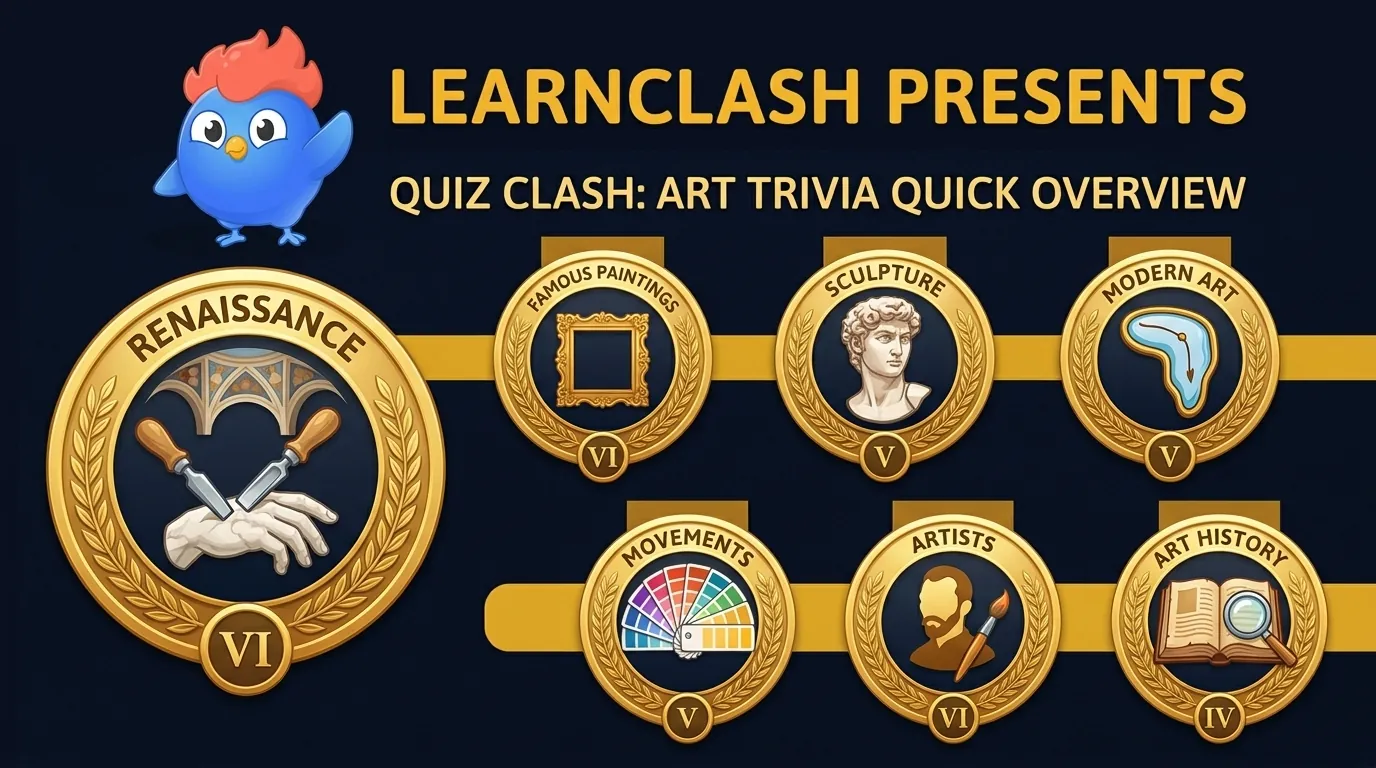 Seven rounds, 2,500 years, one unsolved heist.
A note on difficulty before you start. In June 2026 I exported a per-topic wrong-rate table from the LearnClash production database: 28,891 question documents and every answer recorded against them. Art ranked third-hardest of the 156 topics with enough answer volume to qualify, at 59.9 percent of recorded answers wrong. Famous Paintings, which we track as its own topic, came 20th at 52.2 percent.
Reading through the misses, the pattern was consistent. Players clear the who-painted-it prompts and then fall on sale prices, forgeries, and biography, so recognition turns out to be the cheap half of art knowledge and provenance the expensive half. That is why every answer below carries a note on the miss. If a fact refuses to stick, spaced repetition is the mechanism that fixes it, and our history trivia questions or the master trivia collection make a gentler warm-up.
Renaissance Art Trivia (Questions 1-6)
Everyone knows the big names in this round. The misses come from details museum labels leave off the wall: who did what first, in which medium, and how long a block of marble sat in a courtyard before anyone dared touch it. Six questions on Florence and Rome.
 Michelangelo, Leonardo, Botticelli, and the workshops that shaped Florence.
1. Who painted the ceiling of the Sistine Chapel between 1508 and 1512? Easy
Answer: Michelangelo Buonarroti, working mostly alone on scaffolding 60 feet above the chapel floor.
Why it stumps people: Your gut says Raphael. His Vatican frescoes went up in the same building at the same time. But the ceiling is all Michelangelo, and he hated every minute of it. He called the work “not my profession.” And he wrote angry sonnets about paint dripping into his eyes.
2. What technique did Leonardo da Vinci use to create the soft, smoky transitions visible in the Mona Lisa? Medium
Answer: Sfumato. From the Italian fumo for smoke. Thin glazes built up in dozens of almost invisible layers.
Why it stumps people: The word sounds like a coffee drink, and most people know the effect without ever learning the name. Textbooks tie sfumato to Leonardo, but painters in his workshop used it too, and Correggio pushed it further a generation later.
3. In 1496, Michelangelo buried a sculpture to artificially age it. What subject did this forgery depict? Hard
Answer: A sleeping Eros (Cupid). Dealer Baldassare del Milanese sold it to Cardinal Raffaele Riario as an old Roman piece. When the trick came out, the cardinal asked for his money back. Michelangelo kept the fame.
Why it stumps people: Michelangelo as a forger sounds made up. But the story is real. His own biographer Ascanio Condivi wrote it down, and so did Vasari. The scam made his career. Riario’s circle brought him to Rome. The Pietà came two years later.
4. In Botticelli’s Primavera, which god stands at the far left, raising his staff to hold off the clouds? Hard
Answer: Mercury, identifiable by his winged boots and the caduceus he lifts into the treetops.
Why it stumps people: Everyone reads Primavera right to left, chasing Venus, the Three Graces, and Zephyrus seizing Chloris. Mercury stands apart at the margin with his back half-turned, doing something no one expects a spring allegory to need: clearing the weather. What his gesture means is still argued over in the scholarship.
5. What medium did Leonardo use for The Last Supper, and why has it deteriorated so badly? Medium
Answer: A new mix of tempera and oil on dry plaster, not true fresco. The paint never bonded with the wall. Flaking began within 20 years of the finish date, 1498.
Why it stumps people: People think all Renaissance work was fresco, since that’s the textbook medium. Leonardo wanted more time to rework details. So he chose dry plaster on purpose, against the rules. Five centuries of flaking and repainting later, only a fraction of the surface is Leonardo’s own hand.
6. Michelangelo’s David was carved from a block of Carrara marble that had been abandoned for how many years? Medium
Answer: About 40 years. The block was rejected in 1464 as flawed and nicknamed “The Giant.” Michelangelo started work on it in 1501, aged 26.
Why it stumps people: Two earlier sculptors tried first and gave up (Agostino di Duccio and Antonio Rossellino). The block sat in an Opera del Duomo courtyard for four decades. Michelangelo’s David is carved from someone else’s dropped project.
Famous Paintings Trivia (Questions 7-12)
Naming the painter is the easy half of this round. The hard half is what the painter hid, what the canvas sold for, and who the sitter actually was. Six questions running from the Louvre to the Christie’s sale room.
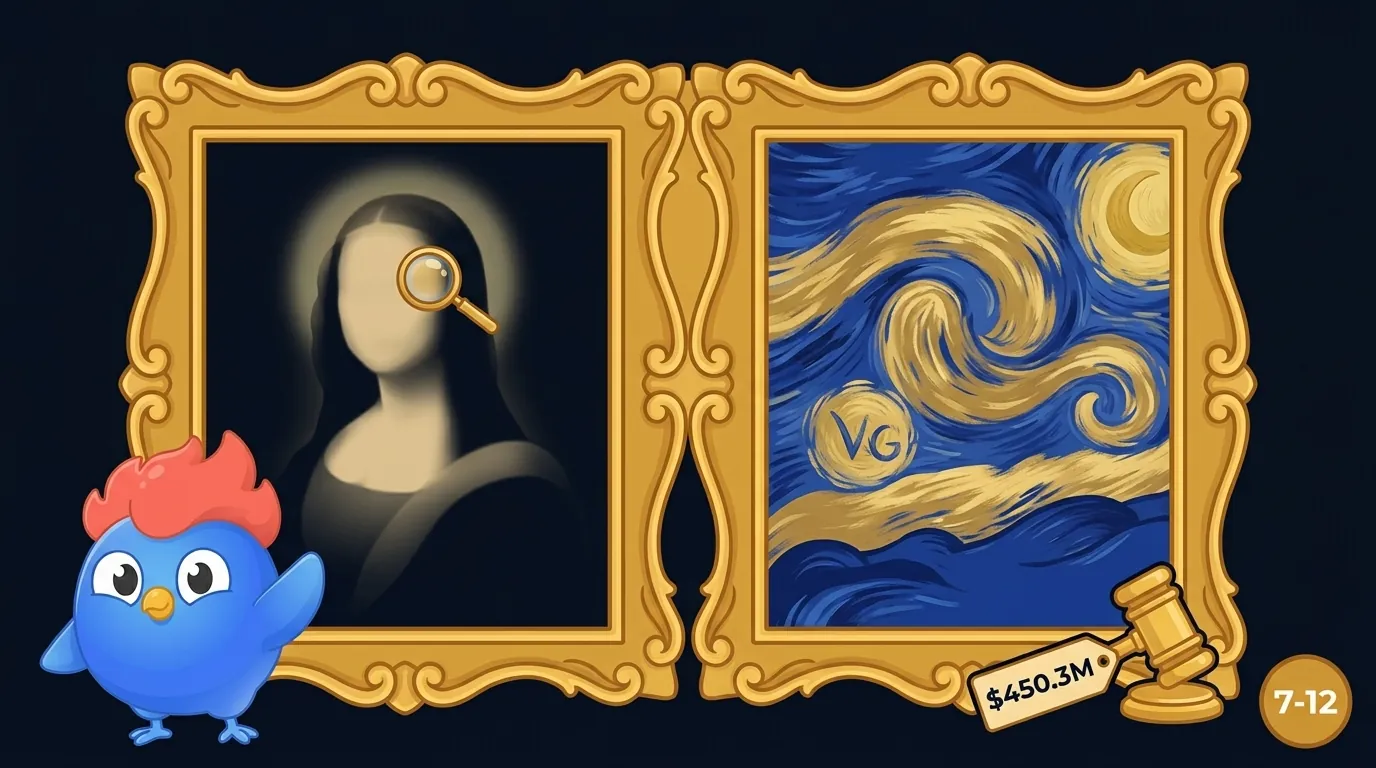 Lisa Gherardini’s married name, Munch’s pencil note, and a disputed Leonardo.
7. What is the subject of the Mona Lisa, who was she? Easy
Answer: Lisa Gherardini, wife of the Florence silk trader Francesco del Giocondo. The Italian title La Gioconda is her married name.
Why it stumps people: The face is famous. The name isn’t. Lisa was 24 when Leonardo started the work, around 1503, and he kept it the rest of his life. He never handed it to the family who ordered it. After his death in France in 1519 it entered the royal collection, which is how the Louvre holds it today.
8. Why does the Mona Lisa appear to have no eyebrows? Medium
Answer: Either she never had them (a style of the time) or they faded during later cleaning. High-res scans in 2007 found faint traces of single hairs on the brow ridge. Both ideas still hold up.
Why it stumps people: The missing brows look like an art choice. The real answer is messier. Pigments shift over 500 years. Past restorers scrubbed brow areas. Italian Renaissance women did sometimes shave or pluck their brows to make the face look longer. The “painted but faded” theory has the best evidence now.
9. What hidden message appears in pencil on Edvard Munch’s 1893 version of The Scream? Hard
Answer: “Kan kun være malet af en gal Mand!” Norwegian for “Can only have been painted by a madman.” The 2021 infrared test by the National Museum of Norway matched the writing to Munch’s own hand, not a later vandal.
Why it stumps people: For over 70 years, people thought the pencil scrawl was graffiti from an angry museum visitor. In 2021, infrared scans and a match to Munch’s own letters and diaries proved he wrote it. He likely wrote it in reply to a critic who called his mind into question.
10. In 2024, physicists reported that the swirling sky of which 1889 Van Gogh painting matches the mathematics of real atmospheric turbulence? Medium
Answer: The Starry Night. A team publishing in Physics of Fluids measured the 14 whirling eddies in the sky and found their scaling consistent with Kolmogorov’s theory of turbulence, formulated 52 years after the painting.
Why it stumps people: The painting is famous for feeling turbulent. The surprise is that the turbulence is measurably right. Van Gogh painted the scene at the Saint-Paul-de-Mausole asylum in Saint-Rémy, describing the view in a letter as seen “through the iron-barred window.” No bars appear in the picture.
11. What painting holds the record for the highest auction price ever paid, and what did it sell for? Easy
Answer: Salvator Mundi by Leonardo da Vinci, 450.3 million dollars including buyer’s premium, at Christie’s New York on November 15, 2017.
Why it stumps people: Almost everyone guesses low, often by a factor of five. The old record, Picasso’s Women of Algiers at 179 million in 2015, was less than half this. The Christie’s record is still disputed too. Some scholars doubt the work is fully by Leonardo. And the painting has not surfaced in public since the sale.
12. In Manet’s Olympia (1863), what animal replaces the sleeping dog of Titian’s Venus of Urbino, and what does it symbolize? Hard
Answer: A black cat, arched and alert. It symbolized sexual independence and scandalous modernity, a direct inversion of Titian’s dog (traditional symbol of fidelity).
Why it stumps people: The Olympia shock wasn’t the nude (Salon visitors were used to myth nudes). It was the stare, the servant, and the black cat. The work was mocked when it showed at the 1865 Salon. Guards had to stand watch so no one would damage it.
Duel a friend on famous paintings
Sculpture and Statues Trivia (Questions 13-17)
Sculpture punishes a specific kind of confidence. You know the work on sight, then the question asks how tall it is, or who carved the lost original, and the certainty evaporates. Five questions across 2,500 years, from Classical Athens to Rodin’s studio.
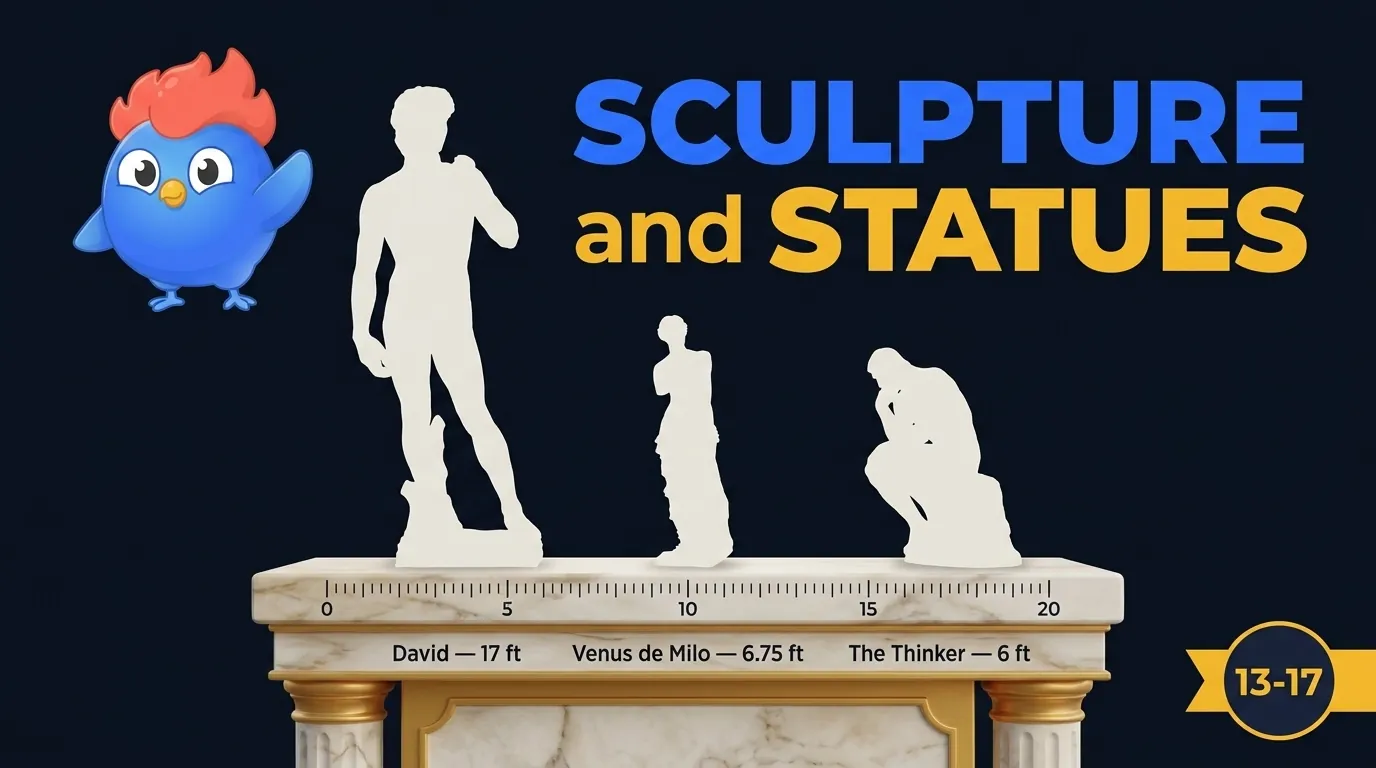 David at 17 feet, the Venus de Milo at under 7, The Thinker at 6.
13. Who sculpted The Thinker, originally designed as part of a larger work called The Gates of Hell? Easy
Answer: Auguste Rodin. The Thinker began as a small figure on the top frame of a huge bronze door built for a Paris museum.
Why it stumps people: The Thinker is famous, so most people know the title. Fewer know Rodin scaled it up decades later into the stand-alone bronze. It was never meant as a solo work. The full Gates of Hell, a door crowded with roughly 180 figures, exists today in bronze casts from Paris to Tokyo.
14. What ancient Greek sculpture, missing both arms, stands in the Louvre and was discovered in 1820 on a Cycladic island? Medium
Answer: Venus de Milo (Aphrodite of Milos). Discovered by a farmer on the Greek island of Milos in 1820. The Louvre dates it to around 150-125 BCE.
Why it stumps people: The arms invite a good story, and one got attached: a dockside brawl between French and Ottoman crews fighting over the statue in 1820. Modern scholarship treats that as embellishment. The figure came out of the ground in pieces, arm fragments were found nearby, and the arms themselves were never recovered.
15. How tall is Michelangelo’s David? Easy
Answer: 17 feet (5.17 meters), plus a 3-foot pedestal. Larger than life by a factor of three.
Why it stumps people: Prints and photos flatten the scale. The statue rules the Galleria dell’Accademia in Florence. It was built to stand on a buttress of the Cathedral roof, seen from street level. The roof plan failed because the finished statue, roughly six tons of marble, was too heavy to raise.
16. Which Greek sculptor created the original Discobolus (the Discus Thrower) around 450 BCE? Hard
Answer: Myron of Eleutherae. The original bronze is lost. Every version in museums today is a Roman marble copy, including the Lancellotti Discobolus in Rome.
Why it stumps people: The pose is unmistakable. The sculptor’s name? Blank for most. Myron’s bronzes shaped Classical Greek taste, and not one of them survives. The Roman copies are great in their own right. But they likely miss details Pliny the Elder wrote about in the first century.
17. What sculpture by Donatello was the first free-standing bronze nude since antiquity? Hard
Answer: David (around 1440). The first free-standing bronze nude cast in Europe since the fall of Rome, roughly 1,000 years earlier.
Why it stumps people: Donatello’s David sits in the shadow of Michelangelo’s marble version (1504) in most memories, even though it came 60 years earlier, in bronze, and marked a genuine art-history first. It lives at the Bargello National Museum in Florence today.
Modern Art Trivia (Questions 18-22)
Modern art is where the wrong rate climbs. The June 2026 production export that put Art third overall also flagged the hardest question in our Celebrities topic (among questions with at least 10 recorded answers), and it turned out to be an art question: why Andy Warhol painted Marilyn Monroe so many times. 93.8 percent of its 16 recorded answers were wrong.
Modern art rewards life-story and sale-price knowledge over a quick look at the canvas. These five lean into exactly that: surrealism, pop art, Pollock’s floor, and the 2025 modernist record.
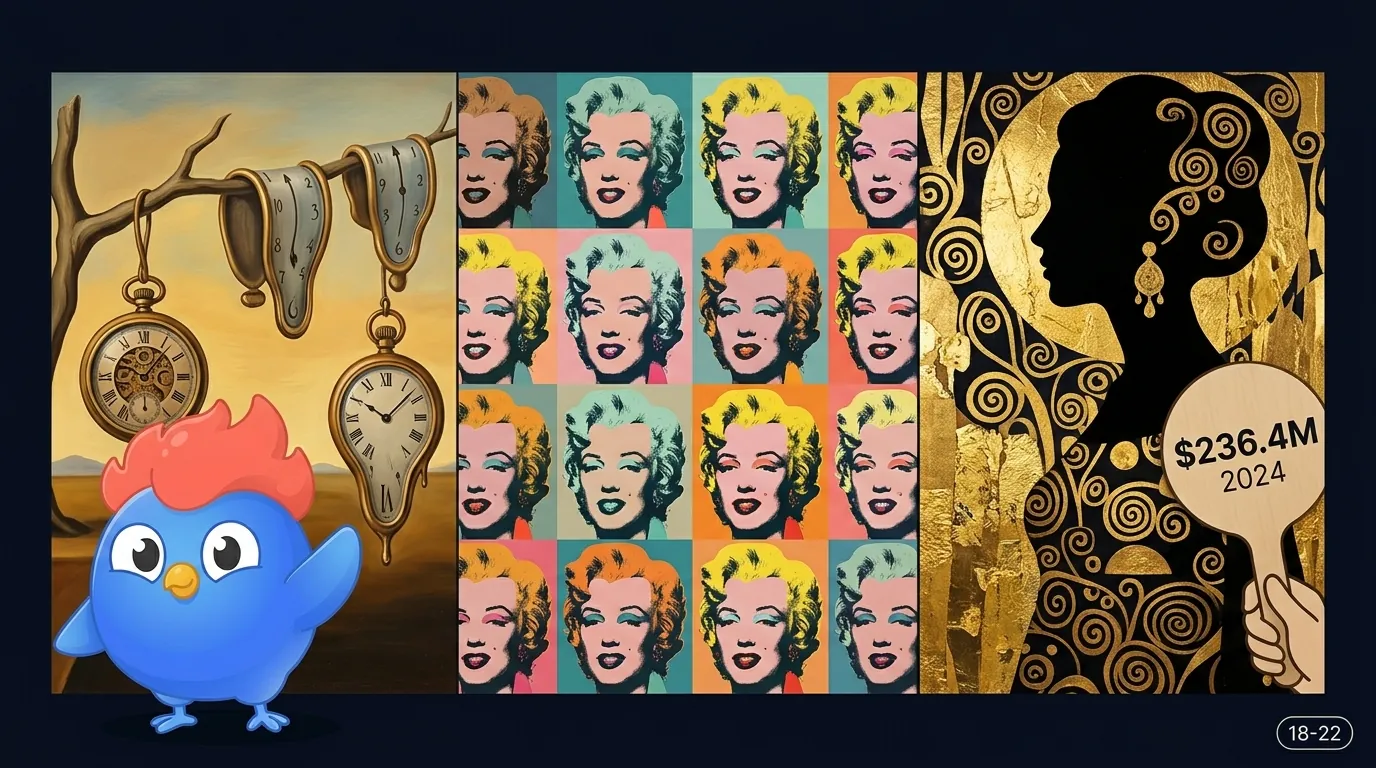 Dalí’s clocks and Warhol’s Marilyns.
18. Who painted The Persistence of Memory (1931), famous for its melting clocks? Easy
Answer: Salvador Dalí. The canvas is surprisingly small: 24 by 33 cm, roughly the size of a sheet of A4 paper.
Why it stumps people: The melting clocks loom so large in pop culture that the real painting feels tiny in the MoMA in New York. By Dalí’s own account, he added the clocks to an already-painted landscape in a single evening while Gala was at the cinema, sparked by Camembert melting in the summer heat.
19. Andy Warhol’s Shot Sage Blue Marilyn sold at Christie’s in 2022 for 195 million dollars. What was Warhol’s original source photograph? Medium
Answer: A 1953 publicity still of Marilyn Monroe from the film Niagara, shot by photographer Gene Kornman. Warhol silk-screened the image dozens of times across colored backgrounds starting in 1962.
Why it stumps people: Warhol is so tied to the Marilyn face that people forget he did not take the photo. He began the series within weeks of Monroe’s death in August 1962. The “Shot” in the 2022 record work refers to a real 1964 bullet hole. A visitor to Warhol’s Factory fired it. The hole was later patched with care.
20. Jackson Pollock’s drip technique originated from observing which practical art form? Hard
Answer: Navajo sand painting, the influence Pollock himself credited. He watched sand-painting demonstrations at MoMA’s 1941 “Indian Art of the United States” exhibition, and his horizontal, on-the-floor pouring echoes what the sand painters did with sand.
Why it stumps people: The usual story says Pollock invented action painting from nothing. His own 1947 artist statement calls his floor method akin to that of “the Indian sand painters of the West,” and historians add a second source most art classes skip: Siqueiros’s 1936 New York workshop, where Pollock first saw paint poured and dripped. MoMA’s Pollock holdings include the drip paintings that followed within six years of that exhibition.
21. What 2025 auction record did Gustav Klimt’s Portrait of Elisabeth Lederer set at Sotheby’s New York? Hard
Answer: It sold for 236.4 million dollars, the highest price ever paid for a modernist painting at auction. The sale was reported by ARTnews on November 18, 2025.
Why it stumps people: Ask anyone to name the modernist record-holder and they’ll reach for Picasso or Warhol. Klimt’s late portraits had sold below 100 million for years. And the back-history is as gripping as the painting: the Nazis seized it in Vienna in 1938, Austria restituted it to Elisabeth’s brother Erich in 1948, and it stayed in private hands until the sale, the last four decades with collector Leonard Lauder.
22. Which artist painted Les Demoiselles d’Avignon in 1907, considered the proto-Cubist work that launched the movement? Medium
Answer: Pablo Picasso. The painting shows five women from a brothel on Carrer d’Avinyó in Barcelona. The faces come from African masks he had studied at the Musée d’Ethnographie du Trocadéro.
Why it stumps people: Cubism and Picasso go together in most heads, yet the guess slides to Braque, or to a later date. Les Demoiselles came three years before full Cubism, and it rattled even Picasso’s own circle. He kept the canvas rolled up in his studio for nearly a decade, until its first public showing at the 1916 Salon d’Antin. It now hangs at MoMA.
Art Movements and Styles Trivia (Questions 23-27)
Movements are a dates-and-founders game. Strip away the year and the studio and the names blur: Suprematism into Constructivism, Dada into Surrealism, a school into a style. Most of the mix-ups follow that one shape, two movements born a few years apart in different cities, and these five sort out the worst offenders.
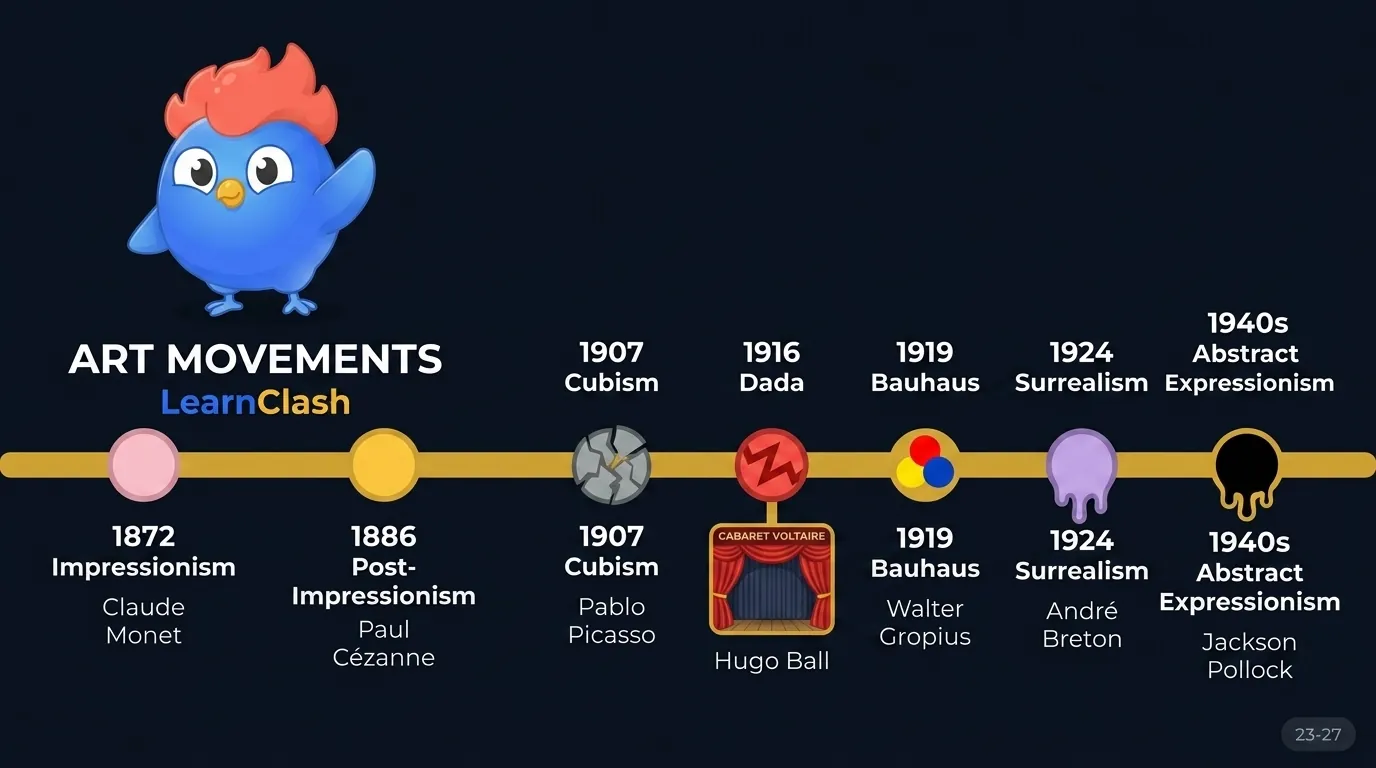 From a Zurich cabaret in 1916 to a Weimar classroom in 1919.
23. Which art movement, founded in Zurich in 1916, was a deliberate rejection of logic, reason, and capitalist society? Easy
Answer: Dada (Dadaism). Started at the Cabaret Voltaire by Hugo Ball, Tristan Tzara, and others during World War I. It was a protest against the values that had led to the slaughter of trench warfare.
Why it stumps people: Dada gets mixed up with Surrealism (which came later, 1924, and grew out of Dada) or with Pop Art. The Zurich date and the wartime start are the parts most quiz-takers miss.
24. What Japanese woodblock print tradition heavily influenced Van Gogh, Monet, and Whistler? Medium
Answer: Ukiyo-e. “Pictures of the floating world.” Japanese prints that reached Europe through trade from the 1850s onward. They shaped the whole Post-Impressionist era.
Why it stumps people: The look is all over Impressionism (flat color, tilted view, framing as pattern). But the name ukiyo-e is rare in Western art classes. Hokusai’s The Great Wave off Kanagawa is the most-copied ukiyo-e print. Most viewers still don’t know the school’s name.
25. The Impressionist movement was named after which 1872 Monet painting ridiculed by critic Louis Leroy? Medium
Answer: Impression, Sunrise (Impression, soleil levant). Leroy used the title mockingly in an 1874 review for the satirical journal Le Charivari, and the Impressionists adopted the insult as a banner.
Why it stumps people: People expect the movement name to come from the artists. It came from a critic who was trying to shut them down. The painting hangs at the Musée Marmottan Monet in Paris. It was stolen in a 1985 armed robbery (and found again in 1990).
26. What 20th-century movement founded by Kazimir Malevich reduced art to pure geometric abstraction? Hard
Answer: Suprematism. Its best-known work is Malevich’s Black Square (1915). A plain black square on white canvas. Malevich called it “the zero of form.”
Why it stumps people: Suprematism is often mixed up with Constructivism (a parallel Russian movement) or with Bauhaus abstract work (German, different aims). Malevich hung Black Square in the “icon corner” of its first show. That was a holy gesture. Critics still debate it.
27. Which movement, led by Walter Gropius, merged fine art with industrial design and functional architecture from 1919 to 1933? Medium
Answer: Bauhaus. Started in Weimar, Germany. Moved to Dessau. Then to Berlin, before the Nazis shut it down in 1933. Key figures included Gropius, László Moholy-Nagy, Paul Klee, Wassily Kandinsky, and Marcel Breuer.
Why it stumps people: Bauhaus is a school, not a style. People use it as shorthand for “clean geometric design.” The real Bauhaus taught weaving, type, and stage work as well. Its global reach came after 1933, when refugee staff took Bauhaus ideas to American schools.
Artists and Their Lives Trivia (Questions 28-33)
Here the test is biography. Ear cuts, bankruptcy, single lifetime sales, the gap between fame and money. Knowing a face from a self-portrait is not the same as knowing the life behind it, and the six lives in this round all hide something the postcards leave out.
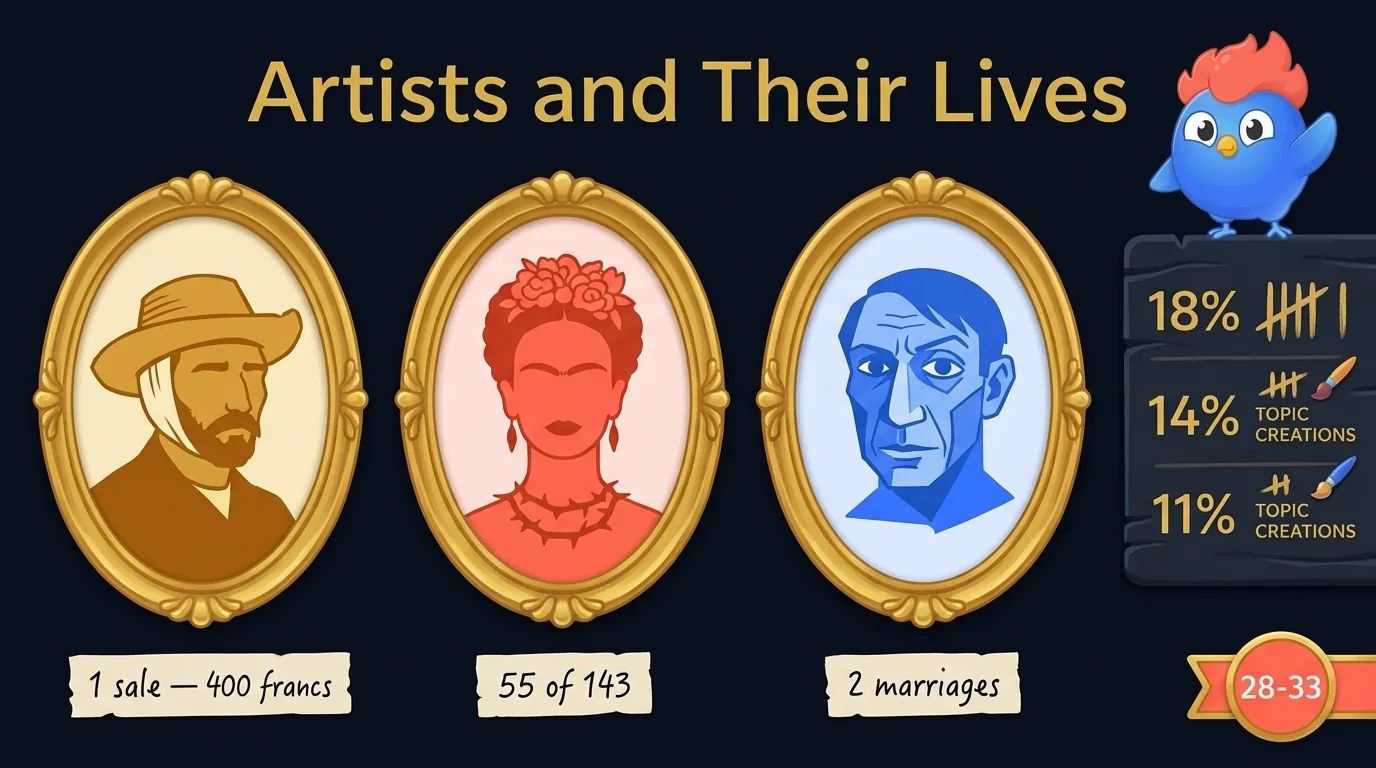
28. Vincent van Gogh sold how many paintings during his lifetime, and which one? Easy
Answer: One. The Red Vineyard, sold to Belgian artist Anna Boch in early 1890 for 400 francs. Van Gogh died by suicide in July of the same year.
Why it stumps people: The exact count (one, not zero and not several) is what trips people up. Van Gogh made about 2,100 works in a 10-year career. He lived on an allowance from his brother Theo. The Red Vineyard now hangs in the Pushkin Museum in Moscow.
29. Which Mexican artist painted 55 self-portraits out of her 143 total paintings? Medium
Answer: Frida Kahlo. Her self-portraits often depicted physical trauma from a 1925 bus accident that fractured her spine and left her in chronic pain for life.
Why it stumps people: People guess Kahlo but miss the ratio. 38% of her total output was self-portraits. She said: “I paint myself because I am so often alone, and because I am the subject I know best.”
30. What ear injury did Van Gogh inflict on himself in December 1888, and what did he do with the severed piece? Medium
Answer: He cut off most of his left ear with a razor during a psychotic episode. He then wrapped it in paper and delivered it to a young woman known as Rachel at a brothel in Arles, asking her to “keep this object carefully.”
Why it stumps people: Two myths trip people up here. “He only nicked the lobe” (a diagram by Felix Rey, the doctor who treated him, surfaced in Bernadette Murphy’s 2016 research and shows the ear severed almost whole), and “he gave it to Gauguin” (the recipient was the woman early accounts call Rachel; Murphy identified her as Gabrielle Berlatier, a farm girl working at the brothel). The 1888 Arles episode did follow a fight with Gauguin. But Gauguin was not the person who got it.
31. Which artist’s self-portraits show a wandering eye that likely left him without normal depth perception, Rembrandt or Picasso? Hard
Answer: Rembrandt. He had strabismus (a misaligned eye; the study never names which side) that researchers later identified across dozens of his self-portraits. Strabismus can weaken stereoscopic depth perception, and the study’s authors argue Rembrandt was likely stereoblind, seeing a flattened view of the world that may have helped him translate three-dimensional scenes onto a flat canvas.
Why it stumps people: You can see it in every self-portrait once you know to look. But no period sources mention it. The find came from a 2004 study by Harvard neuroscientists Margaret Livingstone and Bevil Conway, who measured the eyes across 36 of Rembrandt’s self-portraits.
32. Which Dutch master spent his final years in bankruptcy, despite painting now-priceless works like The Night Watch? Medium
Answer: Rembrandt van Rijn. His bankruptcy was declared in 1656, his home and art collection auctioned off. He died in 1669 with almost nothing to his name.
Why it stumps people: Rembrandt had been one of the richest painters in 1630s Amsterdam. Three things ruined him. Heavy spending on art. Shifts in who paid for work. And the cost of running a large studio. The Night Watch (1642) is now estimated to be worth around half a billion euros. It is the Rijksmuseum’s star.
33. How many women did Picasso formally marry during his lifetime? Hard
Answer: Two. Olga Khokhlova (1918-1955) and Jacqueline Roque (1961-1973). He had many long-term partners between and during his marriages, but only two legal spouses.
Why it stumps people: Picasso’s love life was so tangled that people guess three, four, or more. Olga was a Ballets Russes dancer he met in 1917. Jacqueline was with him for his last 20 years. Neither marriage ended in divorce. Olga died in 1955. Jacqueline was with him at his death in 1973.
Take the biography round into a duel
Art History Trivia (Questions 34-37)
The last four questions are back-of-house: pigment chemistry, museum floor plans, the Nazi confiscation campaign, and the Gardner heist. This is the round where quiz nights go quiet.
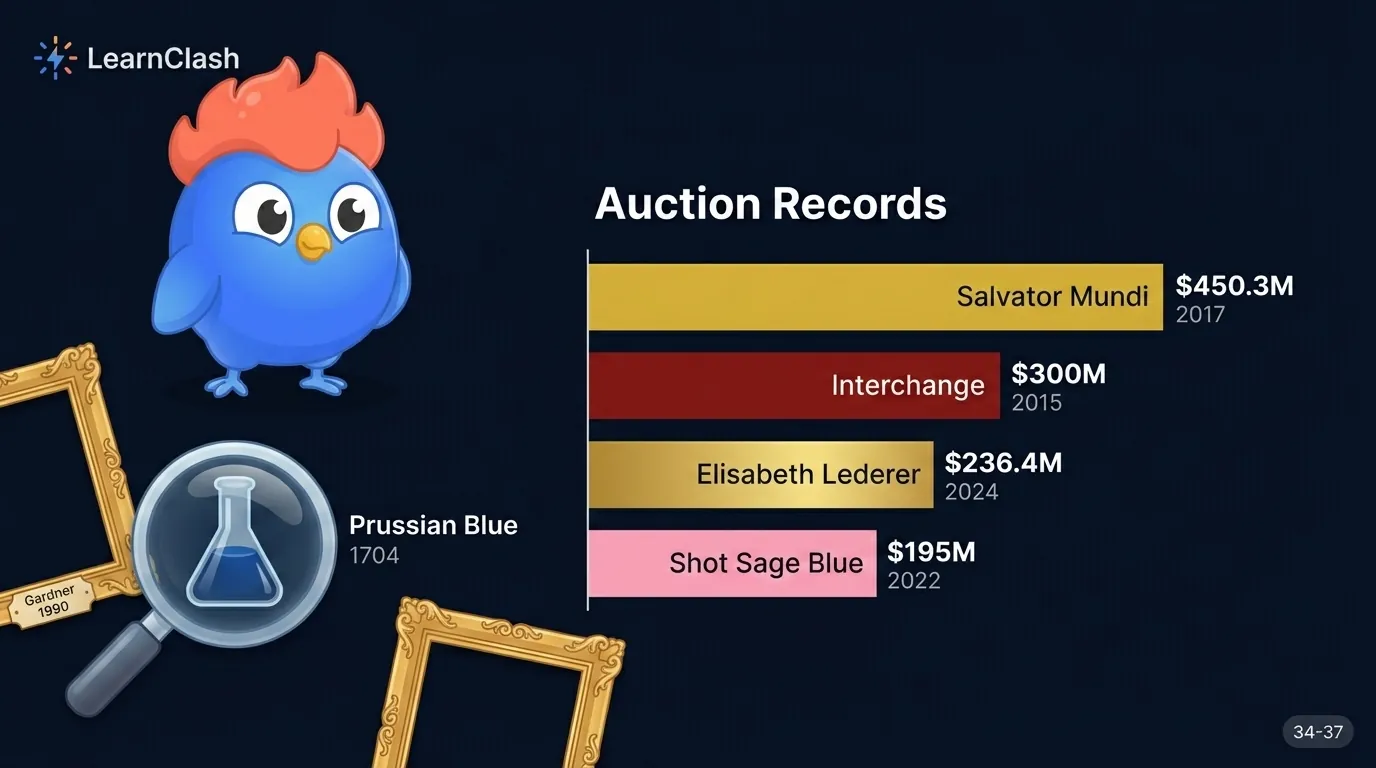 A chemistry accident, a floor-plan dispute, and 13 empty frames in Boston.
34. What was the first paint pigment to be manufactured industrially, created by accident in Berlin around 1704? Medium
Answer: Prussian blue. Found by chance by Johann Jacob Diesbach while he was trying to make a red pigment. His potash had been contaminated with animal oil, and the batch turned deep blue instead of red.
Why it stumps people: The first modern synthetic pigment was an accident. Before Prussian blue, blues came from lapis lazuli (too costly for most) or indigo (less stable). Hokusai’s The Great Wave owes its deep blue to Prussian pigment from Europe. So does Picasso’s Blue Period.
35. Which museum is the largest art museum in the world by gallery space? Easy
Answer: The Louvre in Paris, with 782,910 square feet (72,735 square meters) of exhibition space. The Hermitage in St. Petersburg is second.
Why it stumps people: Most people guess the Metropolitan Museum of Art in New York, whose roughly 633,000 square feet of gallery space trails the Louvre by about 150,000. The closer race is with the Hermitage: 719,480 square feet, around 63,000 behind the Louvre’s three wings.
36. How many paintings did the Nazis officially classify as “degenerate art” (Entartete Kunst) for their 1937 Munich exhibition? Hard
Answer: About 650 paintings and sculptures were displayed in the Munich exhibition. The broader Nazi confiscation campaign seized over 16,000 artworks from German museums between 1937 and 1941.
Why it stumps people: The Munich show was small on its own. But it was built as a public mock of modern art. Works by Kandinsky, Klee, Kokoschka, Nolde, Picasso, and Chagall hung askew with cruel labels. Millions of Germans came to see it. Many seized works were later sold for foreign cash, or burned.
37. In 1990, thieves stole 13 works worth 500 million dollars from which Boston museum in the largest art theft in history? Medium
Answer: The Isabella Stewart Gardner Museum. Two thieves dressed as Boston cops entered the museum at 1:24 AM on March 18, 1990. They cuffed two guards. Then they spent 81 minutes cutting paintings from frames.
Why it stumps people: The theft is still unsolved. The stolen works include Vermeer’s The Concert (one of just 34 known Vermeers). They include Rembrandt’s only known seascape (The Storm on the Sea of Galilee). And a Manet. The FBI and Gardner Museum still offer a 10 million dollar reward for tips that lead to a find. The empty frames still hang where the works were.
A forged Eros, a disputed attribution, an arm lost to legend: these facts lodge when you drag them back out of memory, not when you skim them again. In Karpicke and Roediger’s 2008 experiment, students who kept testing themselves on vocabulary held onto about 80% of it a week later; those who only restudied after the first recall kept about 36%.
What to Do with the Misses
Print the list for a gallery-night round, or run one section per dinner. The who-painted-what prompts warm a table up. The forgery and auction questions decide the winner.
If you want the misses to come back on a schedule instead of vanishing with the evening, that is the decision we built LearnClash around. A missed art question returns after 7 days, a correct answer on the retry locks it away for 90, and a second correct answer retires it as mastered. A 3-minute duel deals 18 questions across 6 sub-topics, so this list is roughly two duels’ worth of material.
The other lists in this cluster, if art wasn’t your best round:
- 45 90s trivia questions for the decade that ended with the Gardner heist
- 43 music trivia questions for biographical stumpers from another art form
- 37 science trivia questions for the chemistry that shaped Prussian blue
- 43 history trivia questions for the Renaissance and early-modern context behind the forgeries
- 43 movie trivia questions for art-heist films and their real-life sources
- 47 celebrity trivia questions for Hollywood real names and the stars who collect the record-breaking fees
Frequently Asked Questions
How hard are art trivia questions in LearnClash?
LearnClash calibrates art trivia questions by ELO tier. Iron players face recognition questions like identifying Van Gogh's Starry Night. Phoenix-tier players get auction records, forgery history, and artist biography. Renaissance recognition questions tend to be easier than modern art, where life-story and sale-price knowledge matters more than a quick visual.
What art trivia topics does LearnClash cover?
LearnClash covers Renaissance masters, Baroque, Impressionism, modern art, sculpture, art history, famous paintings, auction records, and artist biographies. You can create a custom art topic in the app and the AI generates 18 questions across 6 subcategories for a 3-minute duel.
Are art trivia questions good for studying art history?
Yes, when paired with spaced repetition. LearnClash Practice mode reviews missed art questions at a 3-stage cadence: a 7-day cooldown after you miss a question, then a 90-day cooldown once you answer it correctly, then it exits your review pool as mastered. That schedule builds long-term recall that static quiz lists cannot match.
What is the most expensive painting ever sold?
Salvator Mundi by Leonardo da Vinci sold at Christie's New York on November 15, 2017 for 450.3 million dollars including buyer's premium. That remains the highest price ever paid for any painting at public auction. Its current location and authenticity are still disputed.
Did Van Gogh really only sell one painting in his lifetime?
Van Gogh sold one painting publicly: The Red Vineyard, bought by Belgian artist Anna Boch in early 1890 for 400 francs. A few drawings and portrait commissions changed hands privately, but no other completed painting sold through a gallery or dealer before his death later that year.