
53 True or False Questions [With Answers]
53 true or false questions across science, history, geography, animals, pop culture, and the human body. Answers included, plus where each myth came from.
How many do you know?
Think of your answer, then reveal it.
Did you know it before revealing the answer?
Read this answer in the articleRound complete
Turn what you know into a quiz duel.
Start a new duel in LearnClash and learn from every answer.
Get LearnClashFree to play on iPhone and Android. No ads.
Try the questions you missed once more.

Humans use only 10% of their brains. You swallow eight spiders a year in your sleep. Napoleon was short.
All three are false, and all three still take down people who quiz for a living. These 53 true or false questions go after the facts most of us learned wrong, from lightning temperatures to misquoted film lines. Every one carries the answer and a short note on where the false version came from. Challenge a friend to a duel →
Seven categories, one trap type each. Jump to the one you want:
| Section | Questions | The trap |
|---|---|---|
| Science & Nature | 1-8 | Physics, chemistry, weather |
| History & Famous People | 9-16 | Figures, events, misquotes |
| Geography & Places | 17-23 | Maps, countries, records |
| Animals & Biology | 24-31 | Myths, lifespans, senses |
| Pop Culture, Movies & TV | 32-38 | Quotes, logos, lore |
| The Human Body | 39-46 | Anatomy myths, growth |
| Food, Language & Everyday Life | 47-53 | Kitchen, dictionary, rules |
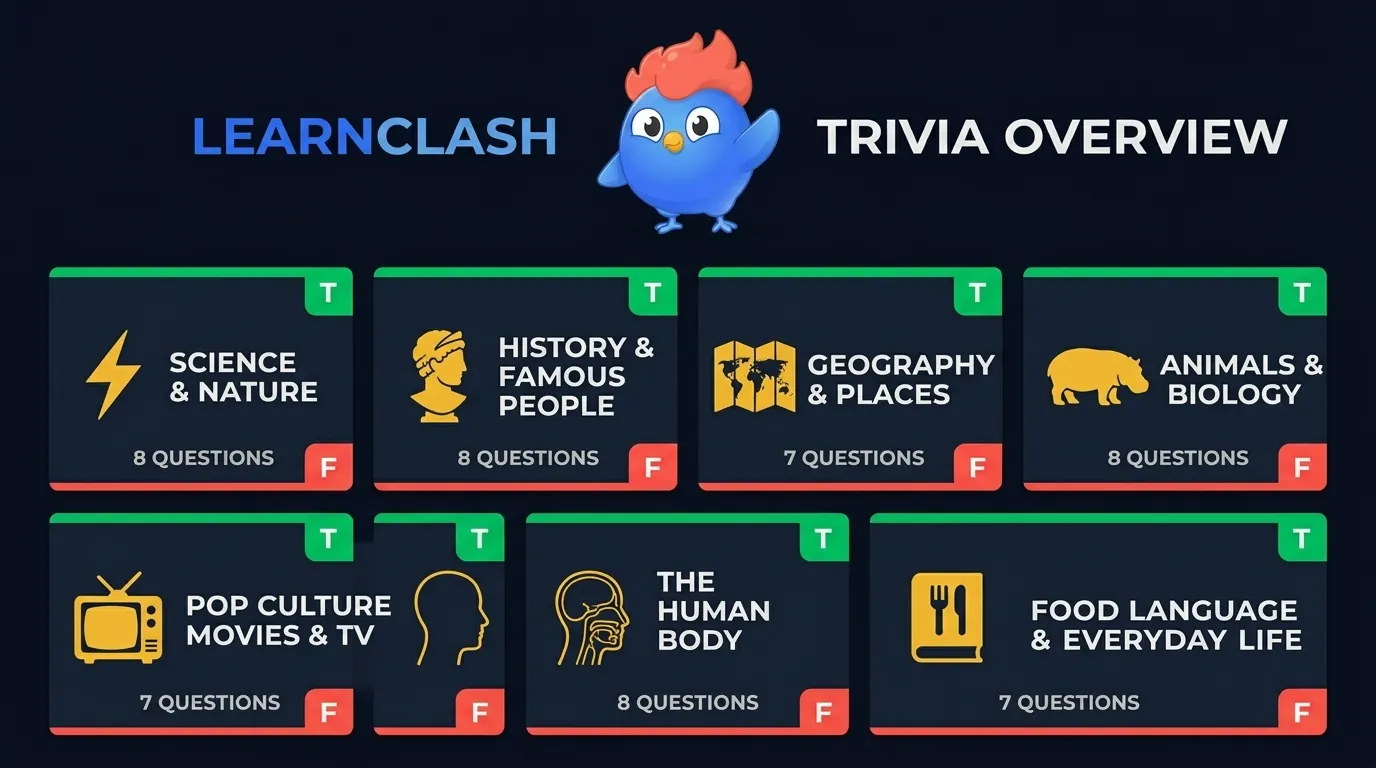 Seven categories, 53 statements, built against primary sources and the Wikipedia list of common misconceptions.
Before the questions, one thing I can actually measure. LearnClash logs the first answer every player gives to a question, and on July 27, 2026 I exported that distribution across the whole catalog: 39,113 question documents, 691 topics. The deepest sample among the questions that cleared the statistical signal cut was a question about Cleopatra’s native language, answered 103 times by players meeting it cold. Greek is correct, and 34% picked it, barely above the 25% a blind guess would score on a four-option question. Egyptian, the answer the retold version of her story points to, took another 25%.
That number is the entire subject of this page. On pure guessing the right answer would sit at one in four; instead two-thirds of first encounters miss a fact that has been public record for two millennia. The export does not measure how sure anyone felt, but it does show where the misses went: a full quarter landed on Egyptian, exactly the answer the retelling would predict. The simplest reading is that the story put that answer there. That is the difference between not knowing something and knowing the wrong thing.
LearnClash serves four-option questions rather than true or false, so I cannot tell you what a binary format does to raw accuracy. What the export does show is the shape of the error: on questions where a misconception exists, wrong answers do not spread evenly across the options. They pile onto the one wrong answer the misconception points to. For a broader warm-up, try our 43 general knowledge questions, the 97 pub quiz questions in classic UK six-round format, or the full hub of best trivia questions across 34 topics.
Science & Nature True or False (Questions 1-8)
Physics and gut instinct collide in this set. Eight statements on lightning, diamonds, sound, and the Coriolis effect, where the false version usually sounds like something a teacher once said out loud.
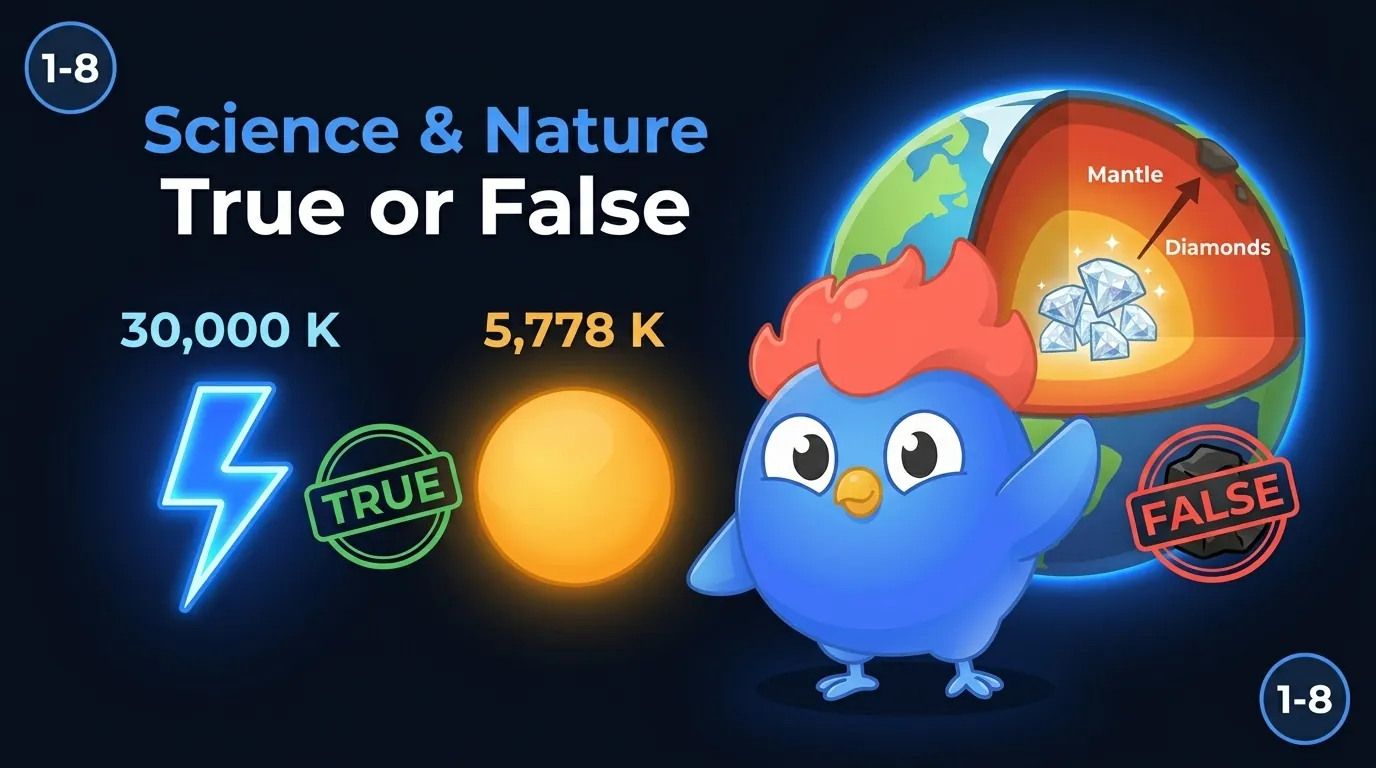 Eight questions where intuition meets cold physics.
1. Lightning is hotter than the surface of the Sun. Easy
Answer: True. A bolt reaches roughly 30,000 K (about 53,500°F). The Sun’s visible surface sits near 5,778 K.
Your gut says the Sun wins, because it is the Sun. Lightning is plasma squeezed by an enormous current for a few millionths of a second, and for that instant it beats the photosphere by a factor of five. The Sun’s core takes the title back at around 15 million K.
2. Diamonds form from coal. Medium
Answer: False. Diamonds crystallize from carbon in Earth’s mantle under extreme pressure, and most are more than a billion years old. Coal forms from plant matter near the surface, and land plants only appear in the fossil record about 470 million years ago.
The timing settles it on its own. Most diamonds are older than plants, which makes the coal version chronologically impossible, but it survives because it is a tidy classroom story that a couple of cartoons then made permanent.
3. Sound travels faster in water than in air. Easy
Answer: True. Roughly 4.3 times faster: about 1,480 m/s in water against 343 m/s in air.
Underwater sound arrives muffled, so the brain files it as slower. Density is what matters. Packed molecules hand the vibration along sooner, which is how whale song crosses thousands of kilometers of open ocean.
4. Toilet water swirls in opposite directions in the Southern Hemisphere because of the Coriolis effect. Medium
Answer: False. The Coriolis effect is real and it steers hurricanes. At the scale of a basin, the shape of the bowl and the angle of the jets decide everything.
The Simpsons ran the gag in 1995 and a fair share of the planet has repeated it since.
5. Turkey makes you sleepy because of its tryptophan content. Medium
Answer: False. Turkey carries roughly as much tryptophan as chicken or beef. The slump after the meal is the volume of food, the carbohydrates, and often the wine.
The reasoning sounds airtight, which is exactly the trap: tryptophan makes serotonin, serotonin makes melatonin, therefore turkey makes sleep. The amount in one serving never crosses the blood-brain barrier in a quantity that could do it.
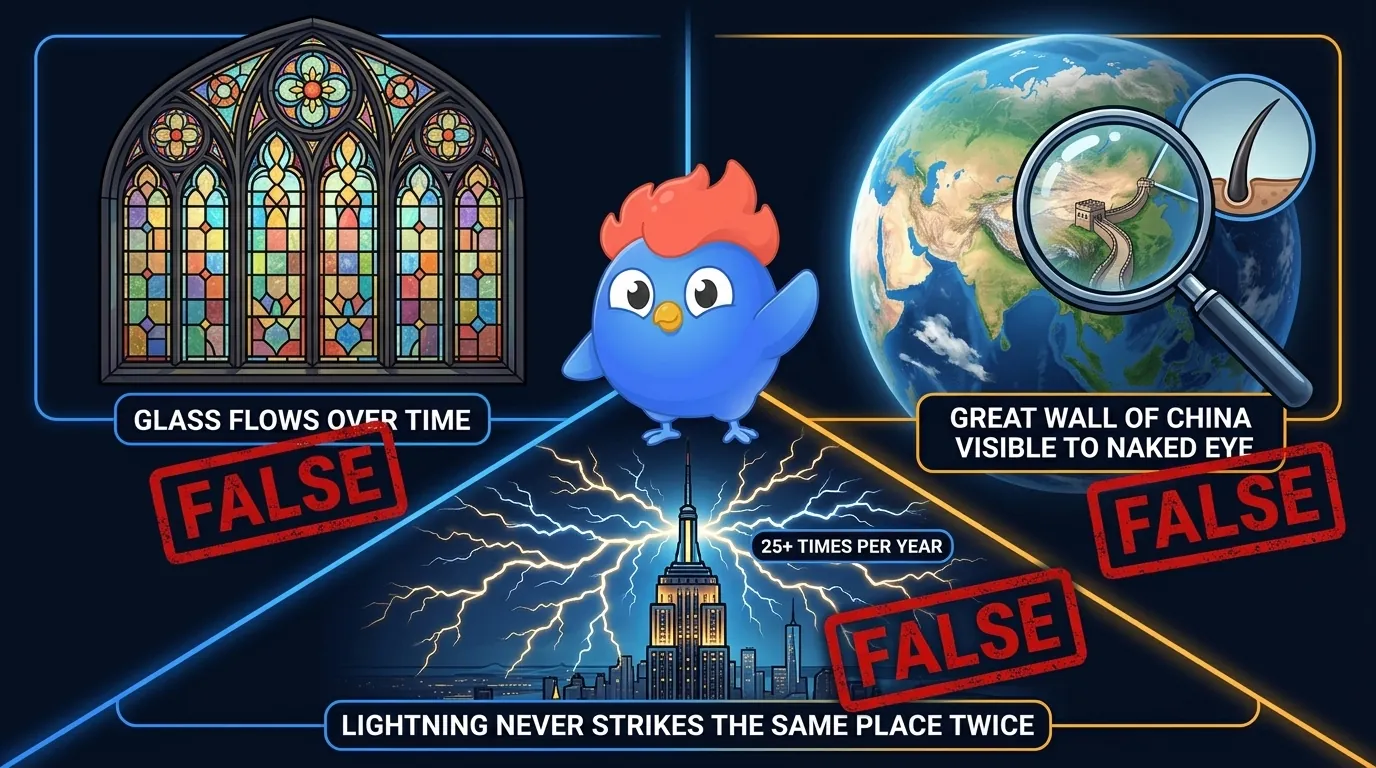 Glass flow, Great Wall visibility, and the lightning cliché.
6. Glass is a slow-flowing liquid, which is why old church windows are thicker at the bottom. Hard
Answer: False. Glass is an amorphous solid. Medieval panes are uneven because crown glass came out of the workshop uneven, and glaziers set the heavy edge at the bottom.
A chemistry teacher somewhere described glass as a very slow liquid and the line escaped the classroom. Run the viscosity numbers and window glass at room temperature would need far longer than the current age of the universe to sag by any visible amount.
7. The Great Wall of China is visible from space with the naked eye. Easy
Answer: False. Yang Liwei, China’s first astronaut, reported from orbit in 2003 that he could not see it. NASA has said the same repeatedly.
A 1932 Ripley’s Believe It or Not! cartoon put the claim into circulation. The Wall is long, not wide, and width is what visibility needs from a few hundred kilometers up.
8. Lightning never strikes the same place twice. Easy
Answer: False. The Empire State Building takes about 25 strikes a year.
It rhymes, which is most of why it survived. Tall, pointed, conductive things get hit more often, not less.
More in this direction: 37 science trivia questions and 43 math trivia questions.
History & Famous People True or False (Questions 9-16)
History breaks where the film version rewrote it. Eight statements on Napoleon’s height, Einstein’s grades, Viking helmets, and the rumor about Walt Disney’s body. This is also the section the numbers at the top of the page came out of: the Cleopatra question behind them sits in the app’s History topic.
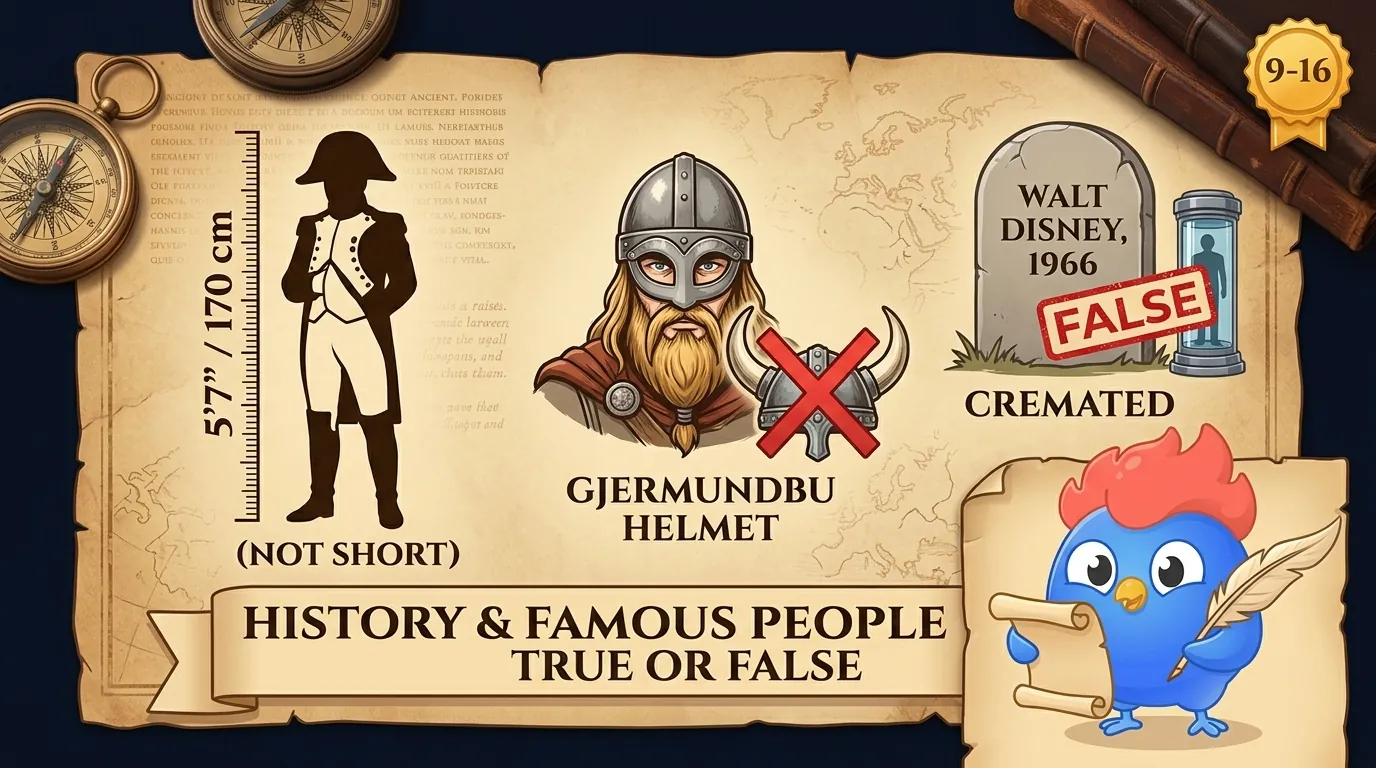 Eight questions where the pop-culture version is the wrong version.
9. Napoleon Bonaparte was unusually short for his era. Medium
Answer: False. He stood about 1.69 m, between 5 feet 6 and 5 feet 7, which was average or slightly above for a French man of his generation.
Two things went wrong. British caricaturists drew him tiny for twenty years, and his death record gave his height in French inches, which run longer than British ones. Read as a British measurement, “5 pieds 2 pouces” turns into 5 foot 2, and the error outlived everyone who made it.
10. Albert Einstein failed math in school. Easy
Answer: False. He was working through differential and integral calculus by around 15, and said as much in his own later autobiographical writing.
A 1935 Ripley’s column claimed the failure. Einstein reportedly saw the clipping and laughed it off. The story survives because it comforts anyone struggling in a math class, which is a kinder reason than most myths get.
11. Vikings wore horned helmets in battle. Easy
Answer: False. No horned helmet has ever come out of a Viking-age grave. The design comes from costumes made for the 1876 premiere of Wagner’s Der Ring des Nibelungen.
A century of sports mascots and cartoons made the horns feel canonical. The one reasonably complete Viking helmet archaeologists have, the Gjermundbu find in Norway, is plain iron with a spectacle-shaped eye guard. Horns on a battlefield are handles.
12. Walt Disney’s body was cryogenically frozen after his death. Medium
Answer: False. He was cremated on December 17, 1966, two days after his death, and his ashes are at Forest Lawn Memorial Park in Glendale.
A 1969 rumor put his head in a freezer under the Pirates of the Caribbean ride. The first human cryonic preservation took place in January 1967, weeks after Disney was already ashes.
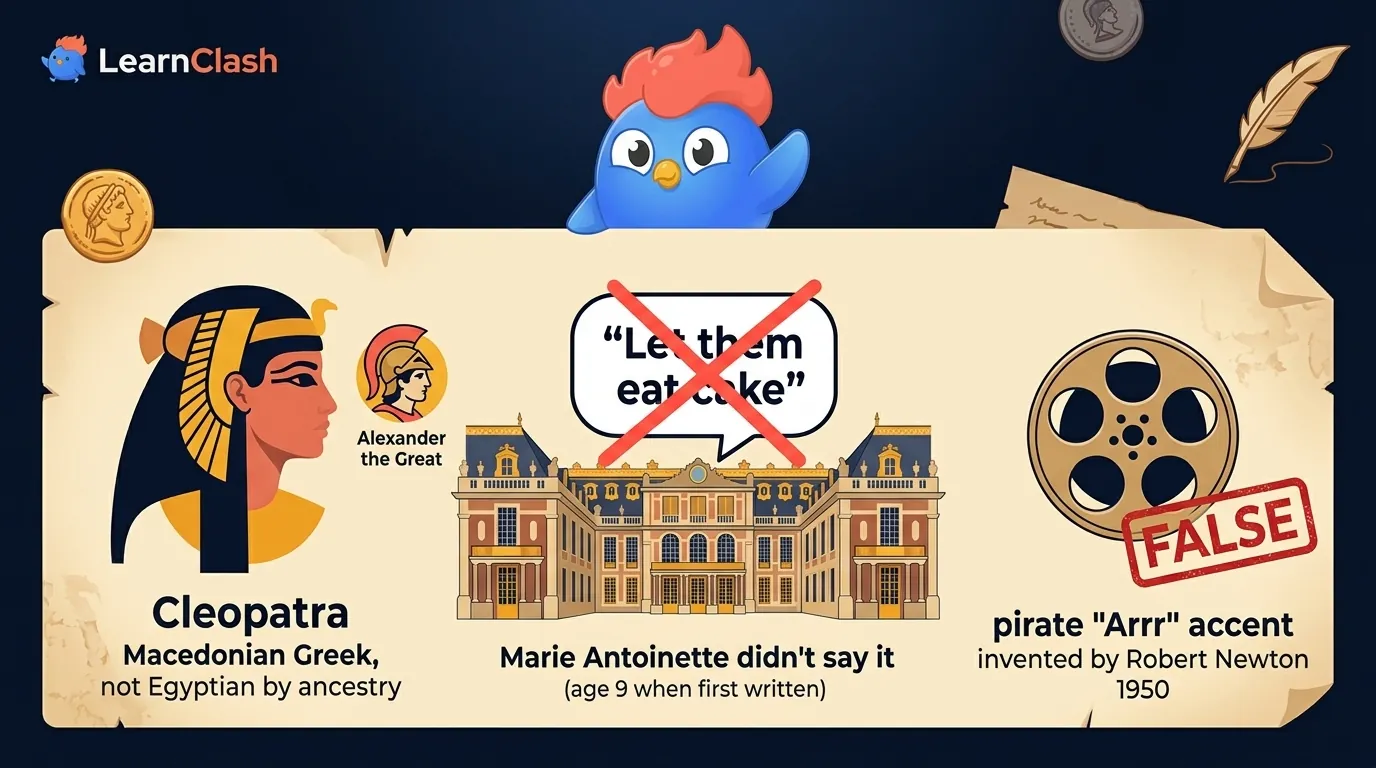 Cleopatra’s ancestry, Marie Antoinette’s alleged line, and an invented pirate accent.
13. The Great Fire of London killed thousands. Medium
Answer: False. The recorded death toll was 6. Historians think the real figure was higher, since the deaths of poor residents often went unrecorded, but nothing supports thousands.
Four days of fire, 13,200 houses and 87 churches gone: it reads like a mass-casualty event. Most of London had time to walk out. The catastrophe was property, not people.
14. Cleopatra was ethnically Egyptian. Medium
Answer: False. She was Macedonian Greek, from the Ptolemaic dynasty founded by one of Alexander the Great’s generals. Greek was her first language, and by Plutarch’s account she was the first of her line in roughly three centuries to learn Egyptian at all.
She ruled Egypt, took Egyptian throne names and presented herself as Isis, and every bit of that was deliberate policy. Her father’s line was Greek. Her mother’s ancestry is still argued over. This is also the misconception our own data pins down with the most confidence: 103 first encounters, and the wrong answer is not a guess, it is a picture.
15. Marie Antoinette said “Let them eat cake” about starving French peasants. Easy
Answer: False. Rousseau pinned the line on “a great princess” in his Confessions, written around 1765. Marie Antoinette was nine years old that year and living in Vienna.
It is perfect villain dialogue for a queen who ended up on a scaffold, which is why it stuck to her anyway.
16. The pirate “Arrr, matey” accent comes from real historical pirates. Hard
Answer: False. It traces to Robert Newton, who played Long John Silver in Disney’s 1950 Treasure Island with a broad West Country accent and never dialed it down.
Every pirate film since has copied him, so the voice feels four centuries old. Real pirates spoke like wherever they came from.
Play world history duels on LearnClash →
Want to go deeper? Our 43 history trivia questions and 47 WW2 trivia questions cover the eras textbooks rush through.
Geography & Places True or False (Questions 17-23)
Geography is the subject most people stopped studying at thirteen. Seven statements on coastlines, altitude, deserts, and which state actually sits farthest south, most of them turning on a definition that the classroom map quietly skipped.
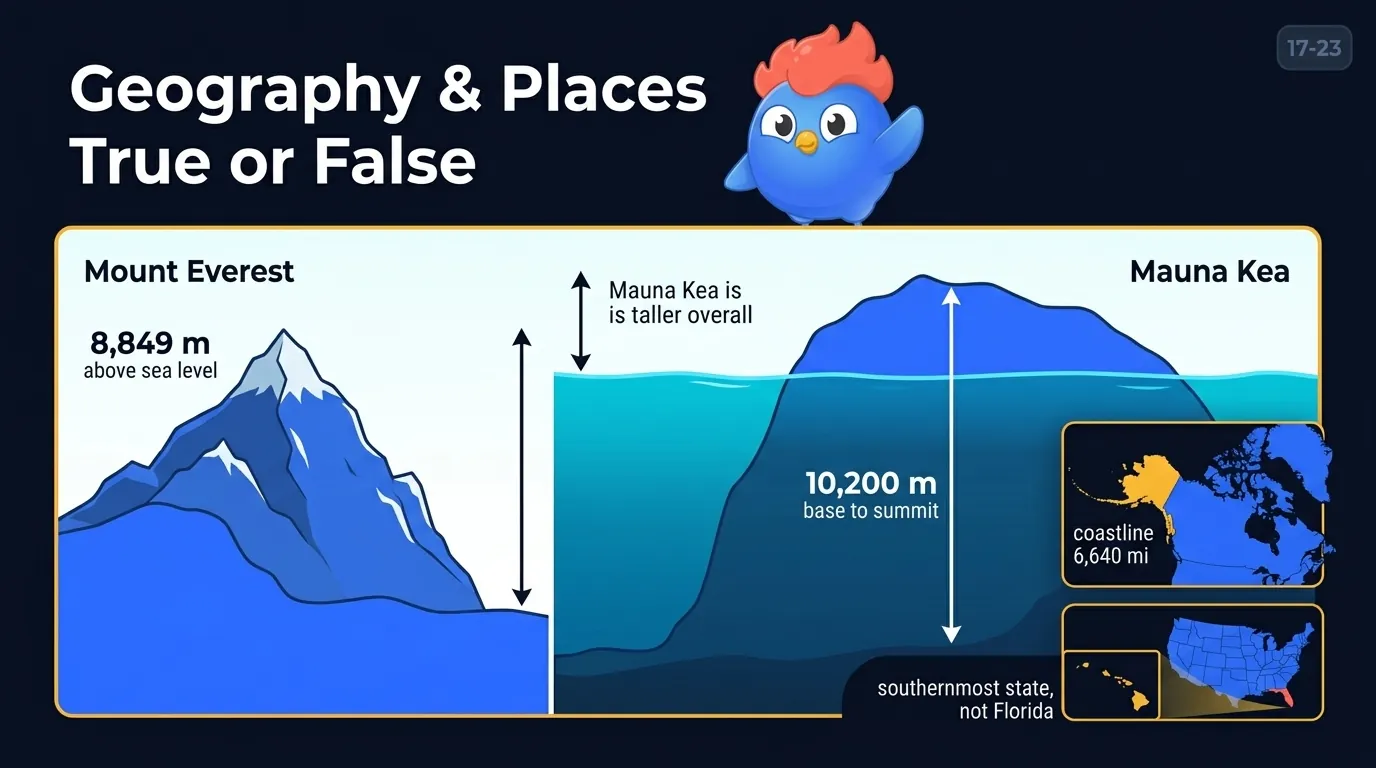 Seven questions where the classroom fact is only half the story.
17. Mount Everest is Earth’s tallest mountain from base to summit. Medium
Answer: False. Mauna Kea runs about 10,200 meters from its base on the seafloor to its summit. Everest wins only when you measure from sea level, at 8,849 m.
One word does all the work. “Tallest” and “highest” are different questions, and Everest answers only the second one, because a mountain measured from sea level gets no credit for the nearly 6,000 meters of itself sitting below the waterline. Mauna Kea shows 4,207 m above the ocean. It reads as a hill.
18. Alaska has a longer coastline than the rest of the US combined. Medium
Answer: True. By NOAA’s general-coastline measure, Alaska runs about 6,640 miles against roughly 5,700 for every other coastal state added together. Coastline numbers swing wildly with the measuring method (NOAA’s finer tidal-shoreline figures are many times larger for every state), but Alaska keeps the lead under either ruler.
California and Florida feel like they should carry this. They are not close. Alaska’s fjords, inlets and island chains fold its edge back on itself thousands of times over, and a folded coast measures far longer than a smooth one covering the same stretch of map.
19. Africa is larger than the United States, China, India, and most of Europe combined. Easy
Answer: True. Africa covers about 30.37 million km². The United States, China, India and Western Europe together land under 30 million.
Blame the map on the wall. Mercator stretches the poles and squashes the equator, which is why Greenland turns up looking like Africa’s twin on a projection where Africa is about fourteen times the larger of the two.
20. The Sahara is the world’s largest desert. Hard
Answer: False. Antarctica is the largest desert at roughly 14 million km². Deserts are defined by precipitation, not temperature.
The threshold is 250 mm of precipitation a year, and the Antarctic interior clears it without trying. Sand appears nowhere in the definition. The Sahara holds the record for the largest hot desert, which is the version that stuck.
21. The southernmost point of the United States is in Florida. Medium
Answer: False. Ka Lae, on the island of Hawaii, sits at about 18.9° north. Key West is at 24.5°, some 390 miles farther up.
Key West has the buoy, the photo queue and the souvenir economy, and it is genuinely the southernmost point of the contiguous states, which is a real distinction and not the one most visitors think they are photographing. Hawaii takes the title among the fifty states. Counting territories, the southernmost point of the US is Rose Atoll in American Samoa, well south of the equator.
22. Canada has more lakes than the rest of the world combined. Medium
Answer: True, with a caveat. Counting lakes larger than 10 hectares, Canada holds roughly 62% of the world’s total, more than everywhere else combined. Count every pond, though, and the global total runs into the tens of millions with Canada nowhere near a majority, which is why Snopes rates the unqualified version false.
Finland sells itself as the land of a thousand lakes. Russia is enormous. Neither comes close, because the answer is geological rather than territorial: the ice sheets scraped the Canadian Shield down to bare rock, then melted and left water sitting in every hollow they had gouged.
23. There are more trees on Earth than stars in the Milky Way. Hard
Answer: True. A 2015 Nature study put the global tree count near 3 trillion. Estimates for the Milky Way run between 100 and 400 billion stars.
Stars feel uncountable. Trees do not, so the comparison sounds rigged before you start. Then better satellite and ground-survey data in 2015 pushed the global tree estimate up roughly sevenfold, and the answer flipped.
For more in this category, see 43 geography trivia questions.
Animals & Biology True or False (Questions 24-31)
Picture books and field biology part ways here. Eight statements on hippo buoyancy, mosquito diets, polar bear skin, and a shark that may have been swimming while Queen Anne was on the throne.
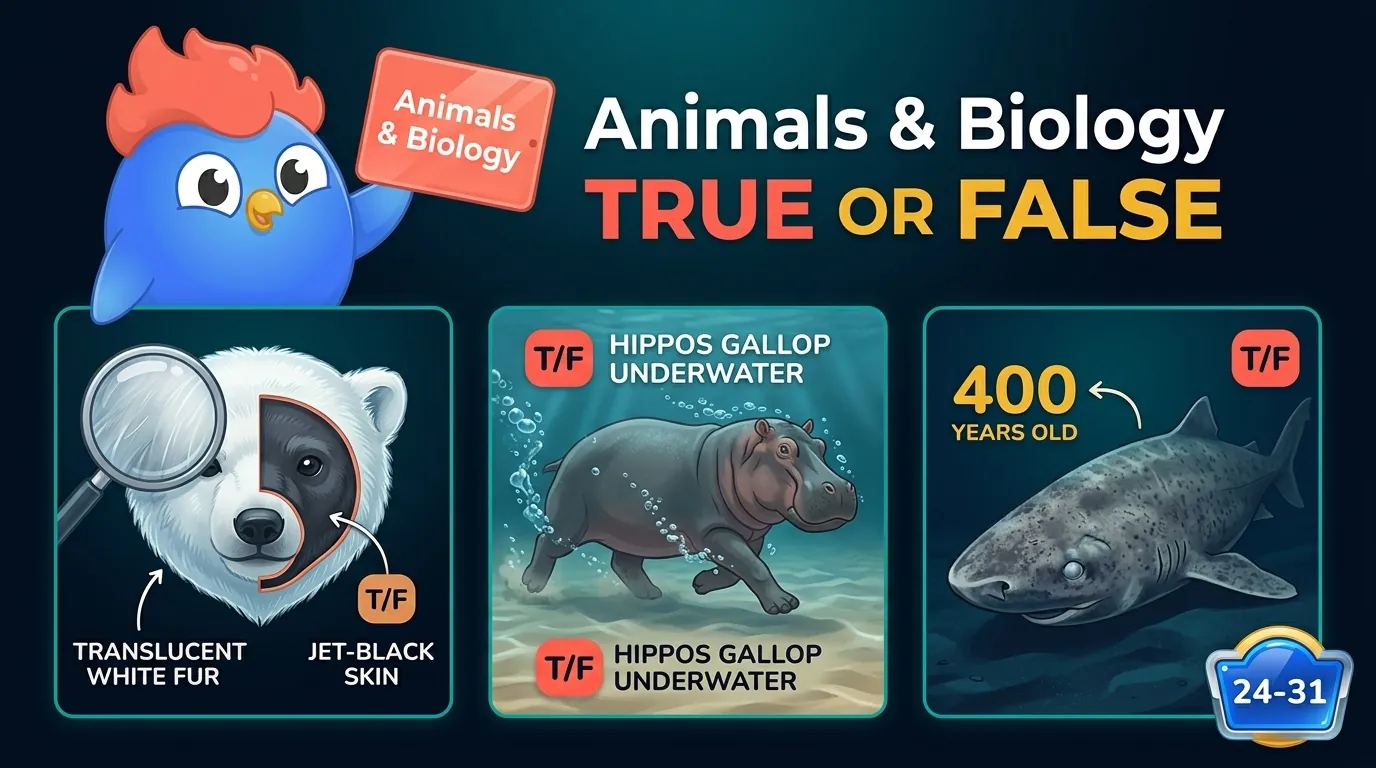 Eight questions that break the cartoon version.
24. Hippos can swim. Medium
Answer: False. Hippos are too dense to float. They walk and gallop along the riverbed, pushing off the bottom to surface for air.
They spend most of the day in water, so swimming is the natural assumption. Calves can float a little. Adults sink, and every viral clip of a “swimming” hippo is a hippo bouncing.
25. Only female mosquitoes bite humans. Easy
Answer: True. Only females take blood, and they need it to develop eggs. Males live on nectar and plant sap.
When a species is this irritating you assume all of it is guilty. The same split runs through most blood-feeding insects.
26. Polar bears have black skin under their fur. Medium
Answer: True. The skin underneath is black. It is often said to help absorb heat, though over the thickest parts of the coat almost no sunlight reaches the skin, so how much warmth that buys is still argued. The fur looks white because each hair is a hollow, pigment-free tube that scatters light.
A white animal ought to have white skin, and the polar bear runs that expectation in reverse: pigment-free scattering at the surface, a fully dark layer underneath.
27. Bats are blind. Easy
Answer: False. Most bats see about as well as other mammals, and fruit bats see very well indeed.
Echolocation got so famous that “bats use sonar” quietly became “bats cannot see”, and the phrase “blind as a bat” sealed it. They use both systems and switch depending on conditions.
28. Bulls charge because they hate the color red. Medium
Answer: False. Cattle are dichromats with no cone for red, so the muleta reads to a bull as a moving shape in muddy yellow-grey.
Swap the cape for blue or white and the bull still charges whatever moves. The red is a choice made for the crowd, and traditionally for hiding blood.
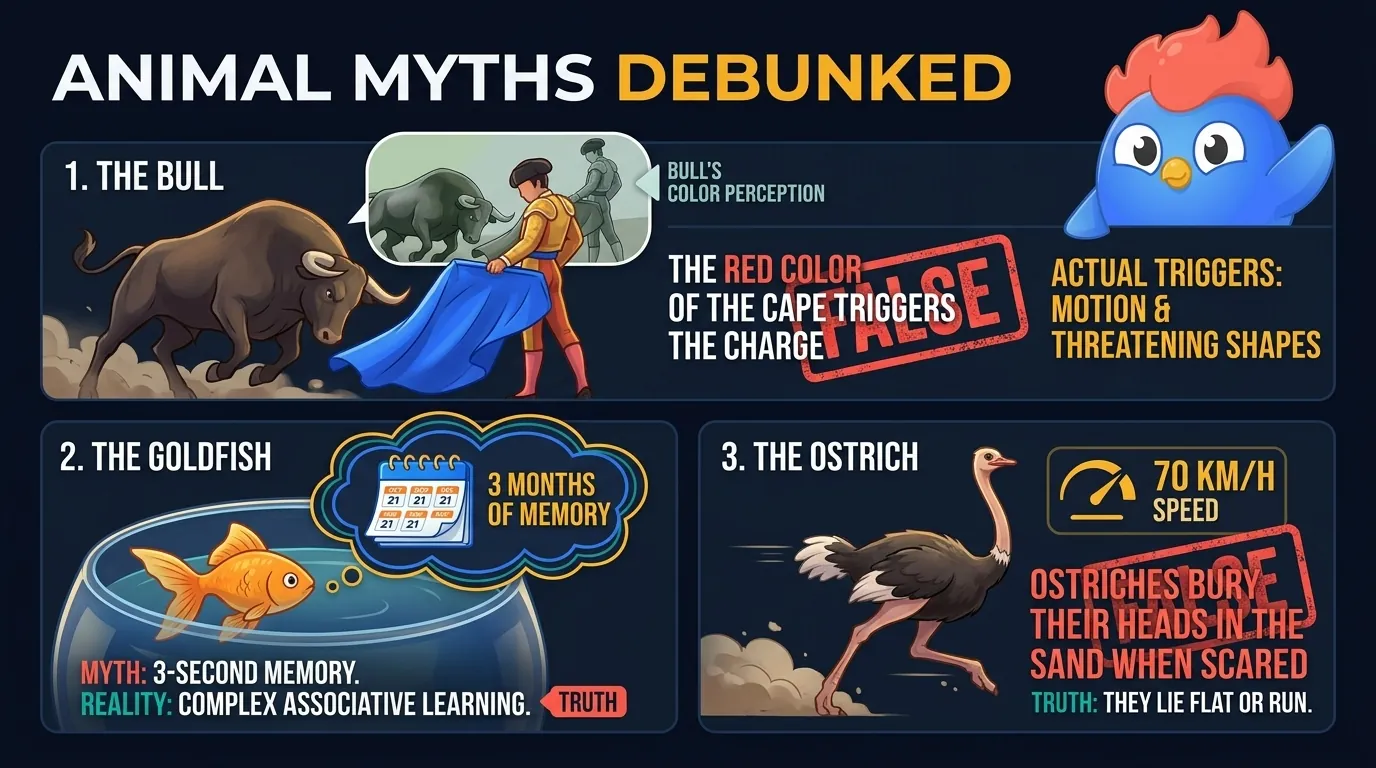 Bulls and color, goldfish memory, and the ostrich legend.
29. Goldfish have a memory span of only three seconds. Easy
Answer: False. Goldfish hold learned associations for months. They have been trained to run mazes, respond to colored cues, and recognize individual faces.
The three-second line traces back to nothing in particular. It is a comforting myth if you ever kept one in a bowl the size of a mug.
30. Greenland sharks can live over 400 years. Hard
Answer: True. A 2016 Science paper radiocarbon-dated one specimen’s eye lens at about 392 years, give or take 120, making Greenland sharks the longest-lived vertebrates known.
Tortoises and whales get the reputation. The shark wins by growing roughly a centimeter a year in water barely above freezing, which is less a lifespan than a very slow schedule.
31. Ostriches bury their heads in the sand when scared. Easy
Answer: False. They lower their heads to turn eggs in the nest or to feed. When something frightens them they run, at up to 70 km/h.
Pliny the Elder wrote something close to this in the first century and it hardened into a proverb about denial. The bird also kicks hard enough to end an argument.
If prehistoric life is your thing, check our 49 dinosaur trivia questions or 47 animal trivia questions.
Pop Culture, Movies & TV True or False (Questions 32-38)
This is where the Mandela effect sets up shop: a false memory shared so widely that the correction is the thing that feels wrong. Seven statements on misquoted films, misremembered logos, and a genie movie that does not exist.
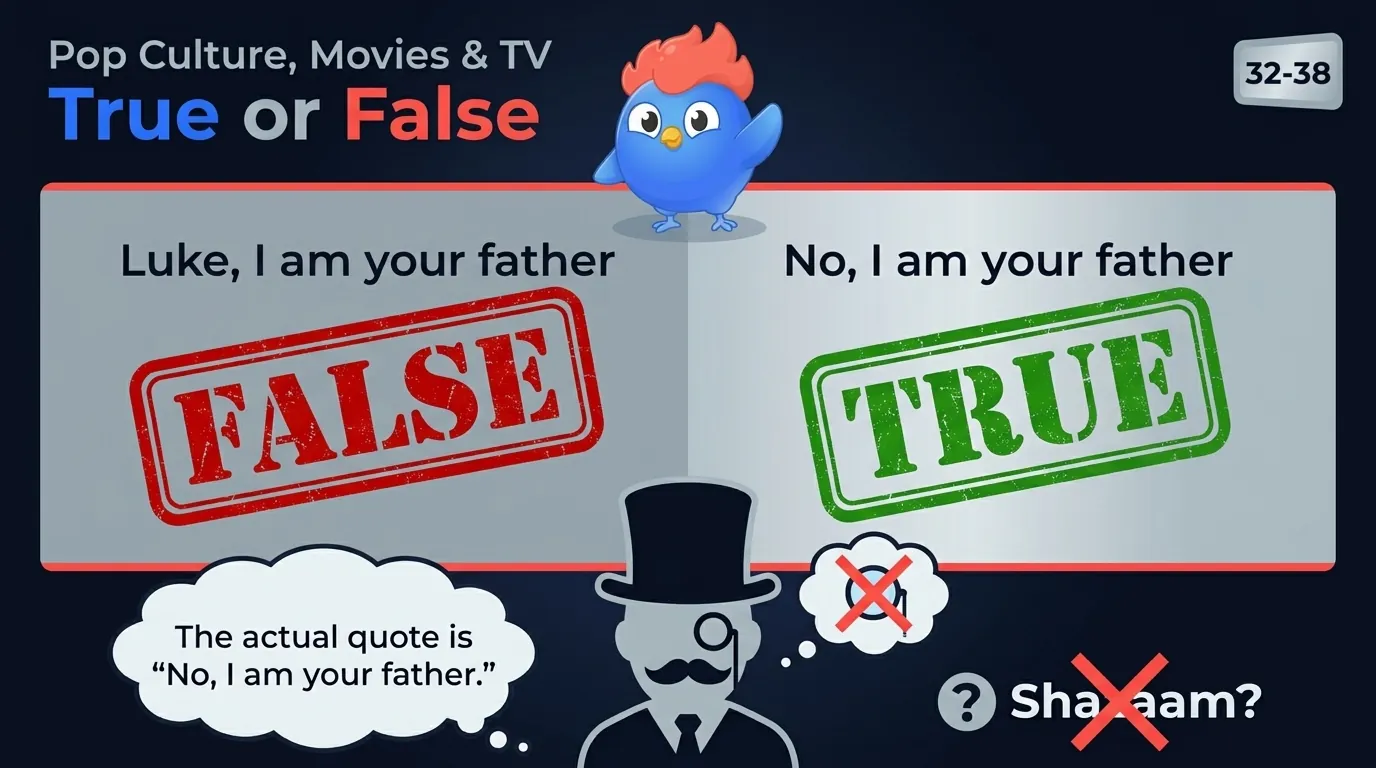 Seven questions where collective memory fails everyone at once.
32. Darth Vader says “Luke, I am your father” in The Empire Strikes Back. Easy
Answer: False. The line is “No, I am your father.”
Out of context it makes no sense without the name, so parodies bolted “Luke” on and the parody outlived the original. It is the cleanest Mandela effect in English: millions of people holding the same memory in the same wrong detail.
33. Comedian Sinbad starred in a 1990s genie movie called Shazaam. Medium
Answer: False. No such film was made, and Sinbad has said so on camera more than once.
Two real things sit underneath it. Shaquille O’Neal played a genie in Kazaam in 1996, and Sinbad once hosted an afternoon movie block wearing a turban as a joke. Stitch those together and the brain supplies a poster.
34. Mickey Mouse has four fingers on each hand, not five. Easy
Answer: True. Four fingers was a 1928 production decision, cheaper to draw and easier to read at speed.
Hardly anyone has counted. Disney later said the missing finger, multiplied across tens of thousands of drawings, had saved the studio millions, and nearly every classic cartoon character inherited the convention.
35. The Monopoly man wears a monocle. Medium
Answer: False. Rich Uncle Pennybags has the top hat, the mustache and the cane. No monocle.
Mr. Peanut wears the monocle. Both get filed under one mental heading, something like “old-timey rich cartoon man”, and the eyewear migrates across.
36. Sean Connery wore a toupee in most of his James Bond films. Hard
Answer: True. He was balding by his early thirties, and Bond historians generally date the first hairpieces to Goldfinger in 1964, with Dr. No and From Russia with Love styled to hide the thinning instead.
Connery is the template for the character’s whole air of effortlessness, so a hairpiece reads as a betrayal of it. Half the leading men of the period sat in the same chair.
37. Kendrick Lamar has won a Pulitzer Prize. Medium
Answer: True. He won the 2018 Pulitzer Prize for Music for DAMN., the first artist from outside classical and jazz to take it.
The music prize had existed for roughly 75 years by then without once leaving those two traditions. A hip-hop album breaking through felt improbable enough that plenty of his own fans still have not heard about it.
38. Fortune cookies originated in China. Easy
Answer: False. They were popularized in California in the early 1900s, most likely by Japanese bakers in San Francisco and Los Angeles.
They arrive at the end of a Chinese-American meal, so the origin label follows the cuisine. In China itself they stayed obscure until an American company tried selling them there in the 1990s.
Related spokes in this cluster: 43 movie trivia questions, 53 TV trivia questions, and 43 music trivia questions.
The Human Body True or False (Questions 39-46)
Playground science hardens into adult conviction in this category. Eight statements on brain usage, hair growth, shaving, and the spider figure that refuses to die.
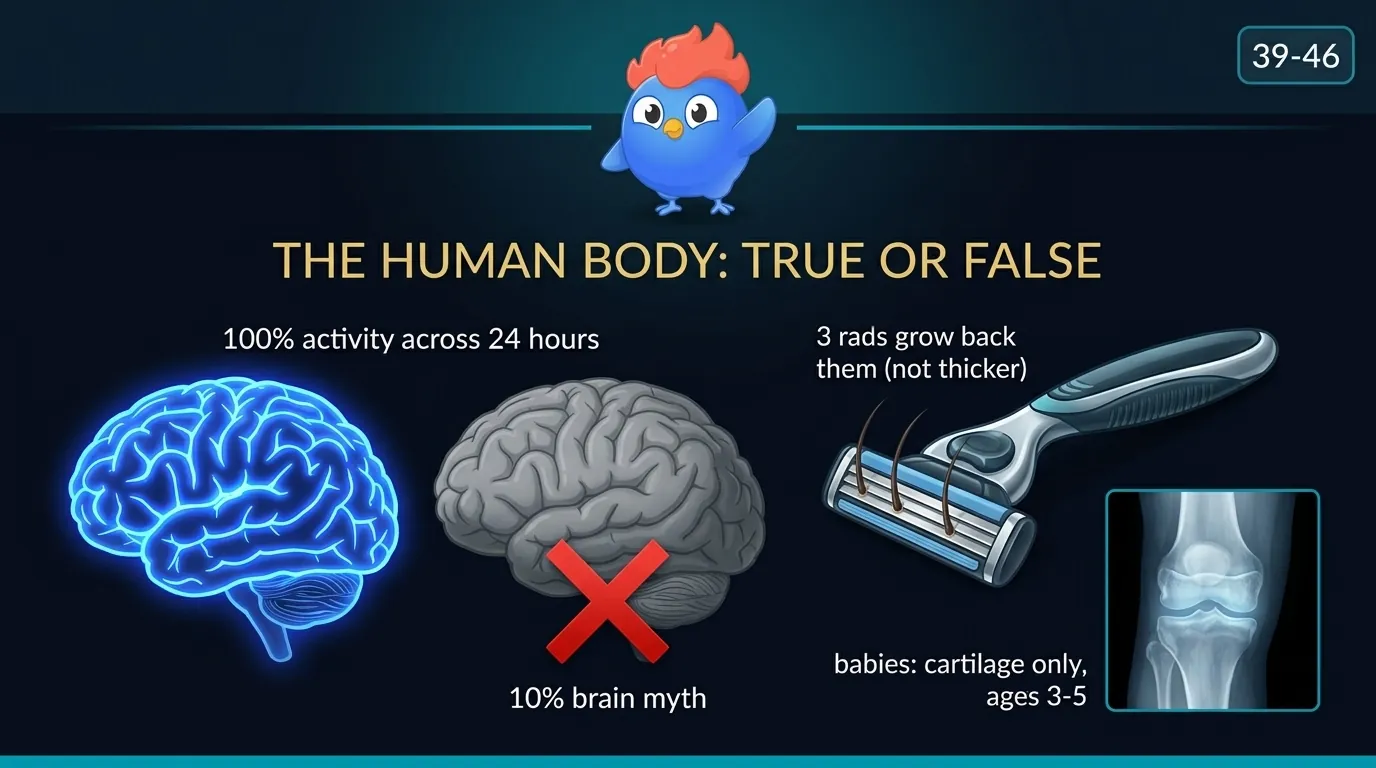 Eight statements that survived middle school science and should not have.
39. Humans only use 10% of their brain. Easy
Answer: False. Functional imaging shows activity across essentially the whole brain over the course of a day, including during sleep.
Self-help books and films like Lucy have sold the 10% line for decades while neurologists have been taking it apart for close to a century. The brain runs on roughly a fifth of your daily energy budget, and an organ that expensive does not carry 90% dead weight.
40. The average person swallows 8 spiders a year in their sleep. Easy
Answer: False. There is no source for the number, and no study has ever counted anything of the kind. Spiders have no reason to approach a large, warm, breathing, vibrating face.
The origin story is better than the myth. For years the claim was said to come from a 1993 PC Professional column by a writer named Lisa Birgit Holst, who supposedly invented it to demonstrate how fast a fake fact travels by email. That column does not exist either.
Snopes ran the Holst story in 2001 as a deliberate troll, and the name is an anagram of “this is a big troll”. A fabricated debunking of a fabricated statistic then spread further than the statistic did.
41. Hair and nails keep growing after death. Medium
Answer: False. Skin retracts as it dehydrates, exposing more of the hair shaft and nail. Growth needs living cells producing keratin.
The forensic anthropologist William Maples set it out in Dead Men Do Tell Tales: the tissue pulls back, the hair does not advance. It is an optical effect, and a convincing one at a viewing.
42. Shaving makes hair grow back thicker. Easy
Answer: False. A razor cuts the shaft at an angle and leaves a blunt tip, which feels coarser as it grows out. The follicle is untouched.
Regrowth is stubbly, darker against the skin and scratchier under a fingertip, and all three sensations get read as “thicker”. Studies going back to the 1920s find no change in thickness, density or color.
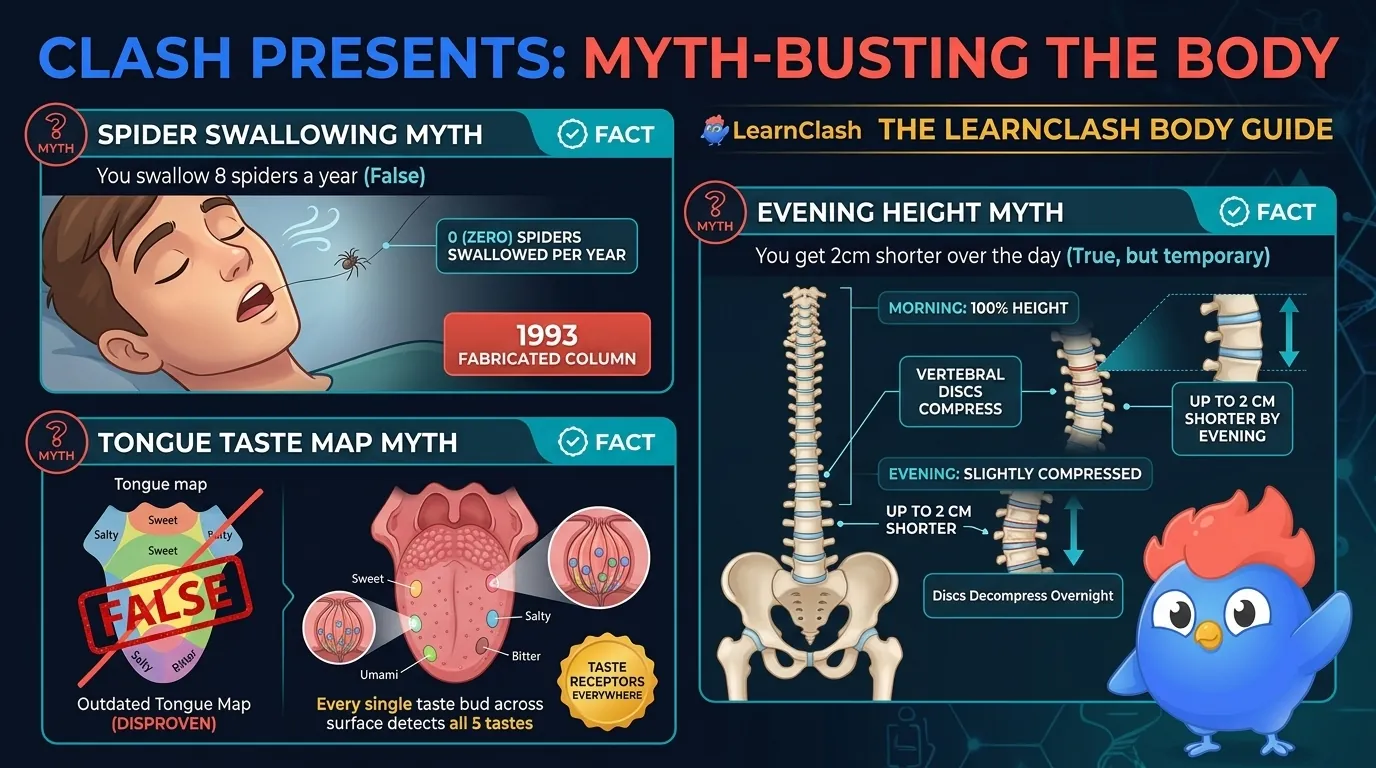 The spider count, the tongue map, and daily height variation.
43. Cracking your knuckles causes arthritis. Medium
Answer: False. Donald Unger cracked the knuckles of his left hand and not his right for about 50 years, found no difference between them, and collected an Ig Nobel Prize in medicine for it in 2009.
The sound is gas coming out of solution in the joint fluid. The warning survives because parents needed a reason for a habit that annoyed them.
44. Babies are born without kneecaps. Hard
Answer: True, with a caveat. Babies have cartilage where the bony kneecap will be. The ossification center appears around ages 3 to 5, and the patella is not fully bone until adolescence.
An X-ray of a newborn knee shows an apparent gap, which is where “no kneecaps” comes from. The structure is there, just soft, and that is also why a toddler can drop onto both knees all day without consequence.
45. Your tongue has separate regions for sweet, sour, salty, and bitter. Hard
Answer: False. Every taste bud responds to all five basic tastes. The map comes from Edwin Boring’s 1942 reworking of a 1901 German study by D. P. Hänig, which had only found small differences in sensitivity across the tongue.
The diagram is clean, memorable and wrong, which is a hard combination to dislodge. It still turns up in textbooks and on the occasional restaurant menu.
46. You are taller in the morning than at night. Medium
Answer: True. You lose roughly 1 to 2 cm across a day as the discs in your spine compress, and get it back overnight.
Height feels like a fixed number you write on a form. The discs are largely water, and a day of standing squeezes some of it out. Astronauts gain several centimeters in orbit running the same process in reverse.
Food, Language & Everyday Life True or False (Questions 47-53)
These are the assumptions nobody audits, because nothing in daily life ever forces the check. Seven statements about tomatoes, peanuts, strawberries, honey, and two words that reliably start arguments.
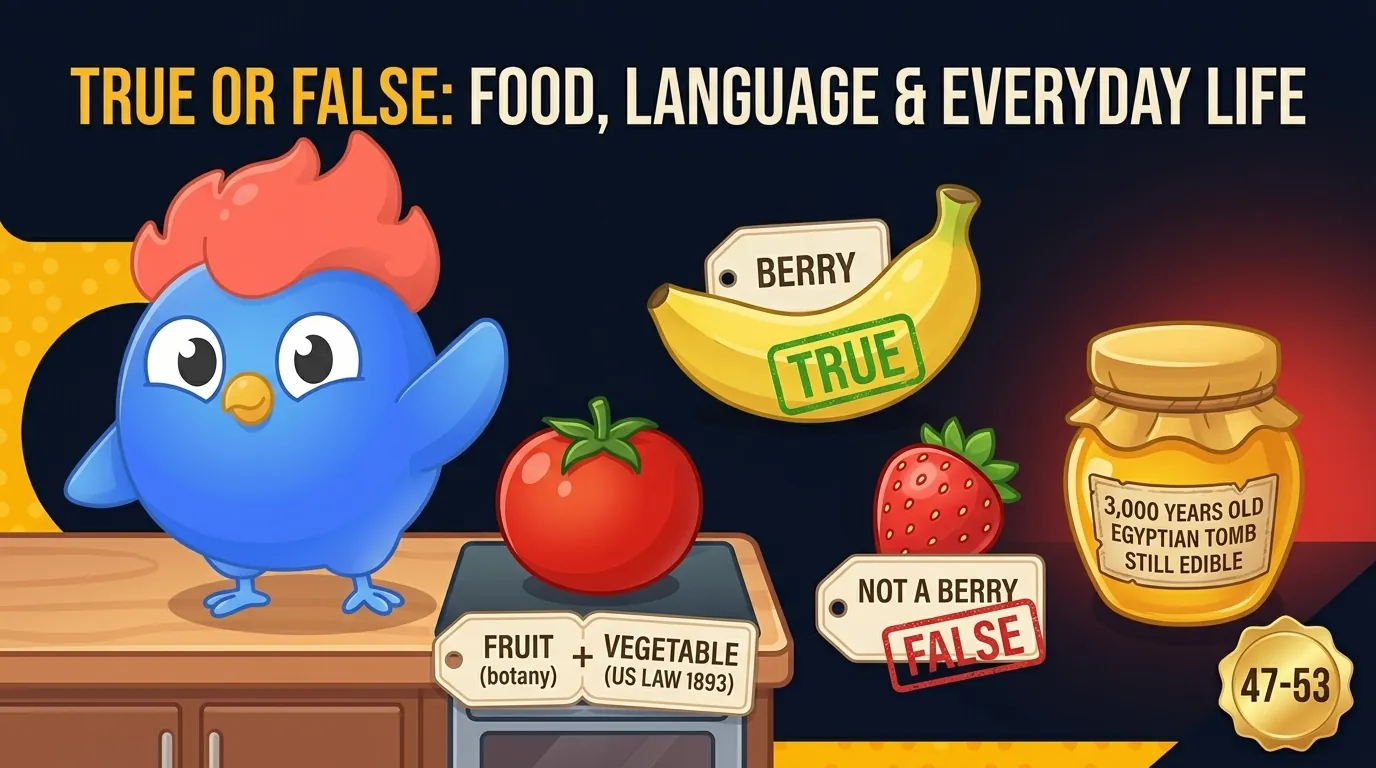 Seven questions where the grocery store and the botany textbook disagree.
47. For US tariff purposes, tomatoes are legally vegetables. Medium
Answer: True. In Nix v. Hedden (1893) the US Supreme Court ruled that tomatoes counted as vegetables for tariff purposes, while conceding they are botanical fruits.
Both systems are right inside their own rules. The Court decided on how people cook and serve them rather than on floral anatomy, because the tariff schedule turned on ordinary usage.
48. Peanuts are a type of nut. Easy
Answer: False. Peanuts are legumes, related to beans, peas and lentils.
The name ends in “nut” and the bag sits next to the almonds, which is the whole basis of the belief. Peanuts ripen underground in pods. Almonds and walnuts grow on trees.
49. Bananas are berries, but strawberries are not. Hard
Answer: True. A botanical berry develops from a single ovary of one flower, which a banana does. A strawberry is an aggregate accessory fruit, built from a swollen receptacle carrying many tiny ovaries.
Size and visible seeds feel like they ought to decide it, and botany ignores both. Avocados are berries by the same rule. Raspberries are not.
50. Honey never spoils if stored properly. Medium
Answer: True. Sealed honey has very low water content and enough acidity to make life difficult for microbes. Jars recovered from Egyptian tombs, roughly 3,000 years old, have been reported still edible.
“Never” is a strong word for a foodstuff, which is why this one draws challenges. Worth flagging that the tomb-honey story is repeated far more often than it is documented. The chemistry is the solid half of the claim.
51. Eskimos have hundreds of words for snow. Medium
Answer: False. Inuit and Yupik languages build words from roots plus suffixes, so a small set of snow roots generates many forms, roughly the way English gets snow, snowy, snowdrift, snowstorm and snowflake out of one word.
Franz Boas mentioned four roots in 1911. Each retelling inflated the count until “hundreds” became folklore, and the linguist Geoffrey Pullum eventually named the whole affair the great Eskimo vocabulary hoax.
52. The word “gullible” is not in the dictionary. Easy
Answer: False. It is in every major dictionary, defined roughly as easily persuaded to believe something.
The joke only works because checking is the punchline. That half-second of hesitation before you look it up is the mechanism this entire page runs on.
53. “Irregardless” is a real word. Hard
Answer: True, technically. Merriam-Webster lists it, labeled nonstandard, with citations going back to 1795.
Style guides have warned against it for a century and descriptive dictionaries record what people actually say. Both camps are answering different questions, which is why the argument never resolves.
For more in this space: 43 food trivia questions and 43 general knowledge questions.
Mixing True or False Into a Quiz Night
Pure true or false rounds go flat fast. The format is quick and low-stakes, and that is also its weakness, because a room can coin-flip its way through twenty statements without engaging with a single one. Roughly one true or false statement per three other questions keeps the pace up without letting the guessing take over.
Read the reason out loud after each answer. That is the part that does the work and the part most quiz sheets skip. A player who hears why the Coriolis effect never reaches a toilet bowl keeps it; a player who hears “false” and nothing else keeps nothing.
In a classroom the 50/50 structure is the whole point. It lowers the cost of being wrong, so students commit to an answer instead of sitting the round out, and pairing each statement with a follow-up “why” turns the exercise into a discussion rather than a scoreboard.
LearnClash automates the same loop. It runs four-option questions rather than true or false, and a question you get wrong comes back on a short cycle while a question you have mastered drops out of the review pool entirely. That is the one thing a printed quiz sheet cannot do: put the correction in front of you again, on purpose, before it fades.
For a themed round in the same spirit, start with the 5 Bible misconceptions almost everyone repeats, or browse the rest of the trivia hub.
Why the False Ones Are Harder to Write
A true statement needs one good source. A false one needs a guarantee that it is wrong under every reasonable reading, which is a much bigger promise, and in our own question sweeps the most frequent defect is not an incorrect answer but a wrong option that turns out to be defensible: a rattlesnake flag question where one of the wrong flags also has a rattlesnake on it, a handwriting-app question where the wrong brand is made by the same company as the right one. So if a false statement on this list feels uncomfortably plausible, that is the format doing its job, and if one feels obviously fake, that is me not having done the harder half of mine.
Explore more trivia topicsFrequently Asked Questions
What makes a good true or false question?
A good true or false question is plausible in both directions. The false version is usually a misconception that already feels correct, which turns a 50/50 guess into a memory test. The hard part of writing one is guaranteeing the false statement is wrong under every reasonable reading, not just the obvious one.
Are true or false questions easier than multiple choice?
Not necessarily. The guess rate is 50%, but a well-built false statement exploits a belief the player already holds. LearnClash serves four-option questions rather than true or false, and in its July 27, 2026 production export the wrong answers on misconception questions cluster on one option rather than spreading evenly, which is the same effect.
How many true or false questions do you need for trivia night?
Use 15 to 25, mixed in with multiple choice at roughly one true or false statement per three other questions. Pure true or false rounds get predictable fast. For comparison, a LearnClash duel is 18 questions across 6 rounds of 3, one topic per round, and runs about three minutes.
What is the most commonly missed true or false fact?
The claim that humans use only 10% of their brain is among the most widely believed false facts. Functional imaging shows activity across essentially the whole brain over a 24-hour period. The myth survives because it sounds intuitively true and films keep repeating it.
Why do people believe false facts so confidently?
Repetition. Hearing a claim often enough makes it feel familiar, and familiarity gets mistaken for truth. Psychologists call this the illusory truth effect, documented by Hasher, Goldstein and Toppino in 1977. The practical counter is to meet the correction more often than you met the myth.