
Basketball Trivia Questions and Answers [2026 Picks]
53 basketball trivia questions with answers across NBA legends, March Madness, Wembanyama, and Caitlin Clark records. Easy, medium, hard.
How many do you know?
Think of your answer, then reveal it.
Did you know it before revealing the answer?
Read this answer in the articleRound complete
Challenge friends on this topic.
Start a new duel in LearnClash and learn from every answer.
Get LearnClashFree to play on iPhone and Android. No ads.
Try the questions you missed once more.

Someone climbed a ladder to retrieve the ball after every single basket. For fifteen years.
These 53 basketball trivia questions and answers cover more than a century of hoops history, from peach baskets nailed to a Springfield gym balcony in 1891 to Victor Wembanyama’s 12-block playoff game on May 4, 2026. Seven categories: NBA legends, basketball origins, franchise history, draft disasters, March Madness upsets, Olympic controversies, and the WNBA era Caitlin Clark keeps rewriting.
Every answer comes with a short note on why the question trips up even hardcore fans. Test your basketball knowledge in a 3-minute LearnClash duel →
| Section | Questions | Easy | Medium | Hard |
|---|---|---|---|---|
| Questions About Basketball with Answers [Quickstart] | Primer | n/a | n/a | n/a |
| NBA Legends & Records | 1-8 | 2 | 3 | 3 |
| Basketball Origins & Rules | 9-16 | 2 | 3 | 3 |
| NBA Teams & Franchises | 17-23 | 2 | 2 | 3 |
| The Draft & Its Disasters | 24-30 | 2 | 3 | 2 |
| March Madness & College | 31-37 | 2 | 3 | 2 |
| International & Olympic | 38-43 | 2 | 2 | 2 |
| WNBA & Modern Game | 44-53 | 3 | 4 | 3 |
The hardest questions here are not the obscure ones. They are the ones where the true answer sounds wrong: Wilt Chamberlain’s stat lines, 135 straight 16-seed losses, a 28-inch height gap between two teammates. If you want a broader mix before going deep on hoops, start with our 43 sports trivia questions or general knowledge trivia.
Questions About Basketball with Answers [Quickstart]
These are the questions about basketball people ask the most. Each one springs a different trap: sometimes the math doesn’t sound real, sometimes the rule sounds invented, sometimes the record just breaks the league.
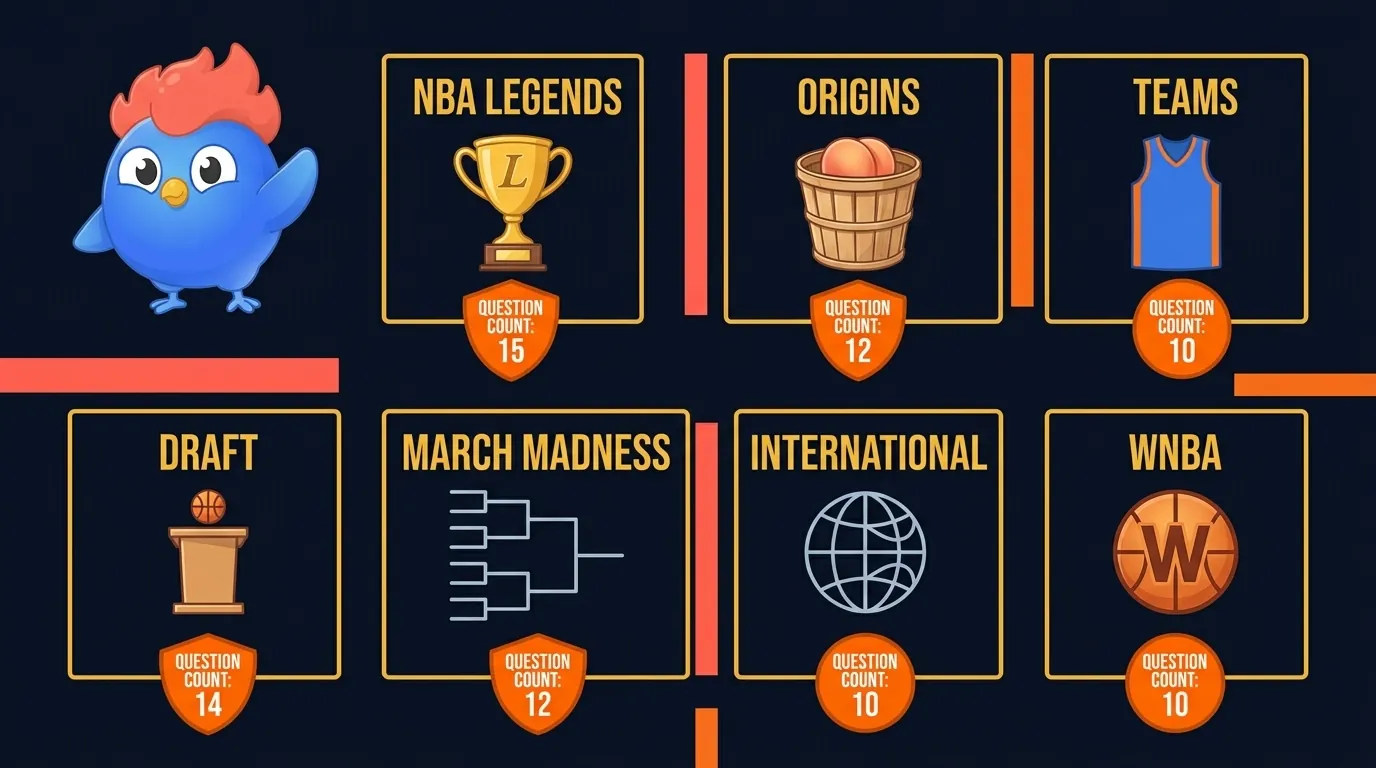 53 basketball trivia questions across 7 categories, from easy icebreakers to hard deep cuts, including 2026 NBA and 2024 WNBA records.
Five starter picks from the 53 below:
- Who scored 100 points in a single NBA game? Wilt Chamberlain, March 2, 1962, Philadelphia Warriors vs New York Knicks. No video exists. (Question 1)
- Why is the basketball hoop 10 feet high? Naismith nailed peach baskets to a Springfield balcony at that height in 1891. The height was never scientifically calculated. (Question 11)
- Who beat a number-one seed first in March Madness? UMBC beat Virginia 74-54 in 2018, ending a 135-game losing streak for 16-seeds. (Questions 32, 33)
- Who set the WNBA single-game assists record? Caitlin Clark, 19 assists vs Dallas, July 17, 2024. (Question 51)
- Who set the NBA single-game playoff blocks record? Victor Wembanyama, 12 blocks vs Minnesota, May 4, 2026. (Question 8)
A great hoops question lands in one of three traps. The number trap (Wilt’s 100, Klay’s 13-for-13 quarter, Wembanyama’s 12 blocks). The rule trap (peach baskets for fifteen years, the dunk banned in college, the shot clock formula). The geography trap (Lakers from Minnesota, Jazz from New Orleans, Yao from Shanghai).
One mismatch to know before you keep score at home: the app never deals two hard questions in the same 3-question round, because at hard-tier accuracy a second one turns the round into a coin flip (the full serving math is in our rating level explainer). This page has no mercy rule: all 18 hard questions are in the list below, and in the app the ones you miss come back on a rising review schedule through the 3-stage SRS loop.
NBA Legends & Records Trivia Questions [1-8]
Big names, everyone knows. The numbers behind them are where things turn ugly. A fan who can name every active roster still freezes the moment a question leans on one of Wilt Chamberlain’s stat lines, because those figures sound physically impossible.
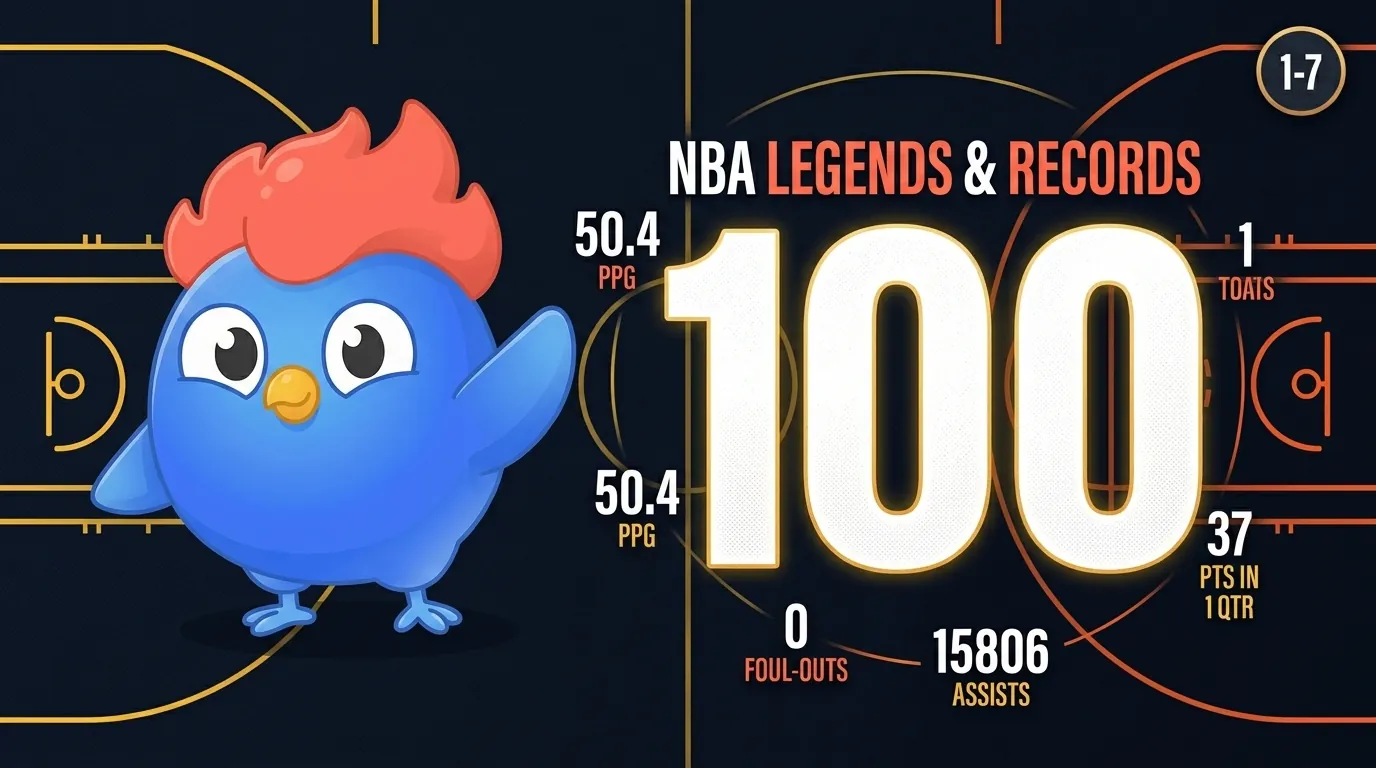 8 NBA legends questions spanning records that have stood for decades, from Wilt’s 1962 100-point game to Wembanyama’s 12-block 2026 playoff record.
1. How many points did Wilt Chamberlain score in his famous record-setting game on March 2, 1962? Easy
Answer: 100 points, for the Philadelphia Warriors against the New York Knicks. He shot 36-for-63 from the field and 28-for-32 from the free throw line.
Everyone knows the number. The part that catches people is this: no video recording of the game exists. The most famous single-game achievement in NBA history was witnessed by about 4,000 fans in Hershey, Pennsylvania, and the only visual proof is a single photograph of Wilt holding a piece of paper with “100” written on it.
2. How many times did Wilt Chamberlain foul out in his entire 14-year NBA career? Medium
Answer: Zero. Across 1,205 regular season and postseason games, Chamberlain never once fouled out, while averaging 45.8 minutes per game for his career.
The number sounds like a typo. A 7’1” center banging bodies under the rim every night for 14 seasons, and he never picked up a sixth foul? Not once? It defies everything you think you know about physical play in the paint.
3. Who is the only NBA Finals MVP to have played for the losing team? Hard
Answer: Jerry West of the Los Angeles Lakers, in the 1969 Finals. He averaged 37.9 points per game in that series, but the Lakers lost to the Boston Celtics in seven games.
The trap is assuming MVP always goes to the winning side. It has in every single Finals since. West opened that 1969 series with 53 points and 10 assists in a Game 1 win, and voters could not ignore the rest of his series either. The irony runs deeper too: his silhouette is widely believed to be the basis for the NBA logo, though the league has never officially confirmed it. His most famous single shot came a year later, a 60-foot heave at the buzzer of Game 3 of the 1970 Finals that forced overtime. The Lakers lost that game anyway. Being Jerry West in the Finals was a cruel job. (For more records that sound made up, see our history trivia questions.)
4. Michael Jordan was picked which number overall in the 1984 NBA Draft? Easy
Answer: Third. The Houston Rockets took Hakeem Olajuwon first. The Portland Trail Blazers picked center Sam Bowie second. Chicago got Jordan at three.
Your gut says first. He’s Michael Jordan. But Portland needed a center, and Bowie was 7’1”. The Blazers have been answering questions about this pick for four decades.
5. What was Wilt Chamberlain’s scoring average during the 1961-62 NBA season? Medium
Answer: 50.4 points per game. He scored 4,029 total points that season. The closest anyone else has ever come is Michael Jordan’s 3,041 in 1986-87, still 988 points short.
Fifty a game, for an entire season. It’s the kind of number that belongs in a video game, not a real stat sheet. Jordan’s legendary 37.1 points per game in ‘86-87 is the best scoring season by anyone since the mid-1960s, and it still sits 13 points a night behind Wilt’s 50.4.
6. Which player scored 37 points in a single NBA quarter without missing a shot? Hard
Answer: Klay Thompson of the Golden State Warriors, on January 23, 2015, against the Sacramento Kings. He went 13-for-13 from the field, including 9 three-pointers, in the third quarter alone. He finished with 52 points.
Thirteen consecutive shots, all makes, in 12 minutes, nine of them from beyond the arc. Call it a hot streak if you want; the math calls it a statistical anomaly. Thompson’s true shooting percentage for that quarter was 133%.
7. John Stockton holds the NBA’s all-time assists record. How far ahead is he of the second-place player? Medium
Answer: Stockton recorded 15,806 career assists. Second place now belongs to Chris Paul, who retired in February 2026 with 12,552. That leaves a gap of 3,254 assists, bigger than many All-Stars’ entire career assist totals.
People know Stockton holds the record. What they miss is that the man who spent two decades chasing it just retired more than three thousand assists short. There is a nice trivia chain hidden in here: the assist that moved Paul past Jason Kidd into second place, in December 2024, was a pass to Victor Wembanyama. With Paul retired, nobody active is anywhere close, and Stockton’s record may genuinely be unbreakable.
8. Who set the NBA single-game playoff blocks record on May 4, 2026? Hard
Answer: Victor Wembanyama of the San Antonio Spurs, with 12 blocks in Game 1 of the Western Conference semifinals against the Minnesota Timberwolves. He finished with 11 points, 15 rebounds, and 12 blocks, and the Spurs still lost 104-102.
The previous record of 10 had stood since 1985, first set by Mark Eaton and later matched by Hakeem Olajuwon (1990) and Andrew Bynum (2012). Wembanyama already had seven blocks by halftime, kept going, and became just the third player in postseason history to log a triple-double that includes blocks, after Bynum and Olajuwon. He was 22, in his third NBA season, and San Antonio went on to reach the Finals that June.
Basketball Origins & Rules Trivia Questions [9-16]
No major sport has an origin story this well documented, or this odd. Peach baskets, a borrowed soccer ball, a shot clock invented with grade-school division, and a college dunk ban that ran almost a decade.
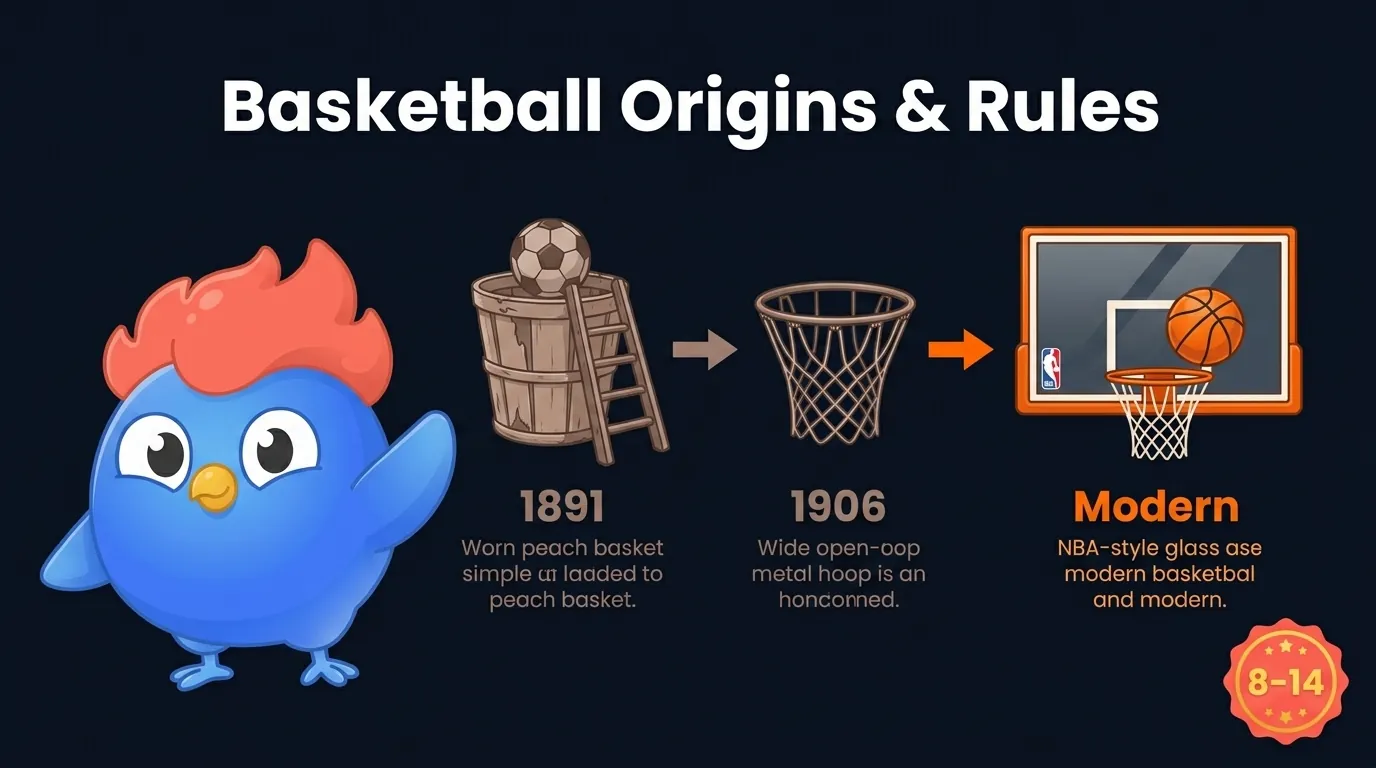 8 origins and rules questions from basketball’s 1891 invention to the modern three-point arc.
9. Who invented basketball, and in what year? Easy
Answer: James Naismith, a Canadian American physical education instructor at Springfield College in Massachusetts, in 1891. He created the game to keep his students active during the cold New England winter.
Naismith’s name doesn’t stick the way you’d expect for someone who invented a sport played by billions. People remember Springfield and blank on the inventor. He wrote 13 original rules, most of which are still recognizable today.
10. What was used as the first basketball? Easy
Answer: A soccer ball. The first purpose-built basketball wasn’t manufactured until 1894, three years after the sport’s invention.
It feels like the answer should be “a custom ball,” but Naismith improvised the entire sport in a few days with whatever the Springfield gym had. The early game looked nothing like modern basketball: no dribbling, no backboards, and a soccer ball lobbed into a peach basket. (If origin stories are your thing, our science trivia questions have a few that hit just as hard.)
11. Why is the basketball hoop exactly 10 feet high? Medium
Answer: It’s an accident. Naismith asked the janitor for two boxes to use as goals. The janitor brought peach baskets instead. Naismith nailed them to the lower railing of the gymnasium balcony, which happened to be 10 feet off the ground.
You’d assume a sport played at every level from elementary school to the Olympics would have a scientifically determined hoop height. Nope. The balcony was 10 feet high. That’s the entire reason, and it has been the standard worldwide for over 130 years because nobody ever changed it.
12. How many years were peach baskets used before open nets replaced them? Medium
Answer: Fifteen years, from 1891 to 1906. During that time, someone had to climb a ladder or poke the ball out with a long stick after every made basket.
A year or two of that sounds plausible. Fifteen years of stopping the game to fish a ball out of a closed basket seems absurd, but the transition to metal hoops with backboards took until 1906. The pace of early basketball must have been glacial: the first public game, in March 1892, finished 5-1.
13. How was the NBA’s 24-second shot clock duration calculated? Hard
Answer: Syracuse Nationals owner Danny Biasone divided 2,880 total seconds in a 48-minute game by 120, the average number of shots both teams took in an entertaining game. The result: 24 seconds per possession, introduced in the 1954-55 season.
The math is elegant and almost nobody knows it. Before the shot clock, teams could hold the ball indefinitely, and the lowest-scoring game in NBA history (see the next question) was the breaking point. Biasone’s formula fixed the sport overnight.
14. What is the lowest-scoring game in NBA history? Medium
Answer: 19-18. The Fort Wayne Pistons beat the Minneapolis Lakers on November 22, 1950. Combined score: 37 points.
George Mikan, the Lakers’ star, scored 15 of his team’s 18 points, so Fort Wayne simply held the ball to keep it away from him. Fans threw coins onto the court in protest, and the game was so unwatchable that it directly led to the shot clock’s invention four years later.
15. Which future Hall of Famer was so dominant that college basketball banned dunking for nine years? Hard
Answer: Lew Alcindor (later Kareem Abdul-Jabbar). The NCAA banned dunking from 1967 to 1976, largely because Alcindor was unstoppable at UCLA. So he developed his famous skyhook instead, which proved even harder to defend.
Banning a core basketball play because one player was too good sounds made up, but the NCAA did exactly that, and it backfired spectacularly. Alcindor’s workaround shot carried him to six NBA championships and the all-time scoring record he held for nearly 40 years.
16. How many three-pointers did Stephen Curry make in the 2015-16 NBA season? Hard
Answer: 402 three-pointers, an NBA single-season record that still stands. He shattered his own previous record of 286, shooting 45.4% from beyond the arc on 11.2 attempts per game.
The closest anyone else has come is James Harden’s 378 in 2018-19, and even that all-out heave season fell 24 makes short. What sells the question is the timeline: the three-pointer didn’t exist in the NBA until 1979-80, and within four decades Curry had redefined what a season of shooting could look like.
NBA Teams & Franchises Trivia Questions [17-23]
Franchises have moved, merged, and vanished more often than most fans realize, and the name stitched on a jersey usually carries a backstory nobody learned.
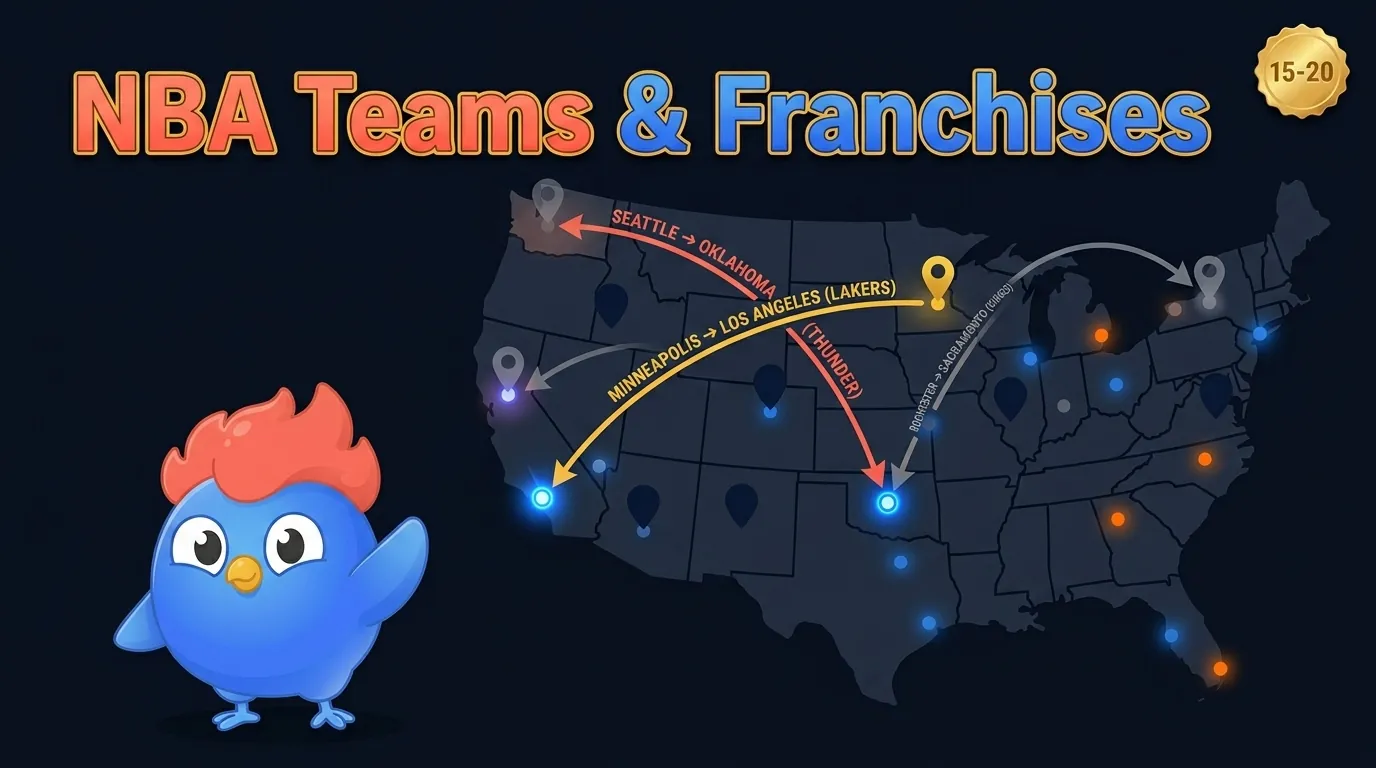 7 team and franchise questions covering relocations, retired numbers, and the all-time tallest-and-shortest teammate pairing.
17. Which NBA franchise has won the most championships? Easy
Answer: The Boston Celtics with 18 titles, most recently in 2024. The Los Angeles Lakers are second with 17.
Lakers fans will fight you on this. The two were tied at 17 apiece until Boston’s 2024 championship over Dallas broke the tie, and the 2026 title went elsewhere entirely: the New York Knicks beat San Antonio for their first championship since 1973. Both leaders’ totals hide a geography wrinkle, too. The Lakers won five of theirs in Minneapolis.
18. Which team holds the longest winning streak in NBA history? Medium
Answer: The Los Angeles Lakers, with 33 consecutive wins during the 1971-72 season. The streak started on November 5, 1971, and ended on January 9, 1972.
Nearly everyone reaches for the 2015-16 Warriors (73-9) or Jordan’s Bulls. But 33 straight wins is a different kind of dominance: the Warriors had the best single-season record, while the ‘71-72 Lakers had the longest run of simply not losing.
19. The Los Angeles Lakers are named after lakes. Which state’s nickname is “Land of 10,000 Lakes”? Hard
Answer: Minnesota. The Lakers were originally the Minneapolis Lakers, founded in 1947. They moved to Los Angeles in 1960 and kept the name, even though LA has no natural lakes worth mentioning.
Younger fans have no idea the Lakers were ever anywhere but LA. It’s one of the most obvious geographic mismatches in sports, and it has company:
The Utah Jazz kept their name after moving from New Orleans in 1979. The Sacramento Kings started as the Rochester Royals. The Atlanta Hawks began as the Tri-Cities Blackhawks. NBA franchise names are a museum of geographic accidents.
20. Which country is home to the only current NBA team outside the United States? Easy
Answer: Canada. The Toronto Raptors have been the sole non-US team since the Vancouver Grizzlies relocated to Memphis in 2001.
The surprise isn’t Toronto. It’s that Vancouver had a team. The Grizzlies played in Canada from 1995 to 2001 before moving to Tennessee, and most fans under 30 don’t know the Grizzlies were ever Canadian.
21. What was the original name of the team now known as the Oklahoma City Thunder? Medium
Answer: The Seattle SuperSonics. The franchise relocated to Oklahoma City in 2008 after 41 seasons in Seattle. The move remains one of the most controversial in NBA history.
OKC fans know the team’s history started with Kevin Durant. Seattle fans know their franchise was taken. Casual fans don’t realize the Thunder and SuperSonics are the same organization. Seattle hasn’t had an NBA team since.
22. Which team has retired the most jersey numbers in professional sports, with 24? Hard
Answer: The Boston Celtics. 24 numbers are permanently off-limits, including Bill Russell’s #6, Larry Bird’s #33, and Paul Pierce’s #34. No team in the NBA, NFL, MLB, or NHL has retired more.
Twenty-four retired numbers means nearly a quarter of the standard 00-99 range is untouchable in Boston. It’s a tribute to the franchise’s depth of history, and a mild logistical headache for every new Celtic picking a jersey.
23. Which NBA franchise once rostered the tallest and shortest active players in the league at the same time? Hard
Answer: The Washington Bullets during the 1987-88 season. Manute Bol stood 7 feet 7 inches, one of the two tallest players in NBA history. Muggsy Bogues stood 5 feet 3 inches, the shortest ever. Same team, same season.
The height gap is 28 inches: standing side by side, Bogues’s head reached roughly Bol’s chest. Bogues is the punchline-proof half of the pairing. He lasted 14 NBA seasons and blocked 39 shots in his career, including one on 7-foot Patrick Ewing in 1993.
NBA Draft & Its Disasters Trivia Questions [24-30]
More front-office regret comes out of the NBA Draft than any other night in pro sports: picks that haunted teams for decades, steals nobody flagged, and dollar figures that read as jokes in hindsight.
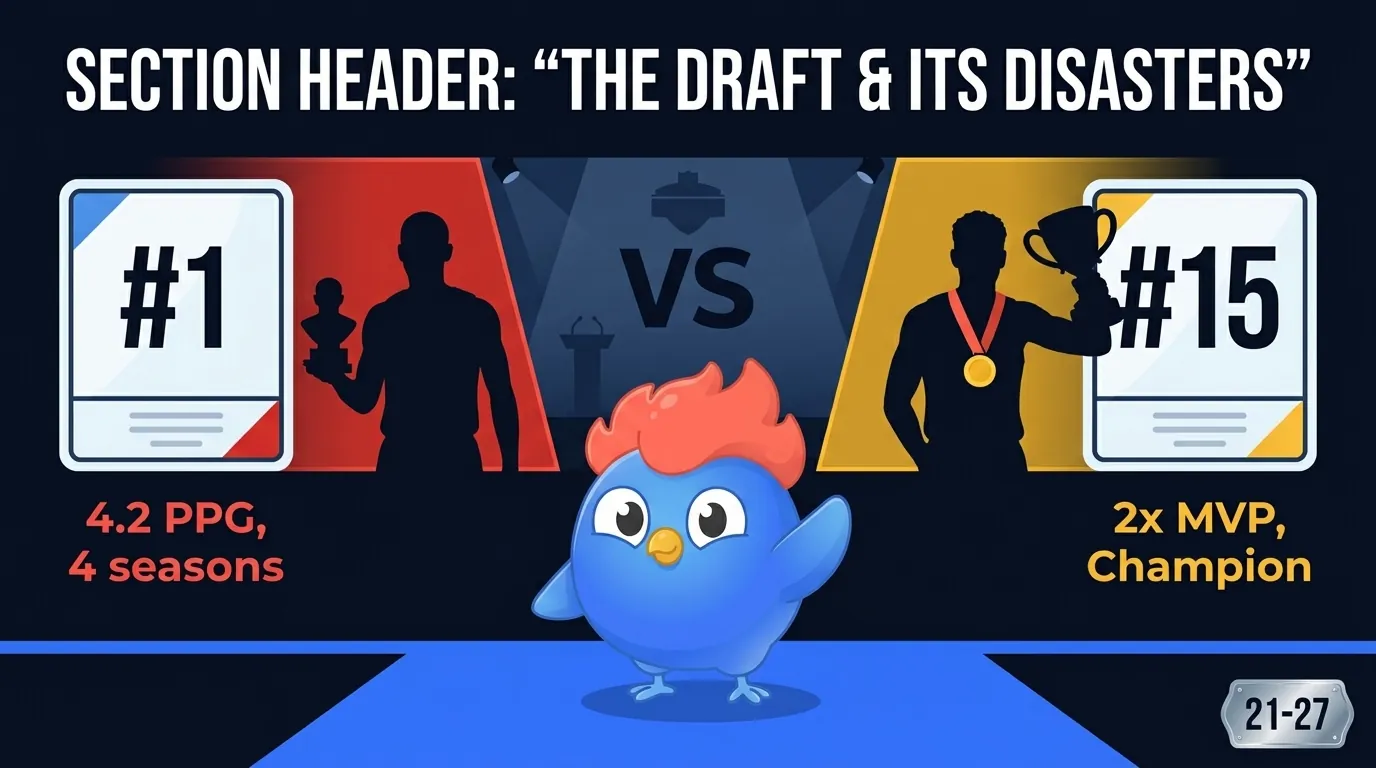 7 draft questions covering busts, steals, and the money behind it all.
24. In the 1984 NBA Draft, which player was selected second overall, one pick ahead of Michael Jordan? Easy
Answer: Sam Bowie, center, picked by the Portland Trail Blazers. Houston took Hakeem Olajuwon first. Chicago grabbed Jordan third.
Olajuwon at number one is defensible; he won two championships. But Sam Bowie over Michael Jordan? Portland needed a center, Bowie was 7’1”, Jordan was a shooting guard, so the Blazers made what seemed like a logical positional pick. Logical, and catastrophic.
25. In the 2003 NBA Draft, LeBron James went first overall. Who was picked second? Medium
Answer: Darko Miličić, selected by the Detroit Pistons. The rest of the top five: Carmelo Anthony (#3), Chris Bosh (#4), and Dwyane Wade (#5).
That 2003 class produced four future Hall of Famers in the top five, and Miličić was not one of them. He averaged 6.0 points per game across his career while Anthony, Bosh, and Wade combined for 34 All-Star selections. Detroit won the 2004 championship, but Miličić barely played.
26. Who is widely considered the worst number-one overall pick in NBA history? Hard
Answer: Anthony Bennett, selected by the Cleveland Cavaliers in 2013. He averaged 4.2 points per game across four NBA seasons on four different teams before washing out of the league entirely.
Four seasons, four teams, a career scoring average below most bench warmers. Scouts had already called the 2013 class weak going in, and Bennett at number one surprised even a weak field: he was the only modern number-one pick who genuinely couldn’t hold an NBA rotation spot.
27. Giannis Antetokounmpo was drafted 15th overall in 2013. What did the number-one pick from that same draft average over his career? Medium
Answer: 4.2 points per game. That was Anthony Bennett. Giannis, picked 14 spots later, became a two-time MVP, Finals MVP, and Defensive Player of the Year.
Before the draft, Giannis was averaging 9.5 points per game in Greece’s second division for Filathlitikos, and no analytics model flagged him as a future MVP. Fourteen teams passed on a generational talent while Cleveland picked the worst bust of all time. The gap between pick 1 and pick 15 from that one draft might be the largest in NBA history.
28. Which NBA legend was drafted by the Charlotte Hornets but never played a game for them? Easy
Answer: Kobe Bryant, picked 13th overall in the 1996 draft. Charlotte traded him to the Los Angeles Lakers for center Vlade Divac before he ever suited up.
Kobe is synonymous with the Lakers: purple and gold, twenty seasons, five championships. The idea that he was technically a Charlotte Hornet doesn’t compute, but the trade was arranged before draft night. Charlotte picked Kobe knowing they’d ship him to LA.
29. Which undrafted player became a 4-time Defensive Player of the Year and was inducted into the Basketball Hall of Fame? Hard
Answer: Ben Wallace. No team drafted him in 1996. He went on to win 4 Defensive Player of the Year awards, make 4 All-Star teams, earn 5 All-NBA selections, and win the 2004 NBA Championship with the Detroit Pistons. He’s the first undrafted player inducted into the Basketball Hall of Fame.
Undrafted players are supposed to be end-of-bench guys. Wallace became the most feared defensive presence in the league: 6’9” with a 7’1” wingspan, built like a linebacker, changing opponents’ shots from 15 feet away. Every team passed on him.
30. What was the first NBA salary cap, and how much was it per team? Medium
Answer: $3.6 million per team in the 1984-85 season. The cap for the 2026-27 season, in effect since July 1, 2026, is $164.961 million, roughly 45 times higher.
The contrast is staggering. LeBron James’s annual salary alone exceeds $50 million; in 1984, that would have covered the full cap of 14 teams. The cap exists to create competitive balance, but four decades of league growth have turned the early numbers into punchlines.
March Madness & College Basketball Trivia Questions [31-37]
Impossible upsets turn into permanent trivia every March. Everyone watches the tournament; almost nobody studies its history, so the numbers behind the upsets blindside people every time. (Prefer your upsets in helmets? Our NFL football trivia runs the same trick.)
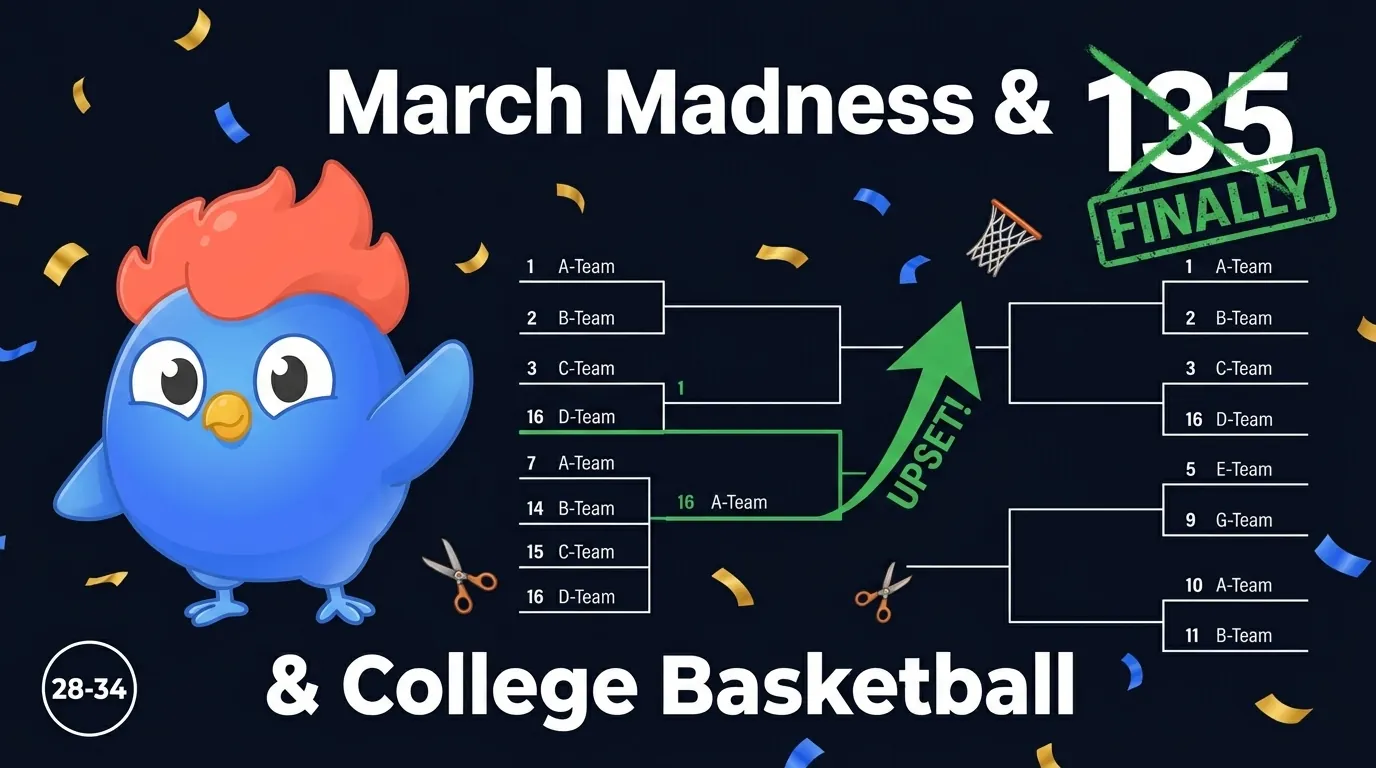 7 March Madness questions from Cinderella runs to records that stood for decades.
31. How many teams compete in the NCAA March Madness tournament? Easy
Answer: 68 teams. The field expanded from 64 to 65 in 2001 (with a play-in game), then to 68 in 2011 with the “First Four” round.
The number 64 is burned into everyone’s brain from decades of bracket pools, so “68” doesn’t feel right. But the First Four has been part of the tournament since 2011. Old habits die hard.
32. For how many years did a 16-seed go without ever beating a 1-seed in the NCAA tournament? Medium
Answer: 33 years. From the 64-team format’s debut in 1985 until March 2018, 16-seeds went 0-135 against 1-seeds before UMBC finally broke through.
The arithmetic: 33 tournaments from 1985 through 2017 produced 132 one-versus-sixteen games, all won by the 1-seed, and the first three matchups of the 2018 round went the same way before UMBC took the floor. People assume upsets happen occasionally at every seed line. They didn’t at this one; the gap was treated as close to biological.
33. When UMBC finally beat a 1-seed in 2018, how close was the game? Hard
Answer: It wasn’t close. UMBC 74, Virginia 54. A 20-point blowout over the tournament’s overall number-one seed, which came in 31-2.
If a 16-seed ever did beat a 1-seed, you’d expect a miracle buzzer-beater. Instead: tied 21-21 at halftime, then a second-half demolition in which a 20.5-point underdog outscored Virginia by 20. The greatest upset in tournament history had no drama in its final minutes at all.
34. Which university has won the most NCAA men’s basketball championships? Easy
Answer: UCLA, with 11 titles. John Wooden coached 10 of those, including 7 in a row from 1967 to 1973. Kentucky is second with 8.
Duke and Kentucky get all the modern attention, but UCLA’s dynasty under Wooden is something no program has come close to matching: seven consecutive national titles, plus an 88-game winning streak that is still the men’s Division I record.
35. Who holds the record for most points scored in a single NCAA tournament game? Medium
Answer: Austin Carr of Notre Dame, with 61 points against Ohio University in the first round of the 1970 tournament. He averaged 52.7 points per game across three tournament games that year.
Austin Carr isn’t a household name, which is exactly why the question works. Sixty-one points in a tournament game has never been matched (the runner-up is 58), and it happened before most current fans were born.
36. How many total attempts did 16-seeds make against 1-seeds before finally winning? Hard
Answer: 135. Thirty-three tournaments (1985-2017) at four matchups each is 132 losses, and the first three 1-vs-16 games of 2018 made it 135 before UMBC beat Virginia. Fairleigh Dickinson added the second 16-over-1 upset in 2023 against Purdue.
One hundred thirty-five failures reads like a law of nature rather than a streak, right up until the night it broke. Through the 2026 tournament, 1-seeds stand 162-2 against 16-seeds.
37. Which 15-seed pulled off a famous upset in their tournament debut, earning the nickname “Dunk City”? Medium
Answer: Florida Gulf Coast University (FGCU), who beat second-seeded Georgetown 78-68 in their first-ever NCAA tournament appearance in 2013. Their high-flying, fast-break style earned them the “Dunk City” label.
FGCU had never played in the tournament before and weren’t supposed to be competitive, let alone dominant. Their athleticism overwhelmed Georgetown’s structured approach, and they beat San Diego State in the next round to become the first 15-seed ever to reach the Sweet Sixteen.
International & Olympic Basketball Trivia Questions [38-43]
Over 200 countries play the game, yet its Olympic history still sparks diplomatic tension decades on, from the Dream Team to a set of silver medals sitting unclaimed in a Swiss vault. (For the full sweep of Olympic legends, records, and the LA 2028 preview, see our Summer Olympics trivia questions guide.)
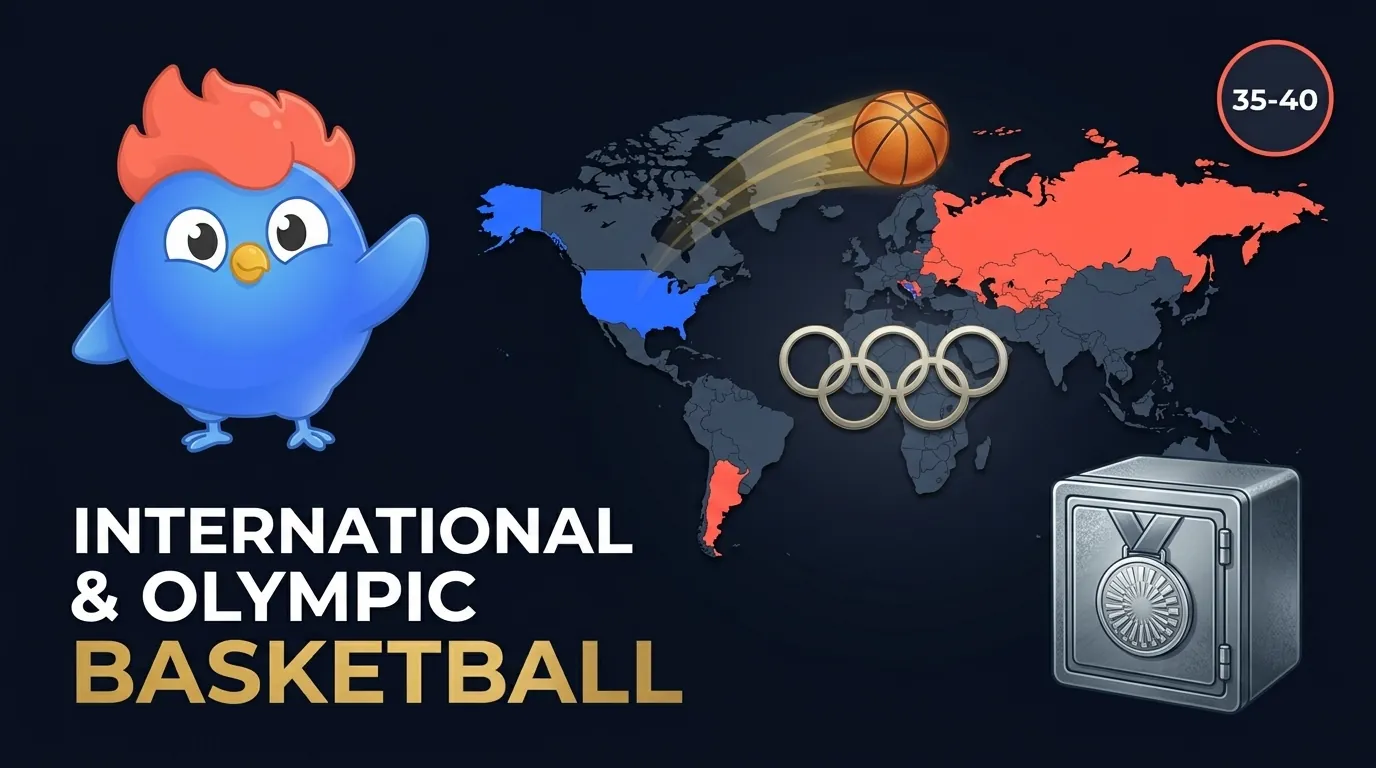 6 international and Olympic basketball questions spanning global records and controversies.
38. How many Olympic gold medals has the United States won in men’s basketball? Easy
Answer: 17 gold medals as of the 2024 Paris Olympics, including five straight from 2008 through 2024. The US has dominated the event since basketball was introduced in 1936.
That is 17 of the 21 men’s Olympic basketball tournaments ever played. The US has failed to win gold only four times (1972, the 1980 boycott, 1988, and 2004). No other country has more than the Soviet Union’s two.
39. In what year did NBA players first compete in the Olympics? Medium
Answer: 1992, at the Barcelona Games. The “Dream Team” featured Michael Jordan, Magic Johnson, Larry Bird, and Charles Barkley. They won every game by an average of 43.8 points.
The assumption is that NBA stars always played. But before 1992, Olympic basketball was restricted to amateurs, and college players represented the US. The Dream Team’s arrival was so overwhelming that opponents asked for autographs and photos. Our 90s trivia questions cover more from that era.
40. The 1972 Olympic gold medal basketball game between the USA and USSR is infamous. What happened? Hard
Answer: With three seconds left and the US leading 50-49, the clock was controversially reset twice, giving the USSR a third chance to inbound. On the final attempt, Alexander Belov caught a full-court pass and scored. The USSR won 51-50. The US team refused their silver medals in protest.
This is one of the most disputed moments in Olympic history, and most people under 50 have never heard of it. The silver medals remain in a vault in Lausanne, Switzerland. No member of the 1972 US team has ever accepted them.
41. Giannis Antetokounmpo represents Greece internationally. Where was he born, and what is his parents’ country of origin? Easy
Answer: Giannis was born in Athens, Greece, to parents who emigrated from Nigeria. He grew up in the Sepolia neighborhood and didn’t receive Greek citizenship until he was 18.
“The Greek Freak” is the easy part. The Nigerian heritage, and the years his citizenship hung in limbo, far less so. Giannis and his brothers sold watches and bags on the streets of Athens to help support their family before basketball changed everything.
42. In which country was the number-one overall pick in the 1984 NBA Draft born? Medium
Answer: Nigeria. Hakeem Olajuwon was born in Lagos and didn’t play basketball until he was 15. He arrived at the University of Houston at 17 and went first overall in the 1984 draft.
Olajuwon is so deeply associated with Houston that people forget the origin story, and the follow-up question fools them twice: he never played Olympic basketball for Nigeria. He became a US citizen in April 1993 and won gold with Team USA at the 1996 Atlanta Games. His legendary footwork, by his own account, came from playing goalkeeper in Lagos youth soccer, and stars like Kobe Bryant later sought him out to study it.
43. How tall was Yao Ming when the Houston Rockets drafted him first overall in 2002? Hard
Answer: 7 feet 6 inches (229 cm). Yao was the tallest number-one overall pick in NBA history and remains one of the tallest players ever to compete in the league.
Yao was tall, sure, but guesses still land 2-3 inches short almost every time. Seven foot six means he could rest his chin on the rim without jumping. His US shoe size was 18, and finding shoes was an ongoing logistical problem throughout his career.
WNBA & Modern Basketball Trivia Questions [44-53]
Three decades in, the WNBA already owns a dynasty that folded, a barrier-breaking dunk, and a rookie season that rewrote five record lines. This last set mixes the women’s game, rule evolution, and the records still being set right now.
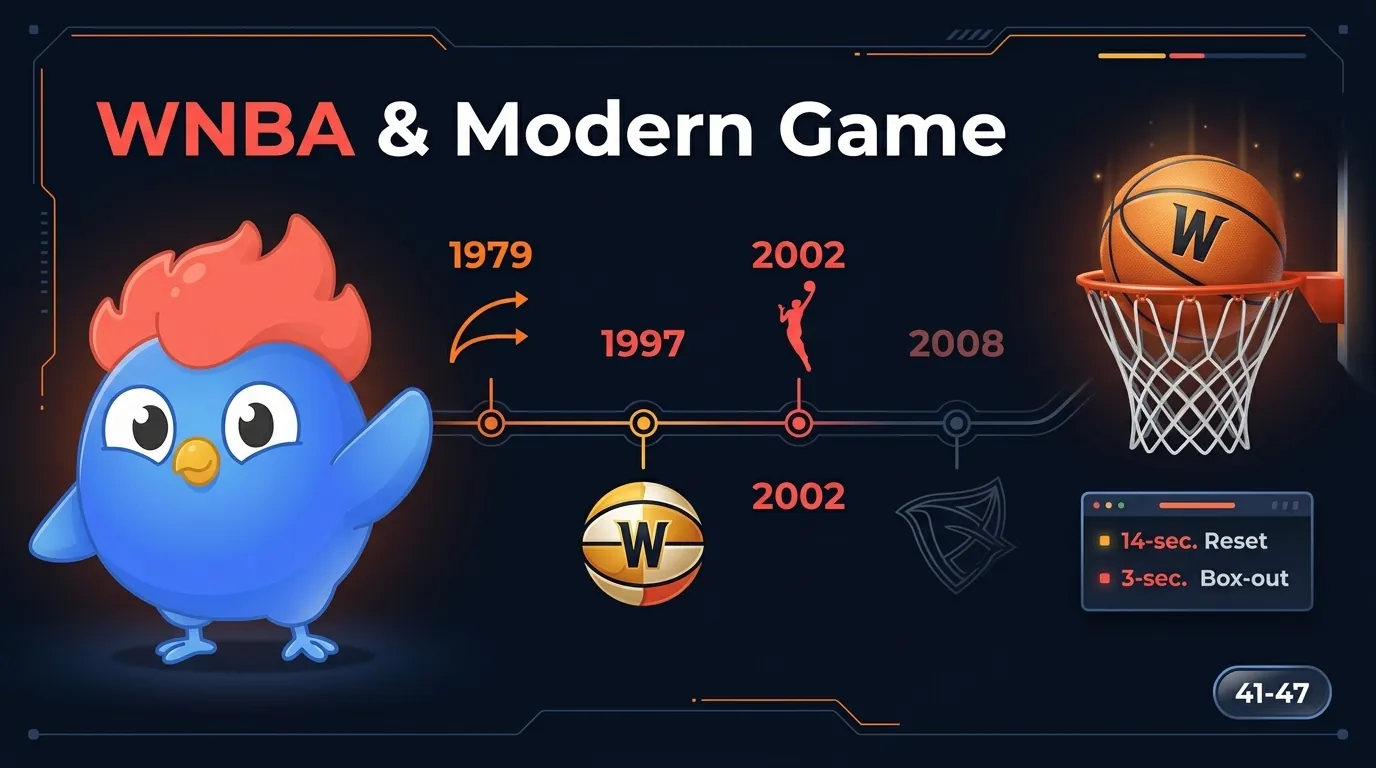 10 questions on the WNBA, rule evolution, and basketball’s modern game, from 1997 founding to Caitlin Clark’s 2024 record-shattering rookie year.
44. In what year did the WNBA play its first season? Easy
Answer: 1997. The league was founded in 1996 and tipped off its inaugural season on June 21, 1997, when the Los Angeles Sparks hosted the New York Liberty at the Great Western Forum. New York won 67-57.
The founding year (1996) and first season (1997) create confusion: people either say 1996 or guess something later like 1999. The WNBA is nearly three decades old, which surprises fans who think of it as a recent league.
45. Which franchise won the first four WNBA championships? What eventually happened to the team? Medium
Answer: The Houston Comets won titles in 1997, 1998, 1999, and 2000, led by Cynthia Cooper. The franchise folded in 2008 after failing to find new ownership.
The most dominant dynasty in WNBA history doesn’t exist anymore. Four straight titles is something even the Jordan Bulls never managed (three, then three again), and the Comets didn’t relocate or rebrand afterward. They simply vanished.
46. Who became the first player to dunk in a WNBA game, and when did it happen? Medium
Answer: Lisa Leslie of the Los Angeles Sparks, on July 30, 2002, against the Miami Sol. She caught an outlet pass on a fastbreak and threw it down. She was 6’5”.
Brittney Griner is the name most associated with WNBA dunking, and she does own the career dunk record, but she wasn’t first or second. Leslie broke the barrier in 2002 after years of trying, Candace Parker followed in 2008, and Griner arrived in 2013, dunking twice in her debut game.
47. When was the three-point line introduced to the NBA? Hard
Answer: The 1979-80 season. Before that, every field goal was worth two points regardless of distance. The ABA had used a three-point line since 1967, but the NBA didn’t adopt it until 12 years later.
The three-pointer feels like it has always been part of basketball. It hasn’t: Larry Bird, Magic Johnson, and Kareem Abdul-Jabbar all started their careers without it, and the NBA initially treated it as a gimmick. Now it defines the entire offensive strategy of the modern game.
48. An NBA game is 48 minutes long. How long is a college basketball game? Easy
Answer: 40 minutes. The men’s college game plays two 20-minute halves; the women’s game plays four 10-minute quarters. The NBA uses four 12-minute quarters.
Casual fans assume both levels play the same game length. That 8-minute difference changes pace, substitution patterns, and scoring averages, and it’s one reason top college players sometimes struggle with NBA conditioning early in their careers.
49. The goaltending rule was created in 1944 because of two specific players. What were they doing? Medium
Answer: Bob Kurland and George Mikan were standing near the basket and swatting virtually every opponent’s shot out of the air on its downward arc. The NCAA banned the practice in 1944, and the NBA followed.
The goaltending rule feels like it has always been there. It’s counterintuitive that someone had to invent the idea that you can’t just stand under the rim and block everything, but Kurland and Mikan were so tall and so dominant that the sport literally changed its rules to stop them.
50. How many players were on each team in James Naismith’s first basketball game? Hard
Answer: Nine per team, for a total of 18 players on the court at once. Naismith’s Springfield College class had 18 students, so he split them into two equal groups.
Five per side is so fundamental that nine sounds wrong, but Naismith designed the first game around his class size, not an ideal number. Teams weren’t standardized to five per side until 1897, six years after the sport’s invention. Nine on nine, with a soccer ball, into peach baskets: that’s how basketball started.
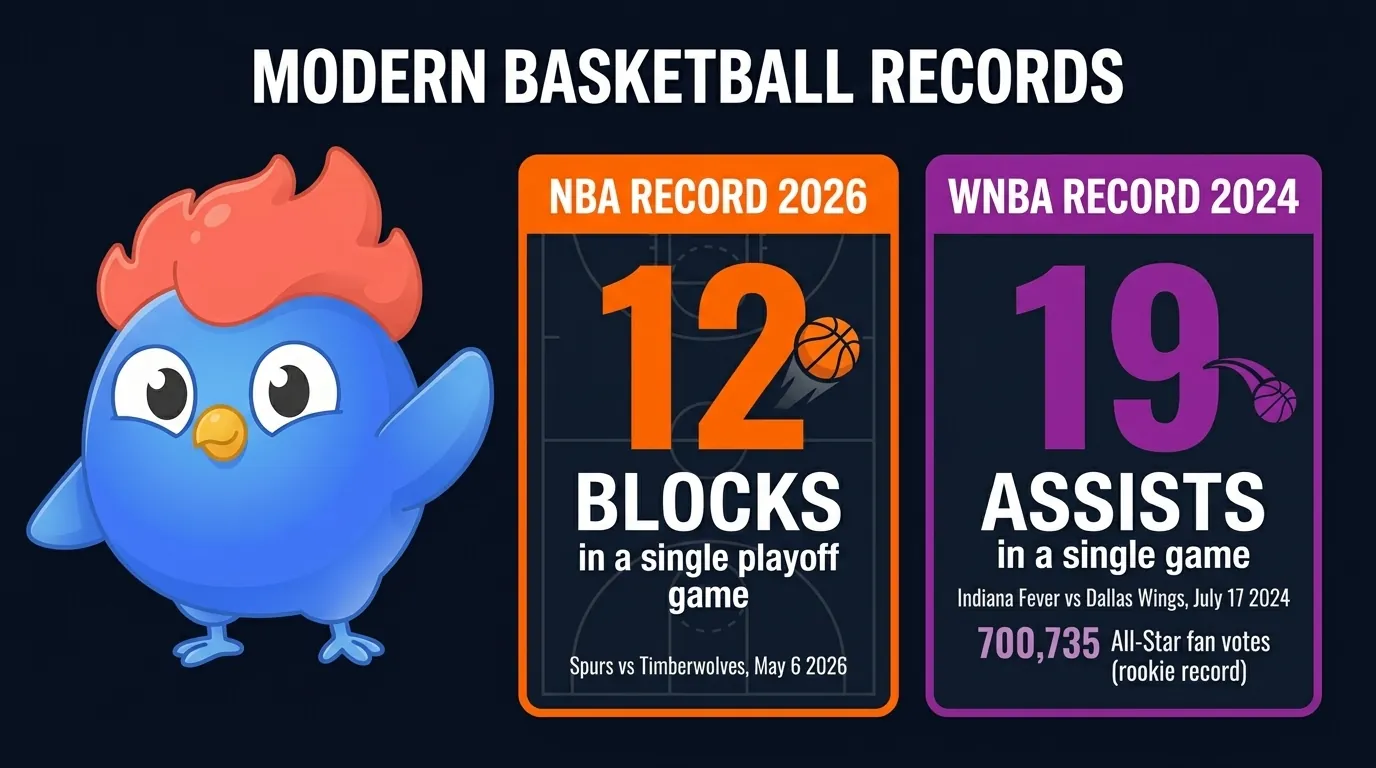 Two records most fans don’t yet have committed to memory: Wembanyama’s 12-block May 2026 game and Caitlin Clark’s 19-assist 2024 mark.
51. Who set the WNBA single-game assists record, and how many did she dish out? Medium
Answer: Caitlin Clark of the Indiana Fever recorded 19 assists against the Dallas Wings on July 17, 2024, in a 101-93 loss. (Source: Basketball-Reference Caitlin Clark page.)
The record chain compresses a whole era: Ticha Penicheiro’s 16 stood for years, Courtney Vandersloot pushed it to 18 in August 2020, and Clark took it to 19 as a rookie four years later, in a game her team lost. She also averaged a league-leading 8.4 assists per game that season and finished with 337 total assists, breaking Alyssa Thomas’s single-season record of 316.
52. Caitlin Clark received how many fan votes in her debut WNBA All-Star Game selection? Easy
Answer: 700,735 fan votes in her 2024 debut, roughly seven times the previous high (A’ja Wilson’s 95,860 in 2023). She then broke her own record with 1,293,536 votes in 2025 All-Star voting, the most in any single year in WNBA history.
Seven hundred thousand votes for a player in her first professional season feels like a misprint, but Clark’s college audience (she set the all-time NCAA scoring record at 3,951 points) followed her to the pros. In the game itself she set the All-Star rookie assist record with 10, past Shoni Schimmel’s 8, in Team WNBA’s 117-109 upset of Team USA.
53. Which player set five different WNBA records in a single rookie season in 2024? Hard
Answer: Caitlin Clark set: (1) single-season rookie assists (337), (2) single-season rookie points (769), (3) single-season rookie three-pointers made (122), (4) single-game assists by any player (19), and (5) All-Star Game fan votes (700,735, a mark she later broke herself in 2025). She was named Rookie of the Year with 66 of 67 votes.
Setting five records in one season is rare in any sport. Setting all five as a rookie, including all-time WNBA marks rather than just rookie records, redrew the whole conversation about modern WNBA stardom.
One study is worth knowing if you actually want these 53 to stick. Karpicke and Roediger (2008) found that students who tested themselves remembered about 80% of material a week later, versus 36% for a group that only restudied. Rereading Wilt’s 100-point line never makes it stick; recalling it cold does. That retrieval effect is the entire reason LearnClash replays your missed questions instead of letting a results screen be the end of it, and why spaced repetition beats rereading for facts like these.
The Records Most Likely to Break Next
Three records here look ready to fall: Wembanyama’s 12 blocks, Curry’s 402 threes, and every Caitlin Clark mark. I know because I re-verified all 53 answers for this update on August 4, 2026, and more than a dozen had quietly drifted or were flat wrong since the last pass. Some were time’s fault: the salary cap resets every July (it’s now $164.961 million), Chris Paul retired in February and locked in second place on the assist list, and the Knicks ended a 53-year drought in June. Several were mine: this page said the US had 16 men’s basketball golds when Paris 2024 had already made it 17, and it had Hakeem Olajuwon playing for Nigeria at an Olympics he actually won with Team USA. Year-stamped trivia rots quietly, which is why every dated record above carries its date.
So here is my honest maintenance forecast. Wembanyama had seven blocks by halftime at age 22, so the likeliest man to break his 12 is him. Curry’s 402 threes go next; the volume era isn’t over. And Clark entered 2026 at age 24 already holding the all-time assist game, so every mark of hers reads more like a floor than a ceiling. Records I’d bet on outliving all of us: Wilt’s 100 and 50.4, UCLA’s 88 straight, and Stockton’s 15,806, because the only man who ever got close just retired 3,254 short.
LearnClash plays these same questions as 18-question 1v1 async duels and 6-question Solo sessions, with the missed ones resurfacing on lengthening cooldowns until they’re yours. That feedback loop is what competitive learning actually looks like in practice. For adjacent decks, try our football trivia questions (NFL records and historic games), the multi-sport sports trivia questions, or the pillar of all 31 trivia question topics.
Frequently Asked Questions
What is the highest-scoring individual game in NBA history?
Wilt Chamberlain scored 100 points for the Philadelphia Warriors against the New York Knicks on March 2, 1962. No video recording exists. LearnClash's NBA legends category includes this and 7 other record-breaking questions.
Why is the basketball hoop exactly 10 feet high?
James Naismith nailed peach baskets to the lower railing of a Springfield gym balcony in 1891, which happened to be 10 feet off the ground. The height was never scientifically calculated. It stuck and became the worldwide standard.
Has a 16-seed ever beaten a 1-seed in March Madness?
Yes. UMBC beat number-one Virginia 74-54 in 2018, ending a 135-game losing streak for 16-seeds. Fairleigh Dickinson repeated the feat in 2023 against Purdue. Through the 2026 tournament those remain the only two 16-over-1 upsets; 1-seeds are 162-2 all time.
What are good questions about basketball with answers?
Good basketball trivia covers seven categories: NBA records (Wilt's 100), origins (peach baskets, 10-foot hoop), franchises (Lakers from Minneapolis), drafts (Anthony Bennett vs Giannis), March Madness (UMBC 74-54), international (Yao 7'6"), and WNBA (Caitlin Clark's 19-assist game). LearnClash serves basketball questions like these in 3-minute, 18-question duels.
What WNBA records does Caitlin Clark hold?
Caitlin Clark set the WNBA single-game assists record of 19 on July 17, 2024, against the Dallas Wings. She also holds the WNBA rookie single-season records for points (769), assists (337), and three-pointers (122), and set the All-Star fan-vote record with 700,735 as a 2024 rookie before raising it to 1,293,536 in 2025. LearnClash WNBA trivia includes Clark's records alongside Lisa Leslie and the Houston Comets dynasty.