
Interleaving Practice: Feels Worse, Works Better [Data]
Interleaving practice mixes related topics in one session. See the evidence, when it backfires, and what 444 real quiz duels show.

It’s Tuesday night. You’ve got three chapters to know by Friday, so you do the obvious thing: master chapter one, then two, then three. Each chapter feels smoother than the last, and you walk in confident.
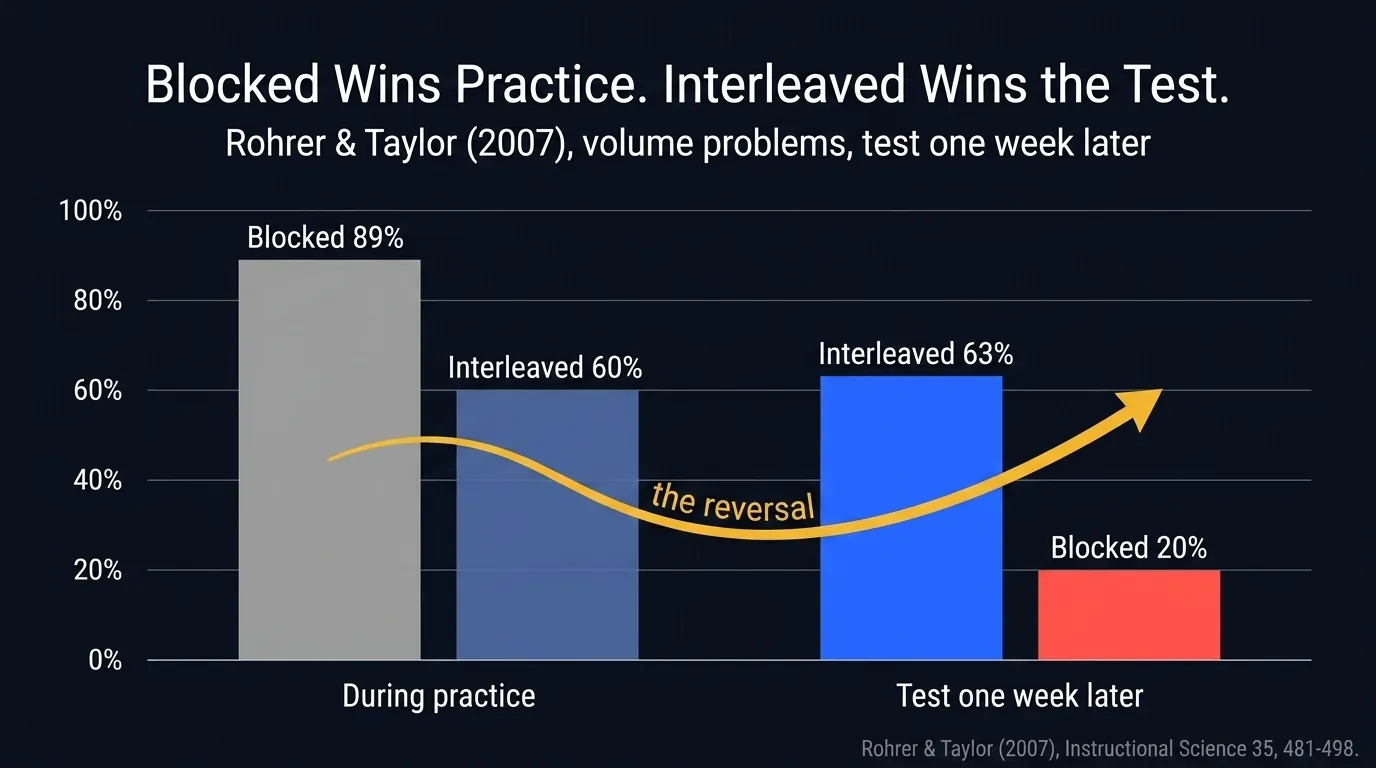
That smoothness lied. Interleaving practice, which mixes related topics inside one session instead of finishing each in a block, produces rougher practice sessions and better exam scores. In the classic lab version, students who shuffled math problem types scored 63% on a test one week later. The students who blocked scored 20%.
Below: what counts as interleaving and what only looks like it, why your own judgment rates it backwards, and the cases where blocking wins. Then a 30-day export of 444 LearnClash duels shows what happens when the mixing is built into the format instead of left to willpower.
What Counts as Interleaving (and What Doesn’t)?
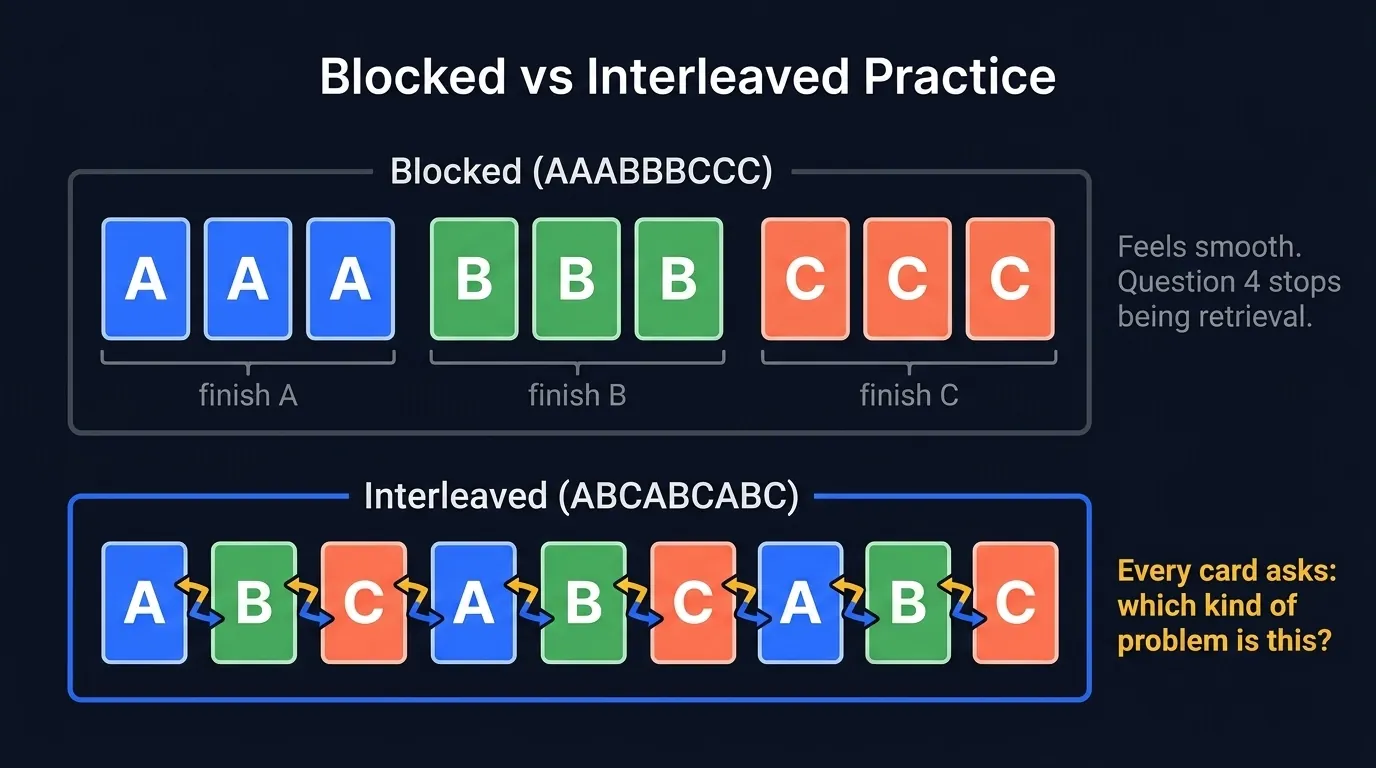
Interleaving practice is the deliberate mixing of related topics or problem types within a single study session. Instead of AAABBBCCC, you work ABCABCABC, so consecutive items keep changing type and each one asks “which kind of problem is this?” before “how do I solve it?”
Two things get mislabeled as interleaving. Neither earns the benefit.
| Looks like interleaving | Actually is | Why it fails |
|---|---|---|
| Studying while switching between notes, texts, and a group chat | Multitasking | Attention splits mid-item; nothing gets a full retrieval |
| Rotating unrelated subjects (calculus, then French, then history) | Variety | Nothing gets confused with anything, so there’s no discrimination to learn |
| Shuffling volume, surface area, and density problems | Interleaving | Similar-looking problems force you to pick the right method each time |
The word doing the work in that definition is related. Interleaving pays off on material similar enough to confuse: problem types that share surface features, painters with neighboring styles, organ systems where the hard part is telling A from B. Calculus followed by French vocabulary is a varied evening, not an interleaved one.
One more boundary. Interleaving happens within a session, while spreading sessions across days is spaced repetition, a separate lever, and the two stack with a third:
| Technique | What it varies | Where it acts |
|---|---|---|
| Interleaving | The order of topics | Within one session |
| Spaced repetition | The gaps between reviews | Across days and weeks |
| Retrieval practice | The format (testing beats rereading) | Every single question |
Blocked Practice Feels Better. It Keeps Losing.
The thing that kills interleaving for most people is their own judgment during practice. Blocking produces fluent, confident sessions. Interleaving produces stumbles and second-guessing, plus a nagging sense that you’re doing it wrong, and then the delayed test flips the ranking.
Kornell and Bjork ran the famous version in 2008. Participants learned the styles of twelve painters, with each painter’s work either shown in a block or interleaved with the others, and were then asked to name the painter of new paintings they had never seen. In the first experiment, 78% of participants scored higher after interleaved study. Asked afterwards which method had helped them learn more, 78% said blocking had worked as well or better.
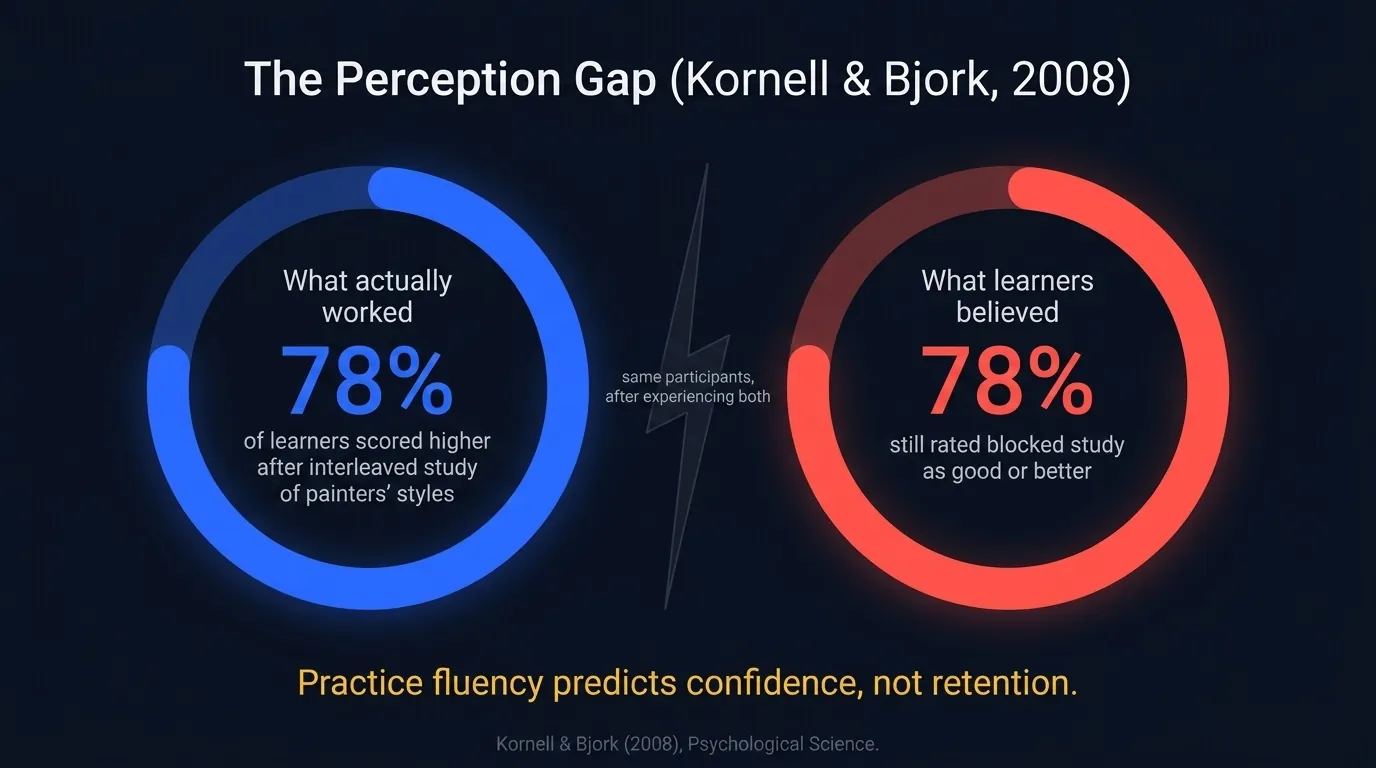
Psychologists call the underlying error a fluency illusion. Easy retrieval during practice feels like learning, but the ease comes from the answer still sitting in short-term context rather than from durable memory. Block ten questions on one topic and by question four you have stopped retrieving the topic and started riding it.
So the discomfort is not a side effect of interleaving. It is the mechanism doing its job, the same way effortful recall drives the testing effect. If a session feels smooth, it is worth asking whether you are learning or coasting, because your gut will vote for the smooth method every time it is asked.
Does Interleaving Really Work? The Evidence
Yes, with an asterisk covered two sections down. The delayed-test advantage of interleaving has replicated from a small lab study up to a preregistered trial across dozens of classrooms, and the whole literature has since been pooled in a meta-analysis.
The study to know first is Rohrer and Taylor’s 2007 experiment. Eighteen college students learned to calculate the volume of four obscure solids (a wedge, a spheroid, a spherical cone, a half cone), with practice problems either blocked by solid or shuffled. During practice the blockers averaged 89% and the mixers 60%. On the test one week later, the mixers scored 63% and the blockers 20%, and almost every blocker error was the same kind: right arithmetic, wrong formula.
Eighteen students is a small sample, which is why the follow-ups matter:
- A real classroom. 126 seventh graders in Tampa worked the same graph and slope problems over three months, arranged as either interleaved or blocked assignments. On an unannounced test one day after a review session, interleavers scored 80% against 64%; at 30 days it was 74% against 42% (Rohrer, Dedrick & Stershic, 2015). The gap doubled as the delay grew.
- A preregistered trial. A cluster-randomized study across 54 seventh-grade classes, 787 students in the final sample, landed at 61% versus 38% on an unannounced test one month later, d = 0.83 (Rohrer, Dedrick, Hartwig & Cheung, 2020). The teachers delivered it with no training at all.
- A meta-analysis. Brunmair and Richter (2019) pooled 59 studies and 238 effect sizes and found an overall Hedges’ g of 0.42, a medium effect for a technique whose only cost is comfort.
Taylor and Rohrer also ran a fourth-grade version in 2010, using prism problems. Interleaving hurt practice-session performance and then doubled the score on a test the next day, 77% against 38%, and their error analysis pointed at the same culprit as the college study: blocked students could execute each procedure but could not tell which problem called for which.
The same meta-analysis that confirms the effect also maps its edges. Those edges are sharp enough to need their own section.
Why Mixing Works: You Learn to Tell Problems Apart
The leading explanation is discriminative contrast. Interleaving lines categories up side by side, so you learn the differences between them rather than only the contents of each. Kang and Pashler showed in 2012 that spreading an artist’s paintings out in time did nothing on its own; the gain came from the juxtaposition, and Birnbaum and colleagues reached the same conclusion in 2013 with photographs of birds and butterflies.
Think about what a blocked session removes. Twenty volume-of-a-cone problems in a row means you never once ask whether this is a cone problem at all, because the chapter heading answered that for you. Real tests don’t come with chapter headings.
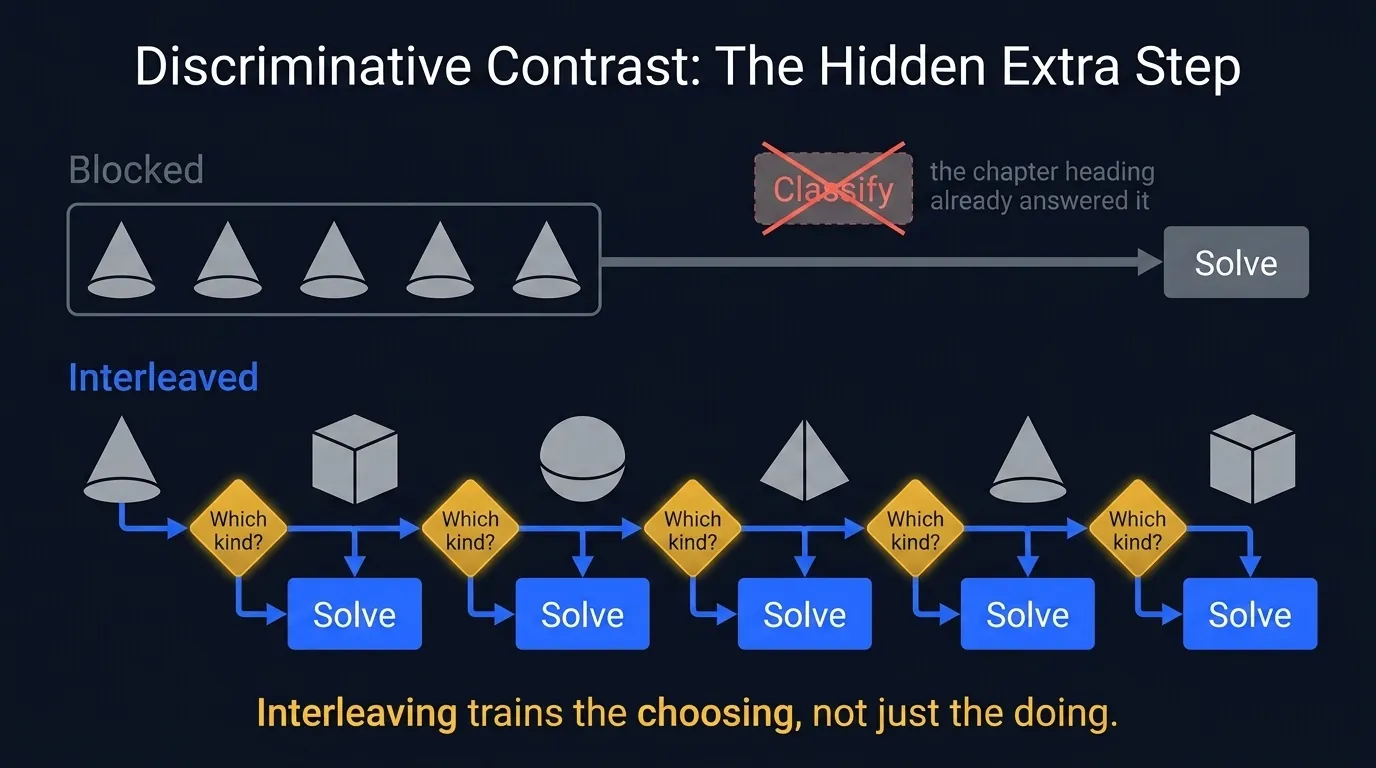
There is a second mechanism stacked on top. Each switch away from a topic lets it fade a little, so returning to it is a genuine act of retrieval rather than a repeat, which makes interleaving a way of smuggling micro-spaced retrieval into a single sitting.
Taylor and Rohrer’s error analysis is the cleanest evidence for which of the two dominates. Interleaving’s advantage came almost entirely from students pairing each problem with the right procedure, not from executing procedures better. Interleaving trains the choosing, not the doing.
When Interleaving Backfires
Interleaving is not a universal upgrade, and pretending otherwise is the fastest way to make you distrust the whole technique. Here is where the evidence says don’t:
| Situation | Better move | Why |
|---|---|---|
| Brand-new topic, zero footing | Block first, briefly | You need a working model of A before contrasting it with B teaches anything |
| Plain vocabulary or isolated facts | Block | Brunmair & Richter found the effect reverses for word lists: g = -0.39 |
| Totally unrelated subjects | Either (no benefit) | No confusable boundary, no discrimination to train |
| Related, confusable topics you’ve met before | Interleave | The g = 0.42 zone: math tasks at g = 0.34, rising to g = 0.67 for paintings and other visual material |
The vocabulary flip deserves its own sentence, because almost nobody quotes it. For isolated word pairs, blocked practice beats interleaving in the pooled data, which makes a Spanish flashcard grind one of the few study tasks where the comfortable method is also the correct one.
The meta-regression behind that table adds a third rule. Interleaving pays off most on one kind of material: items that are similar between categories, distinct within them, and complex enough that telling them apart takes real work. Simple, self-contained facts leave nothing to discriminate. The mixing cost buys nothing back.
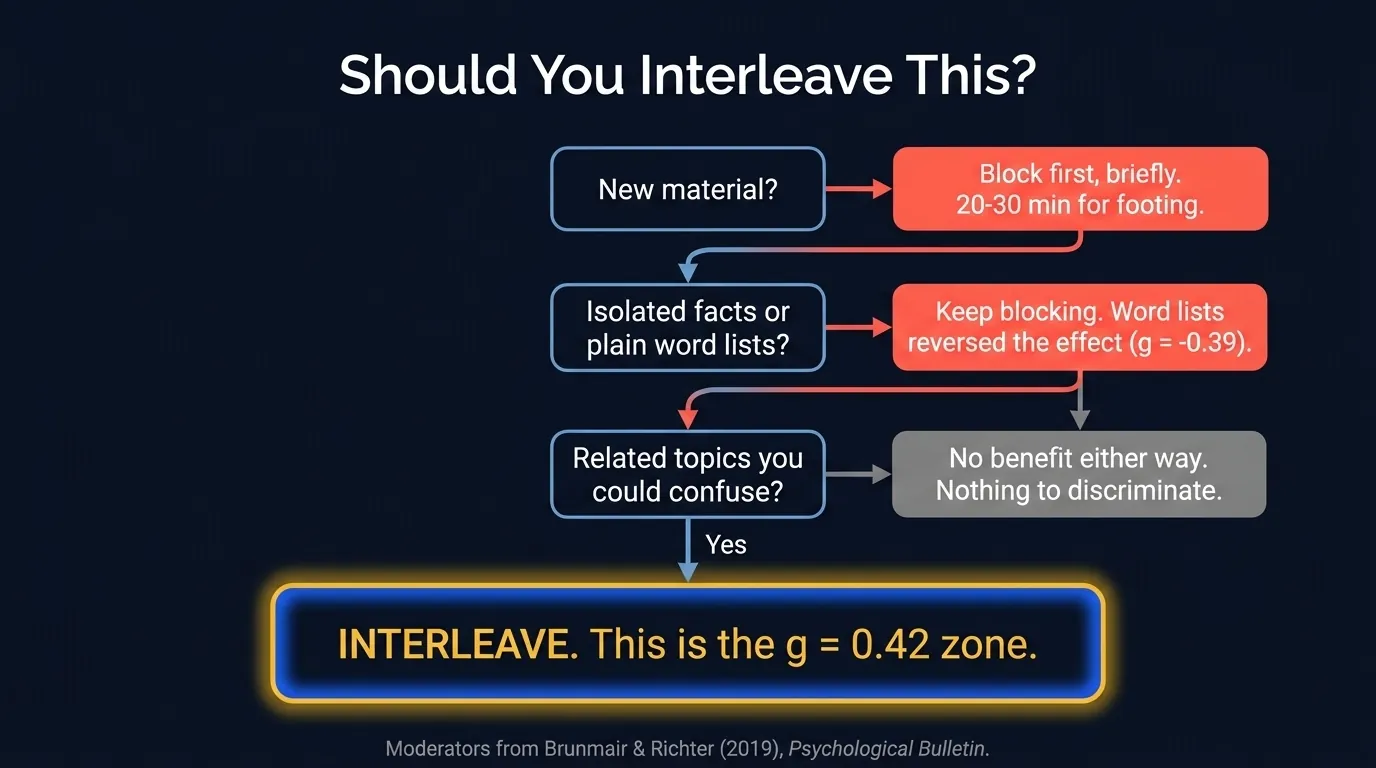
Most “interleaving doesn’t work for me” stories fall into one of the four rows above. Either the person interleaved two subjects with nothing in common, or they shuffled material they had never blocked even once, and in both cases they felt the friction, quit, and blamed the method when it was the targeting that had failed, which is a fixable problem rather than a verdict. Fix the targeting first.
What 444 Real Duels Say About Topic Mixing
Kornell and Bjork’s participants kept voting for blocking even after it lost, which raised a question we could answer with our own data: what happens when mixing is the format’s default rather than a personal discipline? On July 9, 2026 we took a read-only export of the LearnClash production duels collection, scanned the 1,160 duel documents created in the prior 30 days, and kept the 444 that had been completed.
The export summary gives the mean as 4.98 distinct topics per duel, which sounds like a spread. The distribution underneath has no spread at all:
- 353 duels (79.5%) spanned six distinct topics in one 18-question match
- 91 duels (20.5%) used the topic lock and stayed on exactly one topic
- Not a single completed duel landed anywhere between
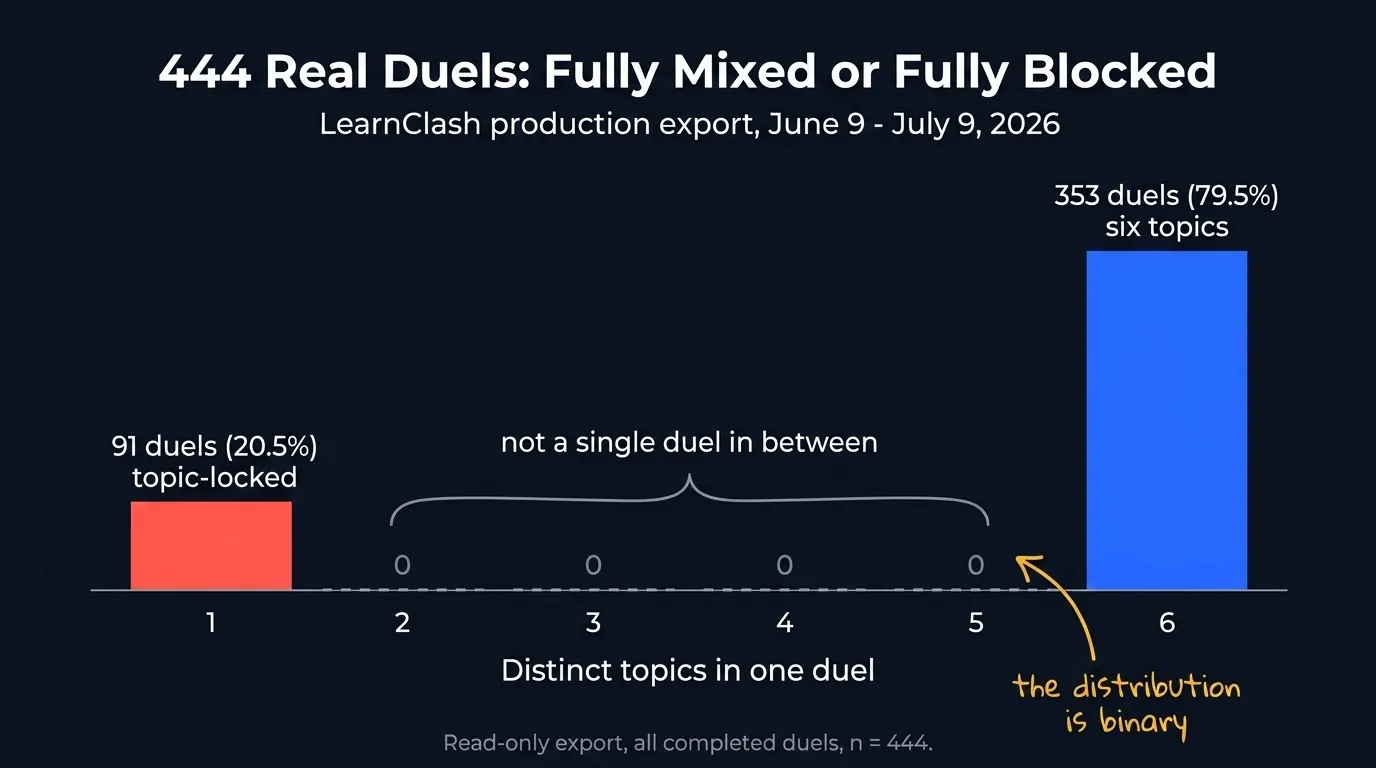
Method: read-only export of the LearnClash production duels collection, taken July 9, 2026, covering completed duels created between June 9 and July 9, 2026 (n = 444). Distinct topics per duel were counted from each duel’s round log. 390 of the 444 were direct challenges (a friend or an invite link) rather than matchmaking; the other 54 came from matchmaking.
Two details in the export made us grin. The most common topic pairing inside mixed duels was Feminism plus The Hitchhiker’s Guide to the Galaxy, which shared a match 24 times; Disney plus Bridgerton came second at 16, and The Big Bang Theory plus United States Politics third at 14. No syllabus produces those pairings. Two players alternating picks do, and 390 of the 444 duels started as a direct challenge rather than a matchmaking pull.
The caveat, since this article just spent a section on caveats: these 444 duels measure how the format behaves, not a controlled learning outcome. The retention evidence lives in the studies above. What the export shows is that when mixing is the default, four out of five matches keep it, and the fifth has chosen blocking through an explicit setting rather than drifted into it, which is the one form of blocking the research endorses when the material is new.
How LearnClash Builds Interleaving Into Every Duel
Most study apps treat interleaving as advice. LearnClash treats it as architecture, and that’s a deliberate bet on the research above.
Four systems do the work:
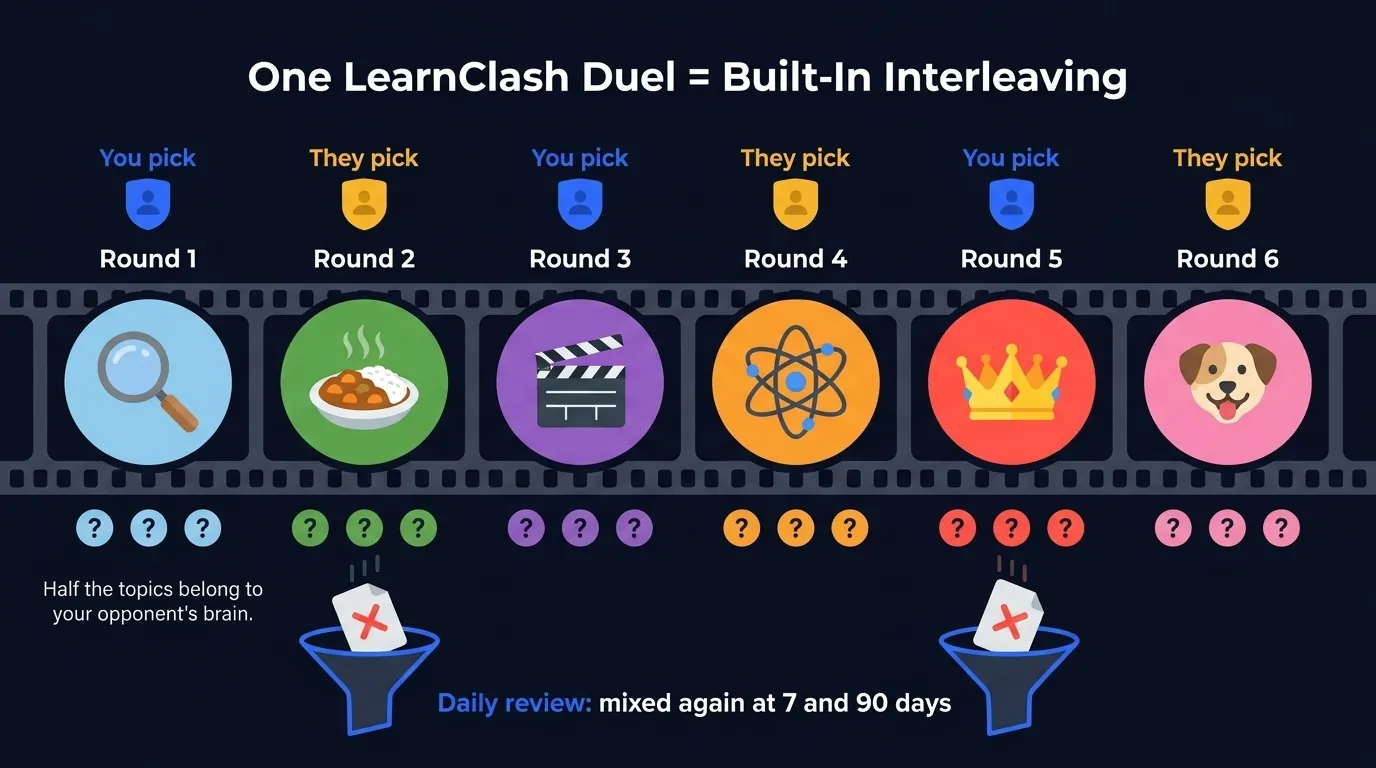
- Six-topic duels. A standard match runs 6 rounds of 3 questions, and the two players alternate topic picks round by round. You can’t grind your comfort zone, because half the rounds belong to your opponent’s brain.
- The topic lock. For deliberate blocking, the lock forces a whole duel onto one topic. It’s the built-in block-first tool for new material, and the grudge-match tool. That’s the 20.5%.
- Daily review. The Solo home’s one-tap session is a due-first interleave across your own topics: the 3-stage SRS collects what you’ve missed and re-serves it after 7 and 90 days, mixed into one session. Spacing across days, interleaving within the session.
- Per-topic stats. The “is it even working?” question gets a data answer: first-answer accuracy and a mastery score per topic, so a dip in one subject shows up as a number instead of a vibe. The full mechanics live in the LearnClash retention-curve breakdown.
The competitive layer does a second job. The fluency illusion survives on private feelings, and a scoreboard interrupts it: when a smooth practice week meets a lost duel on the same material, the duel is the one telling the truth. That collision between felt mastery and measured mastery runs through the whole learning-science playbook, and here it is the antidote to the “interleaving feels bad, back to blocking” relapse.
A Simple Interleaving Schedule You Can Run This Week
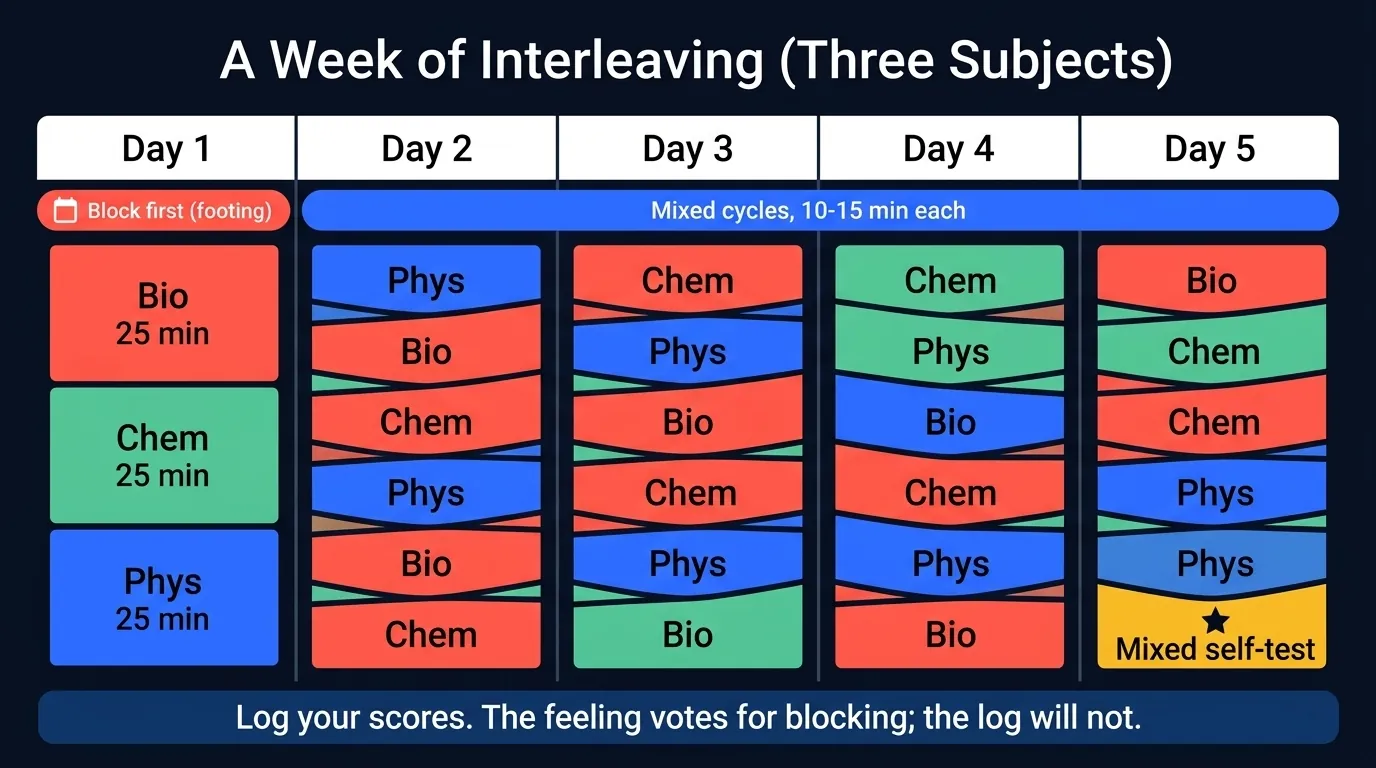
Take the targeting rules from the backfire section and put them on a calendar. This is the version for three related subjects heading into one exam block, say biology, chemistry, and physics:
- Day 1: block, briefly. New material gets one short focused block per subject, 20 to 30 minutes each, enough to build footing. Don’t skip this and don’t extend it.
- Days 2 to 5: interleave in short cycles. One session, all three subjects, switching every 10 to 15 minutes or every few problems. Shuffle the order daily so chemistry isn’t always the warm-up.
- Expect the dip and keep a log. Your practice accuracy will drop compared with blocked studying. Write down end-of-session scores instead of trusting how the session felt, because the feeling votes for blocking and the log doesn’t.
- Test across topics, not within them. Self-quiz with everything mixed, because that’s the format of every real exam. An 18-question mixed duel on study techniques is a 3-minute version of exactly this.
- Let spacing do the rest. Whatever you miss, review it again days later. If you’d rather not manage that schedule by hand, that’s the part the daily review automates.
Five steps. The hard part isn’t the plan, it’s tolerating step 3 long enough to reach the payoff, and that is where most self-managed attempts die.
How do you know it’s working?
Two signals and one warning. First signal: your delayed self-test scores trend up across the week, even while in-session accuracy sags. Second: your errors change shape, from “picked the wrong method” to ordinary slips, which is discrimination improving, exactly what Taylor and Rohrer’s error analysis predicts.
The warning is about timing. Don’t grade the method on day two, because interleaving’s advantage grew with delay in the classroom data, from a 16-point gap at one day to a 32-point gap at one month. Judge it on the test that counts, and if you want the readout without the spreadsheet, per-topic accuracy in the app updates after every duel and nine more memorization techniques plug into the same loop.
Blocked practice will keep feeling better. If you’d rather feel the alternative than read about it, pick the study-techniques topic, play one 18-question duel, and notice the small stall every time the round changes. That stall is this whole article in one beat.
Frequently asked questions
What is an example of interleaving practice?
Instead of solving 20 volume problems, then 20 surface-area problems, you shuffle all 40 so consecutive problems change type. In LearnClash, a standard duel does this automatically: 18 questions across six topics, so the subject keeps changing from round to round.
What is the difference between interleaved and blocked practice?
Blocked practice finishes one topic before starting the next (AAABBBCCC). Interleaved practice mixes them (ABCABCABC). Blocking feels smoother and scores better during the session; interleaving scores better days or weeks later, especially when the material is similar enough to confuse.
Does interleaving really work?
Yes, with conditions. A 2019 meta-analysis of 59 studies found a reliable benefit (g = 0.42), strongest for paintings and other visual material and smaller for math problem types. It fails for plain word lists, where blocking actually wins. Interleave related-but-confusable topics, not random ones.
What is the difference between interleaving and spaced practice?
Spacing spreads practice across time; interleaving mixes topics within one session. They stack. A LearnClash duel interleaves six topics in 18 questions, and the 3-stage SRS then re-serves what you missed after 7 and 90 days, which adds the spacing layer on top.