
Leitner System Explained [From Shoebox to 117,812 Cards]
Leitner system explained: the 1972 five-box original, a paper setup you can copy, and a 117,812-card census from LearnClash's live three-box SRS.


Sebastian Leitner’s learning box was a cardboard case with five compartments, each wider than the last, and the width of a compartment was its review schedule. He published it in 1972. Fifty-four years on, the sorting rule inside that case is still what most flashcard apps run: a card moves up when you get it right and back down when you get it wrong.
Leitner’s box is one of the earliest practical forms of spaced repetition, and still the one you can run without a screen.
This guide covers the 1972 original, a paper setup you can copy this week, the reason most shoebox systems end up in the attic, and a census of 117,812 live cards inside the three-box version we run in LearnClash. If you would rather feel the boxes work before reading about them, the study-techniques topic runs on them; play a round and come back in three minutes.
What Is the Leitner System?
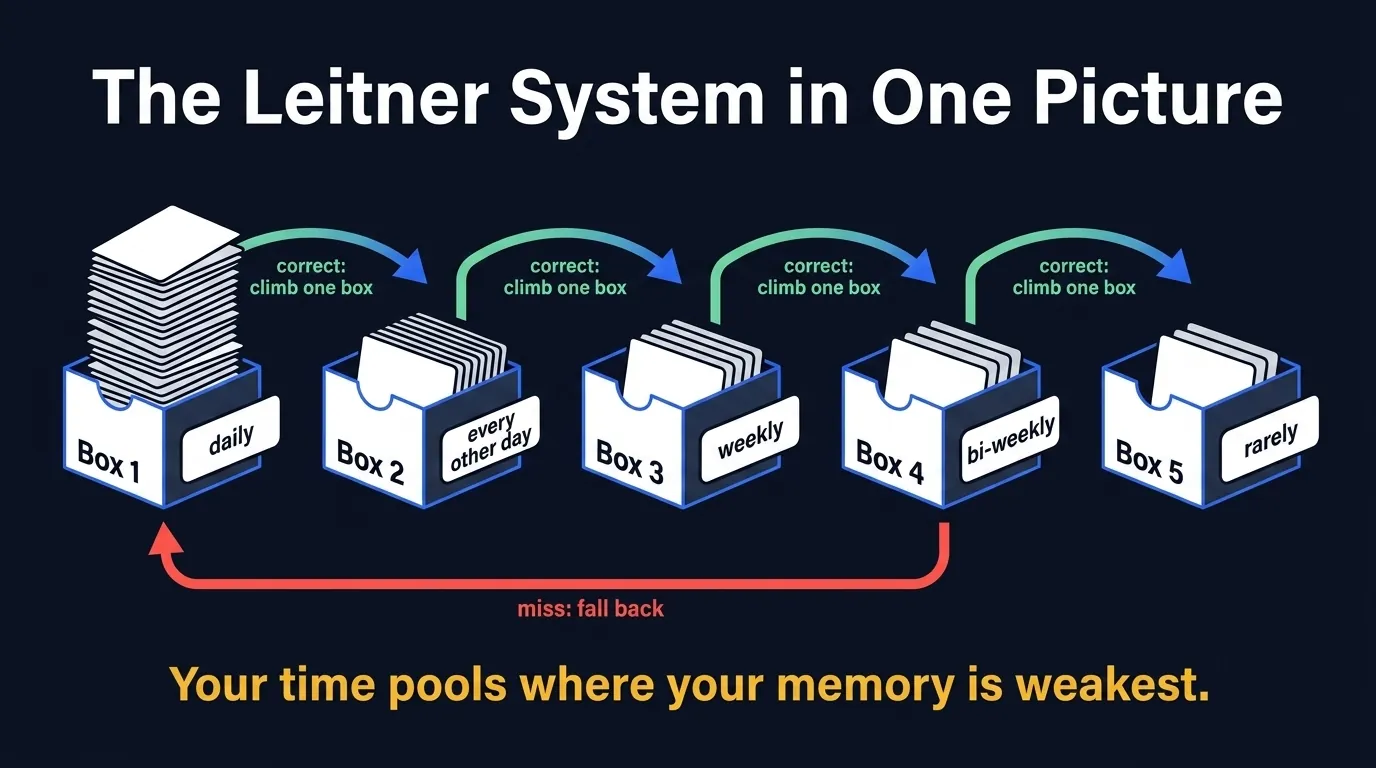
The Leitner system is a flashcard method that sorts cards into boxes by how well you know them. New and missed cards sit in Box 1 for near-daily review. Each correct answer promotes a card one box, which stretches the gap before its next appearance, and each miss sends it back toward the daily pile.
Two research-backed effects do the heavy lifting. The first is retrieval practice: pulling an answer out of memory strengthens it far more than rereading it does, the testing effect that shows up in study after study. The second is the spacing effect: a review lands hardest when it arrives after a delay, close to the point where you would have forgotten.
The boxes bundle both effects into furniture. You cannot reread a flashcard face-down, so every card is a retrieval attempt, and the box number is the delay, with no timer or app needed to compute it.
| Box | What it holds | How often you see it |
|---|---|---|
| Box 1 | New cards and every recent miss | Daily |
| Middle boxes | Cards you’ve answered correctly once or twice | Every few days to weekly |
| Last box | Cards you’ve proven repeatedly | Monthly, or retired entirely |
The property every later system copied is that your time pools where your memory is weakest: a card you keep missing keeps returning, while a card you know cold nearly stops costing you minutes.
How many boxes you use is a tuning decision rather than doctrine. Leitner used five, most paper guides teach three, and the digital version inside LearnClash runs three stages with long waits between them. The box count only decides how finely the waits are sliced.
The 1972 Original: Five Boxes, Measured in Centimeters
Sebastian Leitner was born in Salzburg in 1919 and made his living as a writer and translator, and the system that carries his name arrived in a self-help book before publishers began selling ready-made vocabulary card sets built on it. So lernt man lernen (“How to Learn to Learn”) came out from Herder in 1972. The learning box it described was a physical object, a case with five compartments of increasing width.
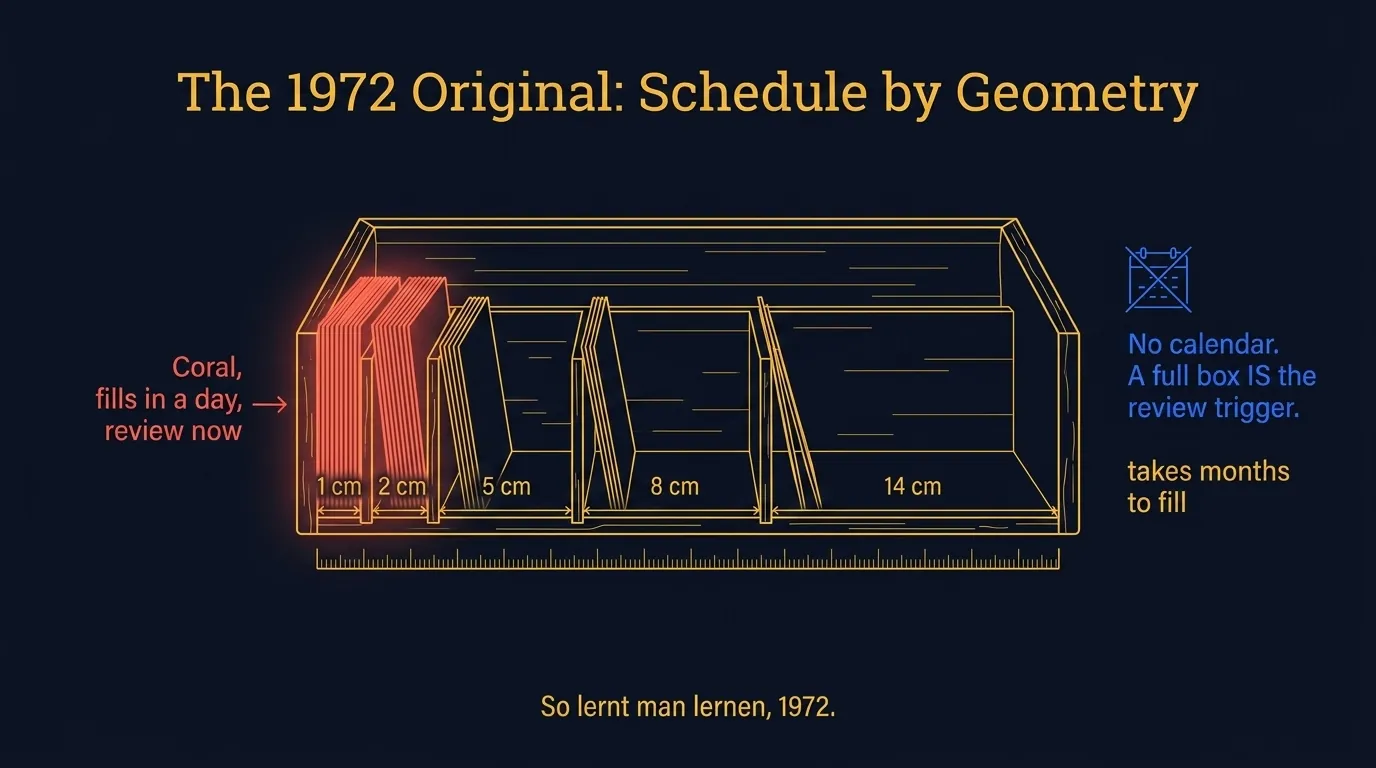
The compartment widths were 1, 2, 5, 8, and 14 centimeters, and those widths did the scheduling work that a calendar or an app does today.
Here is the detail most modern summaries drop: Leitner’s original had no calendar. You did not review Box 2 “every three days”; you reviewed a box when it was full, and the spacing came out of the geometry.
| Compartment | Width | Fills up | Effective rhythm |
|---|---|---|---|
| Box 1 | 1 cm | Within a day or two | Near-daily |
| Box 2 | 2 cm | Days | Every few days |
| Box 3 | 5 cm | A week or more | Weekly-ish |
| Boxes 4-5 | 8 and 14 cm | Weeks to months | Rare |
A fat box fills slowly, so its cards wait longer. A thin box overflows within a day or two, so its cards return fast. Leitner had encoded a review schedule into cardboard dimensions more than a decade before Piotr Wozniak began computing one in SuperMemo in the late 1980s, and long before Anki brought per-card scheduling to everyone in 2006. Both were answering a question the cardboard had posed: what if the box widths could adjust themselves per card?
The book kept selling in German for decades, an 18th edition appeared in 2011, and its listed translations are Lithuanian and Russian, with no English edition among them. Most people outside the German-speaking world meet the method through summaries and through the software that borrowed its boxes.
Three Boxes or Twelve: The Variants That Followed
Almost nobody builds Leitner’s exact case anymore. The adaptations run from a stripped three-box weekly rotation to a twelve-deck setup for certification grinders, and what people built says a lot about which parts of the original they found hard to live with, mostly the bookkeeping.
| Variant | Boxes | Schedule source | Best fit |
|---|---|---|---|
| Leitner 1972 original | 5 | Box fullness | Purists with one big deck |
| Three-box | 3 | Calendar (daily, every few days, weekly) | Anyone starting on paper |
| Proficiency (12-deck) | 12 | Session numbers 0-9 | Long exam campaigns |
| LearnClash 3-stage SRS | 3 | Per-card timers (7 and 90 days) | People who’d rather play than schedule |
The three-box version is the one most study guides teach, and the one worth starting with. It swaps capacity triggers for a calendar and cuts the promotion ladder to two hops. Wikipedia’s worked example reviews Box 1 daily, Box 2 every three days, and Box 3 every five; plenty of guides stretch the last box to a week. It is less granular than the original and far more likely to survive contact with a real week.
At the other extreme sits the proficiency variant: ten numbered decks plus a Current deck and a Retired deck, worked through sessions numbered 0 to 9 on a loop. A card retires only when you get it right during the session whose number matches the last number of its deck’s label. It offers the finest-grained spacing a shoebox can deliver, and a rulebook you have to genuinely study first.
Software took the fourth path and dissolved the boxes into per-card timers. SuperMemo and Anki compute a fresh interval for every single card, which is the logical endpoint of Leitner’s geometry. We went the other way on purpose when we built our version: three fat boxes, long waits, and each promotion meaning more, because a ladder with three rungs is one a player can feel climbing in the middle of a game.
The Rule Everyone Softens: Back to Box 1
Leitner’s demotion rule is brutal: miss a card, any card, and it returns to Box 1, so a card that survived months of climbing to the fifth compartment is erased by one blank moment. Nearly every modern implementation softens that rule, each in its own way, and so did we.
The reset made sense for Leitner’s material. He wrote with vocabulary drilling in mind, and a fully blanked word pair is close to a total loss. For most knowledge a miss is rarely total. You blanked on the year of the Berlin Airlift; you did not forget the Cold War.
So the variants appeared. The common three-box adaptations demote a card one box instead of resetting it. Anki’s lapse settings are their own negotiation with the same problem; the LearnClash retention-curve breakdown walks through what each tool does to a lapsed card.
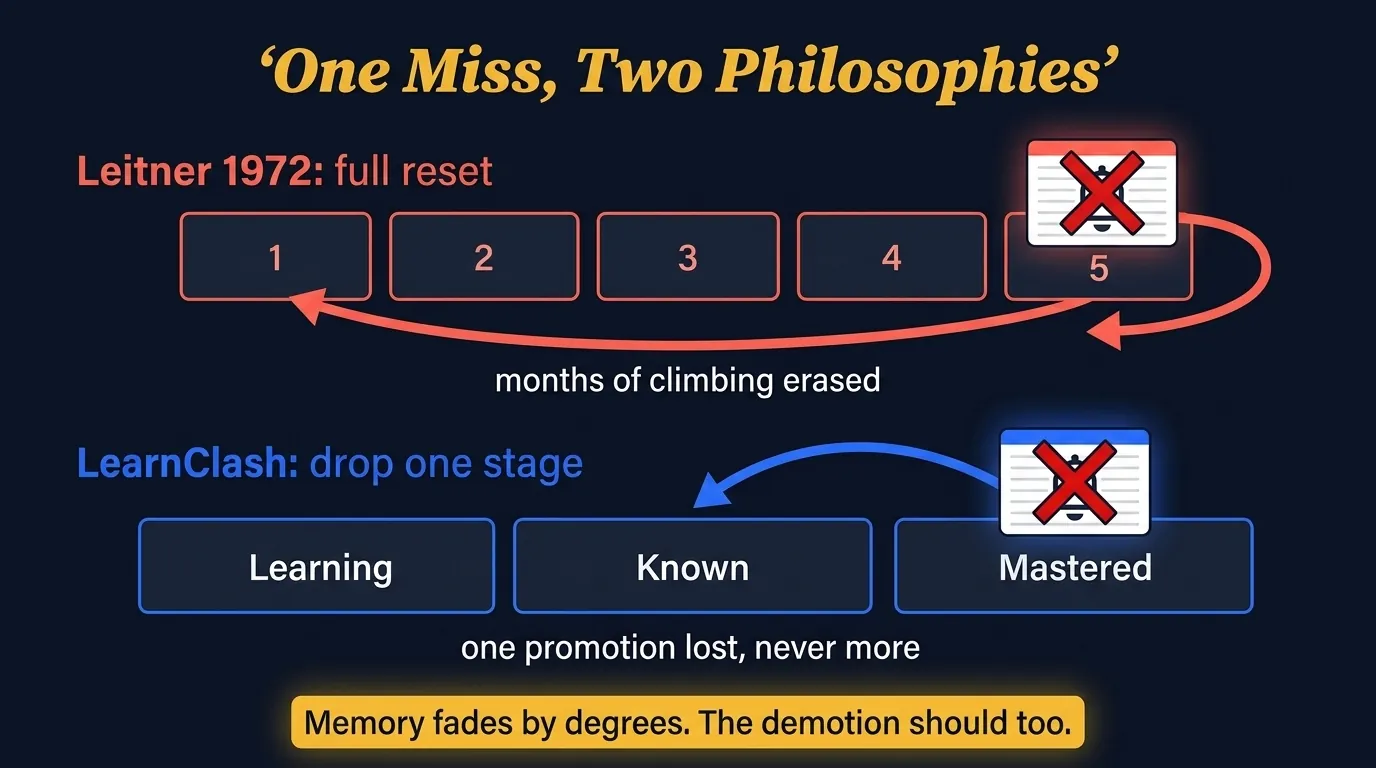
When we wrote the stage-transition rule for the app, the demotion ended up as a single line: the new stage is the old stage minus one, floored at zero. The comment on that rule still reads “gentler than reset to 0”, which was the entire design argument in five words. A Mastered card that lapses becomes Known, waits out a fresh 90-day gap, and gets its chance to re-prove itself rather than going back to the daily grinder: memory fades by degrees, and the demotion should too.
How to Run a Paper Leitner System
You need index cards, three boxes, and a pen. The paper version is the fastest way to understand what any spaced repetition system is doing under the hood, and it works with zero screens involved.
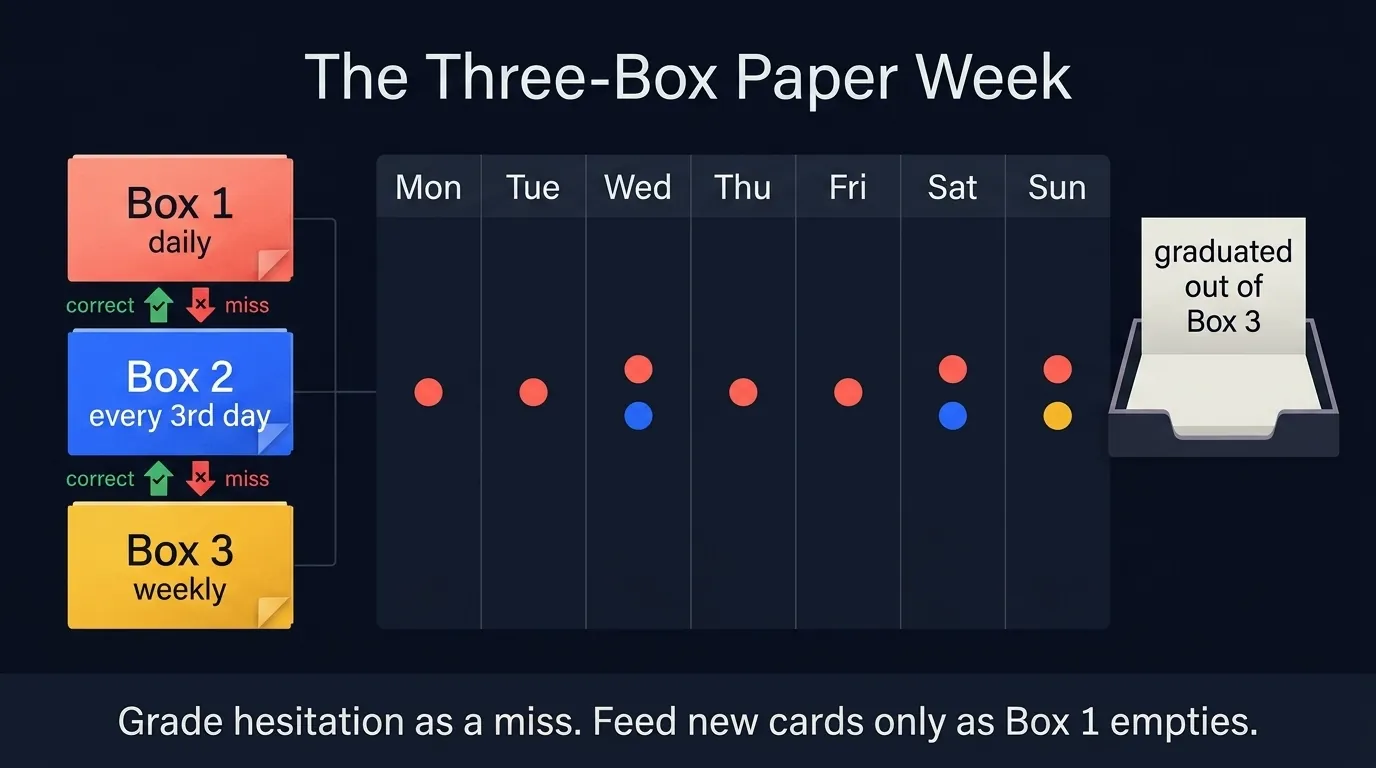
The three-box version runs on a calendar instead of box widths. The rhythm below is a sensible default; the exact day counts are convention, not law, and whether a card climbs or falls matters far more than whether Box 3 comes around on day five or day seven.
- Write your cards. One question per card, answer on the back. Keep the batch small; 20 to 40 new cards is plenty to start.
- Everything begins in Box 1. No exceptions, including material you think you know.
- Review Box 1 daily. Read the question, answer out loud before flipping, then grade yourself. Correct cards move to Box 2. Missed cards stay.
- Review Box 2 every third day. Correct cards graduate to Box 3. Missed cards drop back to Box 1, or one box if you have adopted the gentler rule. We would.
- Review Box 3 weekly. Correct cards retire from the rotation. Missed cards fall back.
- Feed new cards into Box 1 only as the box empties, so the daily pile never grows past what you will actually sit down for.
Here is the first week with a 20-card deck of European capitals, so the flow is concrete:
| Day | Session | What happens |
|---|---|---|
| Day 1 | Box 1 (all 20 cards) | You get 13 right; they climb to Box 2. Seven stay. |
| Day 2 | Box 1 (the 7 holdouts) | Four climb. Three stay for tomorrow. |
| Day 3 | First Box 2 session (13 cards) | Eleven graduate to Box 3. Two fall back down. |
| Day 7 | First Box 3 review | Anything you nail here leaves the rotation for good. |
By day seven, a deck that cost 20 reviews on Monday costs a handful. The shrinking daily bill is what to watch, more than any single test score.
Two ground rules keep it honest. Grade “sort of knew it” as a miss, because hesitation on paper becomes a blank on the exam. And never skip a scheduled day to save up reviews.
Why Paper Leitner Systems Die: Review Debt
A missed Tuesday doubles Wednesday’s stack. The bigger stack feels worse, so Wednesday slips too. Within two weeks the box stops being a schedule and becomes a guilt object on a shelf.
That is the story of most abandoned Leitner boxes. Skip three days and the daily box becomes an hour-long wall of cardboard, because Box 1 fills from two directions: every new card starts there, and every miss from every other box lands back there. None of that is laziness; the system’s cost is front-loaded exactly where motivation is thinnest, on the material you keep getting wrong.
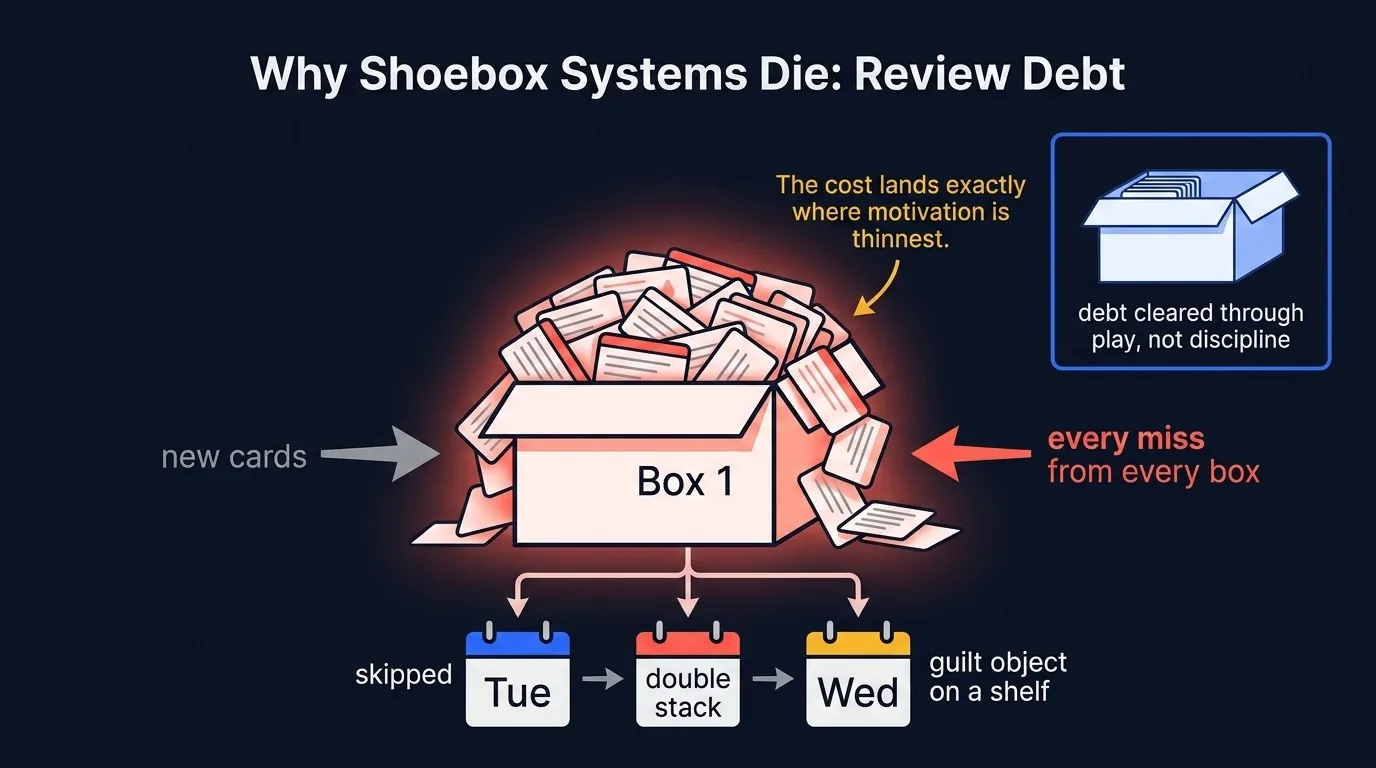
Debt is the loudest of three killers. The other two are quieter: self-grading drift, which corrodes the accuracy of every box, and the fluency illusion, which corrodes your will to continue.
Self-grading drift works like this. On paper you are both student and referee, and the referee softens. “Close enough” becomes correct, cards climb boxes they have not earned, and the schedule quietly stops matching your actual memory. Any setup where something other than you checks the answer, a quiz with a fixed answer key for instance, keeps its accuracy for that unglamorous reason.
The fluency illusion is crueler, because it makes people abandon the method precisely when it is working. Nate Kornell’s 2009 flashcard experiments had students study GRE-type word pairs either as one large stack, which spaces each card out, or as four small stacks drilled one at a time, which masses them.
The method that wins feels like the one that is failing, and paper Leitner asks you to override that feeling with discipline, every day, for as long as the deck lasts. Some people manage it; the census that follows is what happens when discipline stops being required.
117,812 Cards Later: A Census of Three Live Boxes
On July 15, 2026 we exported every per-player card record from LearnClash’s production database: 117,812 live cards across 1,022 players. Of those, 48,300 sat in the Learning box (41.0%), 67,476 in Known (57.3%), and 2,036 were Mastered (1.7%). Each card is one player’s history with one question, sorted by the same climb-and-fall rules Leitner drew in 1972. The wider catalog and rating numbers behind those cards sit in the LearnClash statistics report.
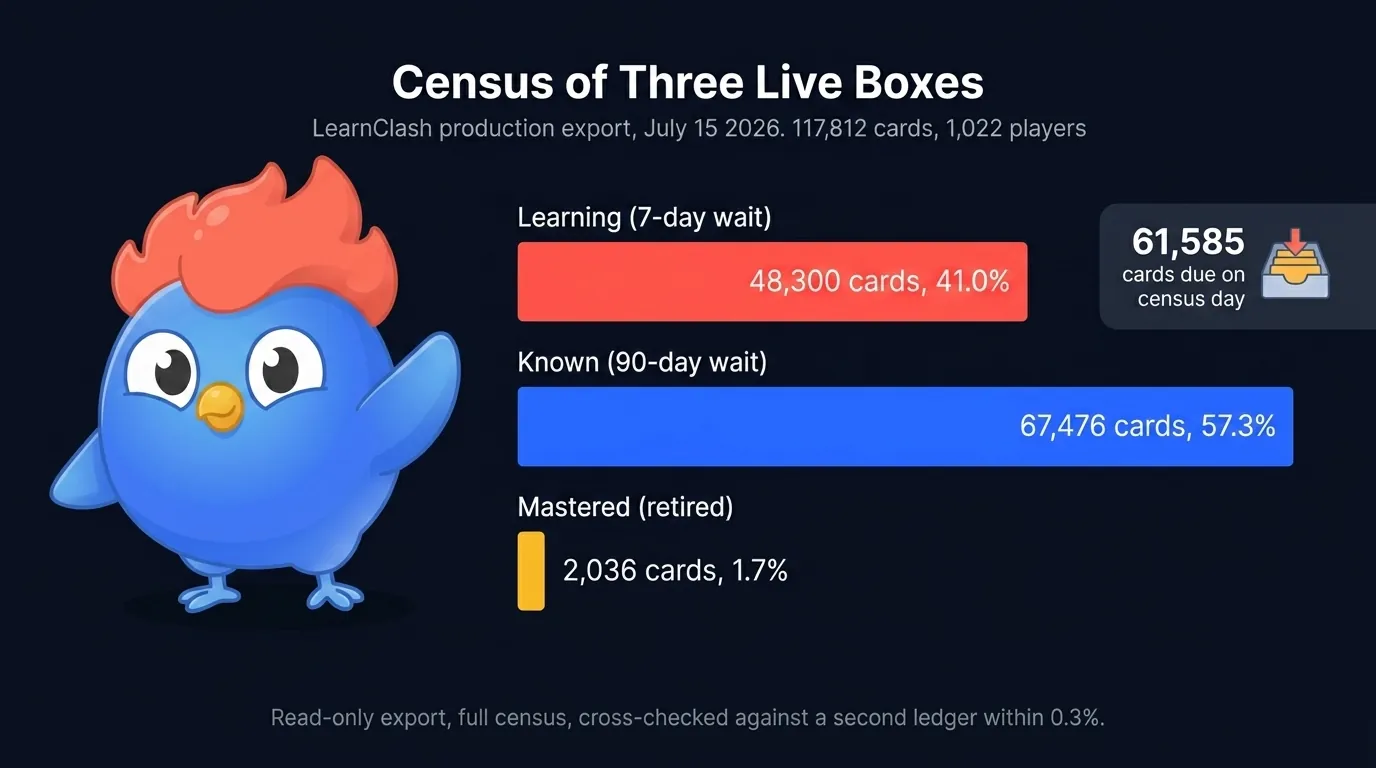
| LearnClash box | Cards | Share | Wait before next review |
|---|---|---|---|
| Learning (Box 1) | 48,300 | 41.0% | 7 days |
| Known (Box 2) | 67,476 | 57.3% | 90 days |
| Mastered (Box 3) | 2,036 | 1.7% | Never again; card retires |
That 1.7% mastery rate looks harsh until you see the gate it guards. A first-try correct answer sends a card straight to Known; a miss parks it in Learning for a 7-day re-check. From Known, the card has to be answered correctly again after the full 90-day wait.
There is no faster path: a correct answer during the wait keeps the card where it is and leaves its timer untouched. Mastery here means you held a fact across three months, which is why the third box fills slowly.
The census could also check the exit stamp directly. All but two of the 2,036 Mastered cards carried the sentinel timestamp of 31 December 9999, the “never again” date that the retention-curve breakdown unpacks.
Zoom into the waits and the census gets more textured:
| Card state on census day | Cards | Timing detail |
|---|---|---|
| Inside the 7-day Learning wait | 3,783 | Median 4.4 days from its next review |
| Inside the 90-day Known wait | 50,408 | Median 38.9 days from its next review |
| Past due for review | 61,585 | Median overdue Learning card: 55 days late |
That bottom row is the familiar one, because review debt survives digitization: players chase new topics, old misses pile up, and Box 1 overflows at production scale exactly as it does on a desk. More than half the corpus was due on census day.
The demotion rule leaves no per-event log, so an honest census counts stocks, not falls. One such stock: 2,175 Learning-box cards had been answered again in a later session and still sat in Learning, cards that got knocked back down or never escaped.
What changes in the app is how the debt clears. In a solo session, every due card the draw turns up is dealt before any new question, most overdue first, and in a duel a due card counts as fresh and competes with never-seen questions for the round’s slots. Either way, the box empties as a side effect of playing rather than of discipline.
One more census number tells that story. First answers split 111,014 in 1v1 duels against 7,361 in solo practice, which puts 93.8% of the mode-labeled first encounters inside a match rather than a review session. The topic ledger as a whole logs 118,691 first encounters, 316 of them with no mode label, and shows players getting 56.9% right on the first try. The boxes get filled, and refilled, mostly by people trying to win a match, with the Leitner machinery running underneath.
How LearnClash Modernized the Leitner System
Set the 1972 case next to the 2026 build and a reader of the original would recognize the promotion ladder at once.
| Leitner 1972 | LearnClash 2026 |
|---|---|
| Five cardboard compartments | Three stages: Learning, Known, Mastered |
| Review when a box is full | Per-card timers: 7 days, then 90 |
| Missed card resets to Box 1 | Missed card drops exactly one stage |
| Cards retire from the last box | Mastered cards leave the schedule; a duel round deals at most one back as filler unless nothing else is left |
| You grade yourself | The server grades a timed quiz answer |
| Daily discipline required | Due cards are dealt back into play |
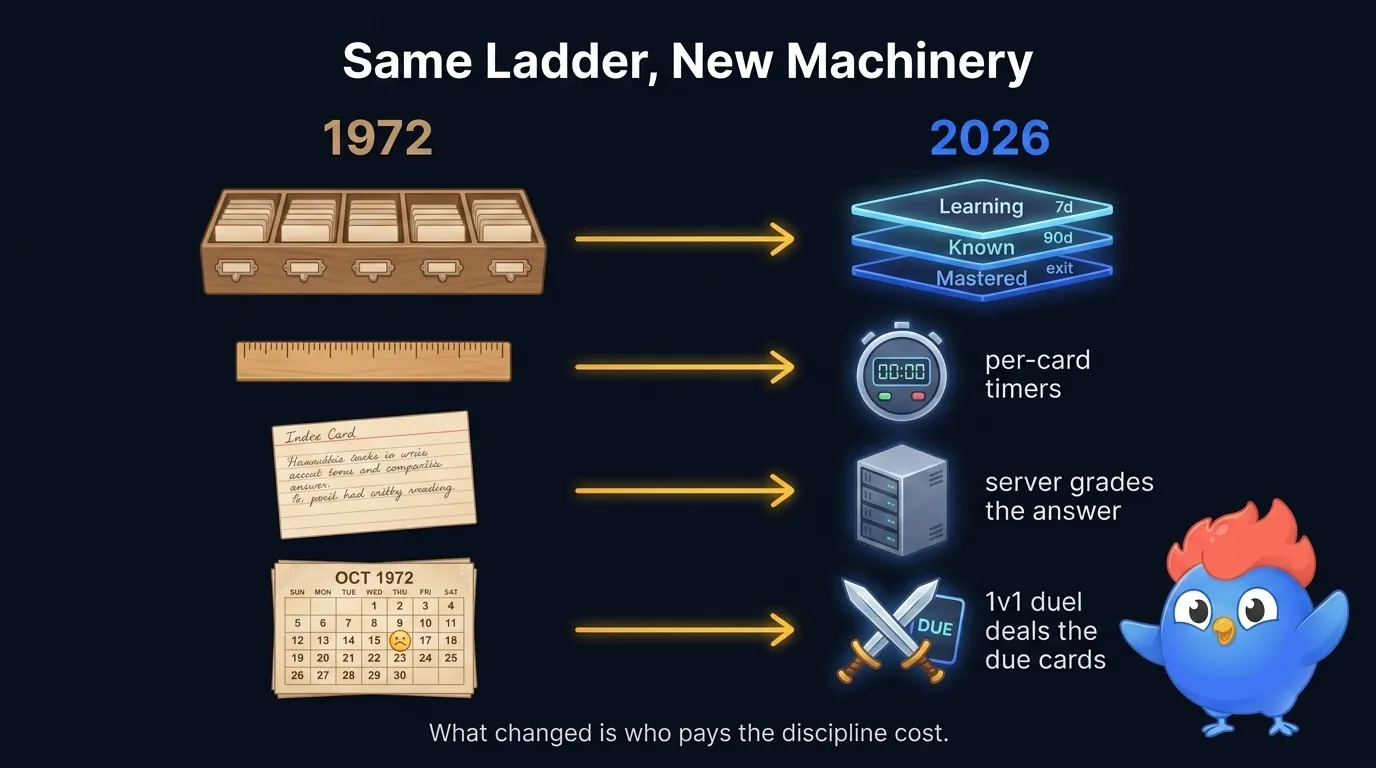
The one detail with no 1972 counterpart is the filler rule: a Mastered card has retired from the schedule, but a duel can still deal it, at most one per round unless nothing else is servable. The timers replace the calendar entirely; the 1/3/7/21 folklore schedule that circulates on study blogs is what keeping that calendar by hand looks like, and the learning-science hub collects the rest of the research behind the build.
Checked against the August 2026 codebase while updating this article: the intervals are still a two-entry list, 7 and 90, and the demotion is still one line. Leitner solved scheduling with a ruler. We solved it with two constants and a game people would play anyway.
Frequently asked questions
What is the Leitner system in simple terms?
It's a flashcard sorting method. Cards live in numbered boxes. Answer a card correctly and it moves up one box, where you review it less often. Miss it and it falls back for frequent drilling. Hard cards get daily attention, easy cards wait weeks, and your time lands where your memory is weakest.
How many boxes does the Leitner system use?
Sebastian Leitner's 1972 original used five compartments of increasing width: 1, 2, 5, 8, and 14 cm. The most common paper setup today runs three boxes on a daily, 3-day, and weekly rhythm. LearnClash's digital version also runs three stages: Learning at 7 days, Known at 90, and Mastered as the exit.
What happens when you get a card wrong in the Leitner system?
In the 1972 original, every missed card returns to Box 1 and starts over, even a card that had reached the last box. Popular variants soften this to a one-box drop, so one bad night never erases months of progress.
Is the Leitner system the same as spaced repetition?
The Leitner system is one implementation of spaced repetition, the general principle of reviewing material at growing intervals. Leitner's boxes were the first practical version most people could run at home. Modern software such as Anki applies the same principle with per-card timers instead of cardboard.