
Blooket vs Gimkit: Free Modes, AI, and Strategy [May 2026]
Blooket vs Gimkit, re-checked August 2026: what each free tier really allows, Khanmigo vs Gimkit AI, Season Ticket math, and the retention gap both share.

Most Blooket vs Gimkit comparisons still miss the update that flipped the unpaid-teacher math: Khanmigo.
Blooket is the safer free classroom pick because its free plan hosts up to 60 players, most of its 27 listed modes cost nothing, and Khanmigo, Khan Academy’s free AI assistant, writes the question sets. Gimkit wins paid strategy depth, and its creation side is more open than most roundups admit: KitCollab student authoring and Creative Platformer map building are free on any account, with the $5 Season Ticket selling exclusive Creative assets and cosmetics on top.
Blooket vs Gimkit: Quick Comparison
Blooket wins unpaid whole-class review: 60 players free, broad mode access, and Khanmigo question generation. Gimkit wins paid strategy sessions and student-built maps. The table below is the whole argument in one place; the rest of the article is the evidence.
| Feature | Blooket | Gimkit | LearnClash |
|---|---|---|---|
| Best unpaid use case | Full-class review with AI question prep | Featured-mode rotation | Self-directed duels |
| Free class access | 60 players | Unlimited on featured modes, 5 on Pro Exclusive modes | Daily duels |
| Game modes | 27 listed (23 year-round + 4 seasonal), 6 Plus-only | Featured rotation plus Pro Exclusive catalog | Duel, Solo, Open Play |
| AI question generation | Khanmigo (Khan Academy, Jan 2025), free | Gimkit AI Question Generator (2025), in-house | On demand, any topic, three difficulty tiers |
| Cross-session memory | None | Smart Repetition is session-only | 3-stage SRS (7 day, 90 day) |
| Best age fit | Grades 3-8 | Grades 6-12 | Teens and adult learners |
| Teacher setup | Required | Required | Not required |
| Ads | No | No | No, on every tier |
| Platform | Web | Web | iOS, Android, Web |
One distinction does most of the work in this comparison. Saying “Gimkit is only free for 5 students” is wrong, and saying “Gimkit is free for a full class” is incomplete. Gimkit Basic hosts a full class when the mode is featured that week, and drops to a 5-player cap on Pro Exclusive modes. Teachers rarely ask which platform is best in theory; they ask whether tomorrow’s game runs without a purchase order.
What I Re-Checked in August 2026, and What Changed
I re-verified this article against both companies’ own documentation on August 5, 2026, and the check caught something embarrassing. An earlier version of this page described two Blooket modes, Adventure Quest and Quiz Kingdom, that appear on dozens of Blooket fan sites but not on Blooket’s official Game Mode Previews page (last updated July 22, 2026). I could not verify those modes exist, so they are gone from this comparison. The official roster instead lists names most roundups skip entirely: Zorblitz, Star Grazer, Mini Mine, Plushie Panic, and Pirate Pool.
The verified 2025-2026 changes are still substantial. Blooket and Khan Academy launched the Khanmigo question generator partnership on January 21, 2025. Gimkit shipped its own in-house AI Question Generator later in 2025 and kept building out its Season Ticket program, which sells 75+ exclusive Creative terrains, props, and devices, 25 map slots, and seasonal cosmetics for $5 per season. One correction cuts the other way, though: Creative Platformer map building itself is not ticket-gated. Gimkit’s own Creative changelog opened it to every account in December 2024, so treat any page that sells the ticket as Platformer access (an earlier version of this one included) as out of date. And Blooket’s $9.99 month-to-month Plus Flex plan, which some roundups file under recent news, has been on the pricing page since 2023.
The same session-only pattern shows up in the Kahoot vs Blooket comparison and the broader games-like-Blooket ranking. Adding another platform to the comparison does not change the story.
Free Tier and Pricing: Predictable vs Powerful
Blooket has the cleaner free story: host up to 60 players on every non-Plus mode, with Khanmigo question generation included. Gimkit Basic is genuinely free for featured modes only, while Creative map building, Platformer included, is open to every account; the $5-per-season Season Ticket sells exclusive Creative assets and cosmetics, not access.
| Question teachers actually ask | Blooket answer | Gimkit answer |
|---|---|---|
| Can I host my whole class for free? | Yes, up to 60 players on free modes | Yes on featured modes (generally 3 rotate at a time) |
| What if the mode is premium? | 6 Plus-only modes require Plus | Pro Exclusive modes cap Basic hosts at 5 players |
| What is the larger live-game cap? | Plus raises most live games to 300 players (Racing and team modes stay at 60) | 500-player hard live limit, 60 for 2D modes |
| Is homework free? | Free homework deadlines max out at 14 days (365 with Plus) | Assignments are Pro-only |
| Annual individual plan | Blooket Plus $4.99/month billed annually ($59.88/yr) | Gimkit Pro $59.88/yr |
| Month-to-month plan | Plus Flex $9.99/month | Gimkit Pro $14.99/month |
| Season add-on | Not applicable | $5 per Season Ticket for 75+ exclusive Creative terrains, props, and devices plus cosmetics |
| School plan | $550/yr (10 seats) to $3,000/yr (80 seats) | $650/yr Department (up to 20 teachers) or $1,000/yr for an entire school |
| AI question generation | Khanmigo, free | Gimkit AI Question Generator, in-house |
The official docs back the practical split. Blooket’s help center says all essential features are free and free hosts can run games with up to 60 people. Blooket Plus adds 300-player live games, enhanced reports, folders, audio questions, set merging, and 365-day homework deadlines. On the other side, Gimkit’s Pro FAQ limits Basic to featured modes, with generally three free at a time, and the player maximums page adds the 5-player Pro Exclusive cap for Basic members.
That makes the free-tier choice less about generosity and more about predictability. Blooket is predictable. Gimkit is powerful, but the best mode for today’s lesson may sit outside this week’s free rotation.
Game Modes: Blooket Variety vs Gimkit Strategy
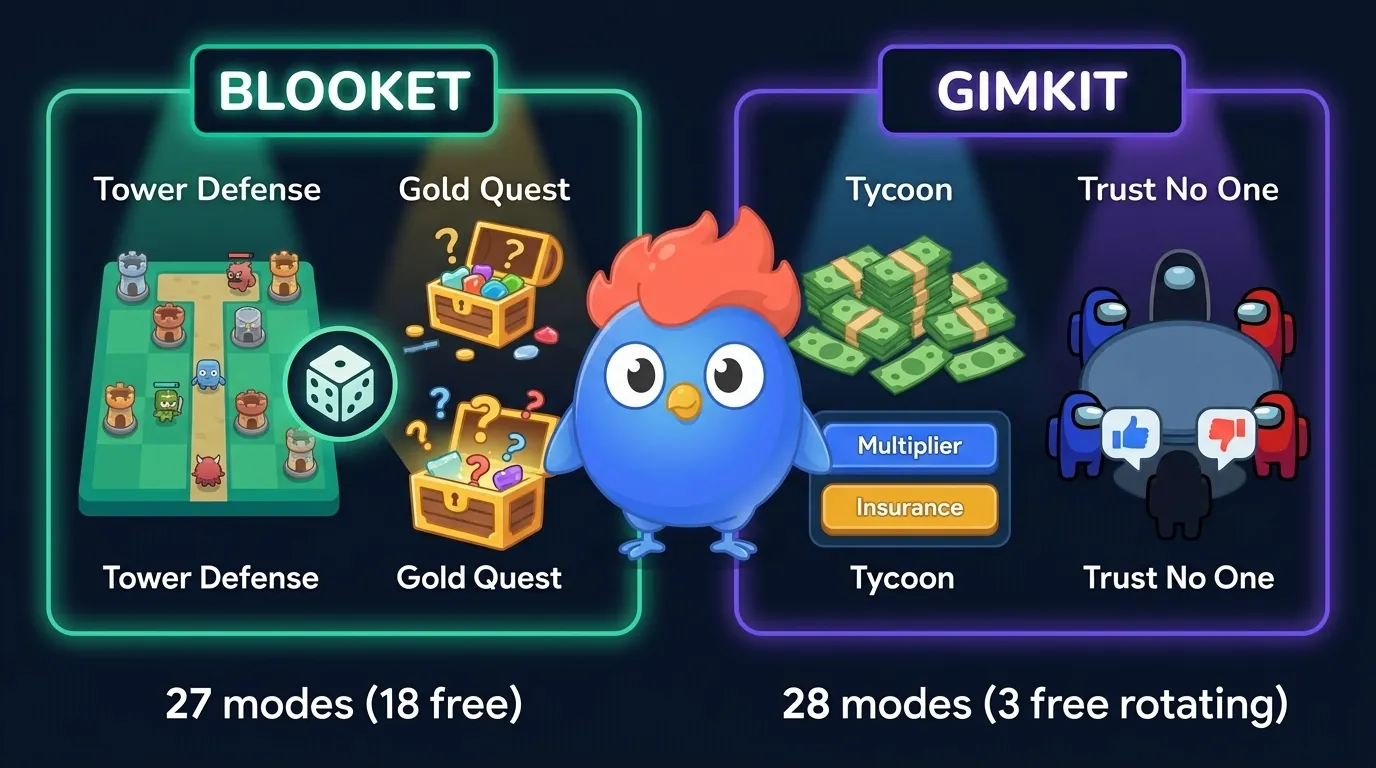
Blooket offers the broader free variety: 27 listed modes as of August 2026, including Gold Quest, Tower Defense 2, Crypto Hack, Monster Brawl, and solo modes like Zorblitz and Pirate Pool, with only 6 gated behind Plus. Gimkit offers deeper mechanics per mode: economy upgrades, 2D movement worlds like Fishtopia and Snowbrawl, and student-built Creative maps.
| Mode question | Blooket | Gimkit |
|---|---|---|
| Best quick mode | Classic or Racing | Classic or Tycoon |
| Best strategy mode | Tower Defense 2 or Crazy Kingdom | Tycoon, Farmchain, Capture the Flag |
| Biggest luck mode | Gold Quest | Less luck-heavy, more economy-heavy |
| Best 2D feel | Monster Brawl | Fishtopia, Snowbrawl, Don’t Look Down, Trust No One |
| Best student-built mode | None | Gimkit Creative and Creative Platformer (any account) |
| Best for quiet focus | Study, Tower Defense, solo modes | Most 2D and Tycoon modes |
| Mode count | 27 listed (23 year-round + 4 seasonal, 6 Plus-only) | Featured rotation + Pro Exclusive catalog |
Blooket’s modes mostly turn a correct answer into a reward roll or arcade progress. Gold Quest converts answers into chest picks that can grant, multiply, or steal gold, which is why it dominates room energy and frustrates teachers who want scores to track knowledge. Tower Defense 2 is where free Blooket gets closest to real strategy: answer questions, build towers, survive waves. The official previews page marks each hostable mode’s free cap at 60 players, with most rising to 300 on Plus; the solo and homework-only modes carry no player cap at all.
Gimkit feels different because correct answers usually become spendable value. In Tycoon-style modes, cash buys multipliers, insurance, and streak bonuses; in 2D modes, answers generate energy, bait, or snowballs that fuel movement and tactics. Creative Platformer extends this with side-view maps that any account can build; the Season Ticket layers 75+ exclusive terrains, props, and devices on top of the standard building kit.
The hidden tradeoff is question frequency. The more time students spend moving, shopping, fishing, or platforming, the fewer retrieval attempts they make per minute, which is fine for engagement and weaker for mastery. For a wider classroom-game map, see the games like Kahoot ranking.
AI Question Creation: Khanmigo Changed the Blooket Math
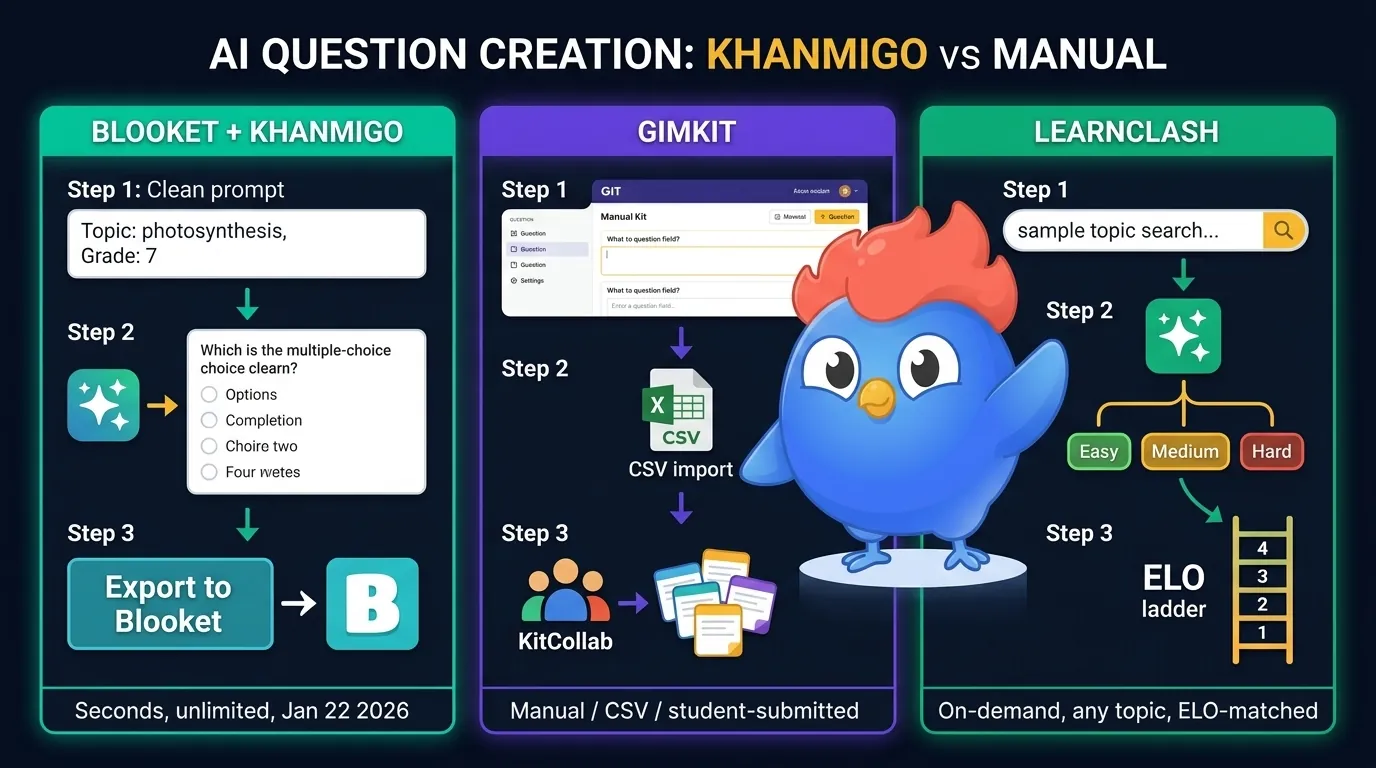
Blooket and Khanmigo launched their partnership on January 21, 2025. Teachers enter a topic and grade level, Khanmigo generates a complete multiple-choice set, and the set exports directly into Blooket. Gimkit answered with its own in-house AI Question Generator later in 2025 (announced that September), without a curriculum partner behind it.
| AI workflow | Blooket | Gimkit |
|---|---|---|
| AI question generator | Khanmigo (Khan Academy, Jan 2025) | Gimkit AI Question Generator (2025) |
| Cost | Free Khanmigo teacher account | No plan gating published in Gimkit’s help center |
| Topic flexibility | Any topic and grade level | Any topic, no published curriculum mapping |
| Workflow | Khanmigo prompt, review, “Export to Blooket” | In-Gimkit prompt, review, save as kit |
| Teacher prep time | Seconds | Seconds (AI) or minutes to hours (manual, KitCollab) |
Per Blooket’s help doc, teachers can start from either side: from Blooket’s Question Set Creator via the Khanmigo banner, or from the Khanmigo dashboard’s Blooket Generator, then export and save. Questions arrive as editable cards, so a teacher reviews and prunes before anything reaches students. Khan Academy’s curriculum spine is the real differentiator for standards alignment, and it is why, for unpaid teachers, Khanmigo plus Blooket is the strongest free AI-prep combo in classroom quiz games right now.
One caution on the Gimkit side of that table: the generator exists (Gimkit announced it in September 2025), but as of this August 2026 check, Gimkit’s help center does not document it, its limits, or which plans get it. Treat the row as what Gimkit has shown, not what it has committed to.
Learning Value: Smart Repetition vs Real Spaced Repetition
Both platforms create retrieval practice. Neither is a complete retention system, and the difference between them here is smaller than either marketing page suggests.
Gimkit’s headline learning feature is Smart Repetition. Its help page describes a lottery system: once a player has seen every question, questions repeat, and missed questions get more tickets in the draw. A deep-dive on the mechanic confirms the weighting is per-student and automatic. Useful, but it operates inside the session; Gimkit documents no carryover from one session to the next.
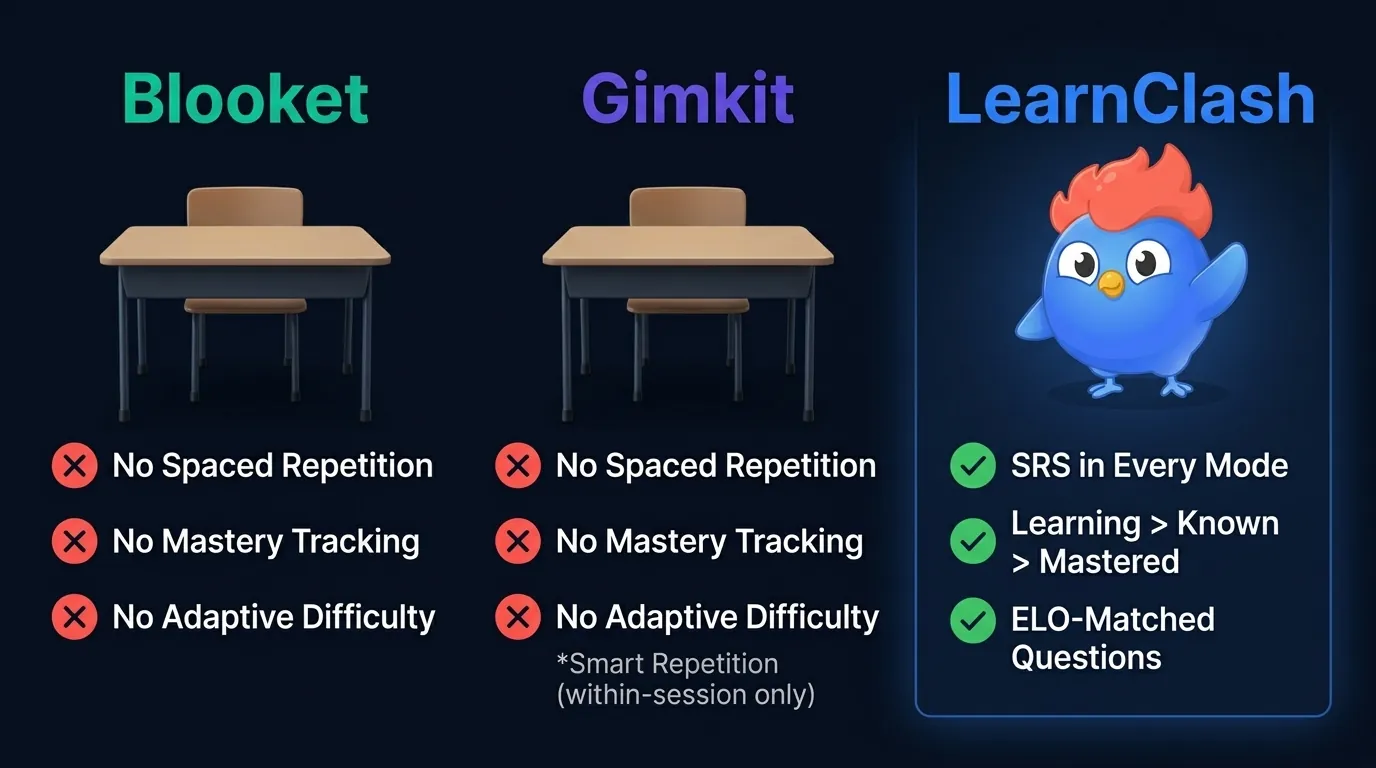
That distinction matters more than it sounds. Smart Repetition helps during the game. Spaced repetition plans what should come back days later. A question missed on Monday has no scheduled return on Thursday in either Blooket or Gimkit.
| Learning feature | Blooket | Gimkit | LearnClash |
|---|---|---|---|
| Retrieval practice | Yes | Yes | Yes |
| Missed-question retry | Mode-dependent, limited | Smart Repetition (lottery-style, session-only) | Wrong answers feed SRS |
| Cross-session SRS | No | No | Yes (7-day and 90-day intervals) |
| Mastery stages | No | No | Learning, Known, Mastered |
| Adaptive opponent skill | No | No | Glicko-2 rating from a 1300 start, calibrates over about 10 duels |
| Teacher required | Yes | Yes | No |
The classroom evidence is real but narrow. A 2025 action-research study on Gimkit-based vocabulary learning with 32 Indonesian seventh graders reported pass rates climbing from 18.75% on the pre-test to 90.6% after two Gimkit cycles. That measures reinforcement across a short intervention, not durable retention, and the authors used Gimkit’s rematch feature to force the repetition themselves.
Blooket is even more engagement-first: it has no memory stage at all, so the platform never knows which biology fact to bring back in seven days. Khanmigo solved Blooket’s creation problem, not its retention problem.
This is the layer LearnClash is built around. One duel creates 18 retrieval attempts; every miss enters 3-stage SRS, returning at 7 days as Learning, at 90 days once Known, and leaving the active pool when Mastered until a miss brings it back. The science here is not controversial: Roediger and Karpicke’s testing-effect study found repeated testing beat repeated studying for later recall (PubMed record), and the testing effect explainer plus why we threw out the 1-3-7-21 interval cover why the scheduling after the game decides what survives.
So, is Gimkit better than Blooket for learning? Slightly, if you mean in-session correction. Neither, if you mean long-term retention.
Content Creation and Teacher Workflow
Blooket now gets a teacher from nothing to a hosted game faster than Gimkit does: topic plus grade level into Khanmigo, review, export, host. The manual-creation step that defined Blooket prep before 2025 is optional.
Gimkit is stronger when creation itself becomes part of the lesson. KitCollab lets students and co-teachers submit questions for approval, live or asynchronously. A student who writes a good question has to understand the concept, predict wrong answers, and make the correct answer distinct, which can beat playing the finished game. CSV kit creation covers spreadsheet imports, and Gimkit Creative lets students build custom maps without coding: Basic accounts store 3 maps, Pro stores 10, and Creative sessions run with up to 60 people even on Basic.
| Workflow | Blooket | Gimkit |
|---|---|---|
| Manual quiz creation | Yes | Yes |
| AI-assisted creation | Khanmigo (free, Jan 2025) | AI Question Generator (2025) |
| Spreadsheet import | Limited | CSV import supported |
| Student question submission | No direct equivalent | KitCollab |
| Custom game worlds | No | Gimkit Creative + Creative Platformer (any account) |
The choice gets sharp here. Blooket asks how fast the teacher can launch a fun review game, and in 2026 the answer is as fast as Khanmigo writes the questions. Gimkit asks whether the class can help build the game itself.
Student Motivation and Cheating Risk
Blooket motivates younger students with collectibles. Blooket’s Market docs describe token-earned packs, rotating weekly shop items, and a Blook Score that tracks rarity and collection value, all paid in gameplay tokens rather than money. That is powerful for elementary and middle school rooms. It is also why some students play for pack openings more than content; if half the room is trading Blook rarities during fraction review, the game has partly eaten the lesson.
Gimkit’s loop is more strategic and skews older. Per Gimkit’s cosmetics docs, players earn XP in 2D modes, get 100 GimBucks per level, and face a 15-level weekly cap, with the item shop rotating Wednesdays at 2 PM Eastern. Cosmetics confer no gameplay advantage, but the weekly reset keeps students returning. Season Ticket holders add exclusive Gims and trails on top.
On cheating, the platforms diverge in documented ways. In April 2025, a Blooket session in a Nebraska Millard district middle school class was hijacked twice through third-party code, the second time with racist content, and the district blocked the platform for the rest of the school year. Blooket has since hardened the obvious surface: tokens, XP, and Blook ownership live server-side, so client-side cheats are rejected. Third-party “Blooket hack” sites remain a real malware risk for students who go looking.
Gimkit is not cheat-proof either; answer-bot scripts exist for it too. But its economy and 2D modes are harder to reduce to answer automation, because a bot that only picks answers misses the actual game in Snowbrawl, Capture the Flag, Trust No One, or Don’t Look Down. Students must move, spend, and react.
Either way, the sane teacher rule holds: leaderboard scores are review signals, not grade-book evidence. Use exit tickets or question-level reports when you need proof of learning.
Which One?
For a teacher with 30 students and no budget, the answer has not moved all year: Blooket, with Khanmigo writing tonight’s set. A school already paying for Gimkit Pro should lean into what that buys, the strategy modes, and let students build a Creative Platformer map while they are at it, since every account can. Grades 3-6 rooms light up for Blooket’s collectibles (save Gold Quest for low-stakes days); teens who have outgrown speed quizzes get more from Gimkit’s economy and 2D modes, and a review that should become a class project belongs in KitCollab. Studying alone, with no teacher and no projector, is the one situation neither tool covers, which is what LearnClash is for. And whichever platform hosts Friday’s game, remembering the material past Friday still needs something that schedules misses across days, because neither Blooket nor Gimkit does.
The part of this update I keep thinking about is not a feature at all. Adventure Quest and Quiz Kingdom, the two modes I deleted from this page in August 2026, are still described in loving detail across fan wikis, listicles, and AI answer boxes; the only place they do not appear is Blooket’s own previews page. Both platforms now ship, rotate, and retire modes fast enough that every static comparison, this one included, starts decaying the day it is published. So take the verdicts above, but before you plan tomorrow’s lesson around a specific mode, spend the thirty seconds to confirm it on the official mode list. That habit outlasts any roundup.
For a Gimkit-only deep dive including the Pro Exclusive cap and its AI generator, read the standalone Gimkit review. For adjacent matchups, see Kahoot vs Gimkit, the three-way Kahoot vs Blooket vs Gimkit breakdown, and the field guide to games like Gimkit.
Frequently asked questions
Is Blooket or Gimkit better for classrooms?
Blooket is better for unpaid classrooms: its free plan hosts up to 60 players, most of its 27 listed modes are free, and Khanmigo generates question sets at no cost. Gimkit is better when a school pays for Pro and wants its strategy modes; KitCollab authoring and Creative Platformer map building are free on any Gimkit account. Neither schedules missed questions to return days later.
Is Gimkit free for a full class?
Yes, but only on featured modes. Gimkit Basic hosts featured modes with unlimited students, and generally three free modes rotate at any given time. Pro Exclusive modes are different: Gimkit's player maximums page caps Basic hosts at 5 players on those, and the rotation changes every few weeks.
Which has more game modes, Blooket or Gimkit?
Blooket's official previews page lists 27 modes as of August 2026: 23 year-round and 4 seasonal, with 6 marked Plus-only. Gimkit's picker rotates featured free modes alongside its Pro Exclusive catalog. Blooket wins free variety; Gimkit wins paid depth plus student-built Creative maps, which any account can build.
What does the Khanmigo Blooket Generator do?
Khanmigo is Khan Academy's free AI assistant. Since the partnership announced January 21, 2025, teachers enter a topic and grade level and Khanmigo generates a complete multiple-choice set that exports directly into Blooket. Gimkit shipped its own in-house AI Question Generator in 2025 (announced that September), without Khanmigo's curriculum backing.
Can students cheat on Blooket or Gimkit?
Students try on both. In April 2025 a Blooket session in Nebraska's Millard district was hijacked twice through third-party code, the second time with racist content, and the district blocked the platform. Blooket has since moved tokens, XP, and Blook ownership server-side. Gimkit's economy and 2D modes are harder to automate because answers alone do not play the game.