
49 Dinosaur Trivia Questions [With Answers]
49 dinosaur trivia questions on anatomy, naming history, extinction, and what Jurassic Park got wrong. Answers and explanations included.
How many do you know?
Think of your answer, then reveal it.
Did you know it before revealing the answer?
Read this answer in the articleRound complete
Turn what you know into a quiz duel.
Start a new duel in LearnClash and learn from every answer.
Get LearnClashFree to play on iPhone and Android. No ads.
Try the questions you missed once more.

The spikes on a Stegosaurus tail have an official name, and a newspaper cartoonist invented it. Gary Larson drew a caveman lecturer pointing at them in a 1982 Far Side panel, crediting “the late Thag Simmons”, and paleontologists went ahead and adopted the word in earnest.
These 49 questions cover anatomy, naming history, behavior, the Chicxulub extinction, what Jurassic Park got wrong, record breakers, and the myths that survive mostly because well-read adults keep defending them. Answers are checked against the Smithsonian National Museum of Natural History, the Natural History Museum in London, and the primary papers named alongside the harder ones.
Seven categories, three difficulty tiers, 165 million years to work with. Dinosaurs are one of 34 sets in the full trivia question library.
The Set at a Glance
The table below doubles as a jump menu. The 49 split by category and difficulty, and they lean medium and hard on purpose, because the easy facts are the ones a nature documentary already handed you.
| Section | Questions | Easy | Medium | Hard |
|---|---|---|---|---|
| Anatomy That Defies Expectation | 1-7 | 1 | 2 | 4 |
| Names, Bones & Scientists | 8-14 | 2 | 3 | 2 |
| How Dinosaurs Actually Lived | 15-21 | 1 | 3 | 3 |
| The Day Everything Ended | 22-28 | 1 | 3 | 3 |
| What Jurassic Park Got Wrong | 29-35 | 0 | 5 | 2 |
| Record Breakers | 36-42 | 0 | 3 | 4 |
| Misconceptions That Fool Everyone | 43-49 | 2 | 4 | 1 |
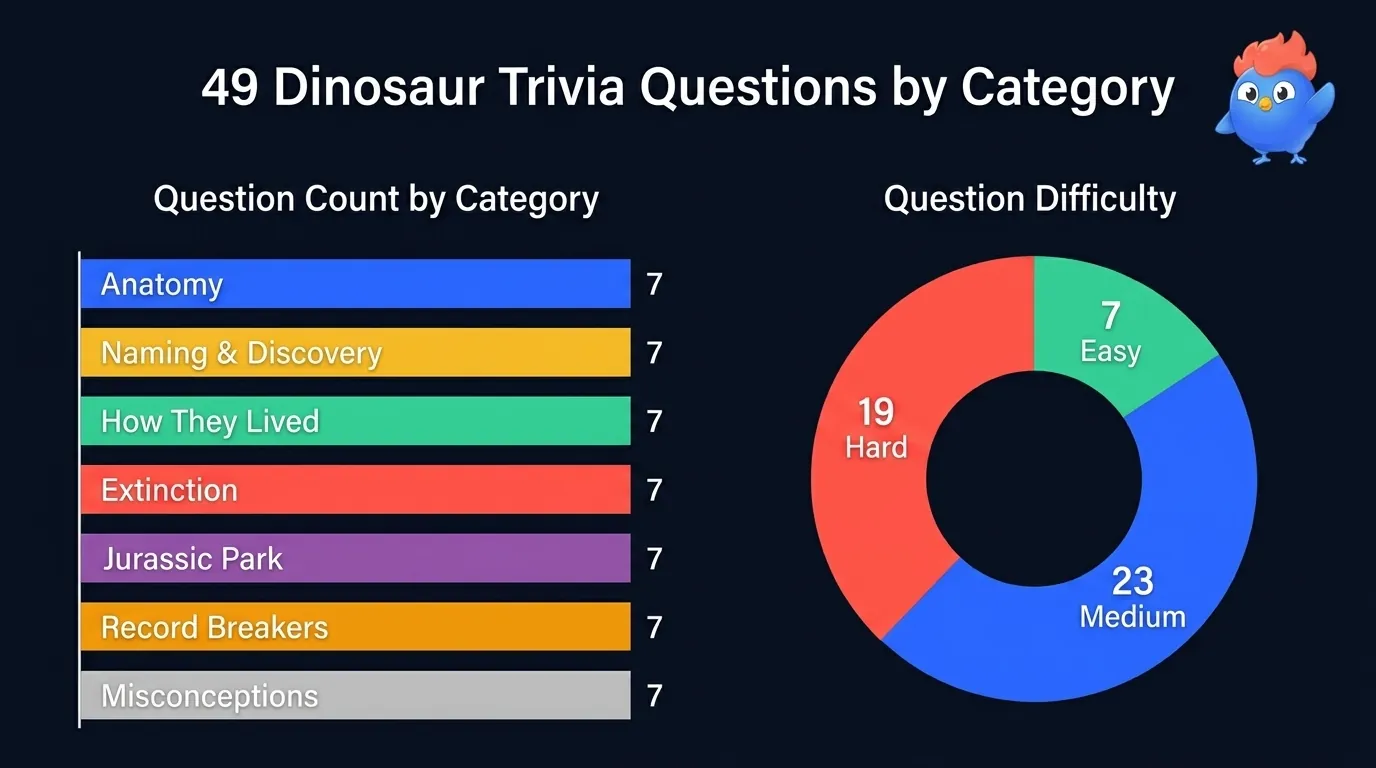 Seven sections of seven, and a difficulty curve that skips the documentary tier.
One pattern runs through the whole set: people are most confident right before they are most wrong. Everyone knows T-Rex had useless arms. Everyone knows Velociraptors were tall and scaly. Both beliefs are wrong, and both are held firmly.
Anatomy That Defies Expectation (1-7)
Seven questions built on body facts that read like typos when you first meet them. A plant eater with the longest claws on record. A skull narrower than the jaw hanging off it. Blood pressure numbers that no living animal comes close to.
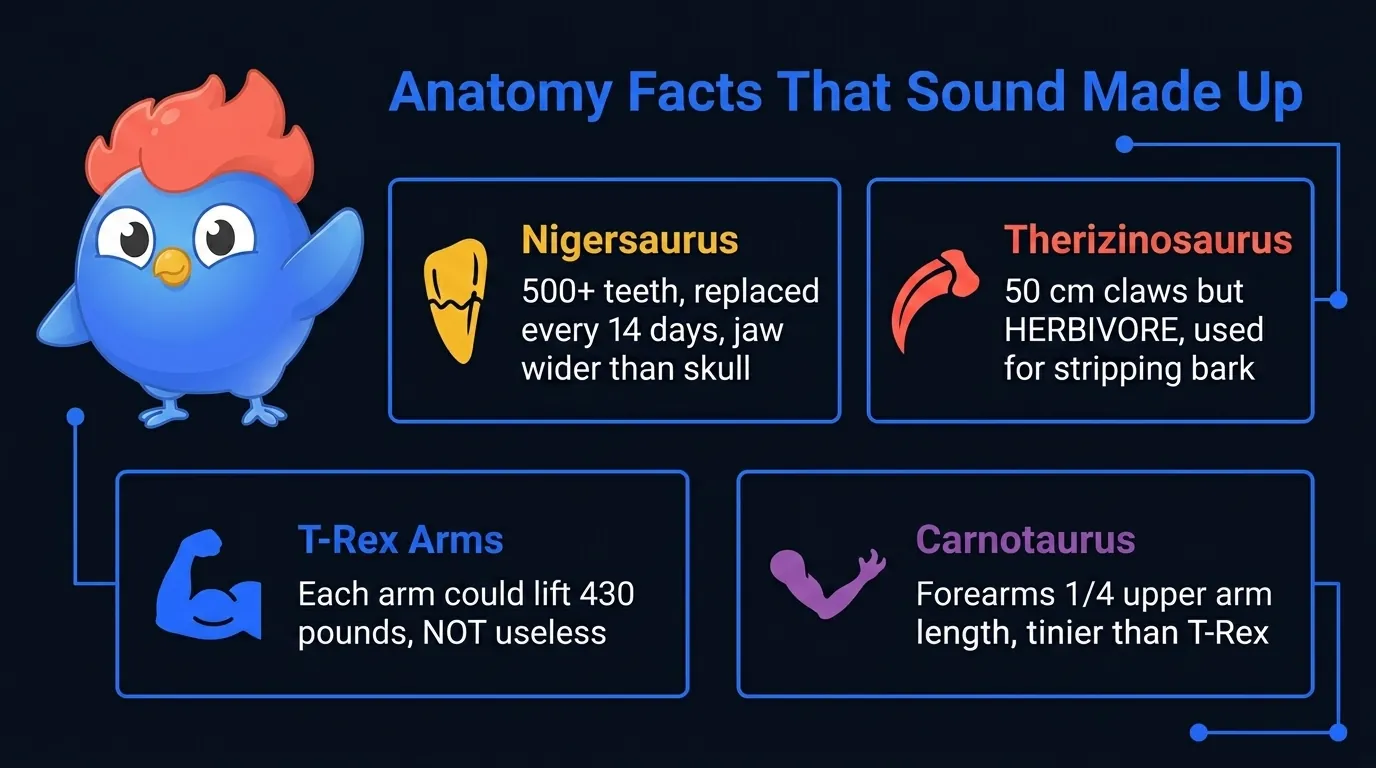 Four facts that rewrite the picture most people carry around.
1. How many teeth did Nigersaurus have at any given time? Hard
Answer: Over 500, each one replaced roughly every 14 days, with a column of up to nine replacement teeth stacked behind every active one.
Most people guess 50 or 80, which is the range a big carnivore jaw suggests. Nigersaurus ran an entirely different machine: a jaw wider than its skull, unique among known four-legged animals, with teeth set in a straight cropping edge at the front like a mower blade. Paul Sereno, who described it in 2007, reached for a vacuum cleaner as the comparison.
2. Therizinosaurus had the longest claws of any land animal ever. Was it a carnivore? Medium
Answer: No. It was a herbivore, and its claws (about 50 cm of bone core, longer once you add the keratin sheath) worked as hooks for pulling branches into reach.
Everything about the animal reads as predator, right down to its position on the raptor and bird side of the family tree. The claws were relatively slender though, built for reach and grip rather than slashing, which is how you end up with a plant eater wearing the most alarming hands in the fossil record.
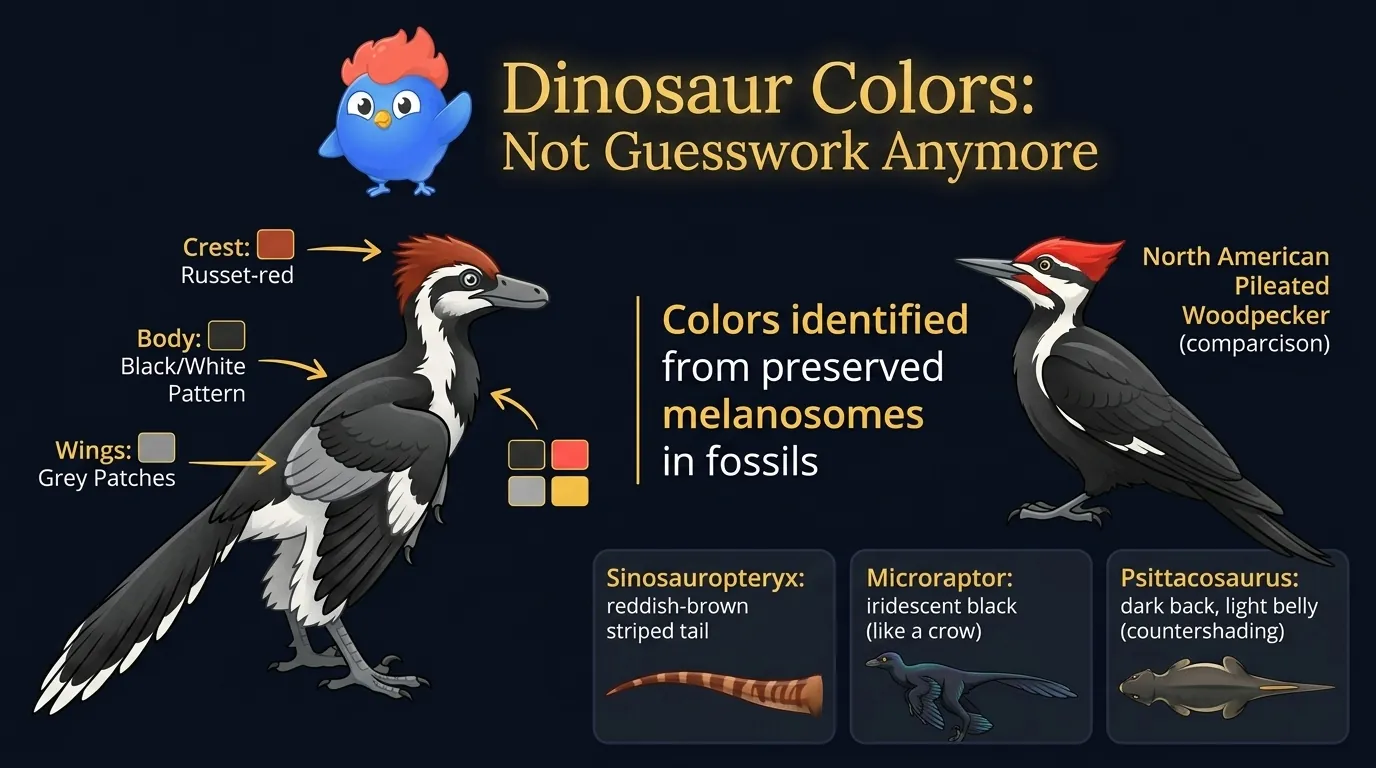
3. What can scientists now determine about some dinosaurs’ appearance that was previously impossible? Medium
Answer: Their actual colors, read from melanosomes, the pigment-bearing structures preserved in fossil feathers.
Dinosaur color was guesswork until researchers noticed two things: melanosomes keep their shape in fossils, and their shape maps onto specific colors in living bird feathers. The 2010 reconstruction of Anchiornis was the first full-body color map of any dinosaur, and it came out black, white and grey with a russet-red crest. Some fossils preserve the packed, ordered melanosomes that produce iridescence, so a few of these animals were glossy.
4. Were T-Rex’s arms actually useless? Easy
Answer: No. They were short, thickly muscled, and the most-quoted estimate puts a single biceps curl near 430 pounds.
The meme version treats them as vestigial jokes. Steven Stanley put the slashing case at a 2017 Geological Society of America meeting: two claws around 10 cm long, beveled like a bear’s, on a limb built for close-range damage rather than reach. Not everyone buys it, and Kevin Padian has argued in Acta Palaeontologica Polonica that the arms shrank for a much less heroic reason, namely that short arms are harder for a neighbour to bite off during a feeding frenzy.
5. Which large theropod had proportionally even smaller arms than T-Rex? Hard
Answer: Carnotaurus. Its forearms ran about one quarter the length of its upper arms.
T-Rex takes all the tiny-arm jokes and is not even the best candidate. Carnotaurus, a horned predator from Argentina known from a single well-preserved skeleton, had forearms so reduced that the elbow barely worked as a joint.
A few of these questions beat our own players, and the widest miss is not about arms at all. Checking the July 27, 2026 LearnClash answer export for anything dinosaur-related with at least ten first-time answers behind it gave me 40 questions and 697 answers, median around 56 percent correct. Three of the 40 had a wrong option outdraw the right one, and the biggest gap of the three was about the hand: ten of fifteen first-time players said T-Rex had three claws per hand, against five who said two, which is the answer.
Fifteen answers is a thin sample, well under the 30 I use as a floor before treating a number as publishable, so I would call that a lead rather than a finding. It does fit the history, though. The first complete T-Rex forelimb was not dug up until 1989, and the earlier reconstructions borrowed a three-fingered hand from Allosaurus, which gave the wrong version most of a century to settle into books.
6. What modern disease has been diagnosed at the cellular level in a 77-million-year-old dinosaur bone? Hard
Answer: Osteosarcoma, the aggressive bone cancer that turns up in human teenagers, found in the lower leg bone of a Centrosaurus from Alberta.
Cancer feels like a modern affliction and is nothing of the kind. The 2020 diagnosis in The Lancet Oncology ran the same imaging and thin-section histology a hospital would use on a living patient, then compared the fossil directly against a human osteosarcoma specimen. Other fossils carry arthritis, healed fractures and bone infections.
7. What blood pressure would a sauropod like Giraffatitan have needed to pump blood to its brain? Hard
Answer: Roughly 770 mmHg, about eight times a typical mammal’s, for an animal holding its head 13 metres up.
Human blood pressure sits near 120 mmHg, and a giraffe runs somewhere around 250. Roger Seymour’s modelling of sauropod circulation suggests a heart working against pressures in that range would burn energy at roughly the rate of the entire rest of the body, which is the reason some researchers argue there must have been help: a secondary pump in the neck, or a habitual posture that kept the head lower than museum mounts imply.
Names, Bones & the Scientists Behind Them (8-14)
Textbooks bury the naming stories in footnotes, which is a shame, because paleontology has never been especially dignified about names. A comic strip named the Stegosaurus tail spikes. Schoolchildren named a genus after Hogwarts. The first dinosaur bone on record was filed as part of a giant human.
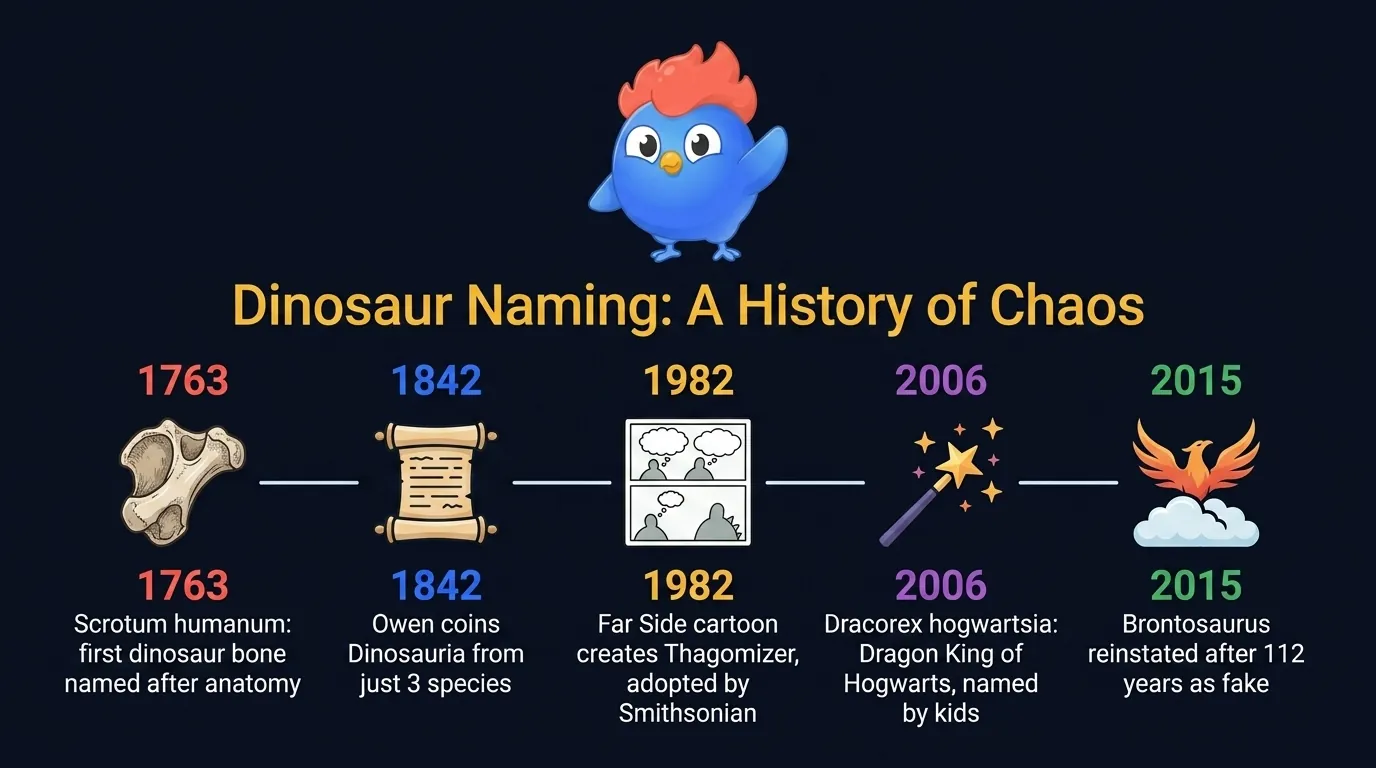 Five milestones that show how loosely the naming actually ran.
8. What is the scientific term for Stegosaurus tail spikes, and where did it come from? Medium
Answer: Thagomizer, from the 1982 Far Side panel.
Ken Carpenter used the word at a Society of Vertebrate Paleontology meeting in 1993 and it spread from there. The Smithsonian uses it, the BBC uses it, and it appears in the literature. No committee approves informal anatomical terms, which is exactly how a one-panel comic ends up naming a body part.
9. What did scholars name the very first dinosaur bone fragment when it was described in 1763? Hard
Answer: Scrotum humanum. Robert Plot illustrated the broken end of a Megalosaurus femur in 1677, and Richard Brookes attached that label when he republished the figure in 1763.
In 1970 Beverly Halstead pointed out that, on a strict reading of naming priority, the label had a technical claim on being the official name for Megalosaurus. William Sarjeant petitioned the zoological nomenclature commission to suppress it in 1993, and the commission ruled the petition unnecessary: a caption under an illustration was never a valid act of naming in the first place. Dinosaur science therefore opens with a label no journal would print now.
10. Oviraptor means “egg thief.” Was it actually stealing eggs? Medium
Answer: No. It was named in 1924 after being found on a nest assumed to belong to Protoceratops. In the 1990s, embryos found inside that same type of egg showed the nest was its own.
Seventy years of a name that accused an animal of a crime it did not commit. Later specimens preserve oviraptorids crouched over their clutches with their arms spread wide, in a posture that reads unmistakably as brooding. Naming rules do not allow a correction for accuracy, so the egg thief keeps the name permanently.
11. What does the dinosaur name Dracorex hogwartsia translate to? Easy
Answer: “Dragon king of Hogwarts.” Children visiting the Children’s Museum of Indianapolis picked the name, and Bob Bakker’s team described it formally in 2006.
The skull came out of South Dakota, flat-topped and spiky and genuinely dragon-like. Worth adding: several researchers now read Dracorex as a juvenile Pachycephalosaurus rather than its own genus, which would make it the only dinosaur named by children and then dissolved by a growth curve.
12. Who excavated the first scientifically described ichthyosaur, and how old were they? Medium
Answer: Mary Anning, aged 12 when it started. Her brother Joseph found the skull in autumn 1811, and Mary dug out the rest of the skeleton about a year later.
A working-class girl from Lyme Regis with no formal training went on to find the first plesiosaur and the first British pterosaur. She sold fossils to survive, was barred from the Geological Society of London because of her sex, and repeatedly watched buyers publish her finds under their own names.
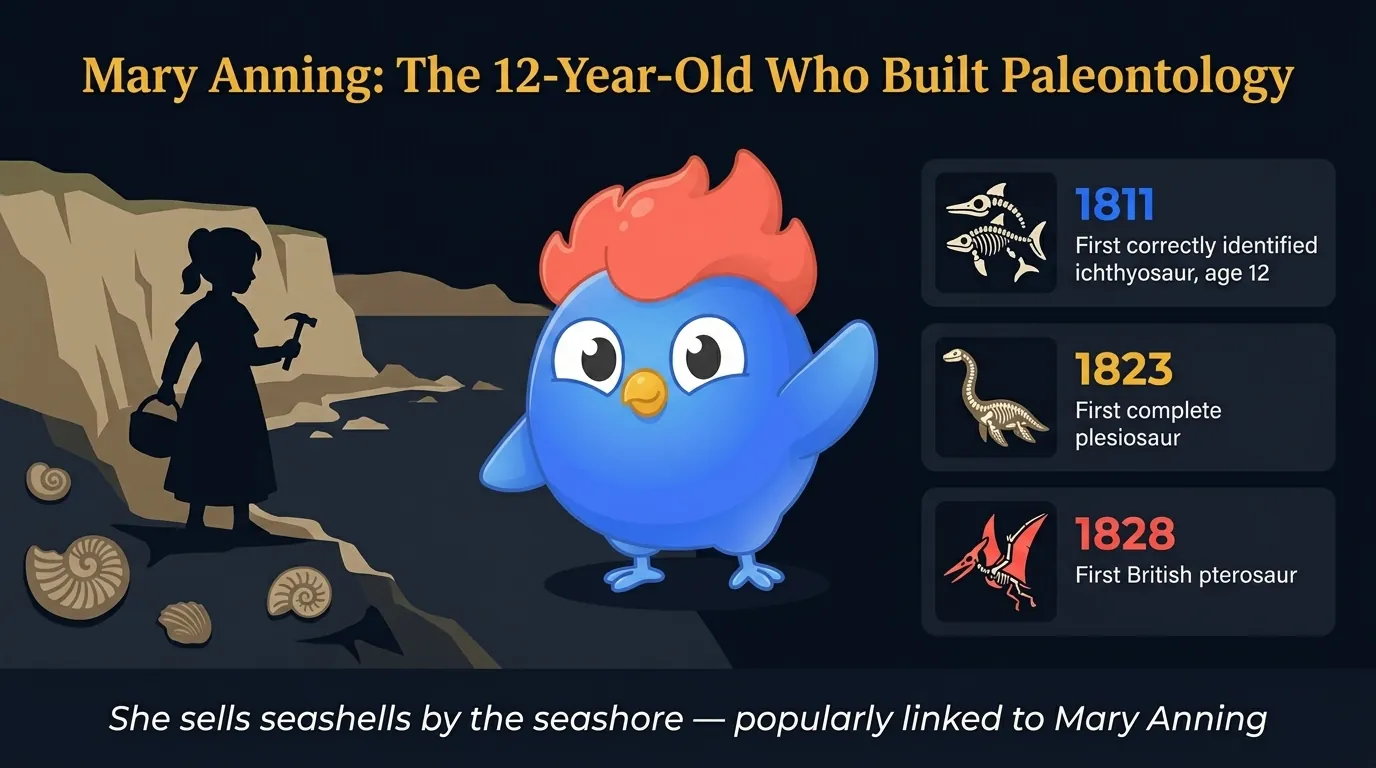 Three landmark finds, all from the same stretch of English coastline.
13. For how many years was Brontosaurus considered a fake dinosaur before being reinstated? Easy
Answer: 112 years. Sunk into Apatosaurus in 1903, restored as a valid genus by a 2015 analysis in PeerJ.
Generations of teachers taught kids that Brontosaurus was a filing error: the right head on the wrong body, the wrong name on the right animal. Tschopp and colleagues then ran a specimen-level comparison across 81 sauropod specimens, 49 of them diplodocids, and found the differences large enough to justify splitting the two back apart. It is not unanimous, and some paleontologists still lump them.
14. How many species did Richard Owen have to work with when he coined the word “Dinosauria” in 1842? Hard
Answer: Just three: Megalosaurus, Iguanodon and Hylaeosaurus.
Owen built a whole new group out of three fragmentary skeletons and one shared trait he thought carried weight, the fused sacral vertebrae anchoring the hip. Around 1,400 species are named today, from more than 90 countries, and the concept has held up better than most nineteenth-century categories.
How Dinosaurs Actually Lived (15-21)
Behavior is the part of paleontology that always has to be inferred, and the inferences in this section come from fossilized dung, trackways, bone histology and physics. Not one of them comes from a film.
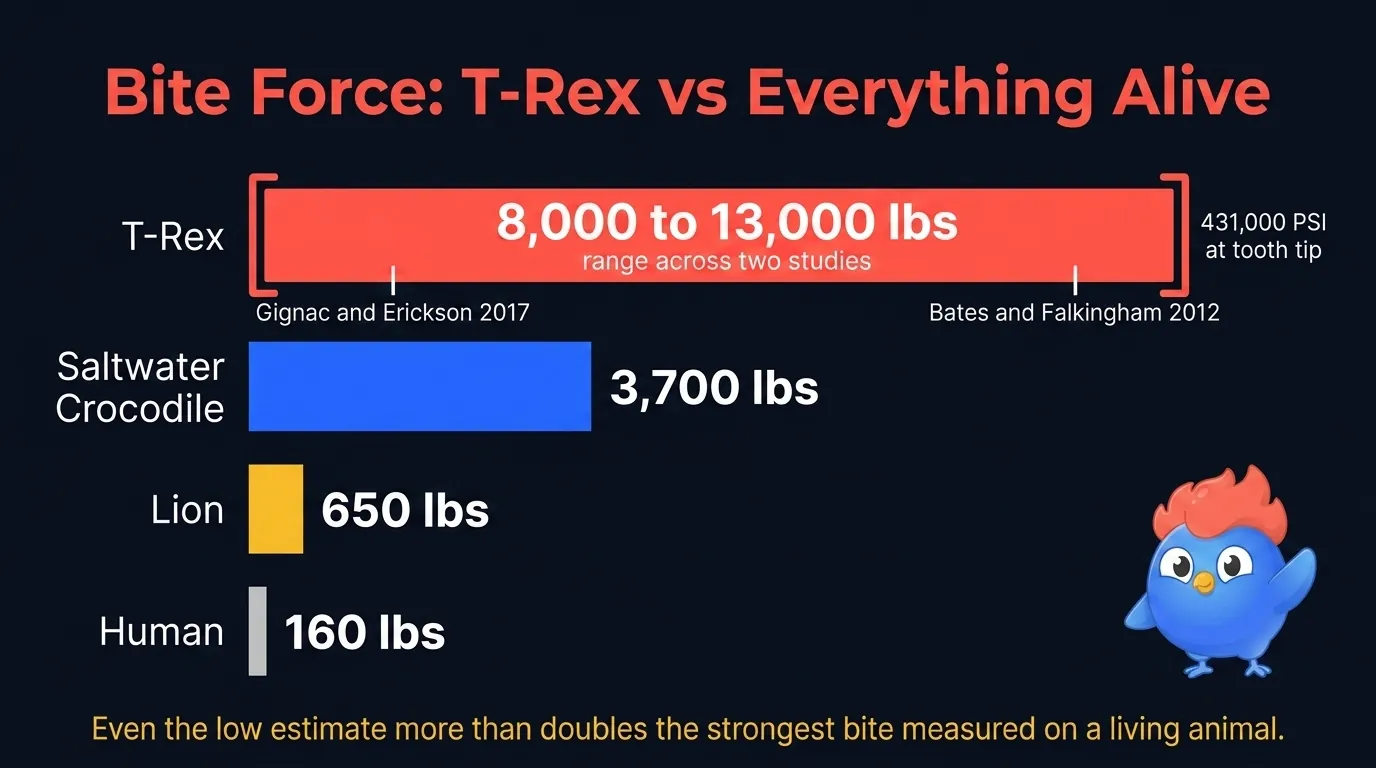 Even the low estimate for T-Rex is roughly double the strongest bite ever measured on a living animal.
15. How much bite force could T-Rex generate? Medium
Answer: Somewhere between about 8,000 and 13,000 pounds of force, depending on the model, with pressure at the tooth tips reaching roughly 431,000 PSI.
Gignac and Erickson landed near the low end in 2017; Bates and Falkingham reached nearly 13,000 pounds in 2012 with a different method. The strongest bite ever measured on a living animal belongs to the saltwater crocodile at about 3,700 pounds, so even the conservative estimate more than doubles it. What that force buys is bone: T-Rex is one of very few predators known to have routinely crushed and digested it, and Triceratops frills turn up punched through with tooth-shaped holes.
16. Were herbivorous dinosaurs strictly plant-eaters? Hard
Answer: No. Hadrosaur coprolites from Utah contain crustacean shells alongside the rotted conifer wood.
Karen Chin’s team found the pattern in dung from the Kaiparowits Formation: fossilized droppings packed with decaying wood and, tucked inside, the remains of shelled invertebrates. Modern deer and cattle do the same thing when they need protein or minerals, usually in the run-up to breeding. Herbivore summarises a diet rather than enforcing one.
17. Did dinosaurs roar? Easy
Answer: Probably not. The evidence points to closed-mouth sounds: booms, coos and low rumbles of the sort crocodilians and ostriches make.
The roar is a sound-design decision, assembled for Jurassic Park out of a baby elephant, a tiger and an alligator. Closed-mouth vocalization has evolved repeatedly in living archosaurs, which is the main argument for it in extinct ones, and hadrosaur head crests read as resonating tubes tuned to low frequencies that carry a long way.
18. How do we know that Maiasaura parents fed their babies at the nest? Hard
Answer: Hatchling leg joints were too poorly formed for walking, yet their teeth were already worn from chewing.
Two facts that only fit together one way: somebody was bringing food in. The nests at the Montana site sat roughly one adult body length apart across the whole ground, which is a colony rather than a coincidence, and the name Maiasaura means good mother lizard.
19. What did stomach stones found in a Wyoming sauropod reveal about its lifetime? Medium
Answer: The stones, called gastroliths, came from Wisconsin, more than 600 miles from the Wyoming rock they ended up in.
Josh Malone’s team matched zircon grains in the polished stones to the 1.7-billion-year-old Baraboo quartzite in Wisconsin, then traced where they were found in Wyoming’s Morrison Formation. Published in Terra Nova in 2021, the work more than doubles the longest journey previously credited to a sauropod. The stones did double duty in life, grinding food the way grit works in a bird’s gizzard.
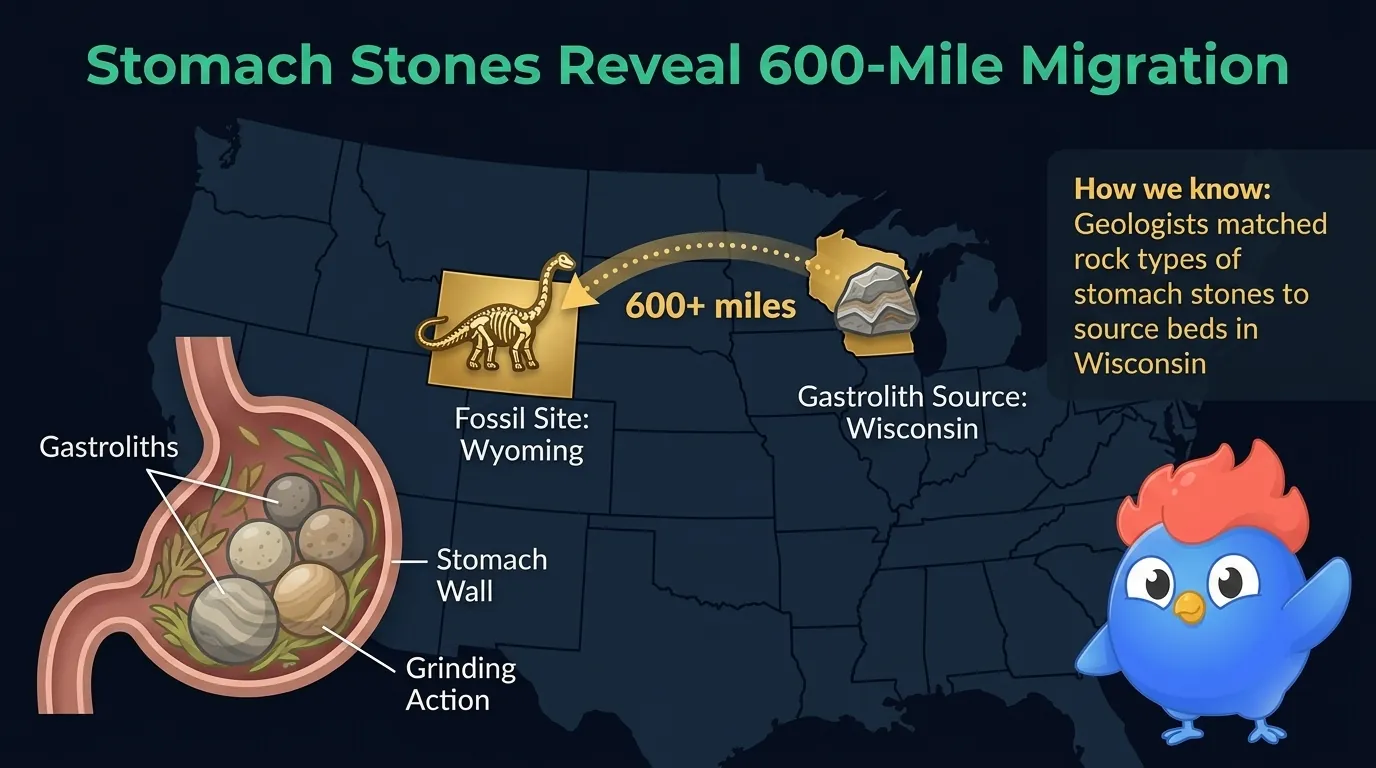 Wisconsin to Wyoming, carried in a stomach.
20. How early did dinosaurs form complex herds? Hard
Answer: At least 193 million years ago, from a Mussaurus nesting ground in Patagonia.
The site preserves eggs, hatchlings, juveniles and adults sorted by age group across the same ground, which is the signature of a social herd rather than an accident of burial. The MIT-led dating pushed the origin of that behavior back roughly 40 million years earlier than anyone had evidence for.
21. How many new dinosaur species are described per year? Medium
Answer: 44 were named during 2025, close to one a week, and the rate has been climbing for two decades.
Ask around and people will tell you the field is finished. The 2025 crop includes Zavacephale rinpoche, the earliest known dome-headed dinosaur, out of the Gobi, and Huayracursor jaguensis, a two-metre Triassic sauropod ancestor from Argentina that shows the neck already starting to stretch. China, Argentina and Mongolia lead the new-name count year after year. The Conversation’s roundup has the full 2025 list.
The Day Everything Ended (22-28)
Everyone knows about the asteroid. The interesting parts are the specifics: what hit, how fast, what it landed on, and the very simple rule that decided who lived.
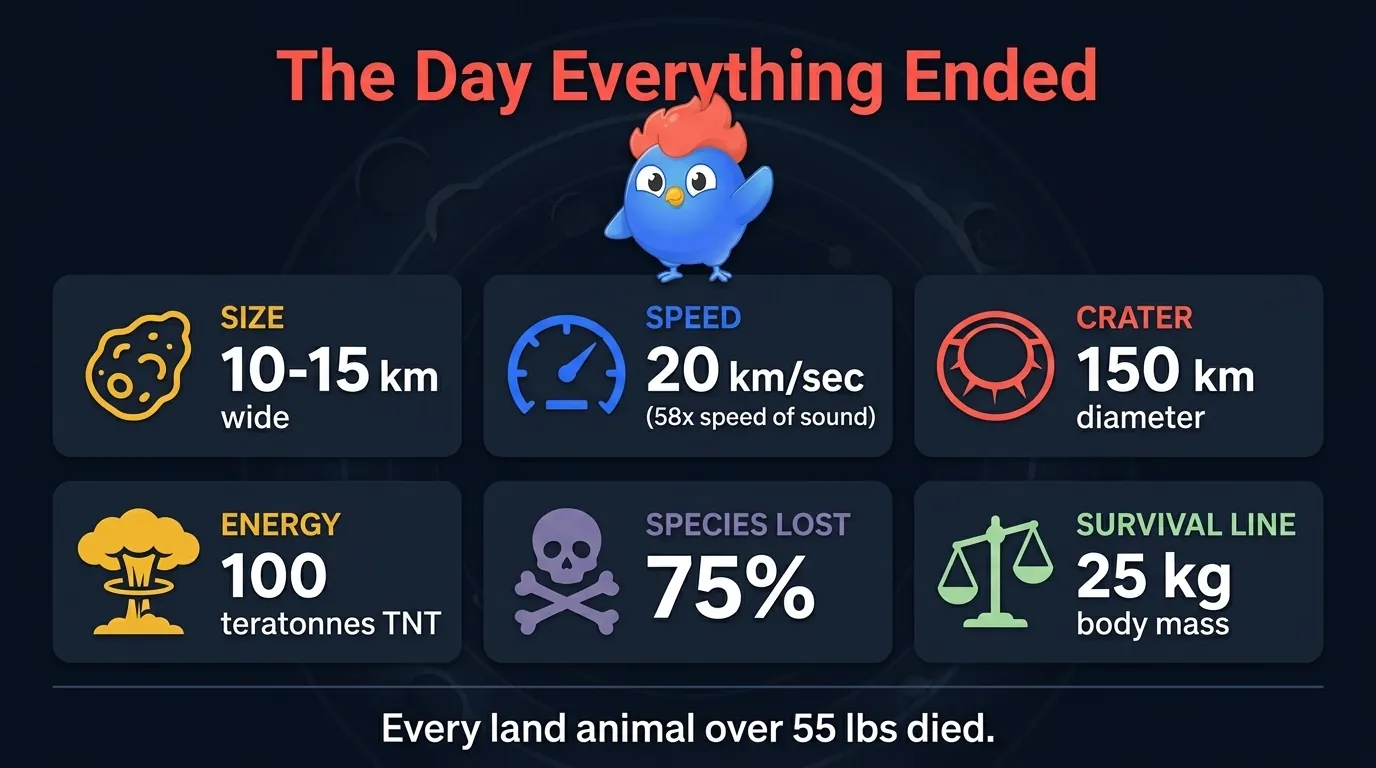 The impact in numbers: a crater about 180 km across, about 75% of species gone, and a hard ceiling at 25 kg on land.
22. How powerful was the Chicxulub asteroid impact in terms of energy? Medium
Answer: Roughly 100 teratonnes of TNT. The object struck the Yucatan at about 20 km per second, some 58 times the speed of sound.
The crater is about 180 km across. What made the impact a global extinction rather than a regional catastrophe was partly the target: shallow seawater over sulfur-rich carbonate rock, which is close to the worst surface on the planet to hit. The sulfur went up as aerosol, the sky closed, and photosynthesis stalled for months to years.
23. What body mass threshold separated the animals that survived from those that didn’t? Hard
Answer: About 25 kilograms (55 pounds). Almost nothing on land above that weight came through.
Survivors were small, or cold-blooded, or burrowing, or aquatic, and usually more than one of those at once. Crocodilians made it on low calorie demand and freshwater food chains that ran on detritus rather than living plants. Body size remains the cleanest single predictor anyone has found for who died.
24. On how many continents have dinosaur fossils been discovered? Medium
Answer: All seven, Antarctica included. Cryolophosaurus, a crested predator around 21 feet long, came out of the ice in 1991.
Antarctica is the continent everyone forgets, and in the Early Jurassic it sat far closer to the equator, forested and mild. The rock does not care where the continent drifted afterwards.
25. What specific type of space object was the dinosaur-killing asteroid? Hard
Answer: A carbonaceous chondrite, a C-type asteroid, identified in 2024 from the ruthenium isotopes in the impact layer.
For decades the argument ran comet against asteroid with no way to settle it. Fischer-Gödde and colleagues published the ruthenium measurement in Science in 2024, and the isotopic fingerprint matched carbon-rich asteroids that formed in the outer solar system while ruling out a comet.
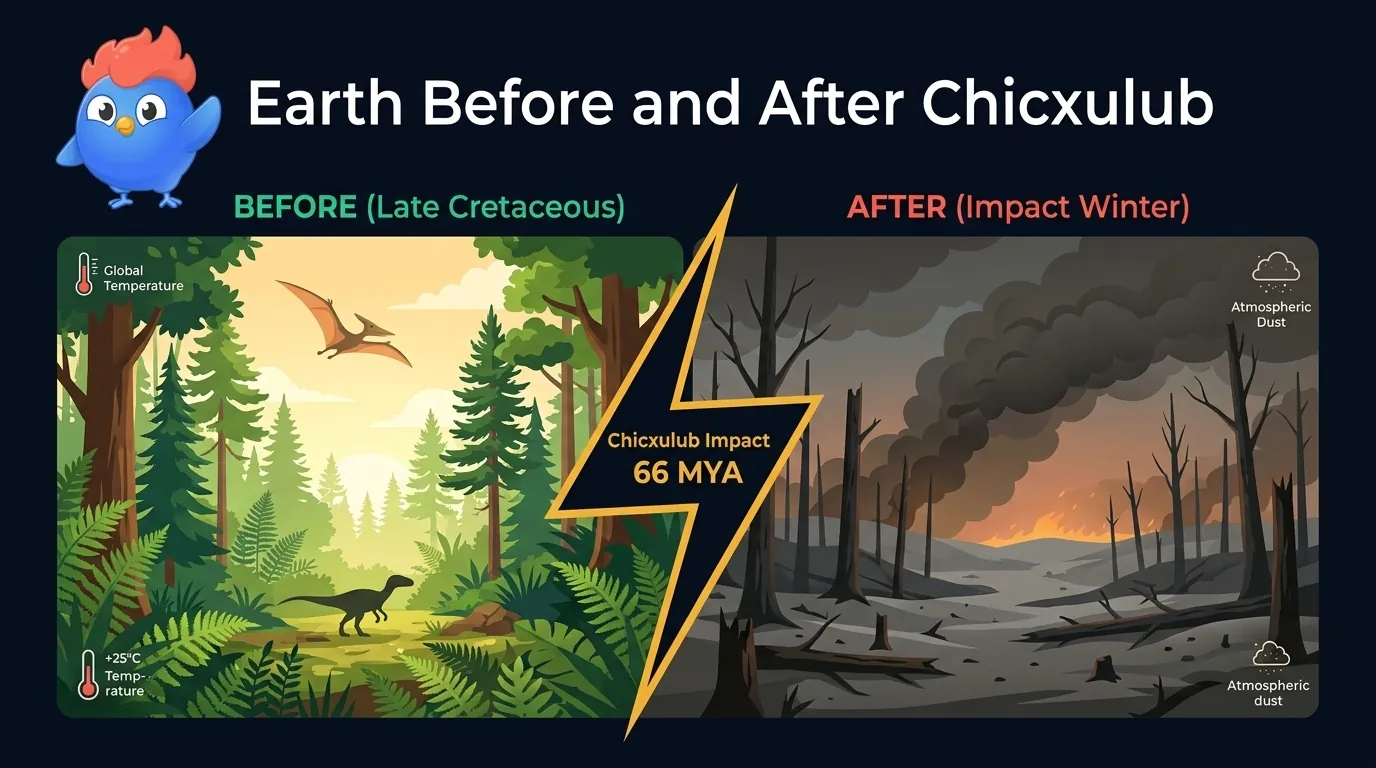
26. How quickly did ecosystems recover after the Chicxulub impact? Hard
Answer: Much faster than the textbooks said. New plankton species appear within a few thousand years of the impact layer.
The old timeline assumed sediment kept accumulating at its pre-impact rate, which it did not, because the die-off changed how fast the seafloor built up. A January 2026 study in Geology from teams at UT Austin and Penn State re-dated the boundary using a rare isotope marker and found 10 to 20 new species of foraminifera appearing within about 6,000 years, some of them inside 2,000. Recovery of the full ecosystem still took far longer, but the first evolutionary response was almost immediate on a geological clock.
27. Did dinosaurs exist for longer than they’ve been extinct? Easy
Answer: Yes, by a factor of about 2.5. Non-avian dinosaurs ran from roughly 231 to 66 million years ago, and have been gone for 66 million since.
Deep time flattens into one mental bucket labelled “long ago”, which is why the ratio surprises people. Compress Earth’s 4.5 billion years into a single calendar year and dinosaurs arrive around December 13, disappear around December 26, and modern humans turn up with about half an hour left on December 31.
28. Which appeared on Earth first: sharks, trees, or dinosaurs? Medium
Answer: Sharks, by a wide margin. Sharks go back roughly 450 million years, trees about 385 million, dinosaurs about 230 million.
Dinosaur gets treated as a synonym for oldest, and it is nowhere close. Shark-like scales appear in the record before the first forests existed, and the lineage has now lived through all five mass extinctions. Timeline questions are the ones people argue about longest, and the extinction that closed the dinosaur run has its own playable topic on the K-Pg event.
What Jurassic Park Got Wrong (29-35)
Jurassic Park got five things wrong that matter, and all five are questions in the LearnClash dinosaur set. Velociraptor was turkey-sized and feathered. T-Rex could see you perfectly well while you stood still. The amber mosquito on screen belongs to a genus whose adults do not drink blood. Dilophosaurus had neither a frill nor venom. And most of the cast lived in the Cretaceous.
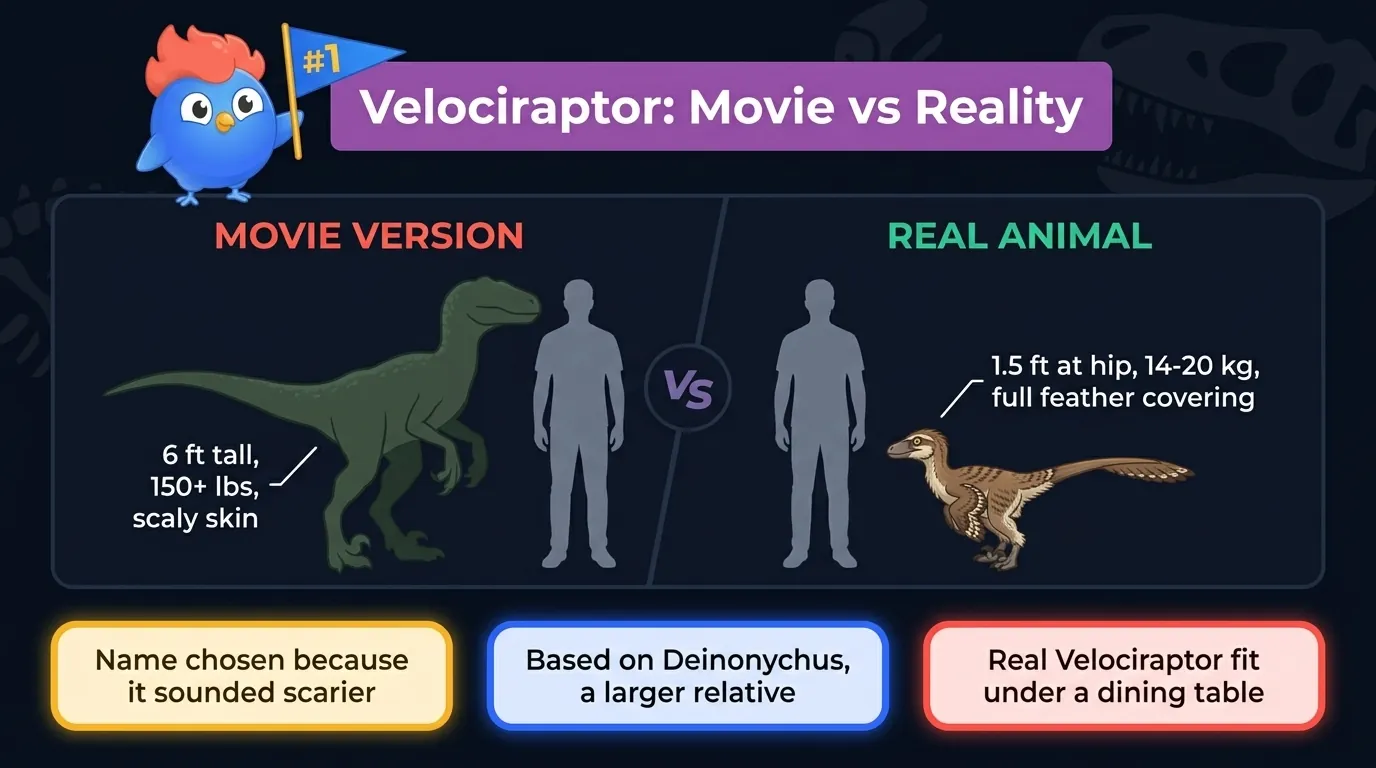 Screen raptor at six feet, real animal at roughly knee height and feathered.
29. How big were real Velociraptors compared to the movie versions? Medium
Answer: Turkey-sized. Velociraptor mongoliensis stood about 1.5 feet at the hip and weighed 14 to 20 kg.
Crichton picked the name because it sounded better; the animals he wrote were built from the larger Deinonychus, and Spielberg scaled them up again from there. Quill knobs found on a Velociraptor forearm in 2007 settled the feather question for the real thing. Picture something between a coyote and an angry turkey, with a sickle claw and a stiff tail.
30. Could you really survive a T-Rex encounter by standing still? Medium
Answer: No. T-Rex had forward-facing eyes, a wide binocular field, and visual acuity estimated in the hawk range or better.
The scene is iconic and the anatomy contradicts it flatly. Kent Stevens measured the binocular overlap on tyrannosaur skulls and found a predator built for judging distance across open ground, which is the opposite of a motion-triggered hunter. The film invented a weakness that never existed.
31. Could the amber-preserved mosquito from Jurassic Park actually contain dinosaur DNA? Hard
Answer: No, for two separate reasons. The mosquito on screen is a Toxorhynchites, a genus whose adults feed on nectar rather than blood, and DNA has a half-life of roughly 521 years.
Allentoft and colleagues measured that half-life in 2012 from moa bones, which puts the last readable fragments somewhere around a million years under ideal cold conditions. At 66 million, every bond has broken many times over. The oldest DNA anyone has recovered comes from permafrost roughly two million years old, and Cretaceous amber sat in the tropics.
32. Most dinosaurs featured in Jurassic Park actually lived during which geological period? Medium
Answer: The Cretaceous, not the Jurassic. T-Rex, Velociraptor, Triceratops, Parasaurolophus and Gallimimus are all Cretaceous animals.
Cretaceous Park does not have the same ring to it. The Jurassic ran from 201 to 145 million years ago and the Cretaceous from 145 to 66, so nearly every famous name in the franchise belongs to the later period. Brachiosaurus is one of the few genuine Jurassic species on screen.
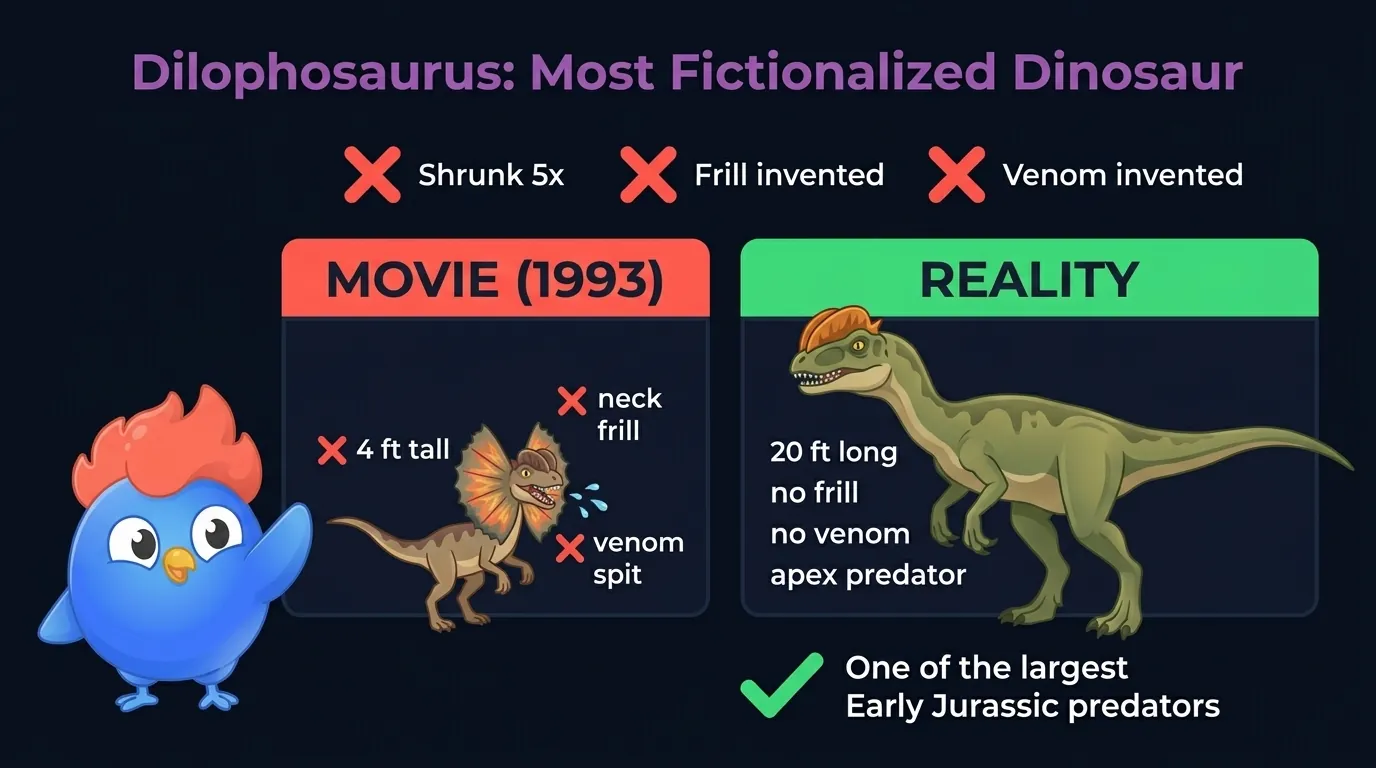 Four feet, frilled and venomous on screen. Seven metres and neither in the rock.
33. Did Dilophosaurus have a neck frill and spit venom? Medium
Answer: Neither. The real animal ran roughly 7 metres long, over 20 feet, carried no frill, and nothing in its fossils supports venom.
The film shrank it to roughly four feet so the car scene would work, then added two features that exist nowhere in the fossil record. A 2020 redescription went the other way entirely and reconstructed Dilophosaurus as a considerably more powerful animal than the older literature allowed, the largest known land predator in North America in its day.
34. Was T-Rex closer in time to Stegosaurus or to humans? Medium
Answer: Humans. Stegosaurus lived roughly 155 to 150 million years ago and T-Rex 68 to 66. The gap between them is about 85 million years, larger than the 66 million between T-Rex and us.
We picture all dinosaurs sharing one landscape, and the arithmetic breaks that picture apart. More time separates Stegosaurus from T-Rex than separates T-Rex from you reading this sentence. The same scale problem shows up throughout our 37 science trivia questions.
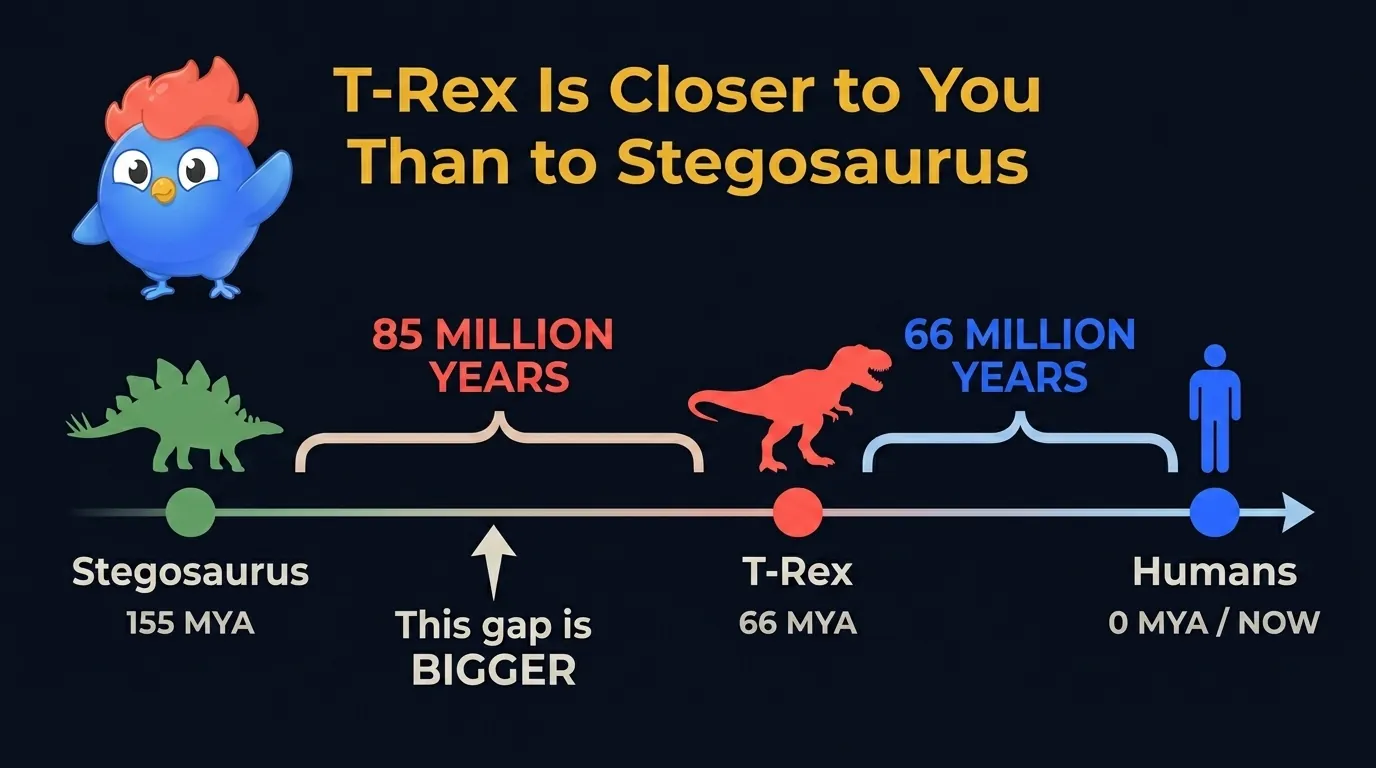 Eighty-five million years on the left, sixty-six on the right.
35. Could you outrun a T-Rex? Hard
Answer: Probably not, though nothing like the film’s chase was on the table either.
Sellers and colleagues modelled the leg bones under load in PeerJ in 2017 and found that a true running gait, with both feet leaving the ground, would have overloaded the skeleton of a seven-tonne animal. What is left is a very fast walk, somewhere in the 10 to 17 mph band, against a jogging human at about 8 mph. The Jeep was safe. You are not. More of the animal, speed argument included, sits in its own playable topic.
Record-Breaking Dinosaur Trivia Questions (36-42)
The records in this section move more than you would expect, because the largest animals are usually known from the fewest bones. Every size figure below is a model built on an incomplete skeleton, and the error bars are wide enough to drive an argument through.
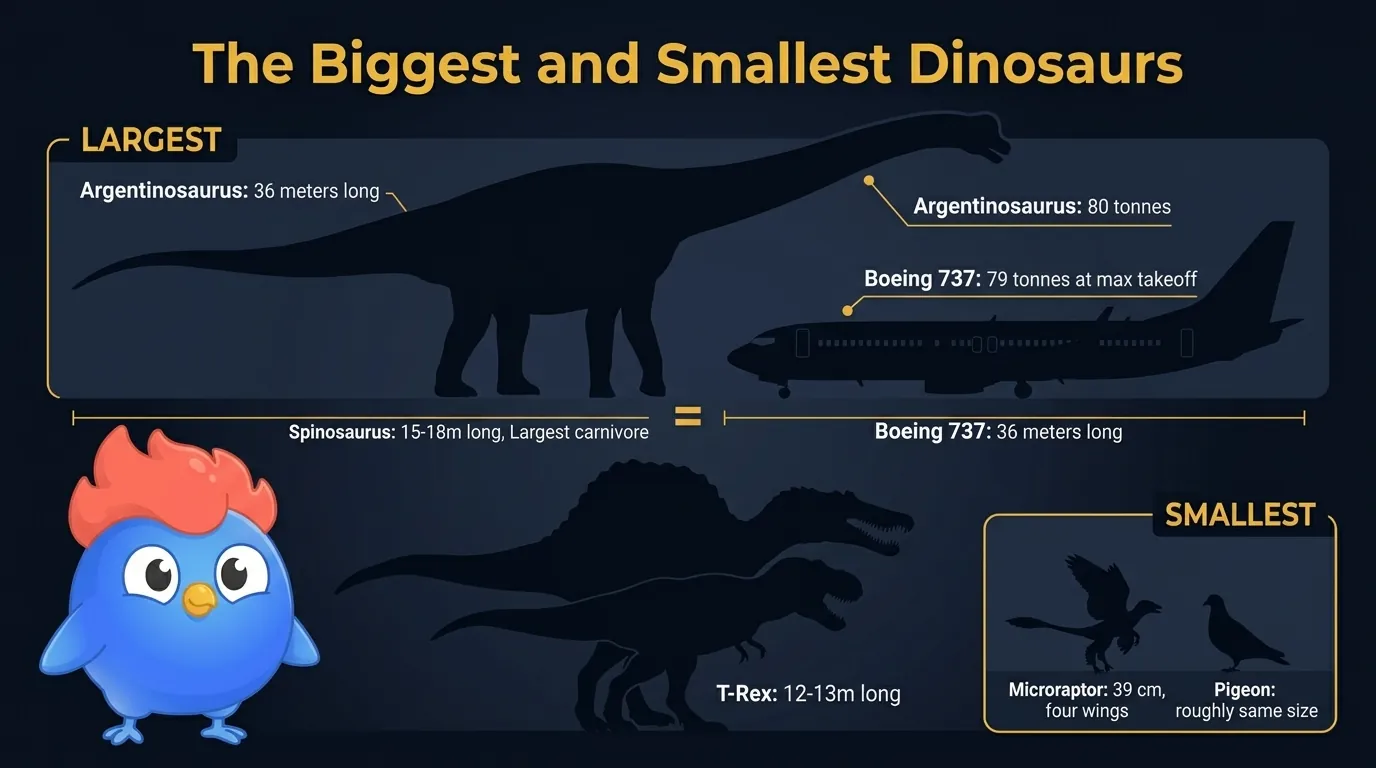 One outweighed a loaded 737. The other came in at pigeon length.
36. How heavy was Argentinosaurus, the largest dinosaur known from solid evidence? Medium
Answer: Up to 80 tonnes and 36 metres long, which is roughly a Boeing 737 at maximum takeoff weight.
An African elephant runs about six tonnes, so stack thirteen of them. Published estimates for Argentinosaurus range from around 65 to 100 tonnes depending on method, because the animal is known from a handful of vertebrae, a femur and some ribs. Amphicoelias fragillimus would have been longer still if Cope’s 1878 drawing was accurate, but the vertebra he drew disappeared and nobody has seen it since.
37. How small was the smallest known dinosaur? Hard
Answer: The Microraptor zhaoianus holotype measures about 39 cm, roughly a pigeon, and holds the Guinness record for smallest dinosaur species.
Two caveats worth carrying. Other Microraptor specimens run closer to a metre, and Parvicursor and Anchiornis sit in the same size class, so smallest depends heavily on which specimen you put on the scale. The genuinely strange part is the layout: flight feathers on the arms and the legs both, a four-winged arrangement with no living equivalent, probably used for gliding between trees in China around 120 million years ago.
38. Which carnivorous dinosaur was likely larger than T-Rex? Medium
Answer: Spinosaurus, at a possible 15 to 18 metres against T-Rex’s 12 to 13.
That T-Rex was not the biggest carnivore surprises people on its own. The 2020 Nature description of a nearly complete tail, tall-spined and paddle-shaped, pushed the argument towards an animal that actively swam. Others read the same skeleton as a wader that fished from the bank, and the fight is one of the liveliest in the field right now.
39. What is the most expensive dinosaur fossil ever sold at auction? Hard
Answer: $44.6 million for the Stegosaurus nicknamed Apex in 2024, ahead of Stan the T-Rex ($31.8M in 2020) and Sue ($8.3M in 1997).
Apex went to a private buyer, Ken Griffin, who put it on a four-year loan to the American Museum of Natural History and let researchers sample it. That is the good version of this outcome. The bad version is the default one: when a specimen sells for more than a museum’s entire annual acquisition budget, its scientific future depends on a collector staying interested. Fewer than a hundred Stegosaurus skeletons are known at all.
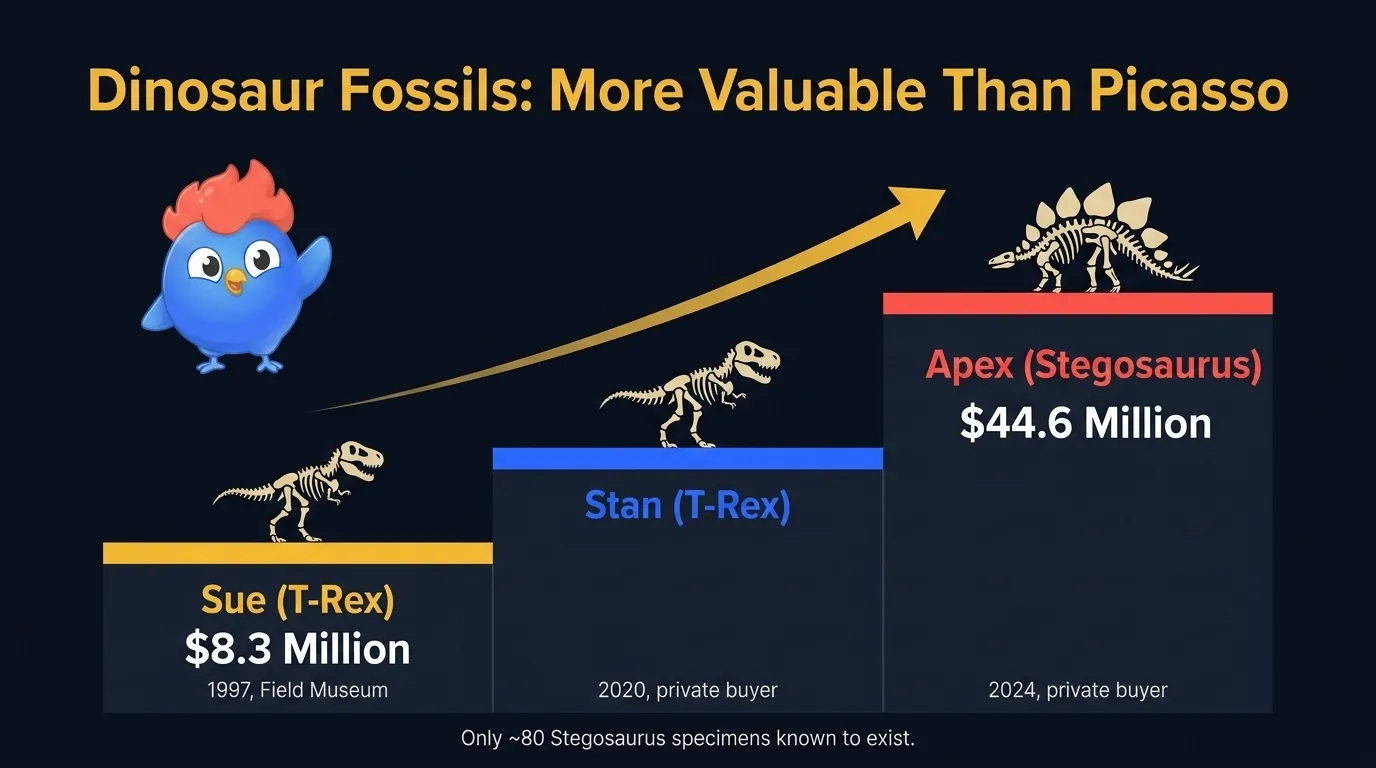 Three sales, twenty-seven years, and a ceiling that keeps moving.
40. What were the “Bone Wars,” and what did they produce? Hard
Answer: The rivalry between Edward Cope and Othniel Marsh (1870s to 1890s), which ran on bribery, theft and dynamite, and which named 142 new dinosaur species along the way.
They bribed each other’s crews, intercepted shipments, and by several accounts destroyed sites rather than let the other work them. Both men ended their careers financially ruined and professionally diminished. American paleontology was effectively built out of the wreckage, which is an uncomfortable thing to have to report.
41. Could an Ankylosaurus actually injure a T-Rex? Medium
Answer: Yes, if the club was large enough. Victoria Arbour’s 2009 analysis found that only the biggest tail knobs could generate bone-breaking force.
Her modelling put an average-sized knob at roughly 960 to 2,000 newtons of impact force, which is a serious hit and not a broken femur. The large knobs cleared the fracture threshold. The tail itself is the giveaway: the rear vertebrae fuse into a stiff handle, an unmistakably weapon-shaped adaptation, though whether the target was a predator or a rival ankylosaur is still open.
42. What was the largest flying animal ever, and was it a dinosaur? Hard
Answer: Quetzalcoatlus, with a wingspan around 36 feet and a standing height like a giraffe’s. It was not a dinosaur. It was a pterosaur.
Pterosaurs are close cousins on the archosaur tree, split off before the first dinosaur, and the same goes for plesiosaurs, mosasaurs and ichthyosaurs. Largest flying animal ever, yes. Dinosaur, no. Those label mix-ups are their own reliable trap, and more of them live in the animal trivia questions set.
Misconceptions That Fool Everyone (43-49)
Most of the beliefs in this last section are wrong in the same direction. They are simplifications a teacher handed you at nine, and nobody ever circled back to update them. Birds are not descended from dinosaurs, they are dinosaurs. Pterodactyls never were. Tails did not drag, and grass barely existed. All seven corrections are questions in the LearnClash dinosaur set.
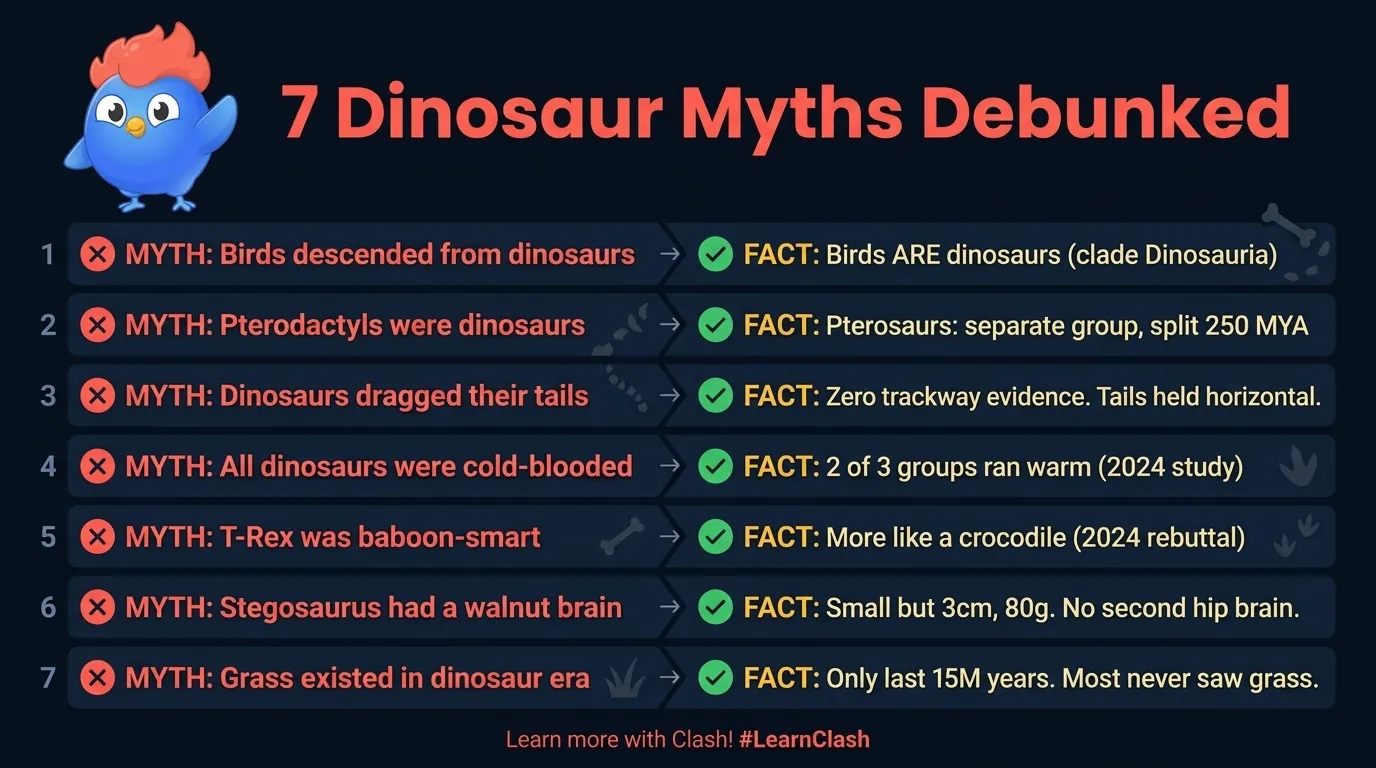 Four beliefs to retire: birds merely descended from dinosaurs, feathers were rare, tails dragged, and the plains were grassy.
43. Are birds descendants of dinosaurs, or something else? Easy
Answer: Birds are dinosaurs. Not descended from. They sit inside the clade Dinosauria as the surviving branch of the theropods.
“Descended from” is the phrasing that causes all the trouble. You did not descend from mammals, you are one, and birds sit inside Dinosauria on exactly the same logic. Nearly everything that makes a bird a bird, feathers and wishbone and hollow bones and brooding behavior, showed up inside that group long before flight did.
44. Were pterodactyls dinosaurs? Easy
Answer: No. Pterosaurs were a separate order of reptiles that split from the dinosaur lineage roughly 250 million years ago.
Ask for a flying dinosaur and most people say pterodactyl, which misses twice: pterosaurs are not dinosaurs, and the actual flying dinosaurs are the birds outside the window. Marine reptiles get filed wrong the same way. Dinosaur is a defined group, not a shorthand for big extinct reptile.
45. Did dinosaurs drag their tails on the ground? Medium
Answer: No. Not one trackway shows a drag mark, and the anatomy points to tails held horizontally as counterbalances.
Thousands of trackways preserve footprints and nothing else. The droopy tail came out of Victorian reconstructions that treated dinosaurs as scaled-up lizards, and it survived in museum halls and children’s books into the 1970s, which is why the posture still looks correct to anyone who grew up with those illustrations.
46. Were all dinosaurs cold-blooded? Medium
Answer: No. A 2024 study put two of the three major dinosaur groups in cold climates from about 183 million years ago, which implies they ran warm.
Chiarenza and colleagues mapped where each group lived against reconstructed climate, and found theropods and ornithischians spreading into cold high-latitude environments in the Early Jurassic while sauropods stayed in the warm belt. That may mean sauropods never made the switch. Either way, the clean warm-mammal, cold-reptile split taught in school does not survive contact with this group.
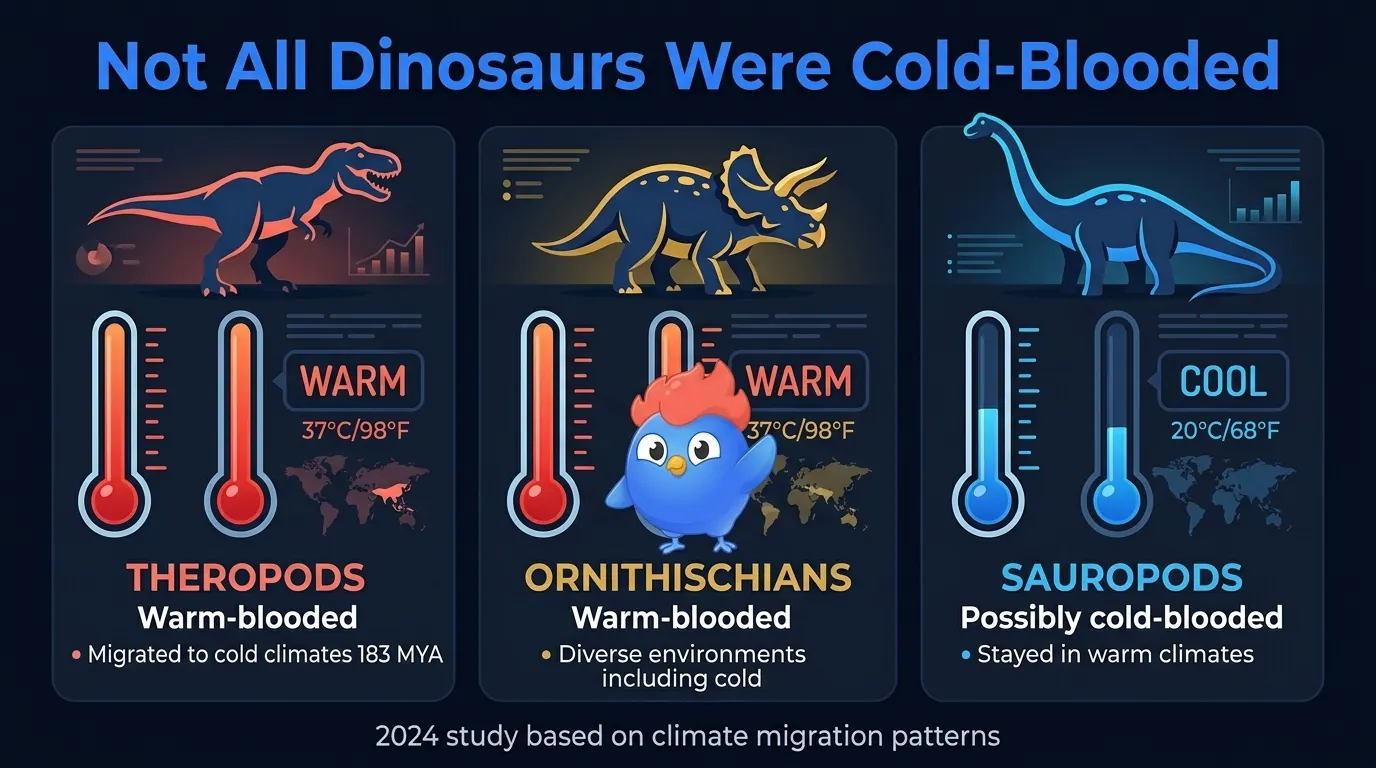 Two lineages went north. One apparently stayed where it was warm.
47. Was T-Rex smart or dumb? Hard
Answer: Neither extreme. A 2023 paper put it in baboon territory at around 3 billion neurons. A 2024 rebuttal recalculated and landed on crocodile-like numbers.
Herculano-Houzel’s count made headlines; Caspar and colleagues re-ran it in The Anatomical Record with different assumptions about how much of the endocast was actually brain, and the recalculated figure lands anywhere from somewhat under her number to well below a billion, depending on whether the neuron density is modelled on birds or on reptiles. That single assumption carries most of the disagreement.
48. Did Stegosaurus have a walnut-sized brain and a second brain in its hip? Medium
Answer: Neither is true. The brain was small but shaped like a bent tube, roughly 3 cm long and 70 to 80 grams. The hip structure was a glycogen body.
The walnut line goes back to nineteenth-century descriptions and stuck around because it is a good line, not because it is accurate. The second brain came from an enlarged canal near the hip that looked suggestive on a diagram; living birds have the same structure in the same place, and it stores glycogen rather than thinking.
49. Did grass exist when dinosaurs were alive? Medium
Answer: Barely. Grasses (family Poaceae) show up only in the final stretch of the Cretaceous, and most dinosaurs that ever lived never saw a blade of it.
We know grass existed at all in the Late Cretaceous because grass phytoliths turned up in titanosaur dung from India. It was a minor plant and nowhere near a landscape. For most of the Mesozoic the ground cover was ferns, cycads and conifers, so every rolling green plain in every dinosaur film is set dressing borrowed from the wrong era entirely.
The One I Open With
At a quiz night I always start with number 28: which came first, sharks, trees, or dinosaurs. Everyone has an answer within two seconds, roughly half the table is wrong, and nobody feels caught out when the answer lands, because sharks sound obviously right the moment you hear them. That is the whole job of an opening question. It sets the tone before anyone has decided whether they like the quizmaster.
Number 34 does the same work with a longer fuse. Tell a table that T-Rex lived closer to us than to Stegosaurus and you can watch people redo the arithmetic in their heads, twice, before they accept it.
The rest of this set holds up the same way, and the ones that hold up best are usually the ones you got wrong. Paleontology also keeps moving underneath all of it: 44 new species named during 2025, an extinction recovery timeline rewritten in January 2026, and a fair chance that some answers here read differently in ten years. Younger dinosaur fans, ages 5 to 13, can start on the shorter set inside our 89 trivia questions for kids. If deep time is the part that bends your intuition, the 42 space trivia questions break the same instinct at a much larger scale. The era either side of the asteroid runs through the 43 history trivia questions, and the timeline traps that catch people here turn up again in the general knowledge questions set.
Frequently Asked Questions
What is the hardest dinosaur trivia question?
How fast T-Rex could actually move is the one that catches the most people. Bone-stress modelling by Sellers and colleagues (PeerJ, 2017) caps it near 17 mph and rules out a true run, because the leg bones would fail under the load at seven tonnes. That is far slower than the movie chase and still faster than you at a jog.
How many dinosaur species have been discovered?
Around 1,400 dinosaur species have been named, from more than 90 countries, and 44 of those arrived during 2025 alone. That is close to one new dinosaur a week. LearnClash covers dinosaurs and paleontology at every difficulty level, from basic anatomy to the details only serious fans carry.
Did all dinosaurs go extinct?
No. Birds are living dinosaurs, classified within the clade Dinosauria. A chicken is as much a dinosaur as T-Rex was. The Chicxulub asteroid 66 million years ago wiped out all non-avian dinosaurs, but the avian branch survived and diversified into the 10,000 plus bird species alive today.
What did Jurassic Park get wrong about dinosaurs?
Several things. Velociraptors were turkey-sized and feathered, not 6-foot scaly killers. T-Rex had vision in the hawk range, so standing still would not save you. The amber mosquito on screen belongs to a genus whose adults do not drink blood. Most of the cast lived in the Cretaceous, not the Jurassic. Dilophosaurus had no frill and no venom.
Are dinosaur trivia questions good for learning?
Yes, when a miss ends in an explanation rather than a shrug. Karpicke and Roediger (2008) measured about 80 percent recall a week after repeated testing against 36 percent for rereading. LearnClash schedules the dinosaur questions you miss at widening intervals until they stick, and duels supply the reason to come back.