
How to Remember What You Learn [Science-Backed]
How to remember what you learn: 7 science-backed techniques ranked by the largest learning research review ever published.

Highlighting, rereading, and summarizing. If you want to remember what you learn, these three study techniques won’t help. All three rated “low utility” by the largest review of learning research ever published.
Dunlosky et al. (2013) reviewed over 700 studies and rated 10 common memory techniques for studying. Only two earned “high utility”: retrieval practice (testing yourself) and distributed practice (spacing your reviews over time). LearnClash builds both into every quiz duel and practice session, turning each answer into a recall event timed by a spaced repetition system.
This guide ranks 7 ways to remember what you learn, from the two that research calls most potent down to the body-based boosters most people skip. Test your study techniques in a quiz duel →
Why Do Most Study Methods Fail?
Most techniques to remember things fail because they create a feeling of knowing without building real recall. You read a chapter and it feels stored. It isn’t. In LearnClash, we built the app around the two techniques Dunlosky rated highest: retrieval practice and distributed practice. The rest layers on moderate-utility techniques that push retention even higher.
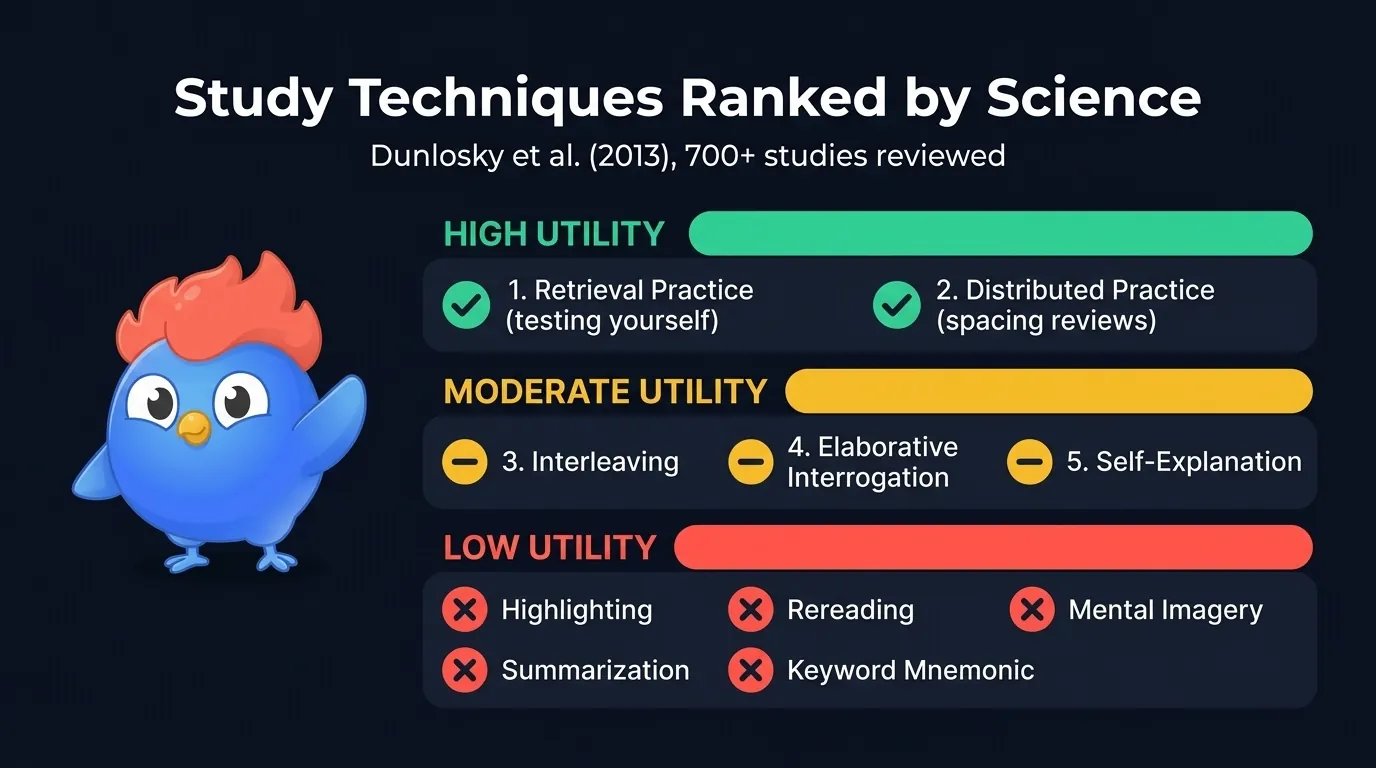 Dunlosky et al. (2013) rated 10 techniques. Only 2 earned “high utility.” The 5 most popular methods among students all fell into the bottom tier.
Here’s what the research found:
| Technique | Dunlosky Rating | What It Does |
|---|---|---|
| Retrieval practice (self-testing) | High | Forces you to pull answers from memory |
| Distributed practice (spacing) | High | Spreads reviews across increasing intervals |
| Interleaved practice | Moderate | Mixes different topics in one session |
| Elaborative interrogation | Moderate | Asks “why?” and “how?” while studying |
| Self-explanation | Moderate | Explains material to yourself step by step |
| Summarization | Low | Writes summaries of what you read |
| Highlighting | Low | Marks text with a highlighter |
| Keyword mnemonic | Low | Links words to mental images |
| Imagery for text | Low | Creates mental pictures while reading |
| Rereading | Low | Reads the same text multiple times |
You’ve probably also seen the “Learning Pyramid” floating around: 10% retained from reading, 50% from discussion, 90% from teaching others. Sounds scientific. It isn’t. Letrud (2012) traced those numbers back to their origin. There was none. The National Training Laboratories published them in the 1960s without citing a single study. No controlled experiment has ever produced these percentages. The core principle (active beats passive) is correct. The specific numbers are fabricated.
So what does work? Seven techniques to remember what you learn, ranked by the strength of the evidence behind them.
The 7 Best Ways to Remember What You Learn
These seven techniques are ranked by research strength, from the two Dunlosky rated highest utility down to the biological boosters that most study guides leave out. LearnClash builds the top four techniques into every quiz duel automatically, so you don’t have to think about applying them.
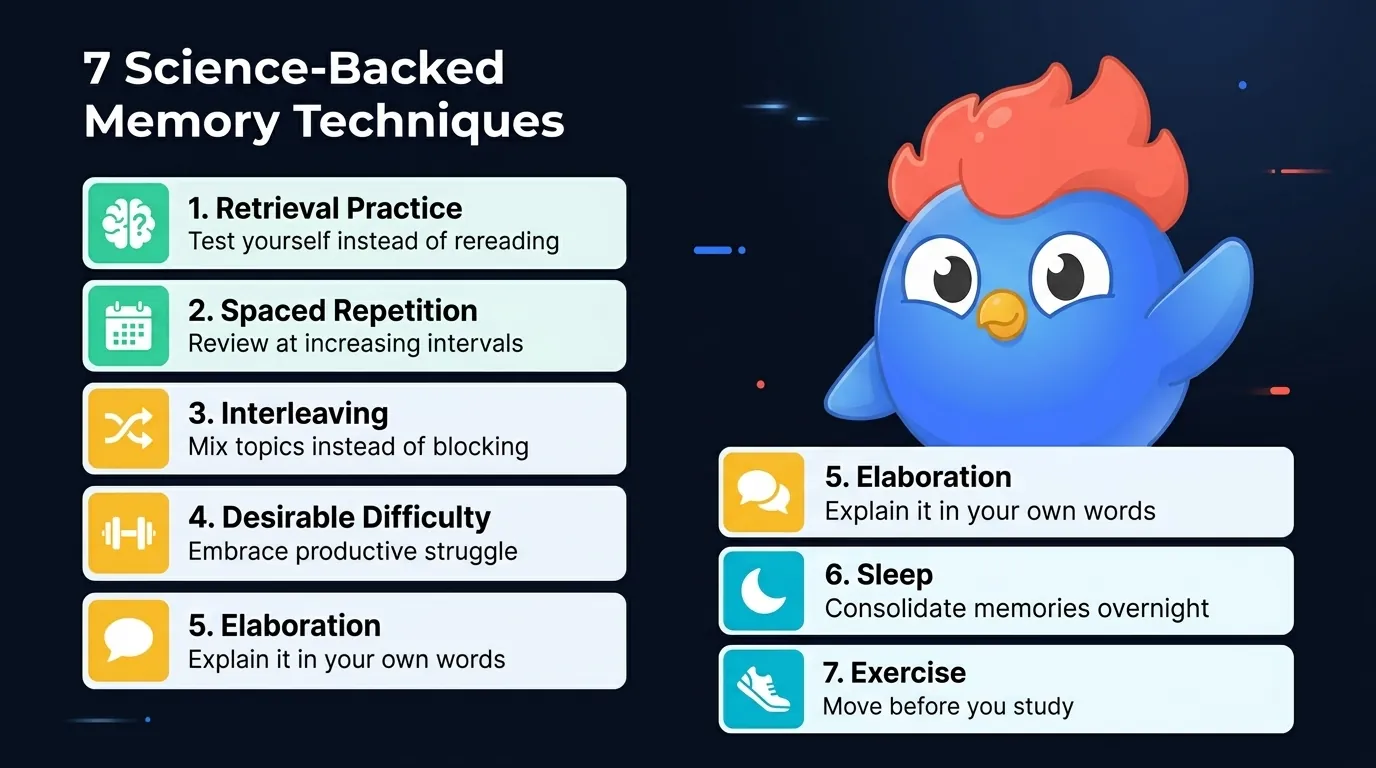 All 7 techniques at a glance. Start with testing and spacing, then layer in mixing, difficulty, explanation, sleep, and movement.
| # | Technique | Dunlosky Rating | What It Means in Practice |
|---|---|---|---|
| 1 | Retrieval practice | High | Quiz yourself, don’t reread |
| 2 | Spaced repetition | High | Review before you forget |
| 3 | Interleaving | Moderate | Shuffle subjects each session |
| 4 | Desirable difficulty | Moderate+ | Embrace productive struggle |
| 5 | Elaboration | Moderate | Say “why” and “how” out loud |
| 6 | Sleep consolidation | Strong (neuroscience) | Study before bed, not morning |
| 7 | Exercise | Strong (neuroscience) | Walk 20 minutes, then study |
1. Test Yourself Instead of Rereading
If you want to remember what you learn, start by testing yourself. Retrieval practice is the single most potent memory technique backed by research. LearnClash applies it in every mode: each quiz question forces you to pull the answer from your brain rather than spot it on a page.
Karpicke and Roediger (2008) ran the key study in Science: students who kept testing recalled 80% of material after one week. Students who stopped testing and reread instead? 36%.
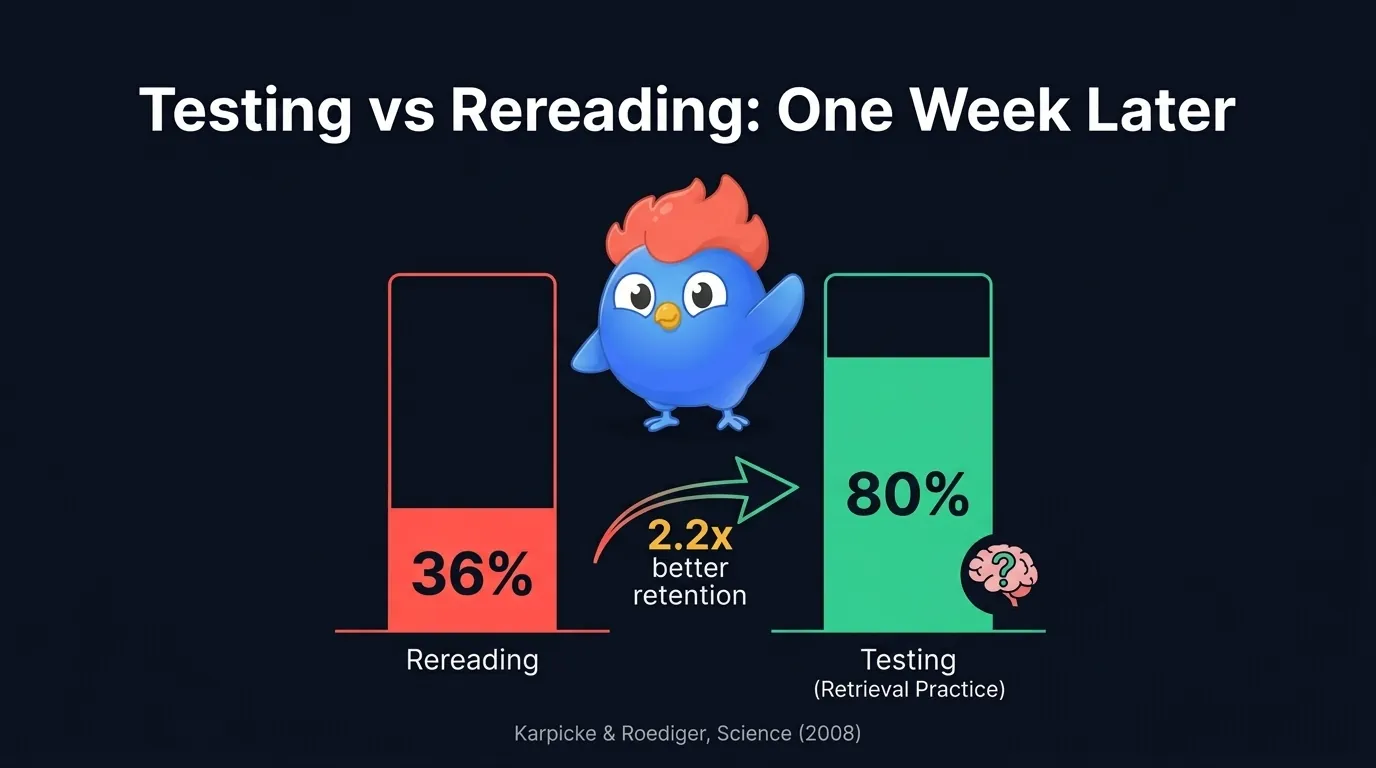 One week later, the testers remembered more than twice as much. And they’d spent less total time studying.
Why does rereading feel like it works? Scientists call it the fluency illusion. When you reread a passage, the words look known. Your brain mistakes that feel of knowing for actual knowledge. But spotting text on a page and pulling the answer from scratch are two very different brain tasks. You can spot a face without recalling the name that goes with it.
Retrieval flips the process. You don’t soak in text. You rebuild the answer from nothing. That effort, even when you get it wrong, builds the brain paths that tie the cue to the answer. And here’s a surprise: getting a question wrong and then seeing the right answer produces stronger memory than getting it right the first time. The error creates a gap your brain rushes to fill.
Did you know? A 2013 review of 700+ studies found that the two most effective learning techniques are both forms of self-testing. Highlighting, the most popular study method among students, was rated “low utility.”
For the full science behind this, including why wrong answers help and how difficulty scales with skill, see the testing effect explained.
2. Space Your Reviews Over Time
Spaced repetition is the second technique Dunlosky rated “high utility,” and it pairs with retrieval practice. LearnClash’s SRS algorithm schedules missed questions at 7-day and 90-day intervals, so the material you struggle with reappears right before you’d forget it.
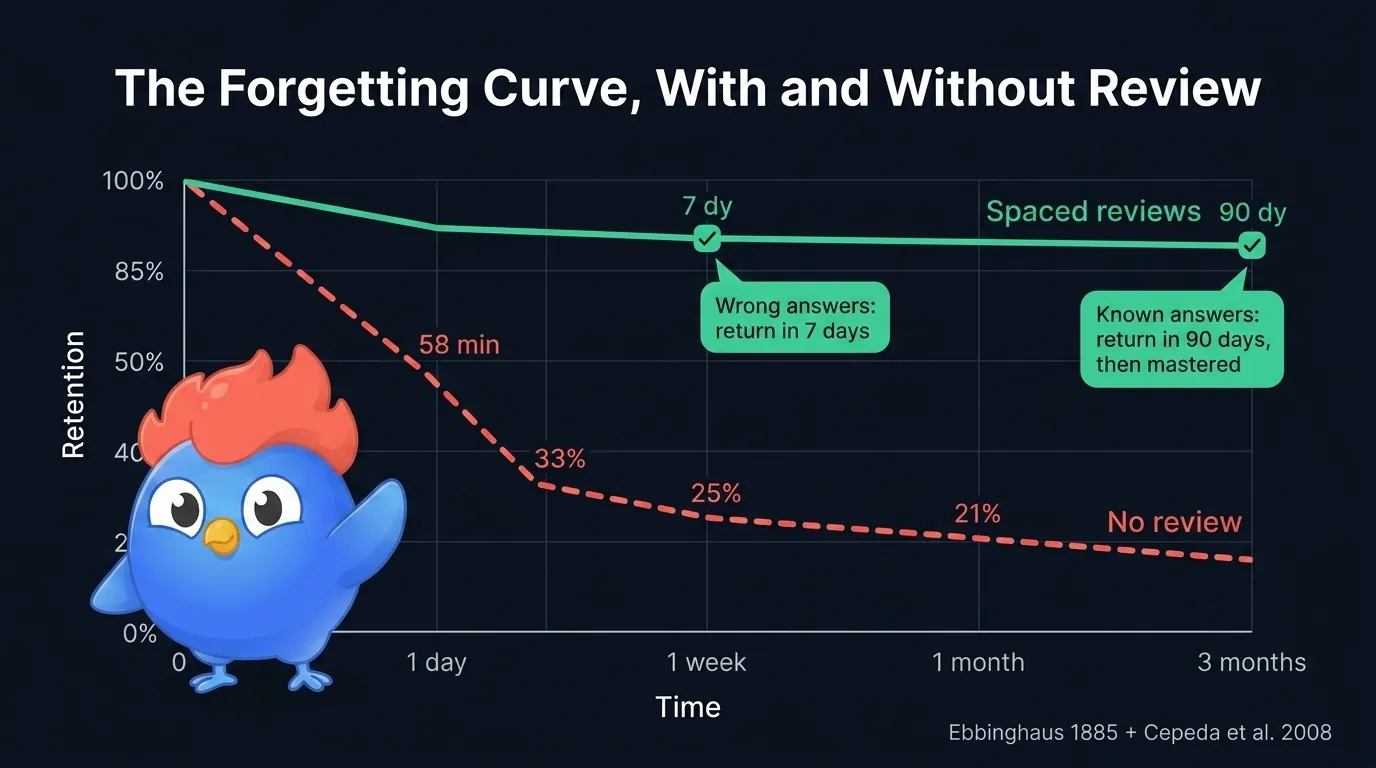 Spacing works because each review arrives after a little forgetting, which makes recall effortful enough to strengthen memory.
Cepeda et al. (2006) analyzed 184 articles on the spacing effect and found that distributed practice improved long-term retention by up to 200% compared to cramming.
The forgetting curve explains why. Hermann Ebbinghaus showed in 1885 that we lose roughly 67% of new information within 24 hours without review. But each well-timed review resets the curve and stretches the gap before you forget again. After 3 to 5 spaced retrievals, the knowledge moves into long-term storage.
| If you need recall for… | Review after about… |
|---|---|
| A quiz next week | 1 to 2 days |
| An exam next month | 3 to 6 days |
| A skill you want next year | 1 to 2 months |
Cramming is the opposite of this. You stuff everything into one night, feel prepared the next morning, and lose most of it by the weekend. Cramming isn’t bad because you study too hard. It’s bad because all those repetitions happen at the same time, so your brain never has to fight to recall anything. No fight, no memory.
Practical review gaps
The best gap between reviews scales to about 10-20% of your target retention period. Studying for a test in one week? Review after 1 to 2 days. Want to keep something for a year? Review after 1 to 2 months. LearnClash figures these intervals out for you based on your accuracy on each question.
And here’s what makes this different from just “reviewing your notes”: the review has to involve retrieval (technique #1). Rereading your notes on a schedule is still rereading. The combination of spacing plus self-testing is what produces the largest gains. For the full breakdown of intervals, the Leitner system, and how LearnClash automates all of it, see spaced repetition explained. For whether the popular flashcard apps actually run real SRS or just relabel a Learn loop, see does Quizlet have spaced repetition.
3. Mix Topics Instead of Blocking
Interleaving means mixing different subjects or problem types in a single study session instead of grinding one topic until you’re done. It feels messy. It works better. LearnClash builds this in as built-in interleaving: every duel contains 18 questions across 6 different topics, forcing your brain to switch gears with every question.
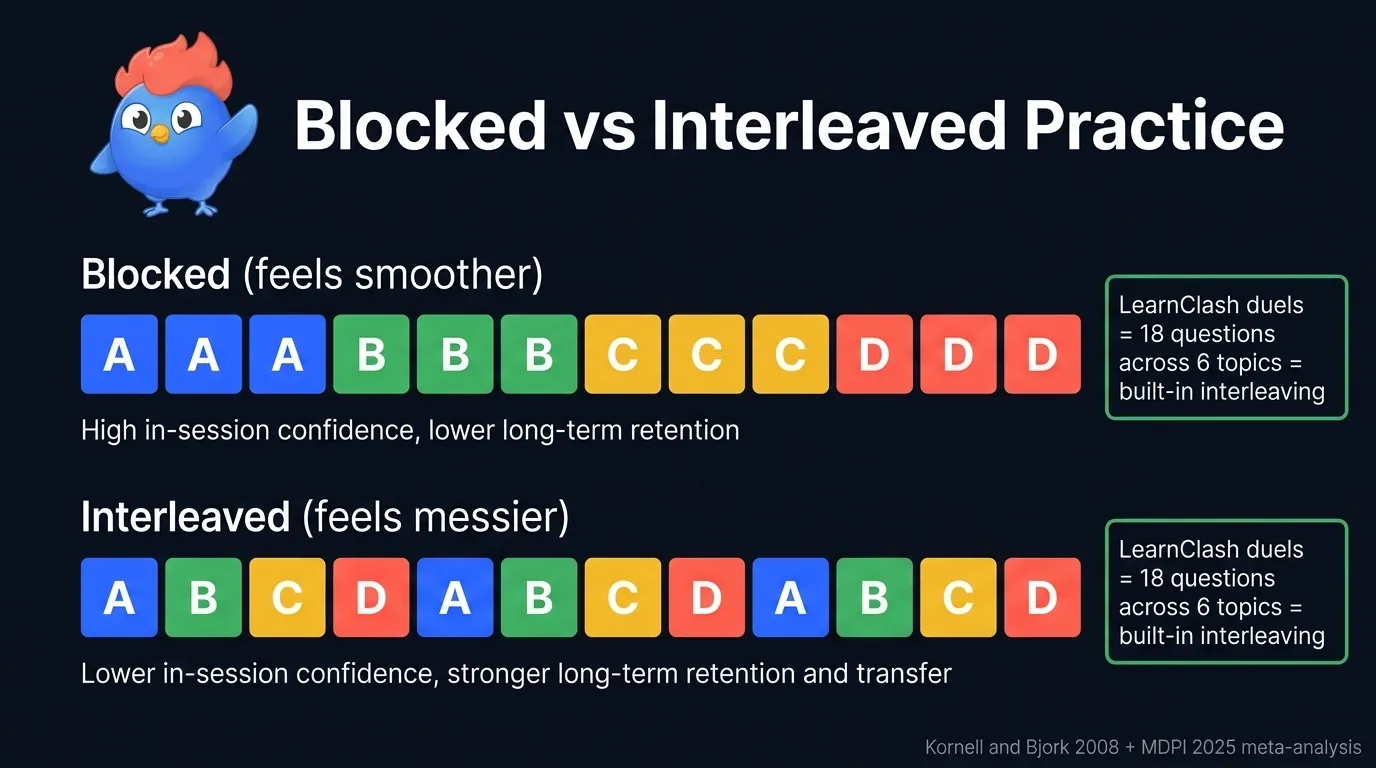 Blocked practice feels smoother while you study. Interleaving feels messier but trains your brain to recognize the right method later.
Kornell and Bjork (2008) showed that mixed practice led to better test scores even though students rated their learning as worse during the mixed sessions. People prefer blocked study (all math, then all science, then all history) because the within-block repetition feels smooth. Smooth during study. Poor recall later.
Why does mixing help? Every context switch forces your brain to reload that topic from memory. That reload is itself a form of retrieval practice. Blocked study lets you coast on short-term memory without ever truly encoding the material. So when you study, shuffle the deck.
Did you know? LearnClash duels use 18 questions across 6 different topics per match. That’s built-in interleaving: your brain constantly switches between subjects, which research shows produces stronger long-term retention than studying one topic at a time.
But here’s where it gets interesting.
4. Make Learning Hard on Purpose
Robert Bjork coined the term desirable difficulties to name a truth that goes against every instinct: conditions that make learning feel harder often produce better long-term recall. LearnClash’s ELO rating system creates exactly this. Questions match your skill level so you’re always working at the edge of what you can do, not coasting through easy answers or drowning in impossible ones.
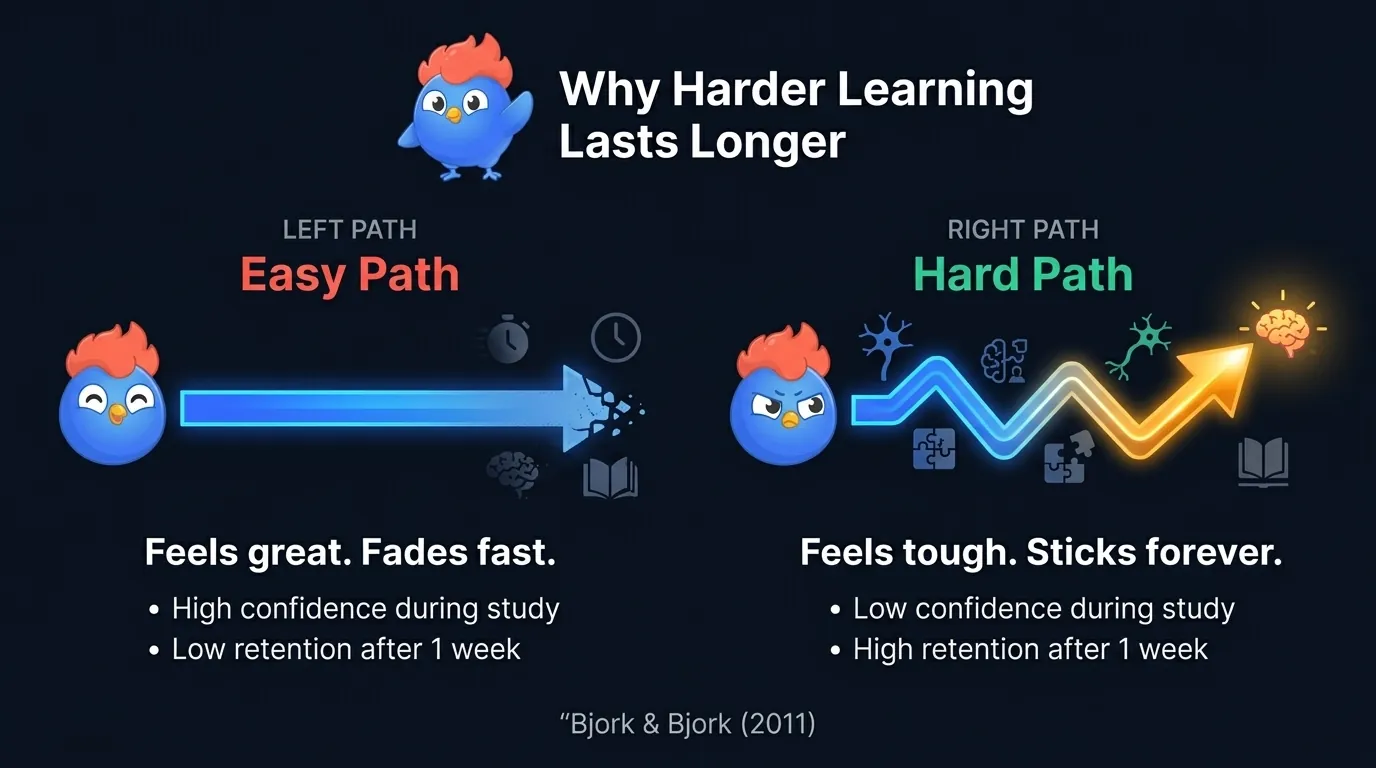 The easy path feels productive. The hard path produces results. Bjork & Bjork (2011) showed this across multiple study conditions.
Three forms of desirable difficulty that boost memory:
- Generation effect: producing an answer from memory (even incorrectly) builds stronger traces than reading the answer
- Varied practice: studying the same concept in different formats and contexts prevents shallow pattern matching
- Increased retrieval effort: questions that make you think harder create deeper encoding
The trap is that desirable difficulty feels like failure. Students rate hard sessions as less useful. Teachers rate smooth lectures as more effective. Both are wrong. The research goes the other direction every time.
When we looked at LearnClash duel data, players who won 45-55% of their matches (tight, competitive games) showed better long-term retention on follow-up practice than players who won 80%+ (easy blowouts). The struggle is the learning. If you’re getting every question right, the questions are too easy to build memory.
This is why the ELO rating system matters for learning and not just ranking. By matching you against players at your skill level, LearnClash keeps you in that sweet spot of productive struggle where every question feels just hard enough to make your brain work, but not so hard that you give up.
5. Explain It Out Loud
Elaboration and self-talk, both rated “moderate utility” by Dunlosky, come down to one habit: asking “why?” and “how?” while studying, then answering out loud. LearnClash’s trivia format does this by design. Every trivia question with a “why it stumps people” note is a form of elaboration, linking the surprising answer to what you already know.
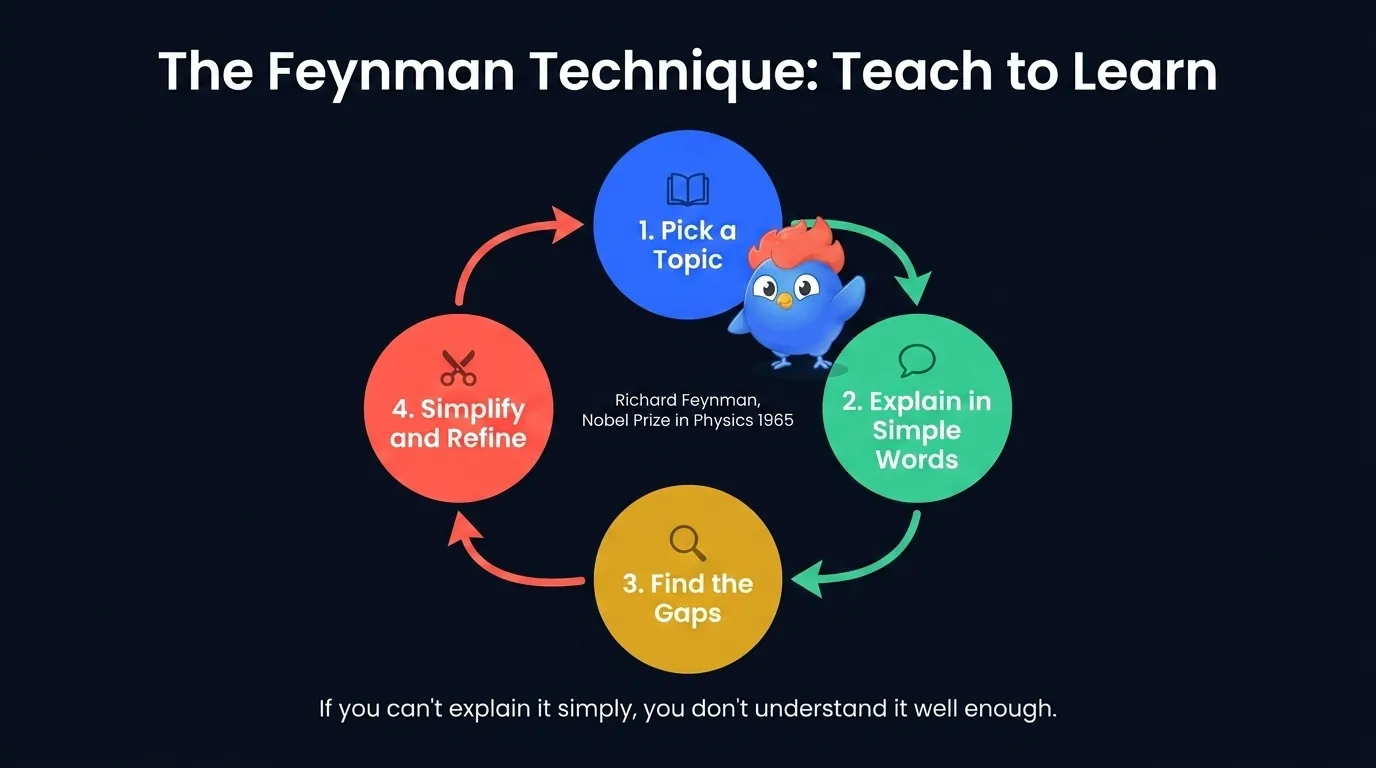 Explaining a concept out loud turns passive input into active output, which exposes weak spots quickly.
The Feynman method captures this well:
- Pick a concept from the material you just studied.
- Explain it simply as if teaching a friend who knows nothing.
- Repair the gap when your explanation breaks, then try again.
Why does speaking help? Reading is passive input. Speaking forces output. Your brain has to sort the facts, find the right words, order the logic. That sorting effort creates cross-linked memory traces that hold up much better than a single read-through. The act of putting knowledge into words forces you to truly own it.
So elaboration works. But the next two methods aren’t study techniques at all. They’re body-based memory boosters that most people skip when learning how to remember what you learn.
6. Sleep on It
Sleep isn’t rest for your brain. It’s the filing shift. During slow-wave sleep, your brain replays the day’s learning and moves it from short-term storage into long-term networks. LearnClash players who finish a practice session before bed are running the encoding step right before the brain’s built-in filing system kicks in.
A study in Current Biology by Ellenbogen et al. (2006) found that sleeping between study and test produced 20.6% higher recall than the same time gap spent awake. And the boost grew when the material was tested (retrieval practice) before sleep. So the best combo is: quiz yourself, then sleep.
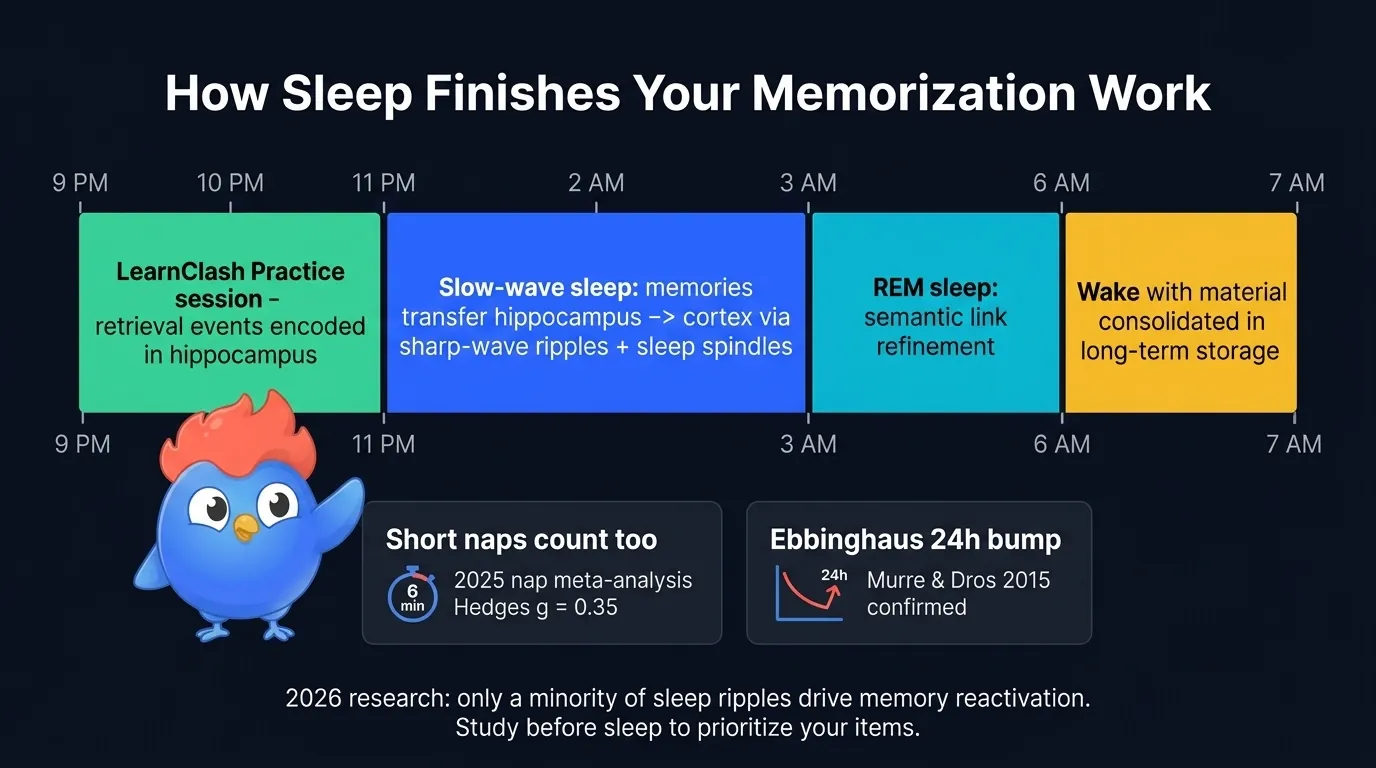 Sleep helps most when the material was actively retrieved before bed, not just passively reread.
The evening sequence is simple:
- Quiz yourself.
- Check the missed answers.
- Stop studying.
- Sleep.
The takeaway is simple: study before bed, not first thing in the morning. If you’re going to do one LearnClash practice session per day, do it in the evening. Your sleeping brain handles the rest.
Even a 20-minute nap after studying helps. Lahl et al. (2008) found that a short nap beat staying awake for memory, even when the awake group spent the extra time reviewing. Naps aren’t lazy. They’re a memory tool.
7. Move Before You Study
A quick burst of exercise boosts memory, and LearnClash players who walk or jog before a practice session often report sharper recall in their duels. A single 20-minute walk or light jog before studying raises BDNF (brain-derived neurotrophic factor) levels. BDNF is a protein that helps your brain build stronger links between neurons during learning.
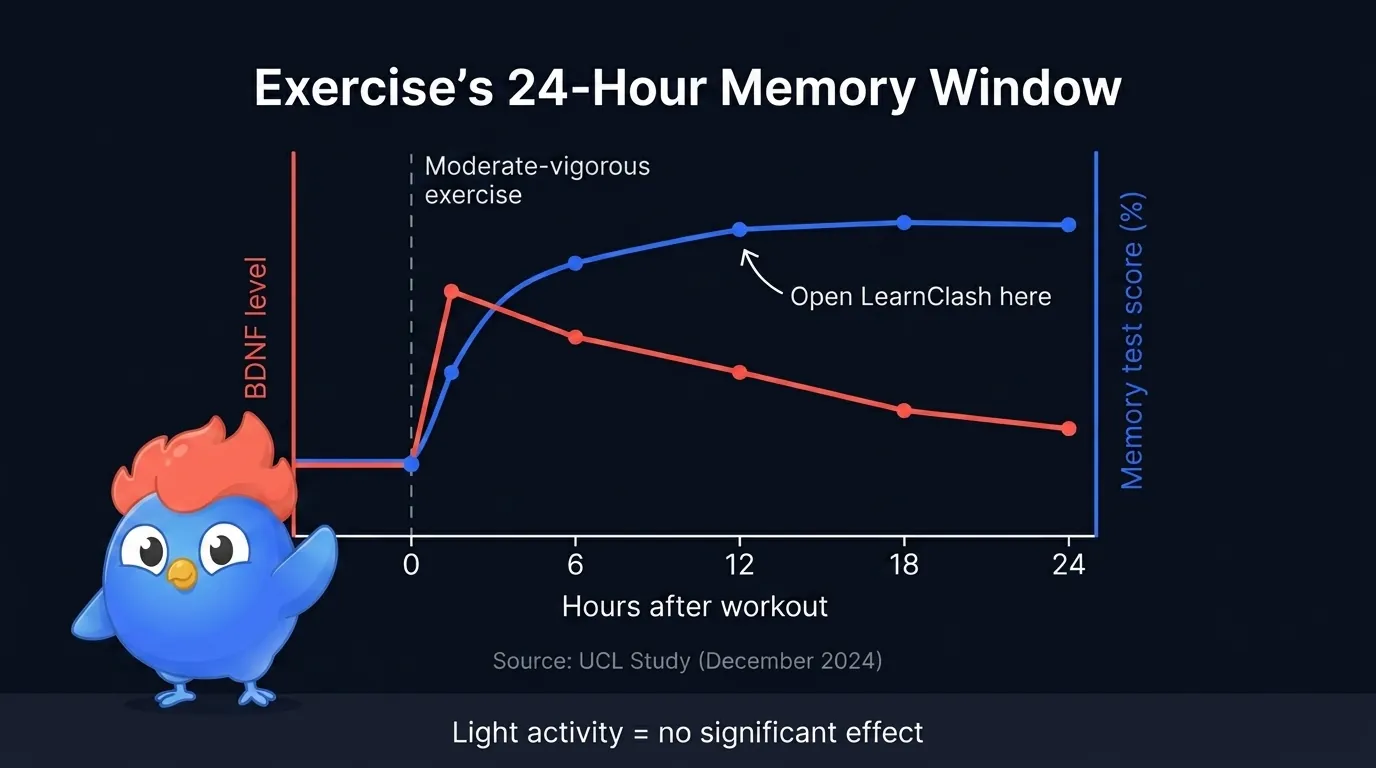 You do not need a full workout. A short walk before studying is enough to turn movement into a memory primer.
Roig et al. (2013) looked at 29 studies and found that one bout of exercise before or after learning improved long-term retention across age groups and fitness levels. The effect was strongest when exercise came before studying, not after.
You don’t need a gym. A brisk walk around the block works. The point isn’t fitness. It’s priming your brain to encode what comes next. Twenty minutes of movement before you open a book or start a LearnClash duel gives your brain a real chemical edge for forming new memories.
How to Build a Memory System That Works
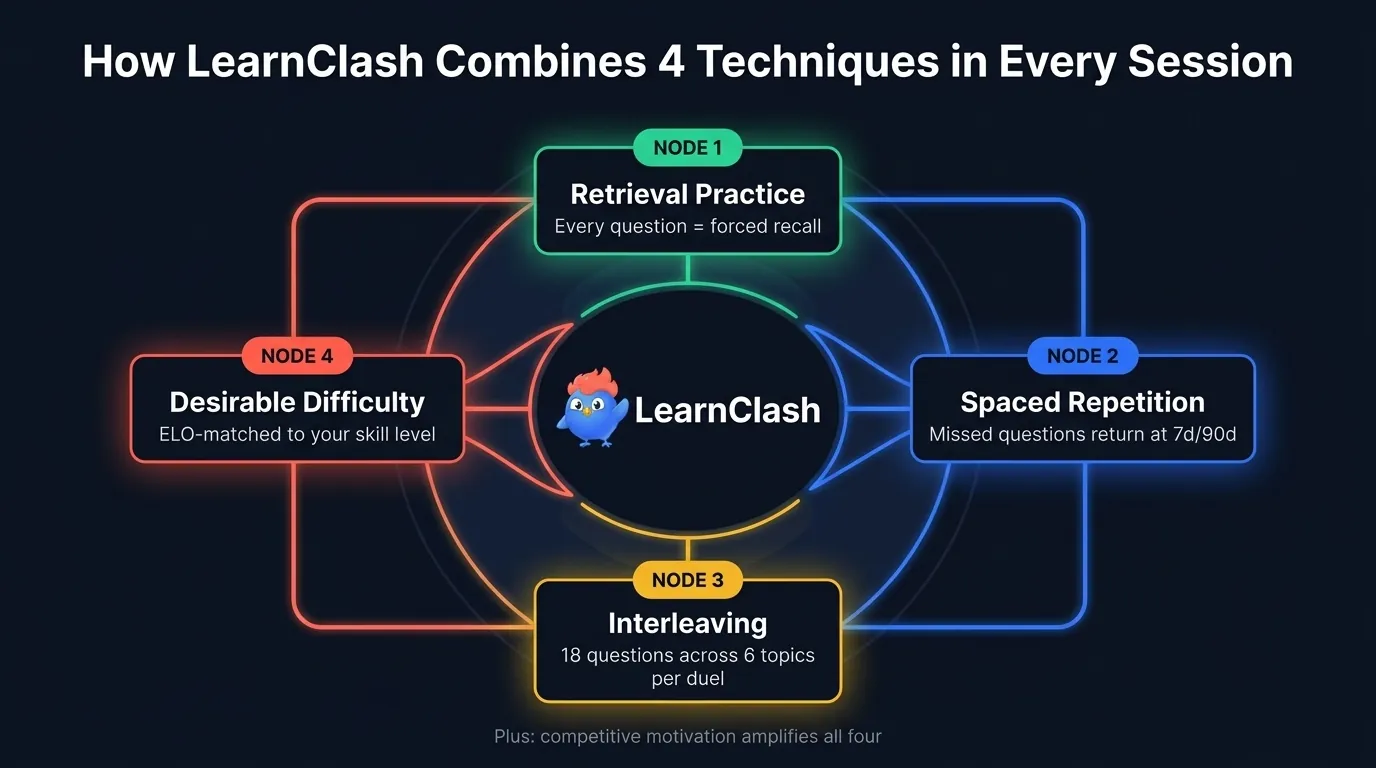 LearnClash combines retrieval practice, spaced repetition, interleaving, and desirable difficulty automatically. Every duel applies 4 of the 7 techniques in this guide.
Knowing 7 techniques is useless if you can’t put them together into a habit you’ll actually keep. Here’s a daily system that stacks the strongest memorization techniques for studying into a routine that takes under 30 minutes. If you want to remember what you learn, this is the routine. LearnClash handles the first four steps on its own, but the framework works with any material.
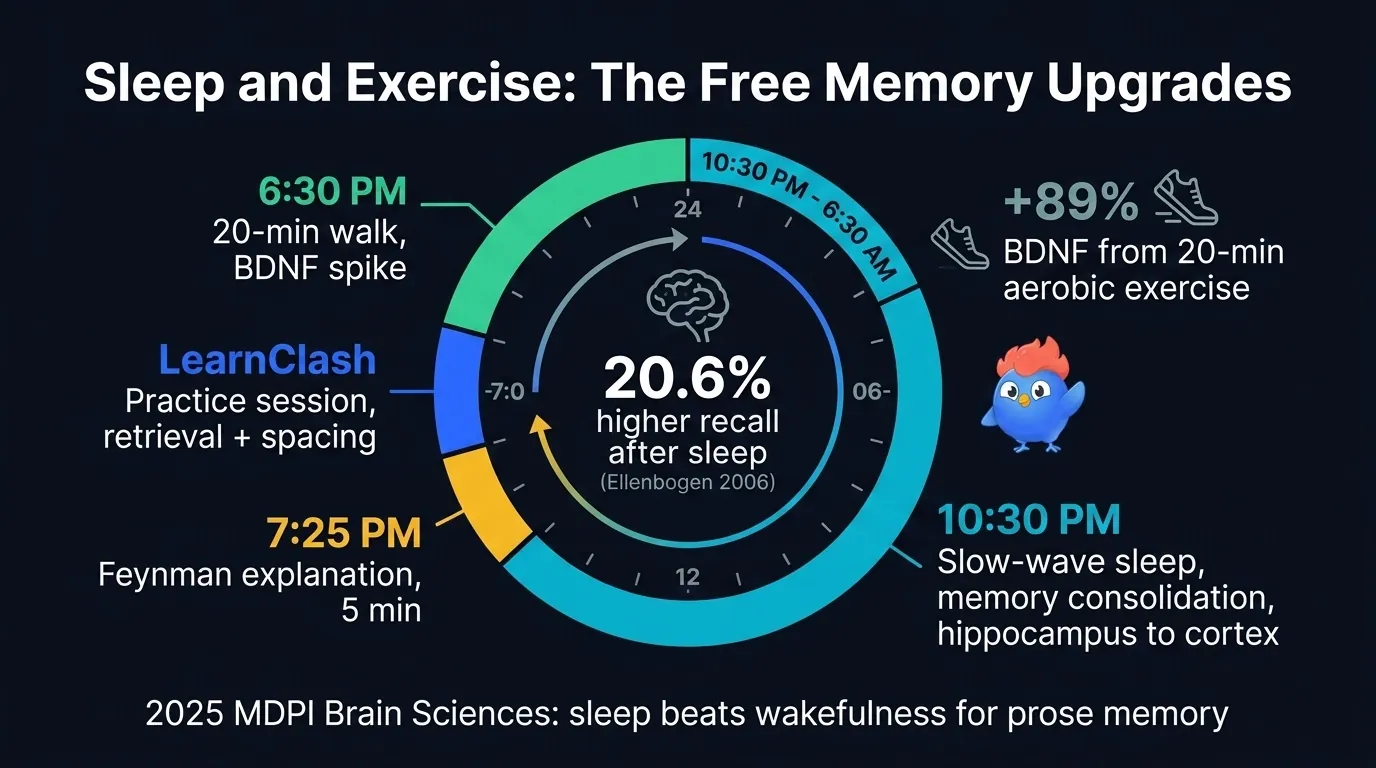 A short evening loop gives your brain retrieval, spacing, explanation, and sleep consolidation in one repeatable habit.
- Move first (5-10 min): Walk, stretch, or do bodyweight exercises. Prime BDNF.
- Test yourself (15-20 min): Don’t reread. Quiz yourself. In LearnClash, play a duel or practice round on any topic. The app handles retrieval practice, interleaving (6 topics per duel), spaced repetition (missed questions return at 7d/90d), and desirable difficulty (ELO-matched questions).
- Explain one thing (5 min): Pick the question that surprised you most. Explain the answer out loud as if teaching a friend.
- Sleep on it: Do this routine in the evening. Let your brain’s consolidation shift lock it in overnight.
That’s four of the seven techniques in a single session. And you didn’t highlight a single thing. For the deadline-driven companion guide on how to memorize fast, see the speed-focused version with memory palaces, mnemonic systems, and the body hacks that pair with retrieval. For the same 7 methods ordered by 2025-2026 research effect sizes, see how to memorize faster. For more on the science behind these methods, explore our learning science articles.
Three mistakes that undo all of this
- Cramming the night before: one long session feels productive but skips the spacing that builds lasting memory
- Rereading “just in case”: the fluency illusion makes rereading feel safe, but it adds almost nothing to recall
- Studying only easy material: if every question feels simple, you’re not creating the desirable difficulty your brain needs to encode deeply
Start a LearnClash quiz duel and apply these techniques nowKey takeaway: The most effective memory techniques all have one thing in common: they force your brain to work. Highlighting and rereading feel productive because they’re easy. Testing, spacing, and mixing feel harder because they are harder. That difficulty is the point.
“Conditions that slow the rate of learning often enhance later retention and transfer.” Elizabeth & Robert Bjork, Psychology and the Real World (2011)
The techniques that feel easy (highlighting, rereading) fail you when it counts. The ones that feel hard (testing, spacing, mixing) are the ones that stick. Pick one tonight.
For the full routine with focus blocks, exam timelines, and sleep protocols, see how to study effectively.
Frequently Asked Questions
What is the most effective way to remember what you learn?
Retrieval practice (testing yourself) combined with spaced repetition. Dunlosky et al. reviewed 700+ studies and rated both 'high utility,' the only two techniques to earn that rating. LearnClash builds both into every quiz duel and practice session automatically.
Why do I forget everything I study?
The forgetting curve. Ebbinghaus showed we lose 67% of new information within 24 hours without active review. Rereading and highlighting feel productive but don't create durable memory traces. Retrieval practice (testing yourself) is 2x more effective than rereading.
Does highlighting help you remember?
No. Dunlosky et al. (2013) reviewed decades of research and rated highlighting 'low utility' for learning. It feels productive because of the fluency illusion: familiar-looking text tricks your brain into thinking it's stored. Active retrieval builds far stronger memory.
How many times do you need to review something to remember it permanently?
Three to five spaced retrievals at expanding intervals moves information into long-term memory. The optimal review gap is 10-20% of how long you want to remember it. LearnClash automates this with a 3-stage SRS: Learning, Known (7-day review), Mastered (90-day review).
What is the best app for remembering what you learn?
LearnClash combines retrieval practice, spaced repetition, interleaving, and desirable difficulty in competitive 1v1 quiz duels on any topic. Unlike flashcard apps, the competitive format adds emotional engagement and ELO-matched difficulty, both proven memory amplifiers.