
Which QuizUp Alternative Fits You in 2026?
Compare LearnClash, Sway, and QuizUp - The Game with September 2026 store checks, clear limits, ELO ranking, and spaced-repetition details.

The icon looks familiar. But searching for QuizUp now leads to several games with different publishers, accounts, and ways to play, so the name alone will not tell you whether you can recover the part of the original you miss.
The original closed in March 2021. LearnClash offers topic-based, turn-based duels with ELO and scheduled review. Sway advertises live trivia shows. QuizUp - The Game, from Two4Tea, uses a different game format under the old name. The right alternative depends on which part of QuizUp you miss.
I founded LearnClash, so this is a disclosed product comparison. The September 5 check uses public US App Store records and LearnClash’s product rules; it does not include a new hands-on session in either rival.
LearnClash vs QuizUp at a Glance
All three apps share the same core loop: pick a topic, answer questions, compete. Where they part ways is everything around that loop: the pace of play, how questions return, and what you pay for.
| Feature | LearnClash | QuizUp (2013-2021) | Sway |
|---|---|---|---|
| Status | Active (updated regularly) | Shut down March 2021 | Listed; latest iOS build December 18, 2025 |
| Team | Pluxia GmbH | Plain Vanilla → Glu Mobile | Rocky Road Games Inc (original QuizUp team) |
| Topics | Any topic you can imagine | 1,200+ curated categories | Hundreds of curated topics |
| Questions | Generated questions, 3 difficulty levels | User-submitted, fixed pool | Curated, mixed difficulty |
| Duel format | 18 questions across 6 topics | 7 questions on 1 topic | Hosted shows advertised; current format unverified |
| Timing | Turn-based, 72-hour window; optional live duels with friends | Real-time (simultaneous) | Advertised live shows; current schedule unverified |
| Ranking | ELO, 8 tiers (Iron to Phoenix) | Per-topic leaderboards | Per-city + per-topic leaderboards |
| Spaced repetition | 3-stage SRS in every mode | None | None |
| Solo mode | 6-question Solo sessions with SRS | None | None documented |
| AI tutor | Clash (chat about any topic) | None | None |
| Ads | Zero on any tier | Ads in the later Glu-era app | Yes on free tier (“Contains ads” on Google Play) |
| Price | Free + Premium ($7.99/mo, $59.99/yr) | Free (later ads + IAPs) | Free + $0.99-$49.99 coin packs + Sway+ ($4.99/week, $15.99/month) |
| Platforms | iOS, Android | iOS, Android, Web (all defunct) | iOS, Android |
What Happened to QuizUp?
QuizUp was discontinued in March 2021. Its closure ended the original topic communities and account system. A new app can borrow the duel format, but it does not bring back those accounts. That distinction matters more to a returning player than which icon looks most familiar.
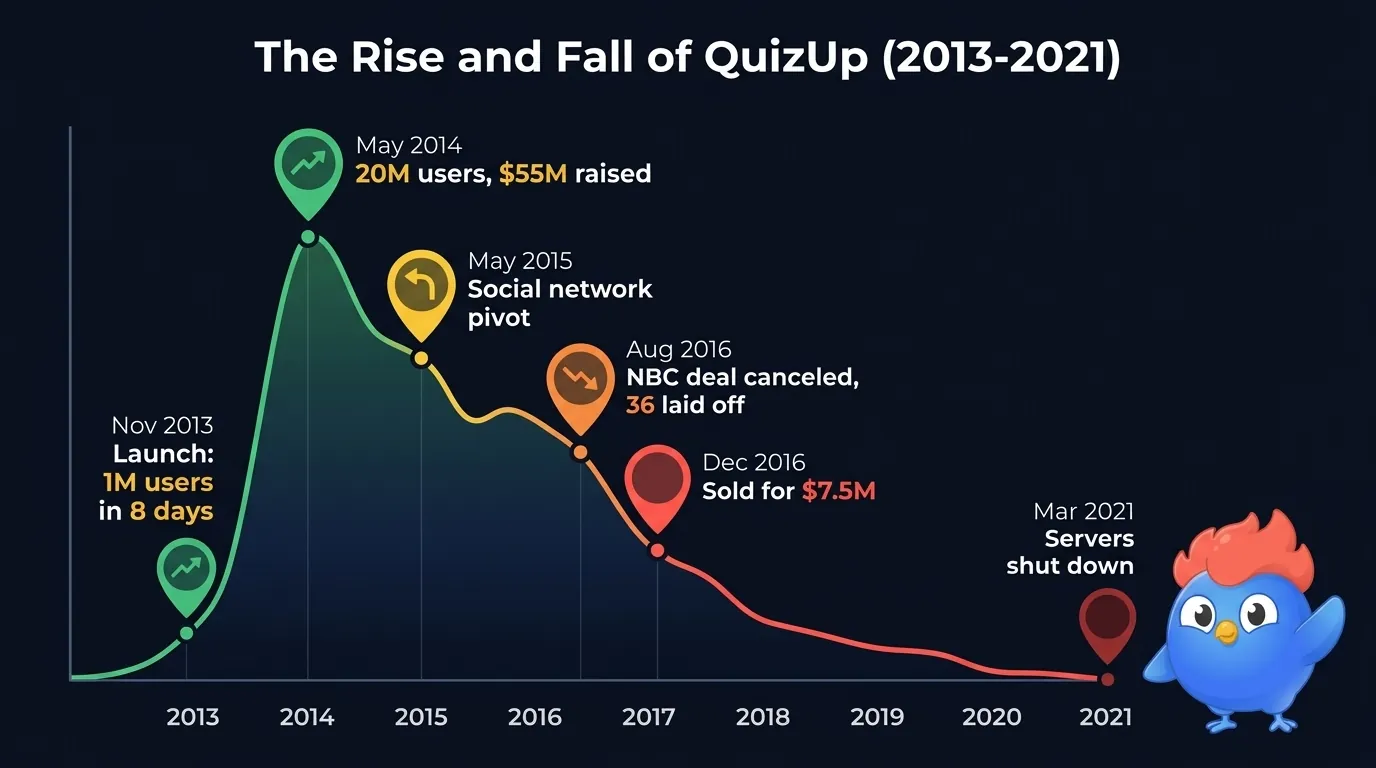
It started in Reykjavik. Thor Fridriksson, an Icelandic entrepreneur, sketched the idea on the back of an overdue electric bill during a dark Nordic winter. His company, Plain Vanilla Games, was broke. Their first game, a cartoon for toddlers called The Moogies, had flopped. So Fridriksson pitched Lionsgate on a Twilight fan trivia game. TechCrunch’s own timeline sums up what happened next in four words, “And the kids love it,” and in April 2013 the company raised a $2.4 million Series A and built the general-purpose QuizUp we remember.
The growth was staggering. QuizUp launched in November 2013 and hit 1 million users in eight days. Within two weeks, 1.5 million users had signed up and 70 million matches had been played. By May 2014 QuizUp had 20 million users spending an average of 40 minutes per day in the app, rivaling Facebook mobile engagement, and Sequoia Capital and Tencent were among the investors who poured in more than $40 million over the company’s life.
- Nov 2013: Launch, 1M users in 8 days
- May 2014: 20M users, over $26M raised to date, 40 min/day engagement
- May 2015: Social-network pivot, core trivia players pushed aside
- Aug 2016: NBC show canceled, 36 employees laid off
- Dec 2016: Sold to Glu Mobile in a deal valued at $7.5M
- Mar 2021: Servers shut down
But QuizUp never made money. In May 2015 the team pivoted QuizUp into a social network with profiles, messaging, and topic-based discussion forums; core trivia players felt pushed aside. Then NBC signed a 10-episode TV show deal in September 2015, which was supposed to save everything, and canceled the show in August 2016 before it ever aired. All 36 employees were laid off and the Iceland office closed.
Glu ran the app in maintenance mode for a little over four years. The Glu-era App Store listing carried an “Offers In-App Purchases” label, and its reviews read like an exit interview. “Too many ads, no option to buy ad free version?” asked one in February 2018, adding that the frequency of video ads was “outrageous.” By February 2020 another returning player found the app “unrecognizable”: “long buggy ads play constantly,” and “at least 50% of time spent on the app is consumed by ads.”
“We put a lot of our eggs into one basket and then that basket was squashed.” Thor Fridriksson on the NBC bet that was supposed to save QuizUp (PocketGamer, 2020)
Fridriksson has kept trying since. Trivia Royale (June 2020) hit 2.5 million downloads in three weeks and shut down in June 2021 when Teatime Games ran out of money. Rocky Road (a hyperlocal mobile MMO) raised a $3M seed round in September 2023. And in May 2025 the same team shipped its most direct QuizUp successor yet, covered next.
What the September Store Check Actually Shows
Two4Tea’s QuizUp - The Game is still receiving releases. Sway’s iOS listing still points to a December 2025 build. These are useful maintenance signals, but neither says whether a match starts promptly or a live show runs today. LearnClash’s own feature comparison should be held to the same standard.
| US App Store record | Sway | QuizUp - The Game |
|---|---|---|
| Publisher | Rocky Road Games Inc | Two4Tea |
| Latest version | 1.0.35 | 1.16.0 |
| Release date of that version | December 18, 2025 | September 4, 2026 |
| Rating state on September 5 | 4.8/5 from 3,507 ratings | Overall rating recently reset |
| Store description | Hosted live trivia shows | Timed answer-finding battles |
| What this check cannot establish | Today’s show availability | Today’s matchmaking or play quality |
Method: public US Apple lookup records and the linked Sway listing and Two4Tea listing, checked September 5, 2026. This is a store-record audit, not an in-app test. Ratings belong to one storefront and can change.
A reset rating is not a zero-star score
The Two4Tea correction is substantial. The previous page’s 1.0/5 label came from two ratings in an August check. Apple now explicitly reports a reset. Its lookup API returns zero for the aggregate count; that does not mean the game deserves zero stars. It means there is no current aggregate to report from that record. Individual older reviews remain visible, but repeating their old average would mislead readers.
The new version matters too. Version 1.16.0 arrived on September 4, one day before this check. The page’s prior framing made the app sound dormant even though it was shipping. Its store description still outlines a different game from the original QuizUp, so judge that format on its own terms.
Separate products and accounts
Sway comes from Rocky Road Games, the company founded by original QuizUp creator Thor Fridriksson. That connection explains the interest from former players. It does not establish that old QuizUp accounts, purchases, or communities transfer. LearnClash is also a separate product: it launched March 1, 2026, with no access to your old QuizUp profile.
Before Paying for Sway’s Live Shows
A live trivia app needs an actual show you can join. Sway’s store description promises hosted, real-time competition, while its latest listed iOS release remains December 18, 2025. Check the current in-app schedule before buying access. LearnClash has no hosted prize-show format, so it cannot substitute for that experience.
The September check leaves 261 days between Sway’s listed build and the audit date. That gap is a reason to inspect current service availability, not a declaration that the app is dead. Shows, questions, and schedules can change on a server without a new App Store binary. Conversely, a store listing can remain available while an advertised activity is unavailable.
Check the show before the purchase
Earlier versions of this comparison relied heavily on negative user reviews about shows and withdrawals. Those reports are not a live operational check. They should prompt a concrete question before a purchase: is there a dated upcoming show, and do its entry and prize terms make sense for you? This guide has not verified a successful tournament entry or withdrawal in September.
The store has long listed in-app purchases. The August audit recorded coin packs and Sway+ subscriptions, so this page’s original story about a free app suddenly breaking a no-pay-to-win promise was unsupported. Check the price and renewal period on your own purchase screen. A weekly subscription and a one-time coin pack create quite different commitments.
Try the free experience
For a returning QuizUp player, the sensible first step is to inspect the free experience. Browse what is available, see whether the activity you want is scheduled, and decide from that evidence. A high lifetime star average cannot answer those questions.
What Independent Reviews Say About LearnClash
A youth-media tester and a QuizUp heir have a natural conversation to have, because the tester’s first question is the one this page keeps asking: what did the app take from the 2010s duel formula, and what did it add? Spieleratgeber-NRW, the state-funded German games-pedagogy body, opens its July 15, 2026 LearnClash review exactly there, with Quizduell’s takeover of 2010s smartphones, and then judges what the AI layer adds. The verdict is mixed and we quote it as such. In the app’s favor: any-topic question generation, the explanation shown after every wrong answer, a spaced-repetition solo mode, and, in a line worth noting on a page about ad-funded rivals, a free version the reviewer records as “werbefrei” (ad-free). Against it: recurring factual errors in the German AI-generated questions, subscription prompts the reviewer found intrusive, and a closing judgment that the app is unsuitable as a classical learning tool because the content stays at trivia depth. The teenagers in the test group advised not to attach too much importance to the quiz. Age recommendation: playable from 12. The German question errors and the premium prompts are both being worked on; the “trivia, not a textbook” verdict is one we accept, because a duel app is what this is.
The Educational App Store reached a friendlier conclusion, praising explanations and follow-up learning. Its review is part of a paid certification and promotional package, so it should be read with that relationship disclosed. Neither editorial review proves a learning advantage over Sway or Two4Tea, and LearnClash’s small store-rating sample is not a substitute for that evidence.
Facts still need checking
The practical limit is clear: if a fact matters for school or work, verify it against a reliable source. Question reports and a review cycle help us improve the product, but they do not make every generated answer correct. Our published misconception data also shows the limits of the sample behind our own claims.
Topics: Any Topic vs 1,200 Curated Categories
QuizUp’s topic library was its crown jewel: over 1,200 categories covering everything from Harry Potter to advanced chemistry, each with its own fan community. LearnClash takes a different approach. Type any topic and play right away, with questions at easy, medium, and hard difficulty. One is a curated library. The other is a search engine.
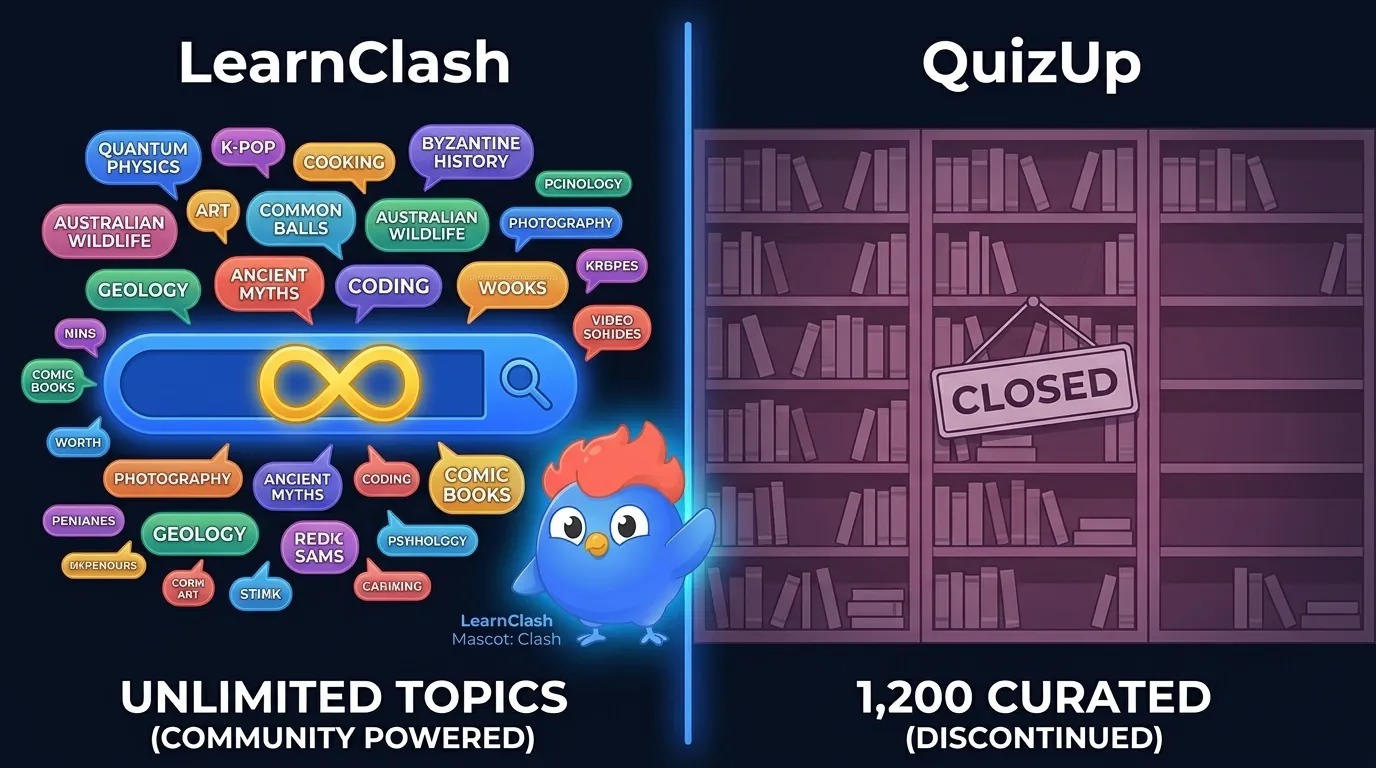
| LearnClash | QuizUp | |
|---|---|---|
| Topic count | Any topic via search | 1,200+ curated |
| Question source | AI-generated, validated | User-submitted |
| Difficulty levels | Easy, medium, hard (ELO-calibrated) | Single difficulty |
| Fresh content | New questions can be generated | Fixed pool, repeats |
| Quality control | Automated validation pipeline | Community moderation |
QuizUp’s user-submitted questions had a charm to them. Fans wrote questions about their favorite shows and games with insider knowledge only true fans would have. But quality varied wildly: some topics had hundreds of well-crafted questions while others had a dozen poorly worded ones that repeated every few matches.
LearnClash generates questions on demand for any topic you type. Byzantine military tactics, 1990s one-hit wonders, Albanian folklore, the hash functions behind Bitcoin mining. Go narrow. A broad category can miss what you actually want to practice, while a topic such as Byzantine military tactics gives you a clearer boundary for the facts you want to learn and the errors you need to catch. The trade-off is real, though: LearnClash has nothing like QuizUp’s per-topic fan communities, and anyone who valued those more than the questions themselves will feel the gap.
How LearnClash Handles Rating and Review
A rank and a review queue answer different questions. The rank estimates how you compete; the queue decides which missed facts you should see again. LearnClash keeps both, and neither should be read as proof of better exam results.
Competition: ELO Ranking vs Topic Leaderboards
QuizUp tracked wins on per-topic leaderboards, and those leaderboards had a flaw anyone who chased a #1 spot in 2014 will remember: they rewarded volume over skill. Play 500 games on a topic and you would rank high regardless of win rate. You could be #1 in Harry Potter and #847 in Geography, and neither number said how good you were, because a win over a first-week novice counted exactly as much as a win over the topic’s best player. Neither revival fixed this. Sway uses city leaderboards and per-topic ranks, and the unaffiliated “QuizUp - The Game” has leaderboards but no rating tiers.
The fix is old and comes from chess: rate the player, not the win count. LearnClash uses Glicko-2, displayed as an ELO score across 8 tiers from Iron to Phoenix, 22 ranks in total, where beating stronger opponents earns more rating points.
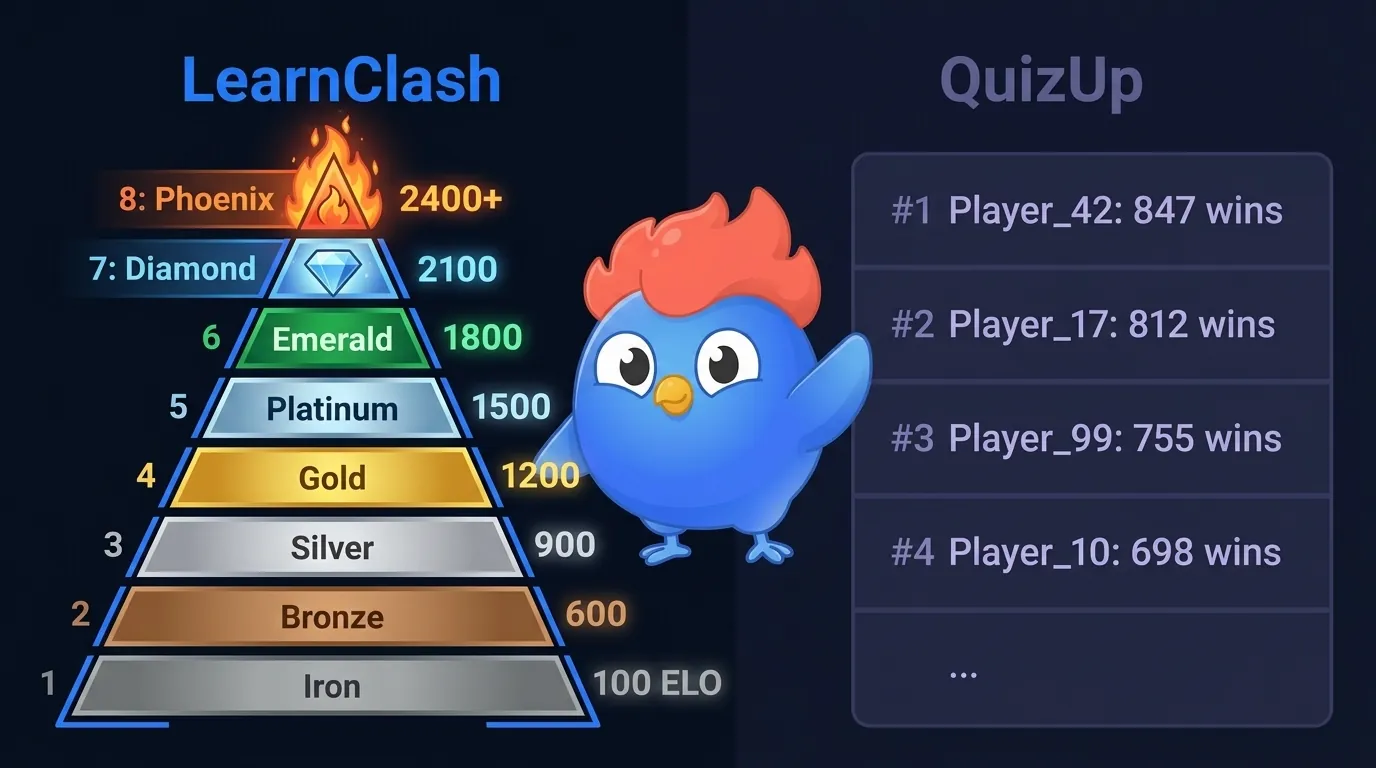
| LearnClash | QuizUp | |
|---|---|---|
| Ranking type | ELO rating (global) + per-topic mastery leaderboards | Per-topic win/loss leaderboards |
| Tiers | 8 major tiers, 22 ranks (each splits into III/II/I except Phoenix) | None |
| Skill tracking | Glicko-2 rating, displayed as ELO | Simple win count |
| Cross-topic skill | Yes (global ELO) | No |
| Progression feeling | Climb tiers, see rating change each duel | See position on leaderboard |
While re-verifying this page on August 15, 2026, I re-opened the rating constants file in our backend to make sure this section still matches the shipped code. It does: eight tiers from Iron (the rating floor is 100) to Phoenix (2400 and up), 22 ranks, and the comment at the top of the file reads “Starting rating (1300) = Gold II (average)”. That start point is deliberate: a new account lands in the middle of the ladder, not at the bottom, so its first duels are calibration rather than a climb out of Iron. One correction from the same check: the per-topic boards in LearnClash are mastery leaderboards, ranked by a topic mastery score, not per-topic ELO ratings. An earlier version of the table above said otherwise.
The first duels find your level
Your score changes from your first rated duel. The first 10 rated duels only decide when it becomes public and appears on the boards. They do not fix your final rank. Glicko-2 starts at 1300, with a rating deviation of 250 and volatility of 0.06. The score floor is 100, the deviation floor is 90, and each game can change the score by at most ±500. Settled players at the same rating move 8 to 41 points, by final score margin. The ELO guide explains the ladder. Finding a rival is a separate step. ELO proximity and shared topic categories each carry half the weight. With fewer than five topic picks by either player, only ELO counts. The matchmaking analysis explains what this model can and cannot tell us.
Learning: Spaced Repetition vs Play-and-Forget
Miss a question about the Treaty of Westphalia in a QuizUp duel and it was gone for good: nothing tracked what you knew, nothing scheduled review. You answered, saw the result, moved on. That is the opposite of what memory research says a quiz should do. The testing effect is one of the most replicated findings in the field: pulling a fact from memory makes it stick far better than rereading it, and the gain grows when the retrievals are spaced out over days and weeks instead of crammed into one sitting. Sway and “QuizUp - The Game” inherit QuizUp’s gap: neither tracks retention.
| LearnClash | QuizUp | Sway | |
|---|---|---|---|
| Spaced repetition | 3-stage SRS in every mode | None | None |
| Solo mode | 6-question solo sessions | None | None documented |
| Mastery tracking | 3 stages (Learning → Known → Mastered) | None | None |
| Scheduled review of missed questions | Seven-day and 90-day checks | No documented schedule | No documented schedule |
| AI tutor | Clash (chat about any question/topic) | None | None |
Due questions return to play
LearnClash builds that 3-stage cycle into every game mode, so a missed question re-enters the pool and comes back at timed intervals until you own it. For the full science, read how spaced repetition actually works and how to study effectively using retrieval practice.
Solo on a daily schedule
Solo mode gives you 6 focused questions per session on any topic. It is pure SRS: due reviews get served first. Free players get one solo session per local calendar day; Premium raises that to 20 sessions an hour. Read more about the testing effect and how retrieval practice works or the broader case for competitive learning.
Multiplayer: Turn-Based vs Real-Time
QuizUp’s original format put both players on the same questions at the same time. Sway introduced live tournaments in 2025. Its App Store listing, read on September 6, 2026, still advertises daily creator-hosted shows. That documents the advertised format, not a working show schedule or a verified prize payout. LearnClash offers asynchronous duels with a 72-hour window per turn and optional live duels with friends.
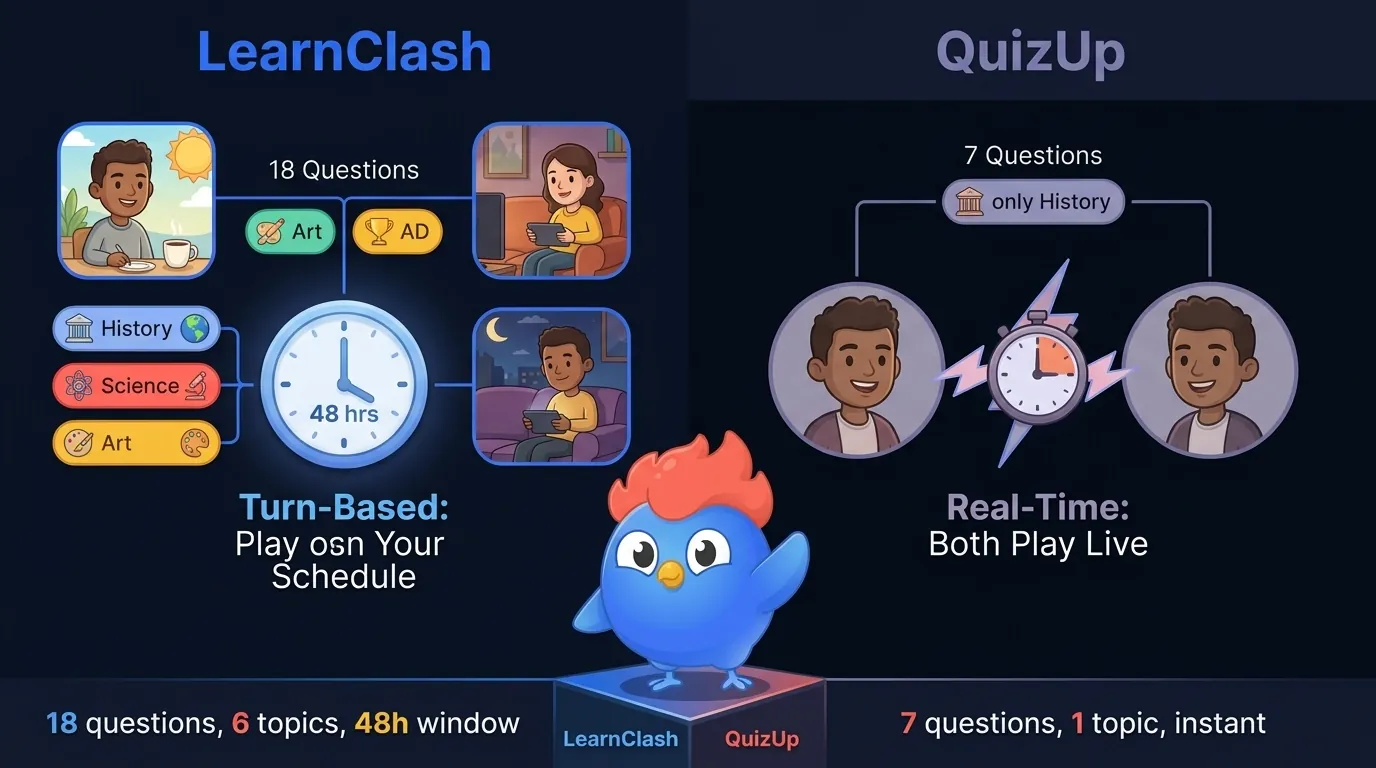
| LearnClash | QuizUp | Sway | |
|---|---|---|---|
| Format | Turn-based; optional live friend duels | Real-time (at once) | Advertised live shows; availability unverified |
| Time per turn | 72 hours in asynchronous mode | Instant (both play live) | Current schedule unverified |
| Players per match | 2 (1v1) | 2 (1v1) | Current capacity unverified |
| Questions per duel | 18 (6 topics, 3 each) | 7 (1 topic) | Current show format unverified |
| Topic selection | Player picks; 6 topics per duel | Player picks 1 topic | Creator-hosted shows advertised |
In LearnClash’s asynchronous mode, both players can answer on their own schedules within the 72-hour turn window. When friends want to play together, live duels provide that option. Sway advertises a hosted group event instead of a two-player duel; check its current schedule before planning around a show or paying to enter. We did not verify a live session or payout.
Pricing and Ads: The Lesson QuizUp Taught Everyone
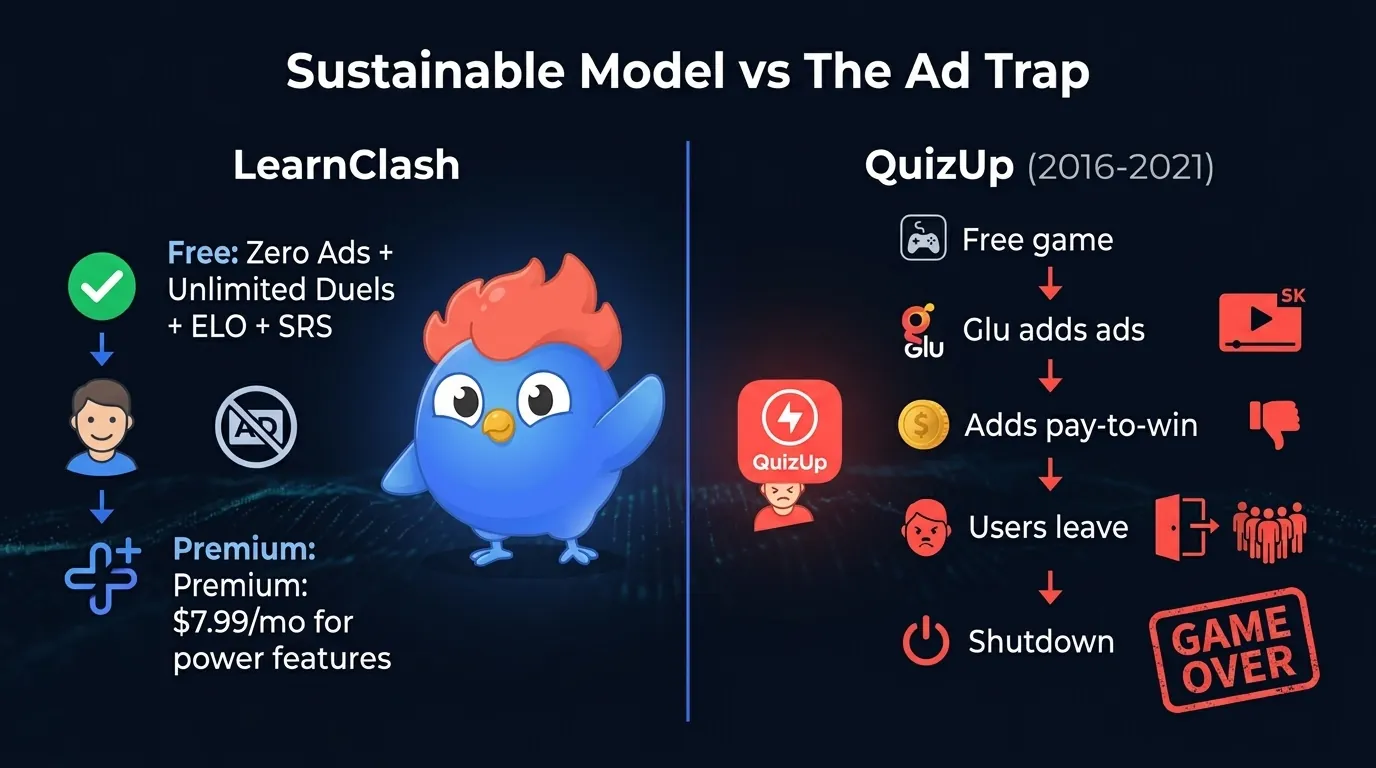
LearnClash has no ads on either tier. The paid plan buys more features and practice capacity. Rival listings can mix subscriptions with coin packs, so check both the price and the renewal period before you buy. The older store checks below are dated August 2026.
| LearnClash | QuizUp (Glu era, 2017-2021) | Sway (August 2026) | |
|---|---|---|---|
| Ads (free tier) | Zero | Yes; video ads at a frequency a Feb 2018 review called “outrageous” | Yes (“Contains ads” on Google Play; an Oct 2025 review describes minutes-long ads after every round) |
| Ads (paid tier) | Zero | No ad-free option (“no option to buy ad free version?”, Feb 2018 review) | Sway+ is sold as “Unlimited Energy, Extra Live!”; no ad-removal purchase listed |
| Subscription | $7.99/mo or $59.99/yr (7-day free trial on annual, in-app) | None seen (ads + IAPs) | Sway+ $4.99/week or $15.99/month |
| In-app purchases | Subscription only, no coin packs or consumables | Yes (“Offers In-App Purchases” label; items from $0.99 in a May 2020 store capture) | $0.99 to $49.99 coin packs (listed since July 2025) |
| Tournament entry | n/a (no tournament layer) | n/a | Coin-gated live shows, per Google Play reviews |
| Free tier includes | Daily duels, all topics, ELO, daily SRS | Base game with ads | Casual play; live shows coin-gated per reviews |
| Pay-to-win | No | Paid extras (“you can choose to pay real money for some extra items”, Glu-era listing) | Coin economy since launch |
What the subscription pays for
Here is how the two monetization designs actually differ. Sway monetizes with a coin economy: $0.99 buys 100 coins and $49.99 buys 7,000, alongside a Sway+ subscription at $4.99 a week or $15.99 a month, and Google Play reviewers report that entering live shows costs coins. LearnClash charges for additional features while keeping the rating and review systems available free: a 22-rank ELO ladder from Iron to Phoenix and a 3-stage spaced-repetition cycle that re-checks misses after 7 days and knowns after 90, with zero ads and no coin packs on any tier.
QuizUp’s users were not cheap. They loved the app and played 40 minutes a day. But when Glu tried to monetize that engagement through ads and paid extras, the uninterrupted quiz experience that made users loyal was the first thing to go, and in early 2018 at least there was not even a paid exit: the reviewer who asked for an ad-free version that February says they “would in a heartbeat” have paid for one. Two years later a returning player called the app “unrecognizable.” The same paywall escalation keeps showing up across the category, from Kahoot 360 Spirit at $20/month to the Quizlet Plus arc covered in our Kahoot vs Quizlet comparison; Two4Tea’s current purchase screen should be checked directly rather than priced from an older review.
The free LearnClash plan
LearnClash’s answer to Glu’s escalation is zero ads on any tier: not on the free plan, not behind a paywall, no coin packs, no paid tournament entry. Spieleratgeber-NRW’s tester, no fan of our subscription prompts, still recorded the free version as “werbefrei.”
The free tier includes daily duels, all topics, the full 8-tier ELO ladder, and one daily solo session. Premium ($7.99/month or $59.99/year; new subscribers on iOS and Android get a 7-day free trial on the annual plan in the app) adds near-unlimited solo practice (up to 20 sessions an hour), advanced stats, and exclusive cosmetic rewards, and raises the streak freezes you can hold from 1 to 3.
Why We Combined ELO and Spaced Repetition
LearnClash combines a competitive rating with scheduled question review. We chose that combination because it gives a duel two kinds of progress: a result against an opponent and a chance to revisit a mistake. It does not prove why QuizUp closed or that our app retains players better.
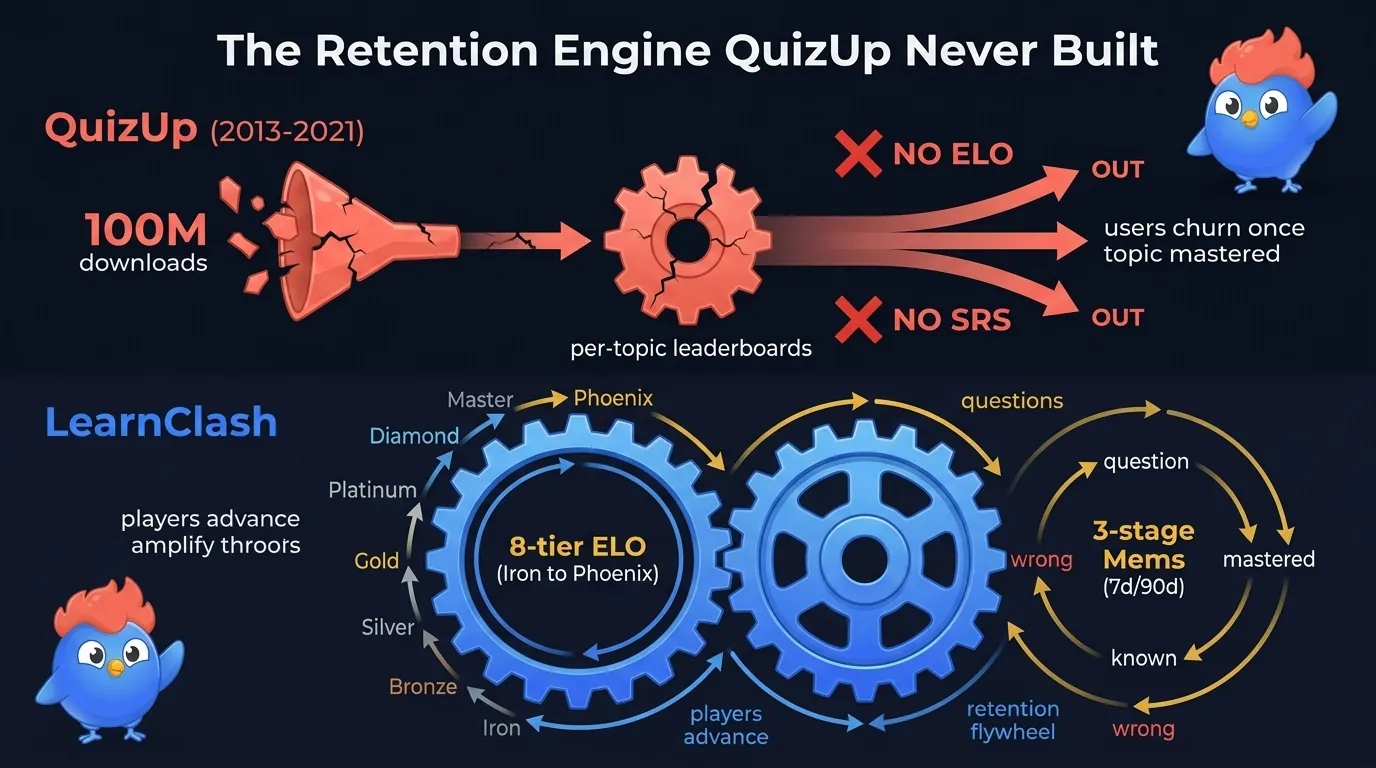
| What the retention engine needs | QuizUp | Sway | LearnClash |
|---|---|---|---|
| Ranking and progression | Per-topic win counts | Per-city + topic leaderboards | 8-tier ELO ladder calculated with Glicko-2 |
| Forgetting-curve review loop | None | None | 3-stage SRS (7d, 90d checks) |
| Re-engagement trigger | Push notifications only | Daily tournament hook | SRS review + quest streaks |
| Progression ceiling | None (hit #1 once, done) | Tournament leaderboard refresh | ELO tier climb + mastery pool |
| Learning evidence in this comparison | No outcome study | No outcome study | Product review rules; no comparative outcome study |
Think about what QuizUp’s 40-minute daily sessions actually produced. A player mastered their topic in month one, hit the top of their per-topic leaderboard, and then what? The app had no way to say “here is a harder opponent” or “here is the 7-day review from your weak spots.”
LearnClash’s answer has two parts. ELO makes every duel matter: beating a higher-rated opponent moves your number more than beating a lower-rated one, and a Phoenix-tier player cannot grind easy wins because the rating gives less credit for beating far weaker opponents. SRS makes every question matter: yesterday’s misses come back in 7 days and pass to the 90-day check on success, visible in your weekly stats. Sway might build this eventually; as of August 2026 neither revival has.
Choose the Kind of Session You Want
The most useful comparison starts with how you want to spend the next few minutes. A slow exchange of turns and a hosted event with a crowd can both be fun, but one cannot stand in for the other.
Who Should Pick LearnClash
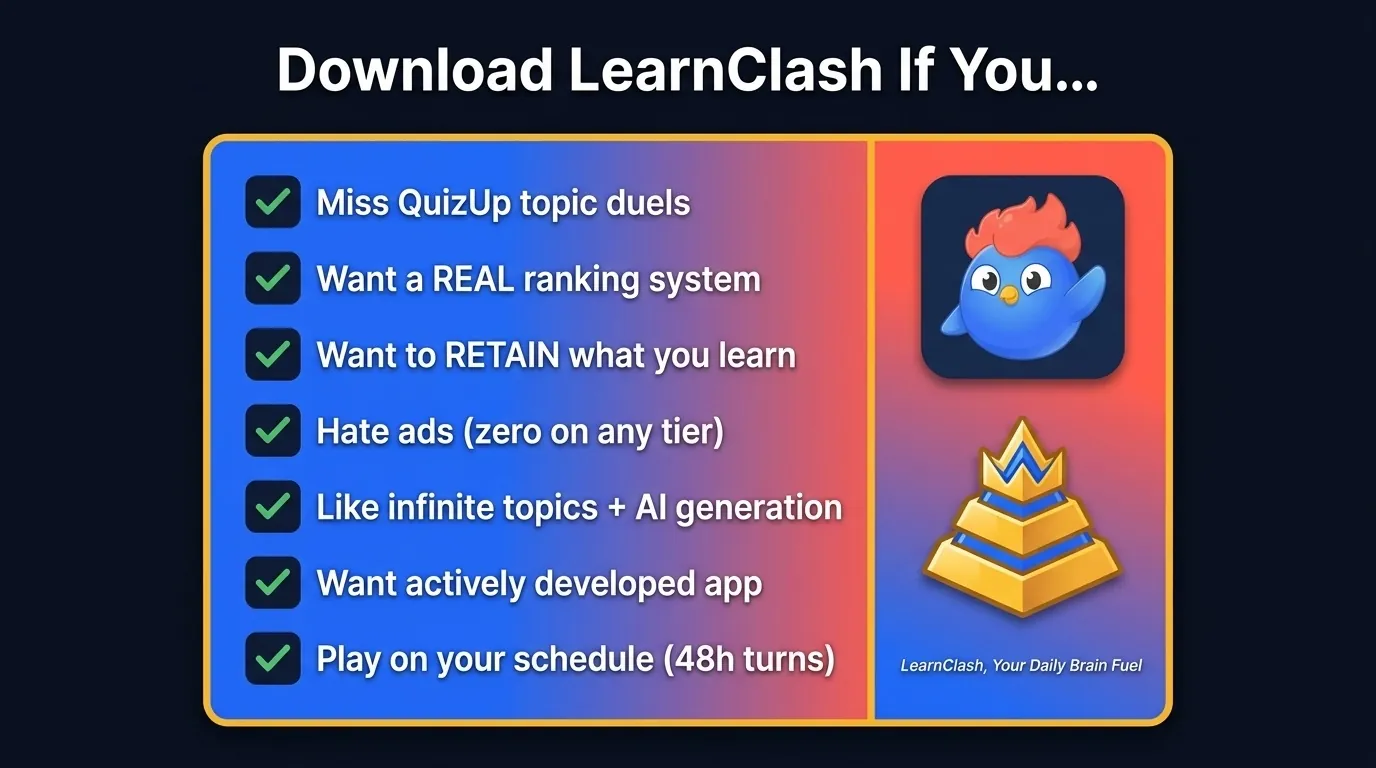
Download LearnClash if:
- You miss QuizUp’s topic-based duels and want that format back
- You want a ranking system that tracks real skill, not just win counts
- You care about retaining knowledge, not just having fun for five minutes
- You want zero ads without paying to remove them
- You want to practice a narrow topic and will check doubtful answers
- You want an app that is actively developed, not abandoned in maintenance mode
- You want to play on your schedule with 72-hour turns
Who Might Prefer Sway or the QuizUp Revival Instead
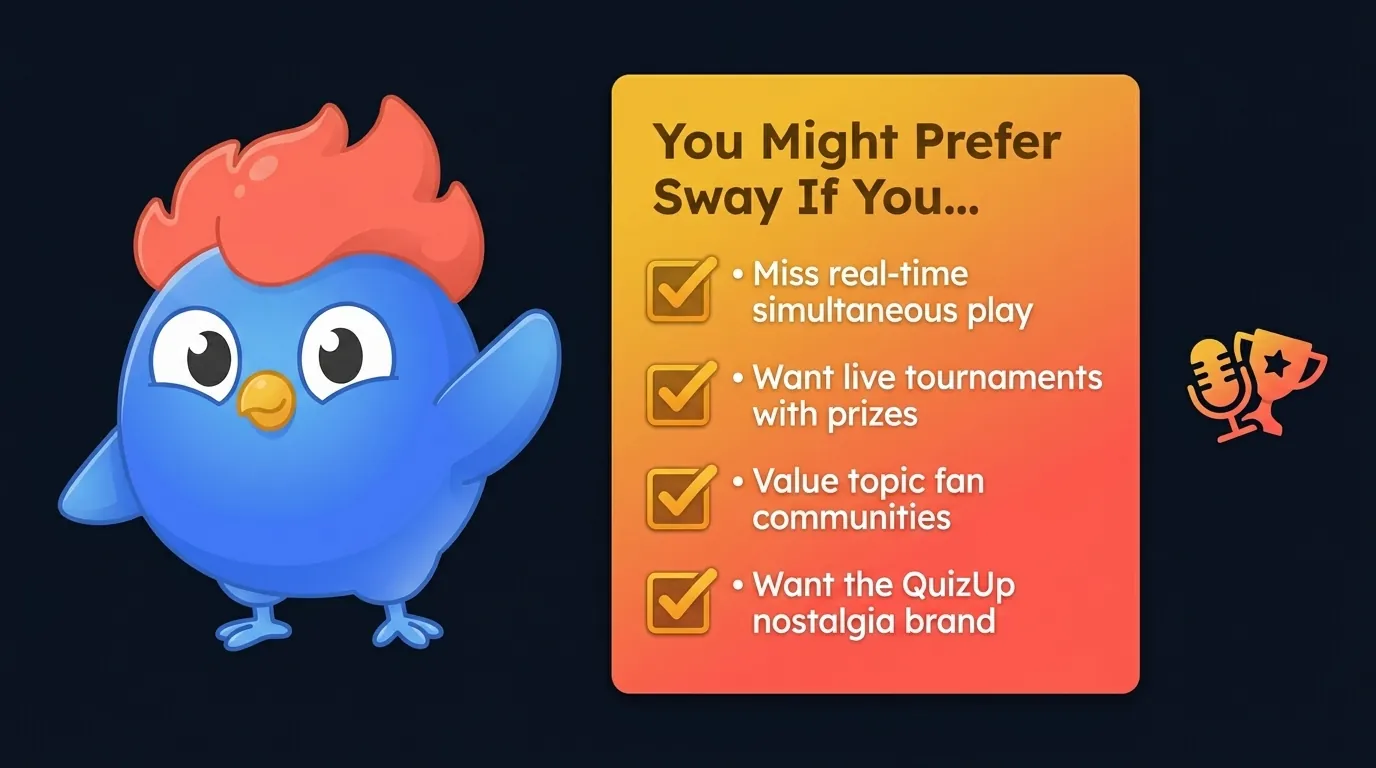
Sway advertises a different format. Check its current availability against what you want to play.
- You miss real-time play with a group. Sway advertises live shows, but this store check did not confirm that a show is currently available. LearnClash supports live friend duels and asynchronous turns with a 72-hour window.
- You want a hosted tournament with prizes. That is Sway’s advertised format, not a confirmed current schedule or payout. LearnClash has no tournament layer.
- You valued topic-specific fan communities and hand-curated questions written by enthusiasts. Sway’s curated library and city-based social ties are closer to that than LearnClash’s any-topic AI approach.
- You want the QuizUp brand nostalgia, literally. “QuizUp - The Game” keeps the name on the icon, if that matters more than the features underneath.
The choice comes down to the session you want to have. LearnClash gives you short turns, an ELO ladder, and scheduled reviews. Sway advertises the shared event of a live show. Two4Tea offers a different answer-finding game under the QuizUp name. Try the relevant free experience before paying, and keep the original QuizUp separate from all three.
For LearnClash, start with a topic you know well. Read the explanations, report any error, and decide whether you want to return for the next review. The three-stage SRS design explains why missed questions return after seven days. If you are still comparing, see LearnClash vs Trivia Crack or LearnClash vs QuizDuel.
How we test
We use the tools we compare. That means installing the mobile apps on real iOS and Android devices, hosting test sessions in the browser tools, and joining from a second device as a participant, because free-tier limits usually show up on the join screen, not the marketing page.
Every number is dated. Prices, player caps, and plan names come from each vendor's own public pricing page or help center, read in a normal browser and recorded with the date we read them. When a claim cannot be re-verified on the vendor's site, we either date it to the last check that confirmed it or cut it. Quotes are verbatim from the cited page or they are not quotes. The last full re-check of every vendor claim on this page ran on September 6, 2026.
First-party data carries its export date. When we cite usage numbers from LearnClash itself, such as answer rates on specific questions, they come from dated production-database exports, and we put the export date and sample size next to the number.
Nobody pays to be here. No vendor has paid for placement or ranking in our comparisons, none sees a draft before publication, and there are no affiliate links in them. If that ever changes, this box will say so.
LearnClash is our own product. These comparisons are written by the person who builds it, which is a bias you should know about. We handle it in the open: our app is always labeled as ours, we do not stage tests designed to crown it, and every comparison names the situations where a competitor is the better pick. Read our app's entry as a founder's pitch with checkable numbers, and the rest as the dated re-checks they are.
Frequently asked questions
What happened to the original QuizUp?
The original QuizUp was discontinued in March 2021. Its former servers and player accounts are not restored by downloading a newer app with the QuizUp name. Sway and Two4Tea's QuizUp - The Game are separate products.
Is there a QuizUp successor in 2026?
Sway comes from the company founded by original QuizUp creator Thor Fridriksson and advertises live trivia shows. Two4Tea publishes a separate QuizUp - The Game. LearnClash is an independent alternative focused on turn-based duels, ELO, and scheduled review.
Is Sway still active?
Its US App Store listing remains available, with v1.0.35 dated December 18, 2025 at our September 5, 2026 check. That is evidence about the iOS release, not a live-service test. Check the in-app show schedule and current terms before paying for tournament access.
Can LearnClash replace QuizUp for studying?
LearnClash supports topic-based practice with a three-stage review system. It cannot restore QuizUp accounts or recreate its fan communities, and generated questions can contain errors. It suits voluntary quiz practice; use source material for exam-critical facts.