
89 Party Trivia Questions [4-Round Host Script]
89 party trivia questions across 4 rounds and 1 wager final, structured to the 50-60% flow band hosts forget. Free to play on LearnClash.

Quiz yourself on these questions
How many do you know?
Think of your answer, then reveal it.
Did you know it before revealing the answer?
Read this answer in the articleRound complete
Challenge friends on this topic.
Start a new duel in LearnClash and learn from every answer.
Get LearnClashFree to play on iPhone and Android. No ads.
A 2018 study of 1,898 trivia players found only 12% of questions cleared 50% accuracy on the first read. That single number explains why so many party trivia rooms thin out before round 3: the questions were never tuned to the people answering them, they were just scraped together at one flat difficulty and dropped on the table to sink or swim.
So these 89 party trivia questions do the opposite. They are tuned to the accuracy zone Csikszentmihalyi mapped back in 1990, the 50 to 60% per-round band where players lose track of time and stop checking their phones. Each round aims at a different difficulty tier, which keeps the room in flow instead of going flat halfway through.
Four rounds of 22, then one wager to finish. Read the host script below. Or skip the live version entirely and duel me on popular culture →, where LearnClash runs the same shape async: each turn takes about 3 minutes to play, and you get 72 hours to take it.
Quick Host Setup: 4 Rounds, 89 Questions, 90 Minutes
LearnClash party trivia runs a 4-round host script, and each round chases a different accuracy band. Round 1 opens at 70 to 75% to build confidence. Rounds 2 and 3 drop into the 50 to 60% flow band. Round 4 stumps the room at 35 to 45%. Then the wager closes on one high-stakes question.
Three setup moves matter before anyone reads a question: pick a host who isn’t playing, cap teams at 4 to 5 players, and stick the scoreboard somewhere everyone can see it.
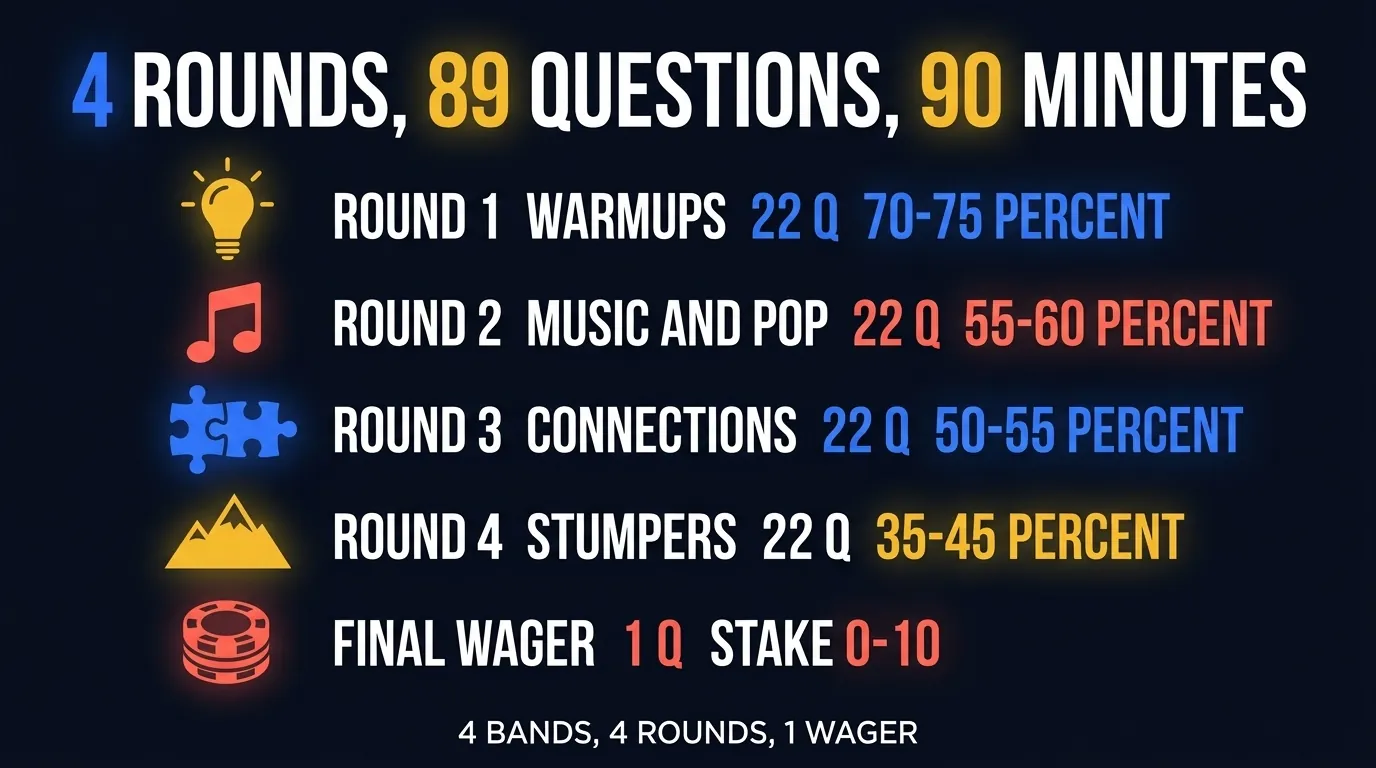
| Round | Time | Questions | Target accuracy | Best for |
|---|---|---|---|---|
| 1. Warmups | 0 to 20 min | 22 | 70 to 75% | First drinks, mixed groups |
| 2. Music & Pop Culture | 20 to 40 min | 22 | 55 to 60% | Mid-game variety |
| Break | 40 to 45 min | 0 | n/a | Refills, score read |
| 3. Connections & Wordplay | 45 to 65 min | 22 | 50 to 55% | Where the room thinks |
| 4. Show-Off Stumpers | 65 to 85 min | 22 | 35 to 45% | Earns the wager round |
| Final Wager | 85 to 90 min | 1 | varies | Stake 0 to 10 points |
Treat that table as the spine of the night. If you only want fun trivia questions for parties and no host script, skip straight down to round 1. For a lead-in before the trivia starts, the 223 forced-choice prompts in our this-or-that set run a snappy 5 minutes, while the 211 would-you-rather hypotheticals go slower and more thoughtful. The activities hub carries every trivia game for party format we cover.
The format flexes across age bands too. Trivia questions for birthday party rounds, office parties, holiday gatherings, a random Friday night with friends, all of it. For a multi-day workplace event, our 53 spirit week ideas for work guide slots this 4-round host script in as the Wednesday peak of a 5-day arc. And holiday hosts hunting for holiday party trivia questions can swap round 2’s pop culture for seasonal categories (Halloween facts, Christmas movies, New Year’s chart toppers) and leave the 4-band structure untouched.
One housekeeping note before the questions start. This script went up in May 2026 and the page has been revised in passes since: a July 2026 accuracy pass, then this August 2026 rewrite of the guide prose around the questions.
Why Most Party Trivia Fails: The Flow Band
Open most party trivia listicles and you get one of two presets. Easy warmups for beginners. Or hard stumpers for show-offs. Neither aims at the band where engagement actually lives. LearnClash built this set on one rule borrowed from flow theory: a room that clears roughly 50 to 60% per round stays hungry enough to ask for a rematch. Crank accuracy higher or lower and the room drifts, toward boredom on one side, frustration on the other.
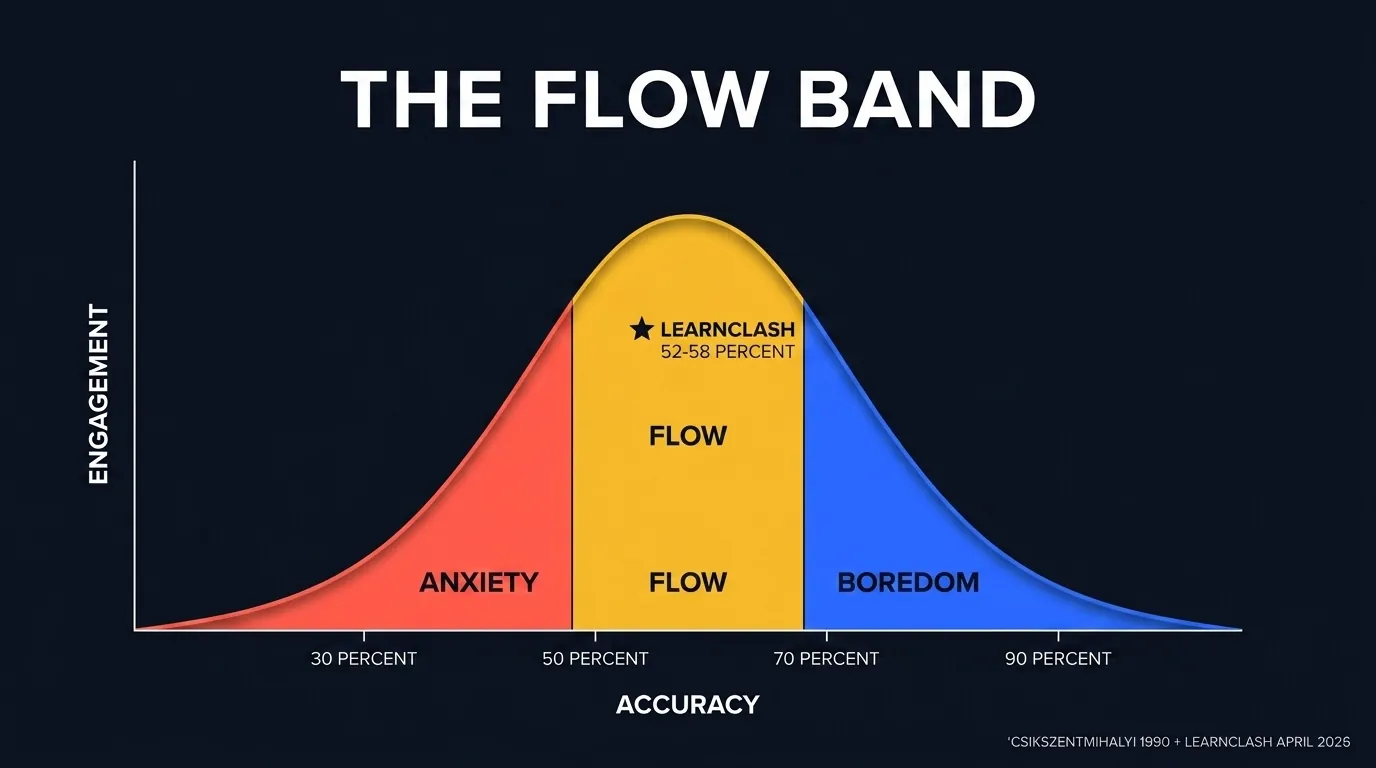
The idea traces to psychologist Mihaly Csikszentmihalyi’s flow theory. Engagement needs challenge to roughly match skill. Clear 70% and up, the room coasts and gets bored. Dip under 35%, and it gives up. Flow sits in the narrow gap between those two failure modes, the state where challenge and ability lock together so tightly that time speeds up and people stop noticing they are playing a game at all.
Random question lists fail this test by default. In the 2018 dataset above, only 12% of questions cleared 50% first-session accuracy, so pulling trivia off a website means the math is already against you before anyone pours a drink.
The fix has nothing to do with easier questions. It’s structural: you pick across four difficulty bands and order the night so each round lands on the one it’s built for. LearnClash runs the same logic in 1v1 quiz duels through ELO-matched matchmaking, pairing you with opponents near your rating so the match stays balanced by design (18 questions, 6 rounds, a 45-second clock).
Round 1: 22 Warmup Questions (Target: 70 to 75% Accuracy)
In the first 20 minutes, easy beats clever every time. You’re not testing anyone yet: the opening round anchors the host’s authority and gives teams a low-stakes runway to settle in, sort out who writes the answers, and finish a first drink before the difficulty climbs. These 22 warmups aim at 70 to 75% room accuracy and stick to geography, animals, food, signs, and pop culture everybody already knows. Save the wordplay for round 3.
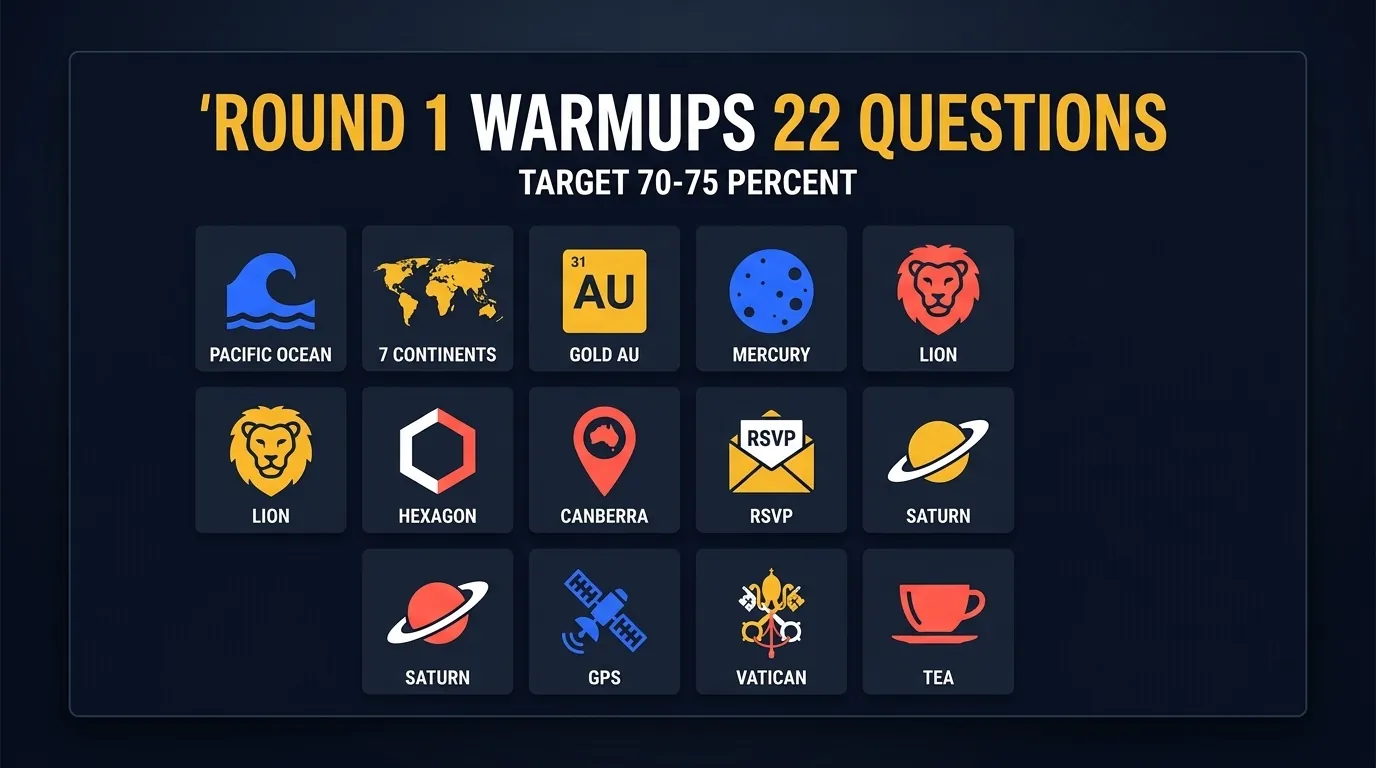
Most warmups land where players expect them to, but the good ones are the 2 or 3 that look obvious and quietly trip half the room (watch what question 12 does to a confident table). For broader variety in the opener, the 163-prompt icebreaker set for warmup rounds runs at the same difficulty band, just with prompt-style questions instead of trivia.
1. What is the largest ocean on Earth?
Answer: The Pacific Ocean. It covers roughly 30% of Earth’s surface, larger than every landmass combined.
Five seconds, tops. Hit them with the follow-up while they’re confident: “How many oceans are there?” The answer is 5 (Pacific, Atlantic, Indian, Arctic, Southern). Anyone who learned four oceans in school tends to forget the Southern Ocean got its own name.
2. How many continents are there?
Answer: 7. North America, South America, Europe, Asia, Africa, Australia, Antarctica.
Watch for the textbook argument here. Some count 6 (the Americas merged) or 5 (Europe and Asia fused into Eurasia). The 7-continent model is just the one US and English-speaking schools default to.
3. What is the chemical symbol for gold?
Answer: Au. From the Latin aurum, meaning “shining dawn.”
Anyone who sat through high school chemistry has this locked. Everyone else guesses Go or Gd. The symbol throws people because it shares zero letters with the English word, and the brain expects at least one.
4. Which planet is closest to the sun?
Answer: Mercury. Average distance about 36 million miles.
Venus snags a lot of teams. It’s hotter at the surface, so it feels like it should be the close one. But heat isn’t distance. Mercury sits closer; Venus is just wrapped in a thicker blanket of atmosphere.
5. What animal is known as the king of the jungle?
Answer: The lion. The phrase is symbolic, not geographic.
Here’s the wrinkle nobody questions: lions live in grasslands and savannas, not jungles. The “jungle” label rode in on The Jungle Book and on medieval European bestiaries that filed every “wild forest” under one word.
6. How many sides does a hexagon have?
Answer: 6. Hex is Greek for six.
Bank this one to set up “how many sides does an octagon have?” a few questions later. Hex sticks. Octa (8) freezes people when it lands out of nowhere.
7. Which language has the most native speakers on Earth?
Answer: Mandarin Chinese. About 940 million native speakers, ahead of Spanish (~485 million) and English (~380 million).
The catch lives in how you count. Total speakers, native plus second-language, and English takes it. Native speakers alone, and Mandarin runs away with the lead.
8. Which fruit is famously associated with Isaac Newton?
Answer: An apple. The story dates to 1666 at his mother’s farm in Woolsthorpe, Lincolnshire.
Forget the apple-on-the-head cartoon. That part’s invented. Newton’s own account is quieter: he watched an apple drop from a tree and started wondering why it fell toward Earth instead of sideways.
9. What body part does an ophthalmologist treat?
Answer: The eye. Optometrists check vision; ophthalmologists are MDs who diagnose and treat eye disease.
Optometrist and ophthalmologist blur together for almost everyone. Simple tell: the longer word with the ph in it is the medical doctor.
10. What two primary colors mix to make green?
Answer: Blue and yellow. In the additive (light) model, green is its own primary; in the subtractive (paint) model, blue plus yellow makes green.
Watch for the loud teammate who insists it’s “blue and red.” They’re picturing purple and don’t realize it yet.
11. A full-size piano has how many keys?
Answer: 88. That’s 52 white and 36 black.
Pianists know it cold. Everyone else lobs a guess somewhere between 80 and 100. This is a question that punishes round numbers, which is exactly why it belongs in a warmup that looks easier than it plays.
12. What is the capital of Australia?
Answer: Canberra. Not Sydney. Not Melbourne.
If one warmup is going to wreck a confident team, it’s this. Sydney and Melbourne are bigger and louder, so they grab the guess. Canberra is the answer because it was purpose-built as the capital in 1913, a compromise to end the Sydney-versus-Melbourne feud.
13. What does the abbreviation RSVP stand for?
Answer: Répondez s’il vous plaît. French for “respond please.”
Everyone types RSVP on an invite. Almost nobody can unpack the actual French. The meaning’s been hiding in plain sight the whole time.
14. Which planet is famous for its rings?
Answer: Saturn. Jupiter, Uranus, and Neptune also have rings, but Saturn’s are the largest and most visible.
Pair it with question 4 (Mercury) for a loose “solar system” mini-thread. It threads the round together without turning warmups into a science lecture.
15. What word describes the period of time it takes Earth to orbit the sun?
Answer: A year. 365.25 days, which is why we add a leap day every 4 years.
Half the room blurts “365 days,” sure the question wants a number. It doesn’t. Read it again and the answer is the unit, not the count. A second read fixes this one instantly, which is a preview of host rule number one.
16. How many time zones does the world have?
Answer: 24 standard zones, but 38 if you count regional offsets.
Nearly every team writes 24, and they’re not wrong. The fuller count folds in the 30-minute and 45-minute offsets used in places like India, Newfoundland, and Nepal. Award the point for either. The 38 figure works better as a “huh, didn’t know that” follow-up than a gotcha.
17. What is the most common blood type in the United States?
Answer: O positive. About 38% of the US population.
A positive draws the wrong guess a lot, and it’s a reasonable miss, since it’s second-most common at ~34%. Save the real teaser for later: “what’s the rarest blood type?” That answer is AB negative (~0.6%), and it comes back around in round 4.
18. Which mythical creature appears on the flag of Wales?
Answer: A dragon. The red dragon on a green and white field, dating back to 7th-century Welsh kings.
Mythical creatures on national flags are rare. Wales and Bhutan are the two that always come up.
19. Which dance originated in Argentina?
Answer: The tango. Buenos Aires, late 19th century.
Flamenco (Spanish) and salsa (Cuban-Caribbean) catch a few teams that hear “passionate dance” and run with it. Tango is Argentine through and through, born in the working-class port neighborhoods of Buenos Aires.
20. What does GPS stand for?
Answer: Global Positioning System. Operated by the US Space Force on a constellation of about 31 active satellites.
Everyone leans on GPS daily. Plenty of people can’t spell out the three words. The “G” is global, by the way, not “geographic” or “general,” which is where the half-right guesses go.
21. Which country is the world’s smallest by area?
Answer: Vatican City. About 0.49 square kilometers (0.19 square miles).
Monaco comes in second. And here’s the detail that earns a reaction: Vatican City is the only country fully wrapped inside another city, Rome.
22. What hot drink is made by infusing leaves in water?
Answer: Tea. Specifically from Camellia sinensis, the same plant for black, green, white, and oolong tea.
Coffee is brewed from beans, which are technically seeds, not infused leaves. And those herbal “teas” on the shelf? They steep other plants entirely, so they’re really tisanes.
Close round 1 by reading the leader’s score out loud, and keep the tone at confidence rather than pressure. Round 2 walks the room into the flow band.
Round 2: 22 Music and Pop Culture Questions (Target: 55 to 60% Accuracy)
Pop culture is the one category that cuts across every generation at the table, which is why it carries the middle of the night. These 22 music and pop culture questions span the 80s through the 2020s and target 55 to 60% accuracy, right where engagement peaks. Spread the decades so no single team runs the table, and rotate songs, films, sitcoms, and one chart-record stat so the round never settles into a rut.
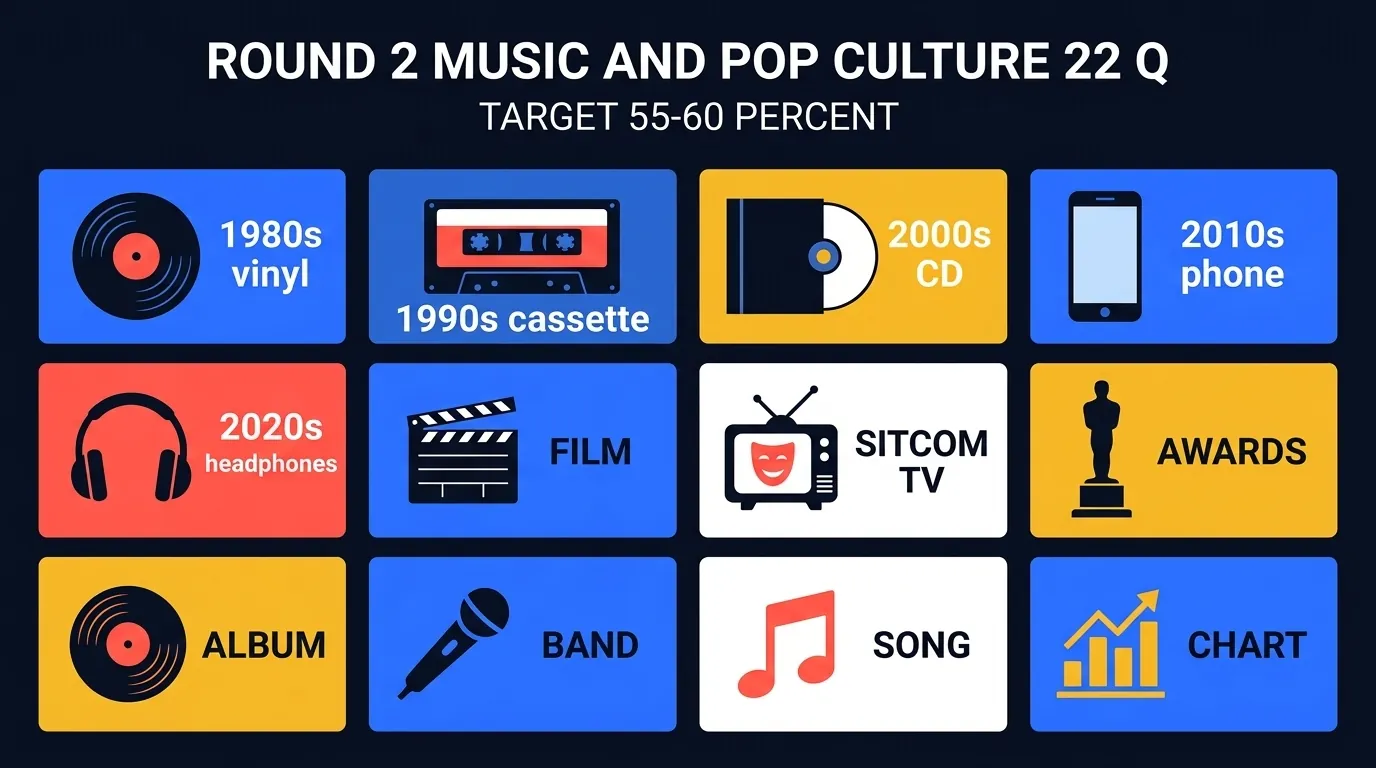
The grandparent who can name every Beatles album and the teenager who lives on streaming charts both find something to score on here, and neither feels shut out. For lower-key mid-game options, the team-building format playbook ranks remote-friendly formats by setup time.
23. Which 2020 single by The Weeknd spent 4 weeks at number 1 on the Billboard Hot 100?
Answer: Blinding Lights. It later set the all-time record for most weeks in the Hot 100 top 10.
Anyone who lived through 2020 knows it on the first beat. Younger teams sometimes swap in Save Your Tears, which is also The Weeknd, also off the same album, so it’s a fair scramble.
24. What 1991 album made Nirvana global superstars?
Answer: Nevermind. Released September 24, 1991. Sold over 30 million copies worldwide.
That cover, a baby underwater chasing a dollar bill, might be rock’s single most famous photograph. And the lead single, Smells Like Teen Spirit, rewired mainstream radio basically overnight.
25. Whose 1982 album Thriller became the best-selling of all time?
Answer: Michael Jackson. Estimated 70 million copies sold worldwide; longest-charting #1 of the 80s.
Then there’s the 14-minute Thriller video, directed by John Landis. It redrew the ceiling for what a music video could even be.
26. Which 2008 series followed chemistry teacher Walter White?
Answer: Breaking Bad. Created by Vince Gilligan; ran 5 seasons through 2013 on AMC.
A few teams reach for Better Call Saul, the prequel, or blur Walter White into the pile of other prestige-TV antiheroes. Stay strict on the show name here.
27. In Star Wars, what is Han Solo’s spaceship called?
Answer: The Millennium Falcon. Co-piloted by Chewbacca; “the ship that made the Kessel Run in less than 12 parsecs.”
Casual fans toss out the X-Wing (Luke’s fighter) or a TIE Fighter (Imperial). Neither is Han’s. His ride is the Falcon, full stop.
28. Which Pixar film features Carl, Russell, and a balloon-lifted house?
Answer: Up. Released 2009; the opening 4-minute married-life montage is one of the most-praised sequences in animation history.
It’s also the first animated feature to land a Best Picture nomination once the Oscars widened that field.
29. Which streaming hit follows the Targaryen civil war?
Answer: House of the Dragon. HBO’s Game of Thrones prequel; first aired August 2022.
The mix-up here is The Rings of Power, Amazon’s Lord of the Rings prequel that aired around the same time. Easy memory hook: Targaryens mean dragons, Aragorn means rings.
30. Which song held number 1 on the Billboard Hot 100 the longest in chart history?
Answer: Old Town Road by Lil Nas X. 19 weeks at #1 in 2019, surpassing Mariah Carey’s One Sweet Day (16 weeks).
Older players reach for I Will Always Love You or We Are the World, the obvious heavyweights. The record actually belongs to a 2019 country-rap hybrid, which is the part that lands.
31. Which actor played the Joker in 2008’s The Dark Knight?
Answer: Heath Ledger. He won a posthumous Oscar for Best Supporting Actor in 2009.
Three actors muddy this one: Joaquin Phoenix (2019’s Joker) and Jared Leto (2016’s Suicide Squad) both come up. The 2008 Dark Knight version is Ledger, and the year is the tell.
32. What 1997 film became the highest-grossing of its era at $2.2 billion worldwide?
Answer: Titanic. Directed by James Cameron; held the all-time record until Avatar (also Cameron) broke it in 2010.
Star Wars and Jurassic Park show up as guesses, both huge, both wrong here. Titanic wore the box-office crown for 12 straight years before anything touched it.
33. Which Beatles album cover shows the band on a zebra crossing?
Answer: Abbey Road. Photographed August 8, 1969, outside EMI Studios in London.
That crossing is now a UK Grade II listed landmark. Tourists still hold up traffic re-creating the photo every single day.
34. Which K-pop group released Dynamite in 2020?
Answer: BTS. Their first single sung entirely in English; debuted at #1 on the Billboard Hot 100.
BLACKPINK and NCT get floated by teams that know K-pop exists but not the specific track. Dynamite is BTS, and it shattered YouTube’s 24-hour view record the day it dropped.
35. Who voices Elsa in Disney’s Frozen?
Answer: Idina Menzel. Broadway veteran from Wicked and Rent.
Kristen Bell slips in as a wrong answer, and it makes sense, she voices Anna, Elsa’s sister. Clean split: Idina sings Let It Go, Kristen sings Do You Want to Build a Snowman.
36. What sci-fi film coined the line “I’ll be back”?
Answer: The Terminator. 1984; spoken by Arnold Schwarzenegger as the T-800.
He’s recycled the line in nearly every film since, half gag, half signature.
37. Which 2019 Best Picture winner was directed by Bong Joon-ho?
Answer: Parasite. First non-English language film to win Best Picture at the Oscars; also took Best Original Screenplay, Best Director, and Best International Feature.
Teams sometimes name 1917 (nominated that year, won Cinematography) or Joker (where Phoenix took Best Actor). Both were in the race; only one took the top prize.
38. Which sitcom takes place in Pawnee, Indiana?
Answer: Parks and Recreation. NBC, 2009 to 2015; created by Greg Daniels and Michael Schur.
The show hands Pawnee a full backstory over seven seasons: a feud with sister-city Eagleton, a cursed harvest festival, the whole bit.
39. What pop singer’s 2013 debut album was titled Pure Heroine?
Answer: Lorde. From New Zealand; she was 16 when Royals hit number 1 in the United States.
Billie Eilish is the common wrong swing, since her debut, When We All Fall Asleep, hit in 2019. But Lorde got there first. Eilish followed a half-decade later.
40. Which 1985 film features a DeLorean time machine?
Answer: Back to the Future. Directed by Robert Zemeckis; produced by Steven Spielberg.
The DeLorean DMC-12 was a real car, and a famously underpowered one. Resale prices on actual DeLoreans jumped after the movie made it an icon.
41. What instrument does jazz legend Miles Davis play?
Answer: The trumpet. Active 1944 to 1991; Kind of Blue (1959) is the best-selling jazz album ever.
Jazz names cross-wire fast here. Saxophone pulls in John Coltrane, piano pulls in Thelonious Monk. Davis is the trumpet, the defining voice of modal and cool jazz.
42. Which boy band performed “I Want It That Way”?
Answer: Backstreet Boys. Released 1999; one of the best-selling singles of the late 90s.
NSYNC, 98 Degrees, and Boyz II Men shared the era. This song, though, is pure Backstreet Boys.
43. Which 2019 film grossed over $2.79 billion worldwide?
Answer: Avengers: Endgame. Briefly the highest-grossing film of all time; later passed by Avatar re-release.
The decoys are stacked: Avatar, Titanic, even The Lion King remake (2019, also a monster earner). Endgame held #1 for several years before Avatar reclaimed it.
44. What 2016 Disney animated film features a Polynesian princess named Moana?
Answer: Moana. Auli’i Cravalho voices the lead; Lin-Manuel Miranda co-wrote the soundtrack.
The franchise kept rolling. A sequel arrived in 2024 and a live-action remake in 2026. Moana 2 hit theaters in November 2024.
That’s round 2. Stop here for the 5-minute break: score it, refill drinks, let the room reset before round 3 demands real thinking.
Round 3: 22 Connections and Wordplay Questions (Target: 50 to 55% Accuracy)
Round 3 is where the night shifts from recall to reasoning: 22 connections, wordplay, and lateral-thinking prompts pitched at 50 to 55% accuracy, blending “what do these share” with fill-the-blank, anagrams, sequences, and odd-one-out. One rule matters most here: rotate the format every few questions (the set below moves from connections to sequences, anagrams, fill-ins, then odd-one-out in short blocks), so the cognitive register keeps shifting.
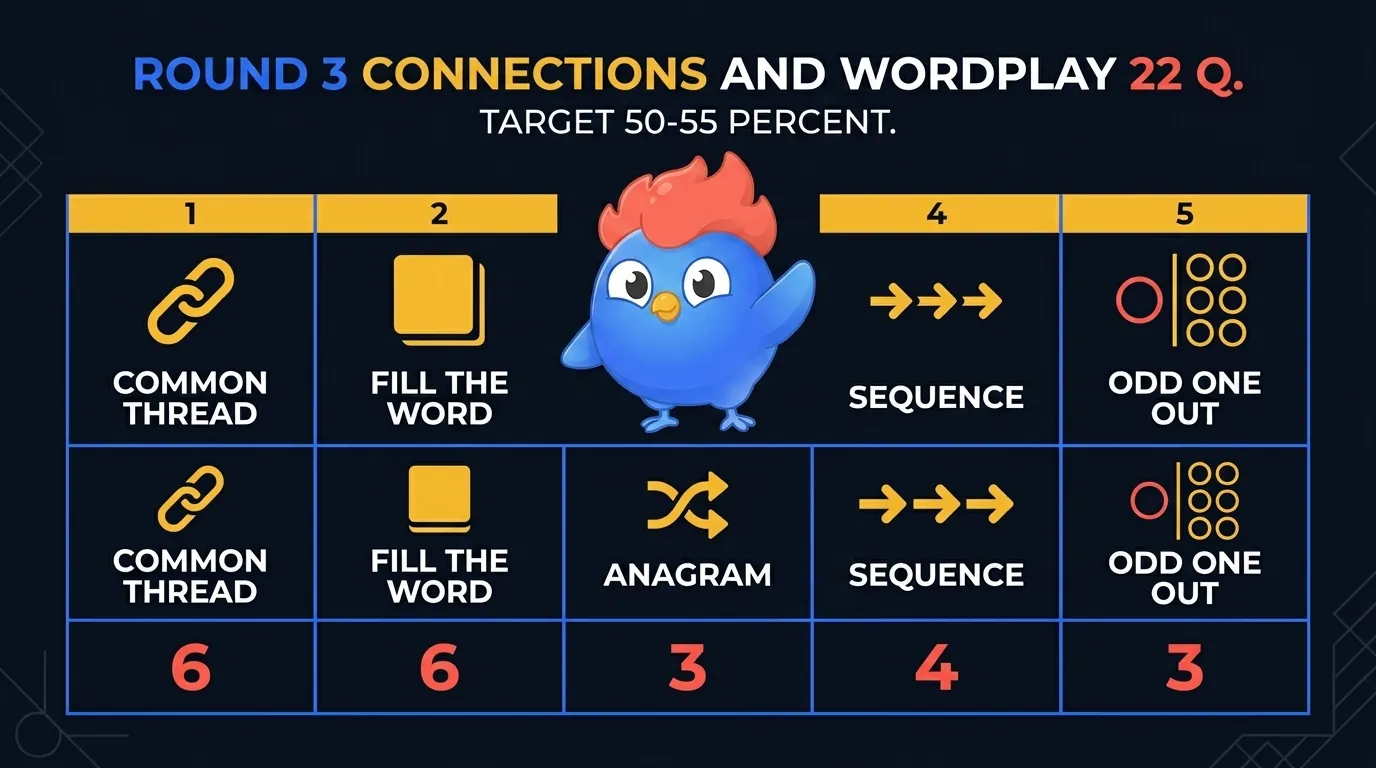
One pacing rule carries this round. Read each connection prompt twice. Wordplay rewards listening over raw knowledge, and a noisy room swallows the first read whole. For a deeper async version of the same idea, our scavenger hunt with 73 riddle-trail prompts runs over Slack or Zoom.
45. What do Mercury, Venus, Earth, and Mars have in common?
Answer: They are the four inner rocky planets of the solar system.
“They’re planets” gets thrown out fast. True, but too loose for the point. The tight answer sets them apart from the gas giants (Jupiter, Saturn, Uranus, Neptune).
46. What ties together Twilight, Eclipse, New Moon, and Breaking Dawn?
Answer: They are all titles in the Twilight Saga novels and films by Stephenie Meyer.
Clever teams overthink this one. Eclipse and New Moon double as astronomy terms, so “lunar phases” feels right. It isn’t. The thread is the book and film franchise.
47. What links Vincent van Gogh, Frida Kahlo, and Norman Rockwell?
Answer: All three are painters known for their self-portraits.
Looser links exist (all 19th and 20th century, all oil painters), but self-portraits is the cleanest fit. The numbers back it: Van Gogh painted ~36 self-portraits, Kahlo painted 55, and Rockwell’s Triple Self-Portrait is iconic on its own.
48. Who are the only two people to win Nobel Prizes in two different scientific fields?
Answer: Marie Curie (Physics 1903 and Chemistry 1911) and Linus Pauling (Chemistry 1954 and Peace 1962).
John Bardeen is the trap here. He won two Physics Nobels (1956 and 1972), but both sat in the same field. Curie and Pauling stand alone as the only cross-field double winners.
49. What do Atlanta, Phoenix, and Memphis share beyond being major US cities?
Answer: All three are named after places or figures from ancient mythology or geography (Atlas / Greek; Phoenix / mythical bird; Memphis / Egyptian capital).
A lot of teams jump to “they’re state capitals.” Only Phoenix is. The real link runs deeper, back to ancient names.
50. Continue the sequence: 2, 4, 8, 16, 32, ___ ?
Answer: 64. Each term is the previous doubled (powers of 2).
Mathy teams fire back instantly. Everyone else hunts for a +6 or +10 rule that isn’t there. Doubling is the pattern, and it’s the bedrock of binary in computer science.
51. Continue the sequence: A, E, I, O, ___ ?
Answer: U. The five English vowels in alphabetical order.
Somebody always says “Y,” dragging up the schoolhouse “and sometimes Y” rule. Not here. The strict five-vowel sequence ends on U.
52. Continue: 1, 1, 2, 3, 5, 8, ___ ?
Answer: 13. The Fibonacci sequence; each term is the sum of the previous two.
Recognize Fibonacci and you’ve got it in seconds. Miss the name and you’ll waste the round hunting for an arithmetic step that never shows.
53. Continue the sequence: Monday, Wednesday, Friday, ___ ?
Answer: Sunday. Every other day starting Monday.
“Saturday” sneaks out from teams expecting a weekday-then-weekend rhythm. The rule is simpler than that. It just alternates days.
54. SILENT is an anagram of which 6-letter verb?
Answer: LISTEN. Same letters, opposite meaning, common to mention in communication classes.
Wordplay people light up at this. The rest shuffle letters under their breath for 30 seconds and then groan when they hear it.
55. ASTRONOMER is an anagram of which 2-word phrase?
Answer: MOON STARER. Both contain A, E, M, M, N, O, O, R, R, S, T.
Anagram lists love this one because the meaning loops right back to the source word. Astronomers stare at moons. That’s the joke and the answer.
56. DORMITORY is an anagram of which 2-word phrase?
Answer: DIRTY ROOM. Both contain D, I, M, O, O, R, R, T, Y.
Same meaning-matches-letters trick as question 55. The doubt comes from teams who don’t trust that it’s anagram-fair, but it is: no letters dropped, none added.
57. Fill the missing word: “Cold ___ Horse” (the missing word completes both phrases).
Answer: WAR. Cold War (the geopolitical era) and War Horse (the Spielberg film and Michael Morpurgo novel).
Spell out the mechanic once. The missing word ends “Cold ” and starts ” Horse.” Say that aloud and the rest of the fill-in prompts move quick.
58. Fill: “Apple ___ Chart”
Answer: PIE. Apple Pie (the dessert) and Pie Chart (the data visualization).
Quick follow-up to question 57. One worked example and the pattern clicks for the whole room.
59. Fill: “Lightning ___ Action”
Answer: BOLT. Lightning Bolt (the natural phenomenon) and Bolt Action (the rifle mechanism).
Somebody will shout “Usain,” brain stuck on the sprinter, then realize a half-second later it doesn’t fit.
60. Fill: “Spider ___ hattan”
Answer: MAN. Spider-Man (the superhero) and Manhattan (the New York borough).
The sneaky part is that the second phrase breaks the word on paper yet sounds identical out loud.
61. Fill: “Black ___ House”
Answer: BIRD. Blackbird (the Beatles song or the bird) and Birdhouse (the wooden garden box).
Two answers hold up. BOX works too (Black Box plus Box House). Give the point for either and move on.
62. Fill: “Sun ___ Pot”
Answer: FLOWER. Sunflower (the plant) and Flower Pot (the container).
Teams test “Sun ROOM Pot” and “Sun BURN Pot” first. Neither closes both ends. Flower does.
63. Which is the odd one out: Apple, Banana, Carrot, Strawberry?
Answer: Carrot. It is a vegetable; the others are fruits.
Quick palate-cleanser. Drop it between the heavier wordplay prompts to let the room breathe.
64. Which is the odd one out: Mars, Saturn, Pluto, Jupiter?
Answer: Pluto. It was reclassified as a dwarf planet by the International Astronomical Union in 2006.
Anyone who memorized nine planets before 2006 will fight you on this. Doesn’t matter. The IAU ruling is the formal answer now.
65. Which is the odd one out: Cobra, Python, Mamba, Tarantula?
Answer: Tarantula. It is a spider; the others are snakes.
Overthinkers get snagged because Black Mamba is also Kobe Bryant’s nickname. Cute, but irrelevant. The mamba is still a snake.
66. Which is the odd one out: Whale, Dolphin, Shark, Manatee?
Answer: Shark. It is a fish; the others are aquatic mammals.
Sharks mostly lay eggs, breathe through gills, and carry cartilage instead of bone. The mammals breathe air and bear live young. Different branch of the tree entirely.
Read a quick score after round 3. The leaderboard tends to feel tight here, since the flow band keeps every team within striking range, and the gaps only start opening in round 4.
Round 4: 22 Show-Off Stumpers (Target: 35 to 45% Accuracy)
Round 4 drops to the 35 to 45% band on purpose, with deep history, obscure science, far-flung geography, and high-art references arriving right when the scoreboard needs drama. The aim isn’t to humiliate anyone. It’s to pay off the team that happens to know one or two niche facts, and to tee up a wager where any team can still steal the night.
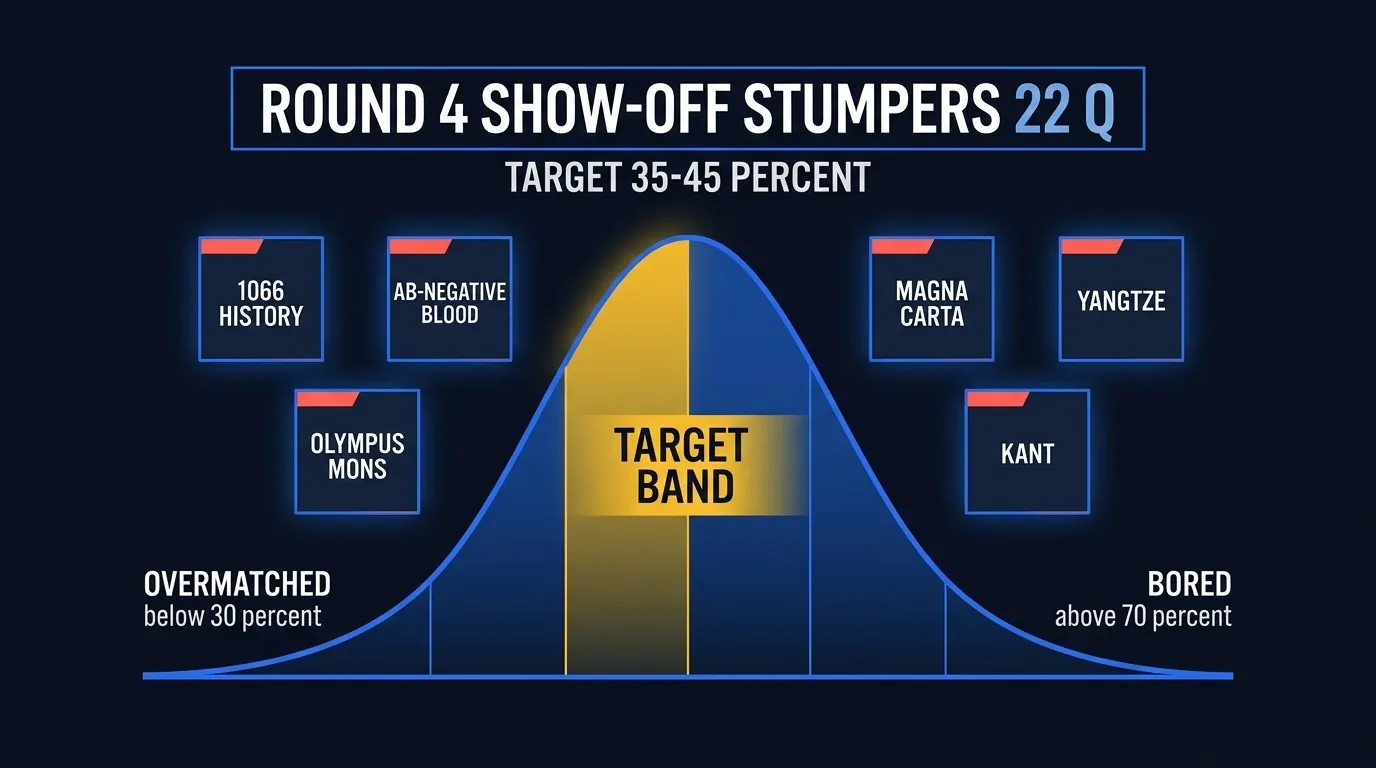
Why cap this round at 22 instead of letting it run? Cognitive fatigue. After 66 questions a room’s attention falls off a cliff, and dragging a stumper round past that point trades a few extra trivia facts for a noticeable drop in the energy you need for the finale.
So keep round 4 lean and drop straight into the wager while the room still cares. For a stumper-only night with no warmups at all, the harder bar-trivia question set sits at this difficulty band by default.
67. Which English king was defeated at the Battle of Hastings in 1066?
Answer: Harold II (Harold Godwinson). Killed in the battle, possibly by an arrow to the eye.
On the winning side stood William the Conqueror, soon crowned William I of England. Few dates in British history get drilled harder than 1066.
68. What is the rarest blood type in the United States?
Answer: AB negative. About 0.6% of the US population.
Worth a follow-up: O negative is the universal donor (anyone can take it) and AB positive is the universal recipient (it can take anything). Rare and universal aren’t the same idea, which is exactly where teams tangle themselves up.
69. What is the deepest known point in the world’s oceans?
Answer: Challenger Deep, in the Mariana Trench. About 10,935 meters (35,876 feet) below sea level.
It sits in the Pacific, southwest of Guam. Barely a handful of crewed missions have touched the bottom. The first was the Trieste, all the way back in 1960.
70. Which element has the atomic number 79?
Answer: Gold (Au). From the Latin aurum.
This calls back to question 3, the symbol Au. Knowing the symbol and knowing the atomic number are two separate memories. Chemists carry both. The rest of the room carries one.
71. Which African country was formerly known as Abyssinia?
Answer: Ethiopia. The name change formalized in 1947, though “Ethiopia” had been the country’s preferred name for centuries.
The old Abyssinia mapped roughly onto today’s Ethiopian highlands. The name itself traces back to the Habesha people of the region.
72. What is the only mammal capable of true sustained flight?
Answer: The bat. Other gliding mammals (flying squirrels, sugar gliders) glide; only bats truly fly.
And there are roughly 1,400 bat species out there, about 20% of every mammal species on the planet.
73. The Dead Sea is bordered by which two countries?
Answer: Israel and Jordan. The West Bank also touches its western shore.
It sits at the lowest land elevation anywhere on Earth, about 430 meters below sea level. The water runs roughly 9.6 times saltier than the ocean, salty enough to float a reader.
74. Who painted The Persistence of Memory (the melting clocks)?
Answer: Salvador Dalí. Painted in 1931; on display at the Museum of Modern Art in New York.
René Magritte, the bowler-hat painter, gets named a lot. Different Surrealist. Dalí owns the melting clocks; Magritte is the cleaner, cooler one.
75. What does DNA stand for?
Answer: Deoxyribonucleic acid. The double-helix structure was identified by Watson, Crick, and Franklin in 1953.
Plenty of teams can describe the double helix and still butcher the spelling. Be generous. Any reasonable phonetic stab earns the point.
76. The Magna Carta was signed in what year?
Answer: 1215. At Runnymede, by King John of England under pressure from rebellious barons.
People call it the foundation of modern constitutional law. Fair enough now, but its actual 13th-century scope was far narrower than the legend suggests.
77. Which planet has the largest volcano in the solar system?
Answer: Mars. Olympus Mons, about 22 km tall: picture two and a half Everests stacked on top of each other.
Earth pulls the wrong guess, usually via Mauna Loa, the largest active terrestrial volcano. Olympus Mons dwarfs it anyway. Dormant, sure, but absolutely enormous.
78. Who wrote One Hundred Years of Solitude?
Answer: Gabriel García Márquez. Published 1967; central novel of the magical realism movement.
Jorge Luis Borges shows up as the wrong guess, but he was Argentine and wrote mostly short fiction. García Márquez was Colombian and took the Nobel Prize in Literature in 1982.
79. Which strait separates Europe from Africa?
Answer: The Strait of Gibraltar. About 13 km (8 miles) wide at its narrowest.
It threads the Atlantic into the Mediterranean. Spain holds the European shore, Morocco the African one, and at 13 km the two continents almost touch.
80. What is the currency of Vietnam?
Answer: The đồng (VND). Roughly 25,000 đồng equals 1 US dollar (early 2026).
Regional currencies blur together fast: baht (Thailand) and yuan (China) both surface. Vietnam runs on the đồng, written ₫.
81. Which composer became deaf yet wrote his Ninth Symphony?
Answer: Ludwig van Beethoven. The Ninth (with the Ode to Joy choral finale) premiered May 7, 1824.
His hearing started failing around 1798 and was nearly gone by the Ninth. He couldn’t hear the audience applaud at the premiere. A performer had to turn him around so he could see them clapping.
82. Which country has the most pyramids in the world?
Answer: Sudan. More than 200, mostly Nubian pyramids of the Kushite kingdoms; Egypt has roughly 138.
This is the question that cleaves a room in half. Egypt is the reflex answer because Giza is famous. Sudan quietly has roughly double the count, and watching that fact land is worth the whole round.
83. What is the longest river in Asia?
Answer: The Yangtze River. About 6,300 km (3,917 miles); 3rd-longest in the world after the Nile and the Amazon.
The Mekong and the Ganges get floated as guesses. The Yangtze wins on a technicality worth knowing: it’s the longest river that stays inside a single country, China.
84. The Thirty Years’ War was fought during which years?
Answer: 1618 to 1648. Ended by the Peace of Westphalia.
It’s reckoned the deadliest European war before the 20th century. Mortality estimates run as high as 8 million across the Holy Roman Empire.
85. Who developed the general theory of relativity?
Answer: Albert Einstein. Published in 1915; expanded the special theory (1905) by adding gravity.
The theory says massive objects warp spacetime. That’s not abstract trivia either. It’s why GPS satellites (question 20) need relativistic corrections to keep your map accurate.
86. The Boxer Rebellion took place in which country?
Answer: China. 1899 to 1901; an anti-foreign, anti-imperialist uprising in northern China.
The “Boxers” came from the Society of Righteous and Harmonious Fists, a Chinese secret society. An Eight-Nation Alliance crushed the uprising in 1901.
87. Which philosopher wrote Critique of Pure Reason?
Answer: Immanuel Kant. Published 1781; one of the most important works in Western philosophy.
Hegel and Schopenhauer get named in the scramble. Kant wrote the Critique. Hegel built on him; Schopenhauer argued with both.
88. The Dewey Decimal System organizes books into how many main classes?
Answer: 10 main classes (000 through 999). Each class divided into 10 divisions, each division into 10 sections.
It’s a nested base-10 hierarchy, top to bottom. Melvil Dewey built it in 1876, and most public libraries still run on it today.
That ends round 4. Read every score out loud before the wager; even the team in last place needs to know how big a stake actually makes sense.
The Final Wager: 1 High-Stakes Question
The night closes on a single question every team bets on blind: stakes of 0 to 10 points go down before the read, right answers add the stake, wrong answers lose it. The leader can sit tight, the underdogs can swing for the fence, and one wager can flip the whole leaderboard on the final answer. That suspense is what keeps every team leaning in until the read.
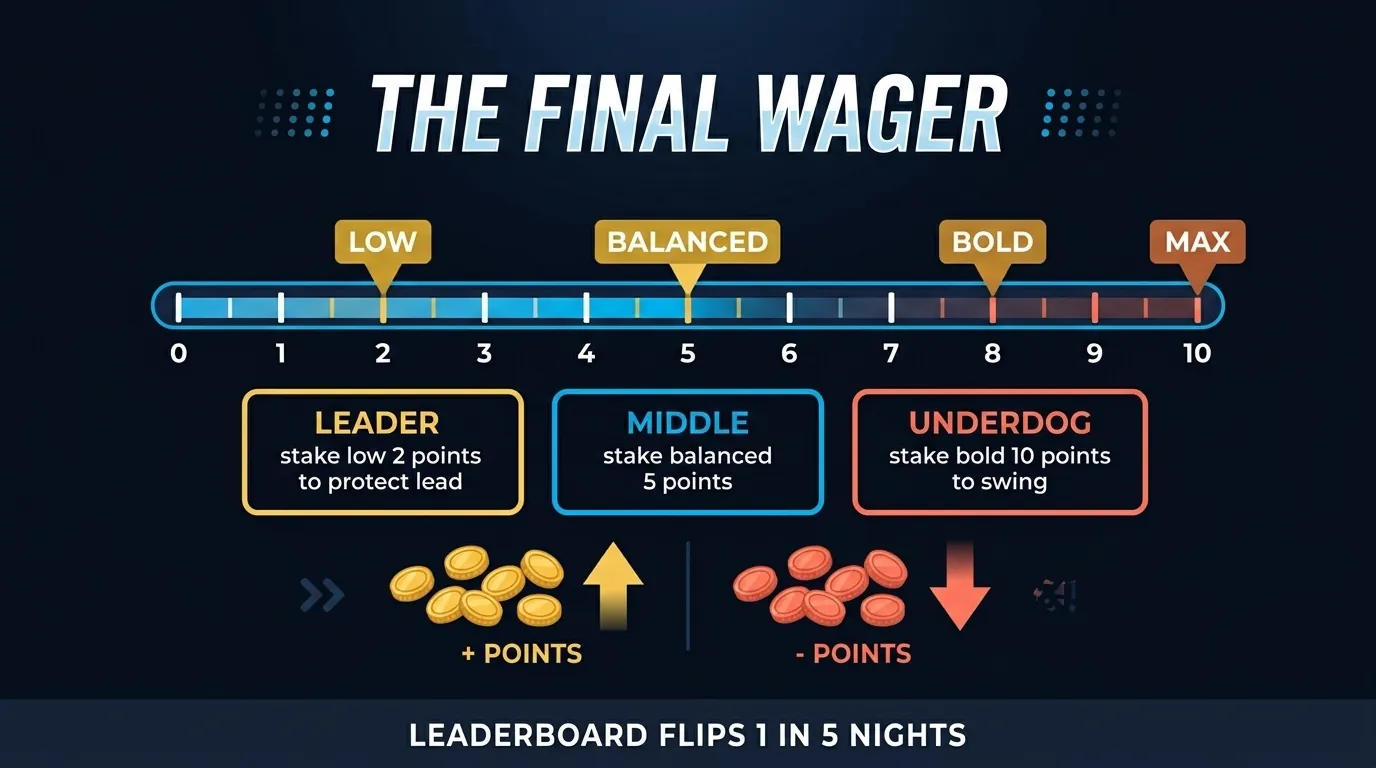
The mechanic is borrowed from “Final Jeopardy”-style closers. It works at parties because it turns a quiz into a poker hand: a team’s chosen stake quietly broadcasts how sure they are of an answer they have not even heard yet, so the number itself carries information. Once the slips are in, nobody can change them. The host reads the question once, gives 60 seconds, then reveals.
Host script: “Each team writes a stake from 0 to 10 on a slip. Hand them to me before I read the question. Then I read the question once, you have 60 seconds, and I reveal the answer.”
89. What was the original name of the search engine that became Google?
Answer: BackRub. Larry Page and Sergey Brin built it as a Stanford research project in 1996. Renamed Google in September 1997, registered as a domain September 15, 1997.
The name pointed at the “back links” the algorithm crawled to rank pages. Almost nobody knows this. The teams that do are deep web-history nerds, computer scientists, or people who actually read John Battelle’s The Search (2005). Perfect wager bait, in other words.
Once the wager resolves, read final scores from last place to first so the night ends on the leader’s name.
Host Pacing and Scoring: The 7 Rules That Keep a Room
These 7 host rules move room engagement more than any single question does, and every one of them sides with the room over the host’s ego. Party trivia is a service, not a performance. I made the same call inside LearnClash’s duel scoring, for what it’s worth: a correct answer earns the point and answering fast earns nothing extra, because the app is built learning-first and speed pressure mostly teaches people to skim the question.
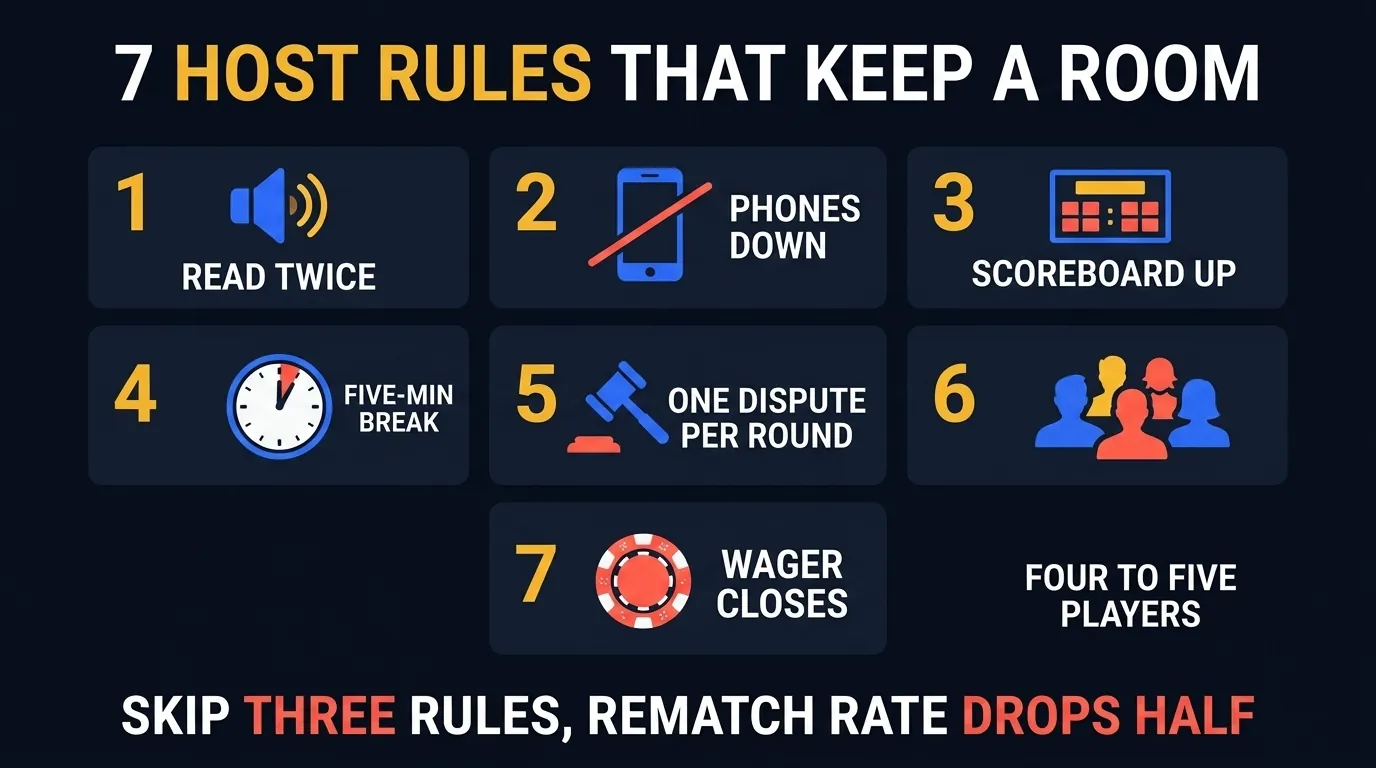
The team-cap rule rests on social loafing research. Maximilien Ringelmann’s 1913 rope-pull experiment found per-person effort sliding to 49% in 8-person teams. The same thing happens to trivia teams that creep past 5. For the full team-size breakdown, our scavenger-hunt team-cap analysis covers when to drop the cap to 4 instead.
1. Read every question twice in noisy rooms. The first read sets the rhythm. The second catches the third of the room that missed it the first time. Read once and you lose the back tables for the night.
2. Phones face-down before round 1. Say it out loud: no Googling, no texting, no peeking at the host’s screen. Trust falls apart without the rule stated. Toss a 1-point bonus to any team that volunteers a phone-free pile in the middle of the table.
3. Document scoring before scoring starts. Write the rules on the scoreboard or read them aloud up front: 1 point per correct, 2 points for the unique-knowledge bonus, wager round 0 to 10. Disputes nosedive once teams know the math going in.
4. 5-minute break between rounds 2 and 3. Refills, bathroom, a score read. Push past 90 minutes and the room slips away. The break resets attention. Skip it and round 3 plays like round 4, which guts the wager before you get there.
5. One disputed answer per round, host’s call is final. Let a team challenge a wording or a factual edge case once per round. After the appeal, the host rules and it’s closed. No squad gets to rules-lawyer its way through four disputes a round.
6. Cap teams at 4 to 5 players. Ringelmann clocked per-person effort dropping to 49% at 8 players. Trivia mirrors it exactly. A 6-plus team turns into one writer, one talker, and three quiet seats checking their watch. Keep teams small and everyone stays in the game.
7. Wager round closes the night. Read scores last-to-first so the final word is the leader’s name. Even dead-last can win on the wager. Never end on a flat round 4, because the room remembers the last 5 minutes far better than the first 80.
Five Ways to Run the Same 89 Questions
The edge was never any single question; it’s the band. 89 questions, 4 rounds, 1 wager, each round calibrated so the room clears 50 to 60% and stays hungry for the next one. Pick the rounds, read each one twice, cap teams at 5, close on a wager.
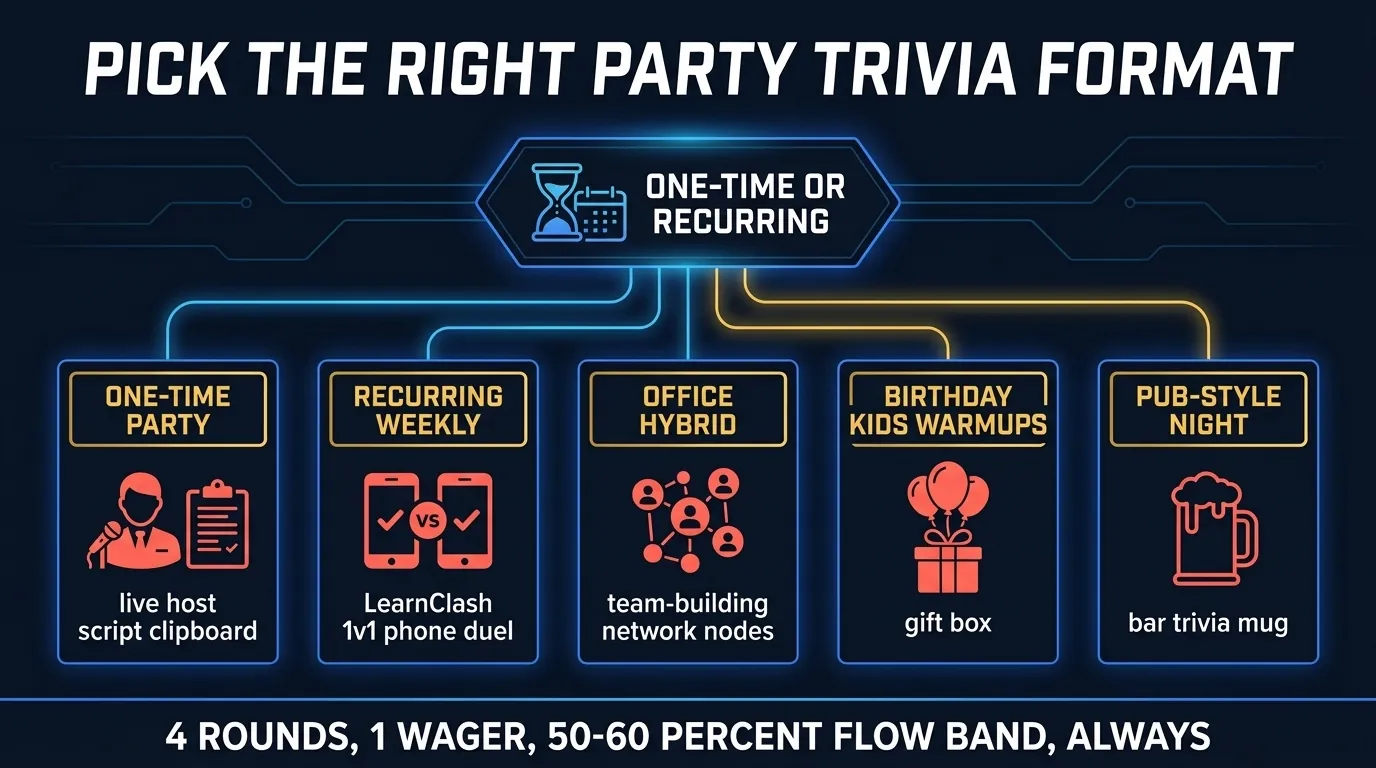
To stretch the format out async with 72-hour turns instead of one live night, start a 3-minute LearnClash duel on popular culture and let ELO-calibrated matchmaking pair you with opponents near your rating.
- One-time party: live host script, 4 rounds, 89 questions
- Recurring weekly: LearnClash 1v1 duels between teammates, 3-minute turns
- Office holiday party: pair this with our team-building format guide for hybrid groups
- Birthday parties: age-banded warmups, swap round 4 stumpers for our family-safe kids trivia warmups
- Pub-style night: harder by default, run our 67 bar-trivia questions instead
Or skip the hosting entirely: duel me on popular culture →.
Frequently asked questions
What are good party trivia questions?
Good party trivia questions land inside the 50 to 60 percent accuracy band. Above 70 percent the room gets bored; below 35 percent it disengages. The strongest sets mix round 1 confidence builders, round 2 themed pop culture, round 3 connections or wordplay, and round 4 stumpers, then close with a 1-question wager. LearnClash filters for that band across 89 prime-count prompts.
How many trivia questions should you have for a party?
Plan 80 to 100 questions for a 90-minute party trivia night. We use 89 across 4 rounds of 22 plus 1 wager final, which fits the 60 to 90-minute window industry hosts recommend. LearnClash duels run a parallel shape: 18 questions across 6 rounds of 3 on a 45-second timer.
How do you host a trivia party?
Pick a host who is not playing, set up 4 rounds inside a 60 to 90-minute window, read every question twice in noisy rooms, score 1 point per correct answer, and close with a 0 to 10-point wager round. Cap teams at 4 to 5 players so social loafing does not collapse the scoreboard. After the live game, run async LearnClash 1v1 duels for the rematch.
What's the best scoring system for party trivia?
One point per correct answer is the cleanest baseline. Add a 2-point bonus for any answer no other team got right (rewards obscure knowledge), and end with a wager round where teams stake 0 to 10 points on the final question. Document the rules on a visible scoreboard before round 1 to prevent disputes.
What rounds should you include in a trivia party?
Use 4 rounds with descending difficulty bands: warmups at 70 to 75 percent accuracy, themed pop culture at 55 to 60 percent, connections or wordplay at 50 to 55 percent, and stumpers at 35 to 45 percent. Close with a 1-question wager round. Each band targets a different cognitive register, which matches Csikszentmihalyi's flow theory better than 4 flat-difficulty rounds.