
139 Q&A Questions [Group, Funny & Deep]
139 Q&A questions for groups, work, class, parties, and deep talks. Confidence-bet scoring, 3 depth layers, and a work-safe filter for teams.

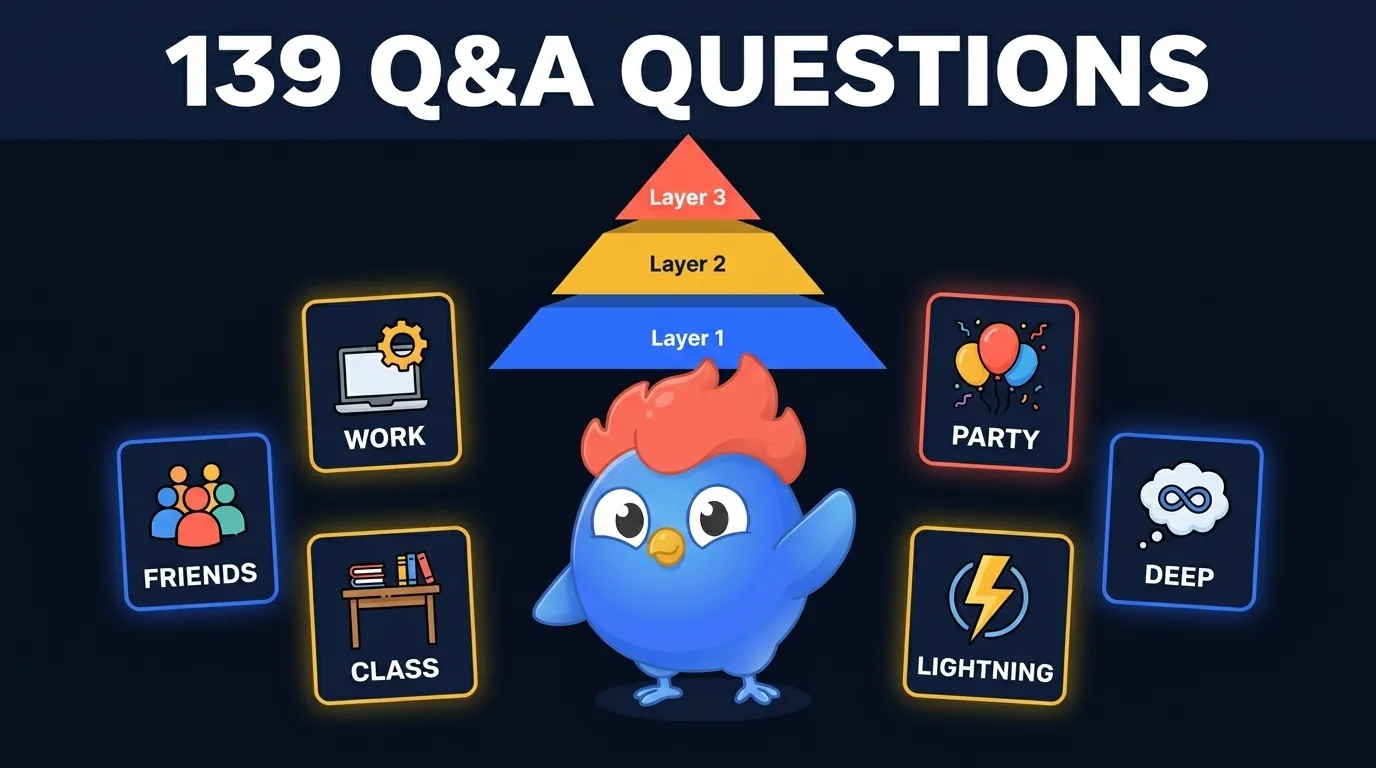
You’ve seen the lists. A hundred prompts, no rules, and one host reading down the page until half the room is on their phones. The prompts are usually fine. What’s missing is a way to play them.
So these 139 Q&A questions ship with the part everyone leaves out. Six settings. Three depth layers borrowed from Arthur Aron’s 1997 closeness study. A confidence-bet scoring system lifted from competitive trivia.
Start with the warmup set when the room is cold. Keep the safety filter on for a team offsite. Save the deep set for a small dinner. And if your group would rather have a referee than a host, start a Q&A duel on LearnClash →; one turn takes about three minutes.
How We Picked These 139 Q&A Questions
Every candidate prompt had to clear four gates: start a story in under 30 seconds, stay safe for the room, survive as a scored game, and land in one of three depth layers. Miss a gate, get cut. The ones that lived through all four are what you’re reading.
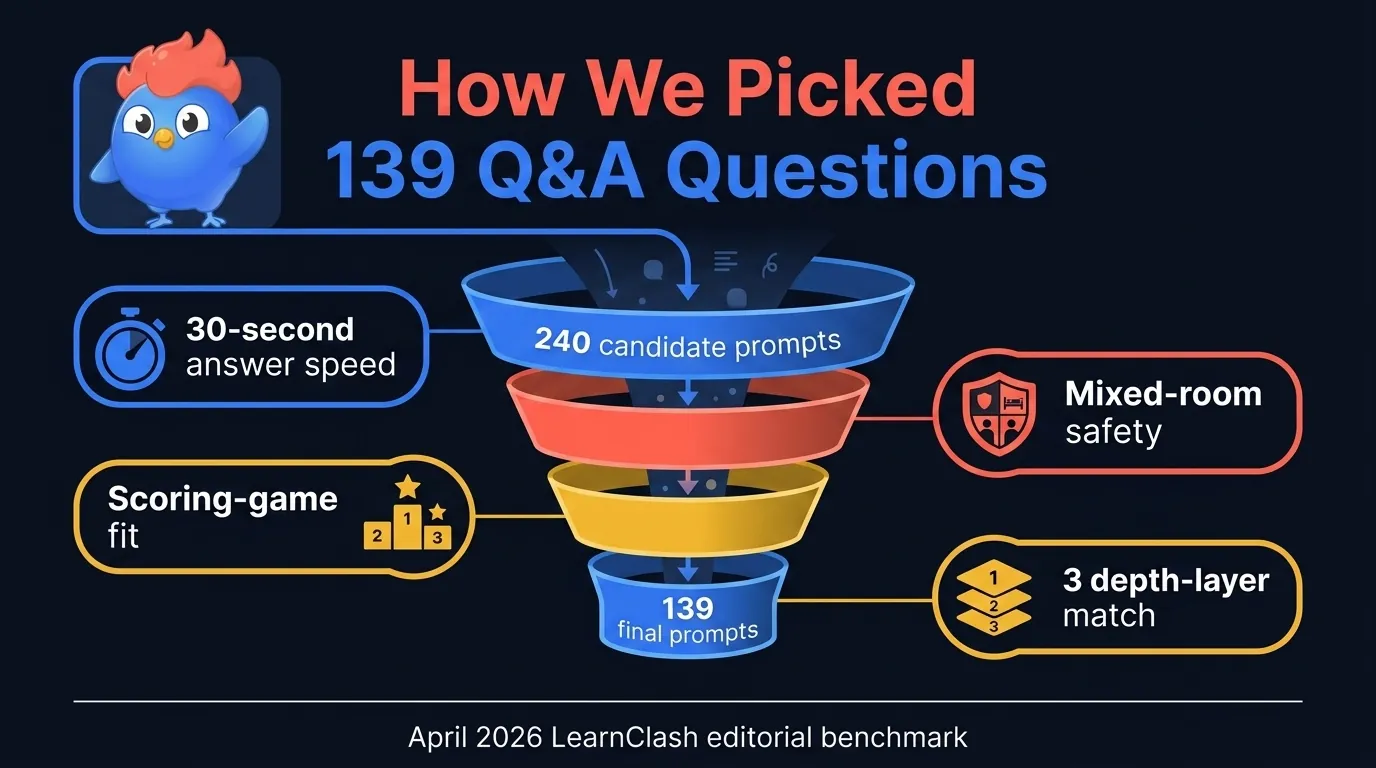 The filter behind the list: fast, safe, scorable, and depth-tiered.
Search for Q&A questions and you mostly get walls of prompts with no rules for who answers, no scoring, and no hint about which prompt belongs at the icebreaker and which belongs at the late-night dinner where the wine has been open for an hour. The host reads top to bottom and the energy sags around prompt 17.
The staging is not a style choice; it is the load-bearing wall in the research. In Aron et al. (1997), structured self-disclosure produced measurably more closeness than ordinary small talk, and two conditions did the heavy lifting: the questions escalated gradually, and the partners took turns answering each one. The UC Berkeley Greater Good in Action version of those 36 questions still organizes them into three escalating sets rather than one undifferentiated dump. The same architecture runs through this list: warmup before rapport, rapport before depth, depth in small groups.
| Section | Questions | Depth | Best for |
|---|---|---|---|
| Friends and Family | 31 | Layer 2 | Dinners, road trips, extended family |
| Workplace | 31 | Layer 2 work-safe | Standups, retros, offsites, onboarding |
| Classroom | 23 | Layer 2 school-safe | K-12, college seminars, clubs |
| Party | 23 | Layer 2 mixed | Cookouts, casual dinners, holiday tables |
| Lightning Round | 19 | Layer 1 | Energy reset, large groups |
| Deep (small group) | 12 | Layer 3 | 3 to 4 person dinners only |
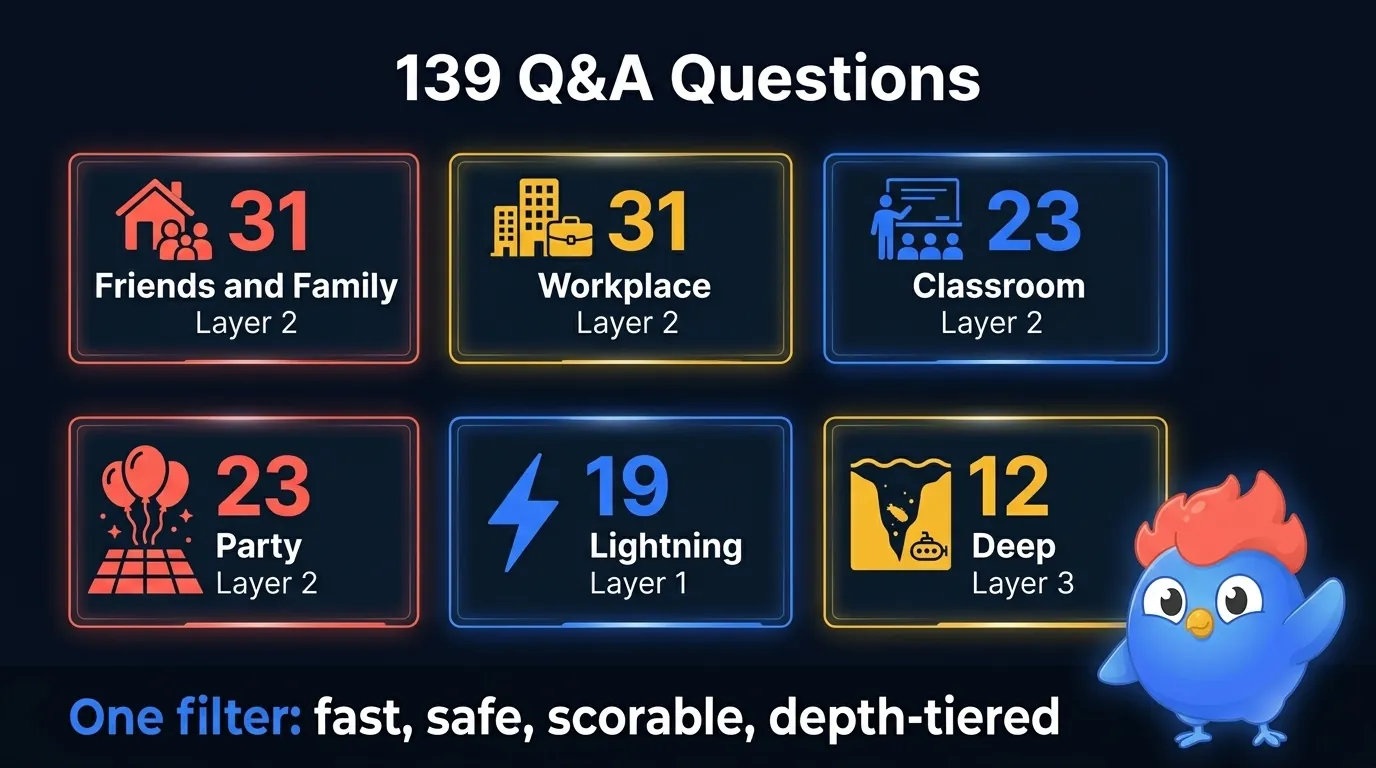 Six prompt sections, three depth layers, one shared filter for speed and safety.
A note on the numbers, because I once got one wrong on this exact page. The first published version quoted a 48-hour turn window for LearnClash duels, and that figure was stale on day one: I had moved the deadline to 72 hours in the app on May 4, 2026, three days before this article went live, and the copy never caught up. A store-listing audit on June 9 finally flagged it, and the sitewide fix touched 123 files, this one included. Product numbers on this page now get checked against the app’s actual constants instead of my memory.
One hosting rule before you read on. Don’t make every player explain every answer. Let people pass, let one or two answers breathe, then move. A depth-3 prompt dropped cold falls flat; the same prompt lands after a warmup, so ordering carries real weight.
How to Run Q&A as a Group Game
Two pieces turn a question list into a game, and almost every list skips both: confidence-bet scoring and a group-size playbook. Each question is worth 1, 3, 5, or 7 points, set by how sure the answerer feels and locked in before they speak. The session closes with a final 0 to 10 wager on a category someone picks.
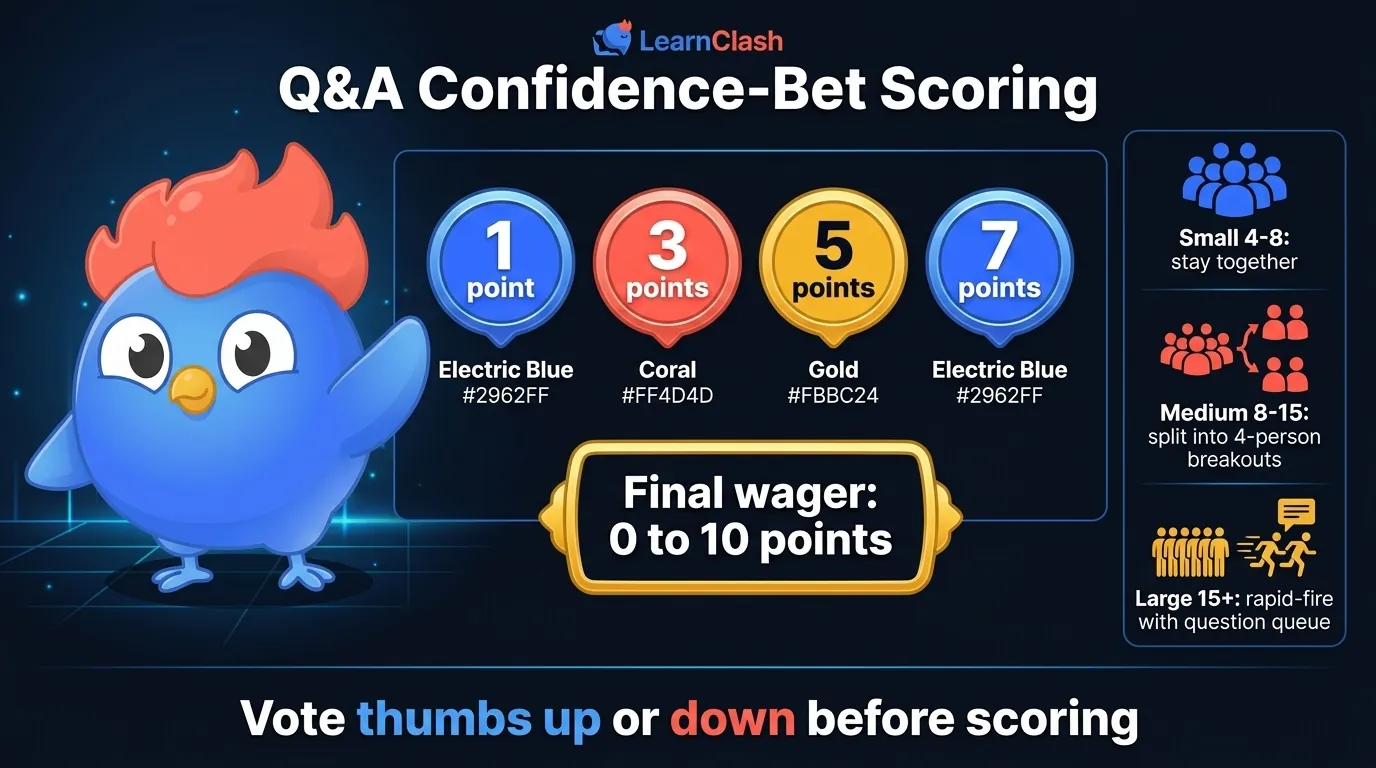 Confidence-bet scoring plus group-size flow: small groups stay together, medium groups split, large groups go rapid-fire.
Pick 18 prompts before you start, three from each section you plan to use, shuffled so two depth-2 sets don’t run back to back. Set a phone timer for 30 seconds an answer. Read the prompt, then ask the answerer for their number (1, 3, 5, or 7) before they say a word. Low numbers play it safe. High numbers risk more if the group decides the answer was thin.
Then the rest of the group votes, thumb up or thumb down. Majority up, the answerer banks their wager; majority down, they bank nothing; ties go to the answerer, with no long debate and no second tries.
LearnClash bakes the same stake-before-result logic into its rating ladder, where rating shifts depend on the gap between two players rather than a flat win-or-lose result.
The closing wager round goes like this. Name a category. Each player wagers 0 to 10 of the points they’ve already banked, then you read the prompt. Same vote, same scoring. Wager nothing and stay safe, or wager 10 and flip the leaderboard on one answer.
Group sizes change the mechanics:
- Small (4 to 8 people): everyone stays together, the host reads, the group votes, the round ends in about 18 minutes.
- Medium (8 to 15 people): split into 4-person breakouts for the rapport rounds, then come back together for the lightning round and final wager. Layer 3 stays in the breakouts; never read deep prompts to the whole group.
- Large (15 or more people): use rapid-fire mode for the lightning round, set a 5-second answer cap, and run a question queue so people know when their turn is coming.
The 3 Depth Layers Most Q&A Lists Skip
Q&A questions sort into 3 depth layers, never a flat list. Layer 1 is fast warmups: 5 to 10 second answers, binary or single-word. Layer 2 is rapport: 20 to 30 second answers, the professional sweet spot. Layer 3 is deep, and it belongs to groups of 3 to 4 only. The structure follows Arthur Aron’s 1997 closeness research.
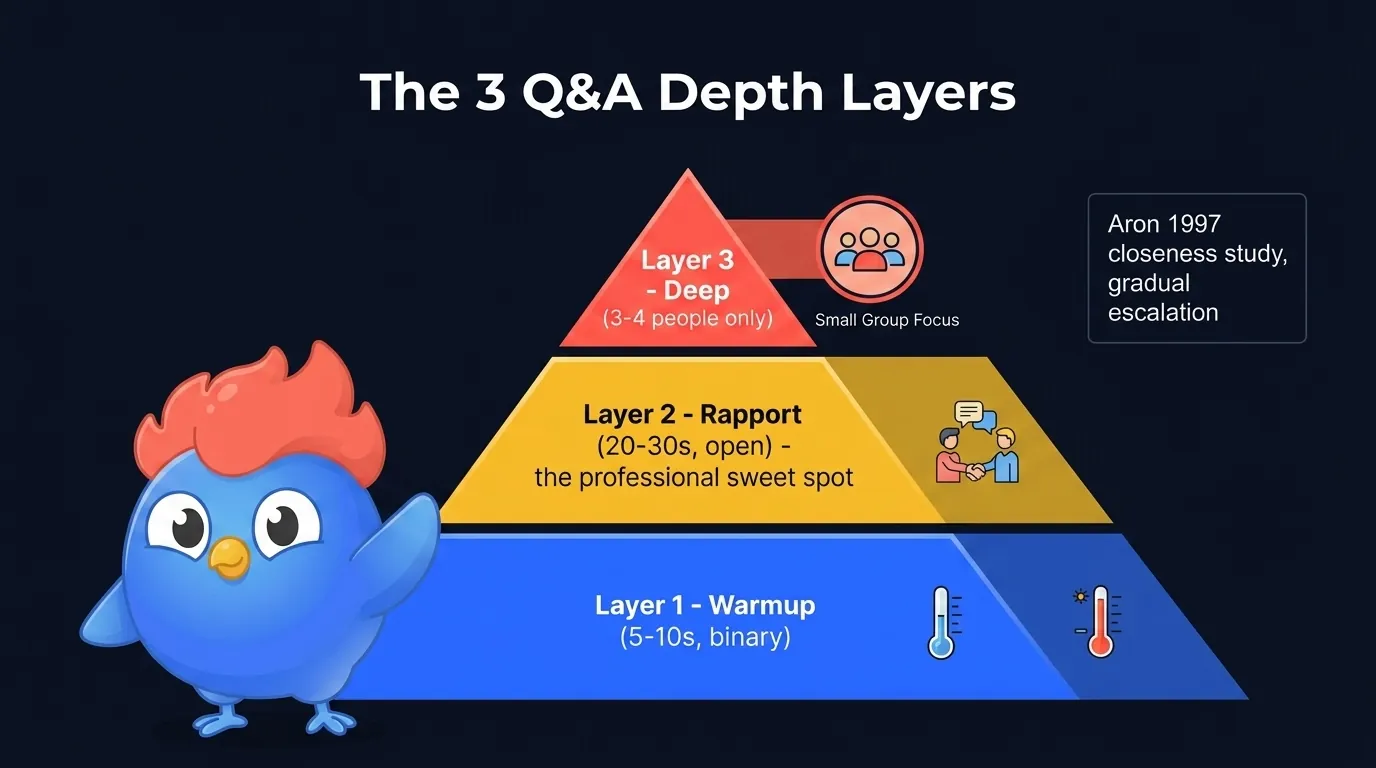 Figure 4: the depth pyramid. Layer 1 builds in, Layer 2 is where most rooms should stay, Layer 3 is small-group only.
In Aron’s experiment, pairs of strangers traded 36 questions across 45 minutes, and the questions climbed from shallow to personal in a deliberate sequence while the pairs took turns asking and answering each one. By the end, those strangers reported feeling closer than the pairs who’d traded 36 rounds of small talk. The questions weren’t the engine. Reciprocal self-disclosure was, escalated in stages.
| Layer | Timing | Format | Group size |
|---|---|---|---|
| Layer 1 Warmup | 5 to 10 seconds per answer | Binary or single-word | Any size, including 30-person Zoom |
| Layer 2 Rapport | 20 to 30 seconds per answer | Open prompt, one quick story | Up to 15, then split into breakouts |
| Layer 3 Deep | 60 to 120 seconds per answer | Reciprocal disclosure | 3 to 4 people only, never broadcast |
Skip the staging and you get the failure mode of most lists: “What’s your name?” sitting right next to “What’s your biggest regret?” with the host picking prompts at random. That flattens the gradient Aron’s research treated as the entire point. Rooms either stay too shallow to bond or lurch too deep too fast and freeze up.
Layer 1 is the warmup. Five to ten seconds an answer, binary or single-word: coffee or tea, beach or mountains. Binary choices clear the brain fast, so even the shy folks answer before pressure has time to build.
Layer 2 is the rapport zone, where most professional and family Q&A should live. Twenty to thirty seconds an answer, open enough to reveal something specific about a person, light enough that anyone in the room can respond without preparation. Most of the 139 prompts below sit right here.
Layer 3 is deep. Small groups only, 3 to 4 people, with the two conditions the Greater Good guidance insists on: everyone opts in comfortably, and disclosure runs both ways in turns. And don’t skip the Layer-2 round on your way down, even with people you’ve known for years.
For Layer-2 forced-choice prompts with more built-in debate, the 211 would you rather questions list runs the same depth band. The 163 ice breaker questions set is also Layer-2, with a workplace-safety bias.
Friends and Family Q&A: 31 Layer-2 Questions
A good friends-and-family prompt is specific enough to spark a story and light enough that nobody feels cornered into one. These 31 hold up at dinners, on road trips, and across extended-family video calls. Anything that demanded a polished memory or a single definitive favorite got cut.
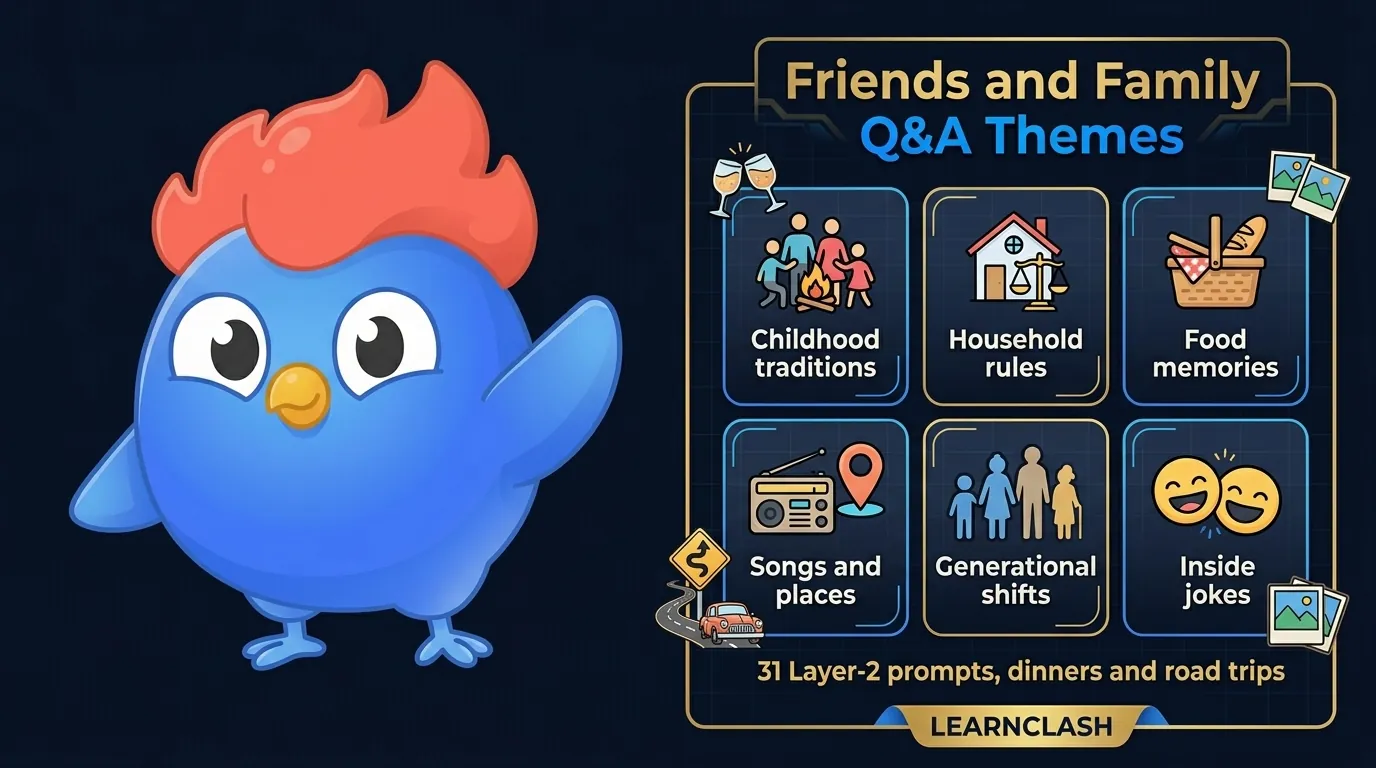 Six themes that move fast and leave room for one story per answer.
One trick saves family rounds: the follow-up rule. Ask one why, not five. You want a quick story, not a deposition. When a question lands flat, move; when it lands hot, give it 90 seconds, then move anyway.
Running Q&A in the car? The 73 road trip trivia questions set is the answers-included companion.
1. What family story gets retold every gathering?
2. What is the strangest thing your household considered normal?
3. What was your loudest birthday?
4. What food did you secretly hate as a kid but pretended to like?
5. What is the best thing a friend ever defended you on?
6. What was your earliest argument about taste?
7. Which family member changed the most over the last decade?
8. What is one childhood rule you broke and never got caught for?
9. What house rule from a friend’s family did you wish you had?
10. What is a phrase only your family uses?
11. What is the longest you’ve gone laughing at one inside joke?
12. What did you used to think was rich-people behavior?
13. What habit did you absorb from a sibling, parent, or roommate?
14. What is a friend group tradition you’d want to keep for life?
15. What is a moment you realized your parents are people?
16. What old toy or object would still make you smile if you found it?
17. What is the closest call you had on a family trip?
18. What is a song that means something different to your family than to others?
19. What is something your friends knew about you before you did?
20. What is the most useful thing you learned from a friend’s parent?
21. What is the funniest argument that has ever happened at your dinner table?
22. Which family member or friend would survive a 3-day power outage best?
23. What is the most embarrassing thing your phone autocorrects to?
24. What is one tradition you started yourself?
25. What is a hobby you only enjoy with one specific person?
26. What is the weirdest compliment you’ve ever received from family?
27. What is a place you keep meaning to visit with someone?
28. What did you think would matter at 30 that doesn’t?
29. What is the worst meal a friend ever cooked you, and did you finish it?
30. What is a small thing that makes a house feel like home?
31. What family habit do you secretly hope your future household keeps?
Workplace Q&A: 31 Layer-2 Questions for Teams
Good workplace prompts connect coworkers without pulling anyone into private territory. Every prompt here cleared a work-safe filter that drops salary, religion, politics, hiring bias, health status, and family planning. What’s left is 31 prompts built for standups, retros, offsites, and onboarding.
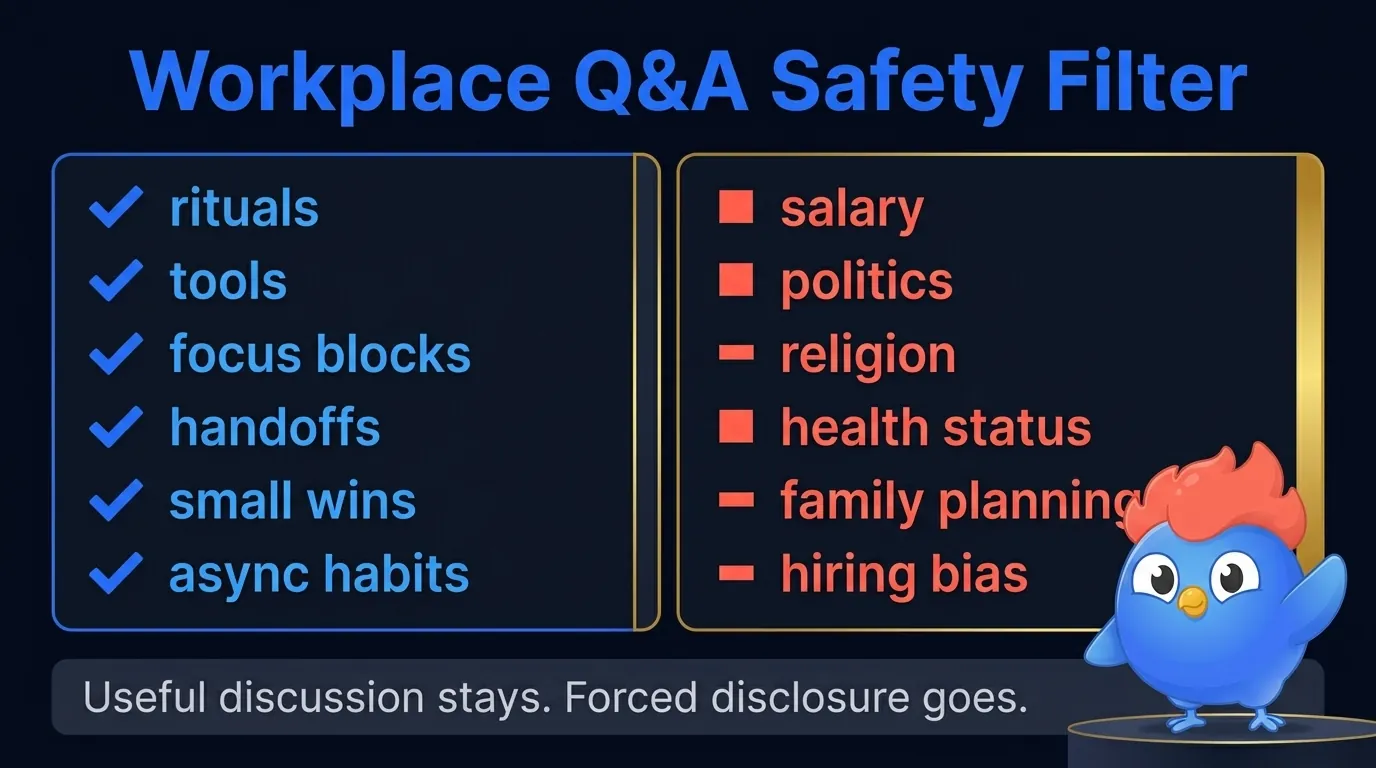 The work-safe filter: useful discussion stays, forced disclosure goes.
One principle governs all of it: anchor to a work habit, never a private-life detail. A strong work prompt asks about a tool, a ritual, a small win, or a handoff. A weak one pressures someone into performing a personal story for the entire team, and that second kind is an HR problem waiting to happen.
Pair it with team building trivia on days when the fact round needs a social on-ramp first. Q&A also drops cleanly into a 5-day spirit week as the Tuesday format, safety filter intact.
32. What ritual makes the start of your workday smoother?
33. What tool do you use that other people sleep on?
34. What is one work skill that looked easy until you learned it?
35. What kind of feedback do you actually want on a draft?
36. What does a great handoff look like in your role?
37. What is the most useful keyboard shortcut you’ve found?
38. What kind of meeting always runs over, and what fixes it?
39. What is a project from your past you’d happily redo with what you know now?
40. What is the most overrated meeting practice?
41. What does a “good Monday” look like for your week?
42. What part of your job would surprise someone outside the industry?
43. What is the smallest improvement that made your week better?
44. What recurring meeting would you turn into an async update?
45. What workflow tool have you outgrown?
46. What is one thing a great manager has ever done for you?
47. What kind of focus block actually works for you?
48. What is the question you wish people asked before assigning a task?
49. What does a trustworthy retro feel like to you?
50. What is the best way for your team to celebrate a small win?
51. What kind of work milestone do people skip celebrating?
52. What is an underrated skill in your role?
53. What is a piece of advice that worked for a previous job but not your current one?
54. What is the one thing you wish you had at your first job?
55. What kind of question slows down a productive meeting?
56. What does asynchronous communication look like at its best?
57. What habit makes a teammate easy to work with?
58. What kind of progress update is most useful to receive?
59. What part of your job would not exist if it was rebuilt today?
60. What new tool are you cautiously curious about?
61. What is the best onboarding moment you’ve ever had?
62. What is one bad meeting habit your team has fixed?
Classroom Q&A: 23 Questions for K-12 and College
Classroom prompts have to respect three things at once: age, social pressure, and the clock. These 23 stretch from middle school through college seminars, and the set doubles as Q&A questions for teens in clubs, camps, or homeroom. Steer clear of anything that asks a student to defend a private identity in front of peers, and let anyone pass on a prompt without a reason.
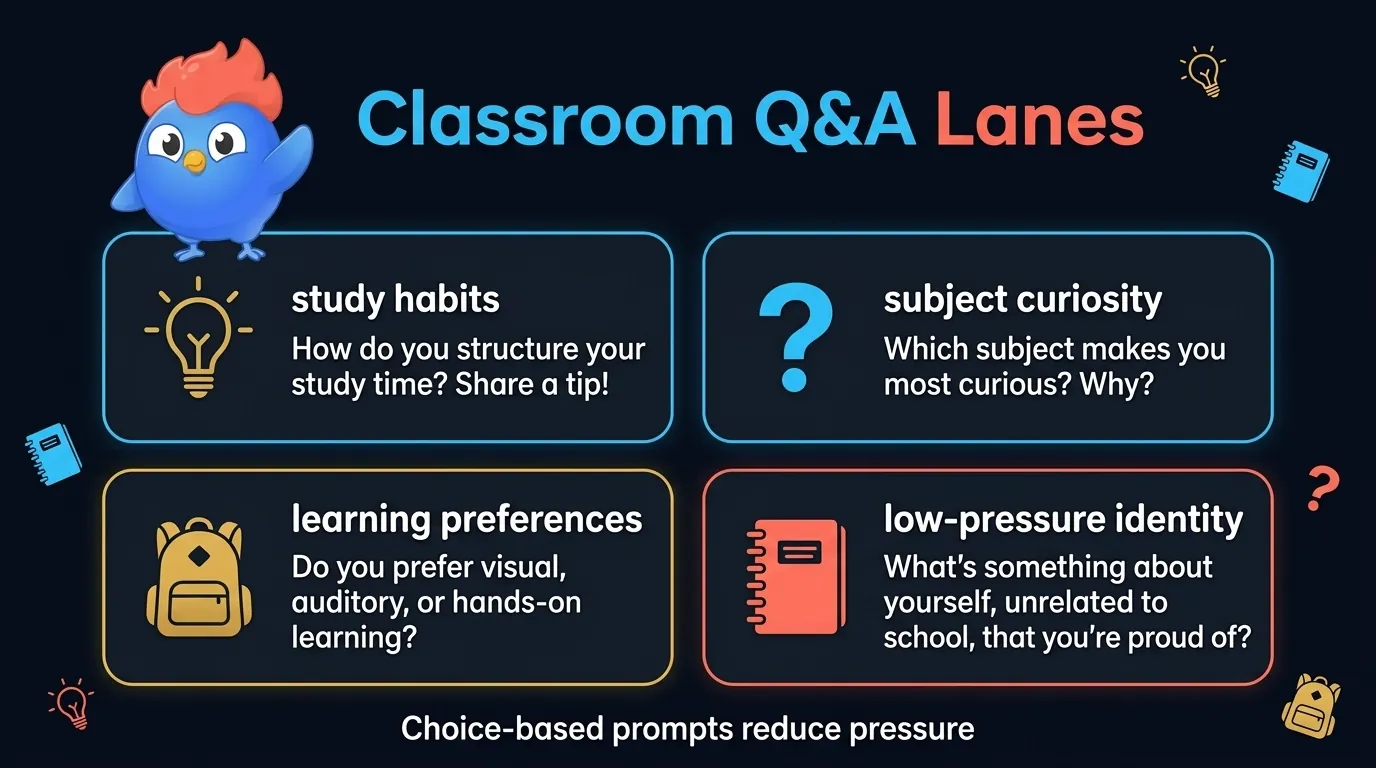 Choice-based classroom prompts reduce pressure and protect quieter students.
Watch for the forced-favorite trap. “What is your favorite book of all time?” drops a 14-year-old on the spot, and what comes out is rarely honest. Ask instead for one book that surprised them this year, or one topic a teacher made them curious about.
For pair-share, send the prompts into 2-person breakouts first, then pull answers back to the full class. A shy student gets to answer once before facing 25 people, and by the second round the room is calmer.
63. What subject do you wish school taught earlier?
64. What is a topic you got curious about because of one teacher?
65. What is a study habit you stole from another student?
66. What is the most useful thing you learned outside class this year?
67. What kind of homework do you actually enjoy?
68. What is an example you remember from a textbook even though you forgot the lesson?
69. What is a club, sport, or activity that changed how you think about school?
70. What is a project you’d rebuild if you had one more week?
71. What is the most surprising thing about your favorite subject?
72. What is a class you didn’t expect to like?
73. What is a small classroom habit that helps you focus?
74. What is a question you wanted to ask in class but didn’t?
75. What is the best way you’ve ever practiced for a test?
76. What is a skill you learned faster from a friend than from a teacher?
77. What kind of group project actually worked?
78. What is a study trick that sounds silly but works?
79. What is a topic you’d happily teach for one period?
80. What is the most interesting field trip you’ve been on?
81. What is a small change that would make your favorite class better?
82. What is the most useful thing to keep in your backpack?
83. What is something you used to think was boring and now find interesting?
84. What is a question you ask yourself when you’re stuck on a problem?
85. What is a topic you’d want an 18-question LearnClash duel on?
Party Q&A: 23 Mixed-Group Prompts
Party prompts have to land fast, play across mixed ages, and never trap anyone on stage past 20 seconds. These 23 fit backyard cookouts, casual dinners, holiday tables, and game nights. The rhythm: one prompt, one answer, one quick why, then move.
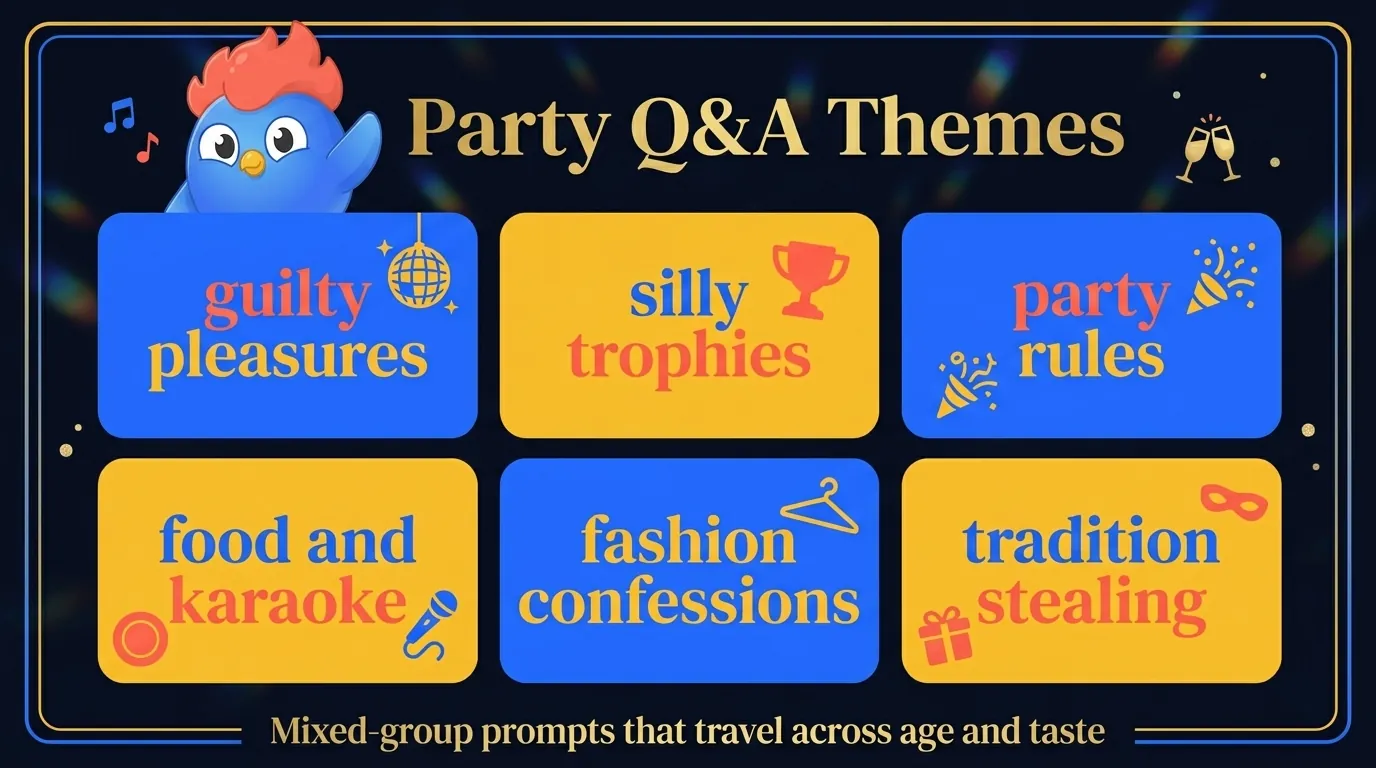
Read the room before you pick a set. A cousin reunion plays nothing like a college reunion, and a holiday table with kids around plays nothing like a 1 AM kitchen with old friends. If the room goes adults-only after dessert, that’s your cue to swap in the deep set later.
For a fact-based scored format that pairs with this round, the 89 party trivia questions across 4 rounds script runs the same wager-round shape.
86. What is your most useless talent?
87. What food would you proudly serve at every party?
88. What is a small win you’d accept a trophy for?
89. What is a guilty-pleasure show, song, or game you defend in public?
90. What is a tiny rule every dinner table should have?
91. What is the worst icebreaker question you’ve ever been asked?
92. What is a name you’d give a houseplant if you had to?
93. What is a trend you tried once and immediately regretted?
94. What is the most overrated party game?
95. What is a moment you laughed at the worst possible time?
96. What is a recipe you trust to impress a guest?
97. What is an outfit you’ve kept way too long?
98. What is the best playlist you’ve ever made?
99. What is an underrated reason to throw a party?
100. What is a group activity that always ends differently than planned?
101. What is a snack everyone judges you for liking?
102. What is the funniest mistake you’ve ever made at a party?
103. What is a karaoke song you secretly want to be asked to sing?
104. What is a rule you’d add to a holiday gathering?
105. What is something small that always makes a party feel done right?
106. What is a tiny moment from a previous party you still smile at?
107. What is a friend you haven’t seen in a while you’d want at the next dinner?
108. What is a party tradition from another country you’d steal?
Lightning-Round Q&A: 19 Rapid-Fire Prompts
Lightning rounds are pure Layer-1 territory: answers in 5 to 10 seconds, binary-friendly choices, and no follow-up before the next prompt fires. Use these 19 when the room needs a reset between deeper sets. Read fast, answer faster, skip the setup; the whole round runs under three minutes.
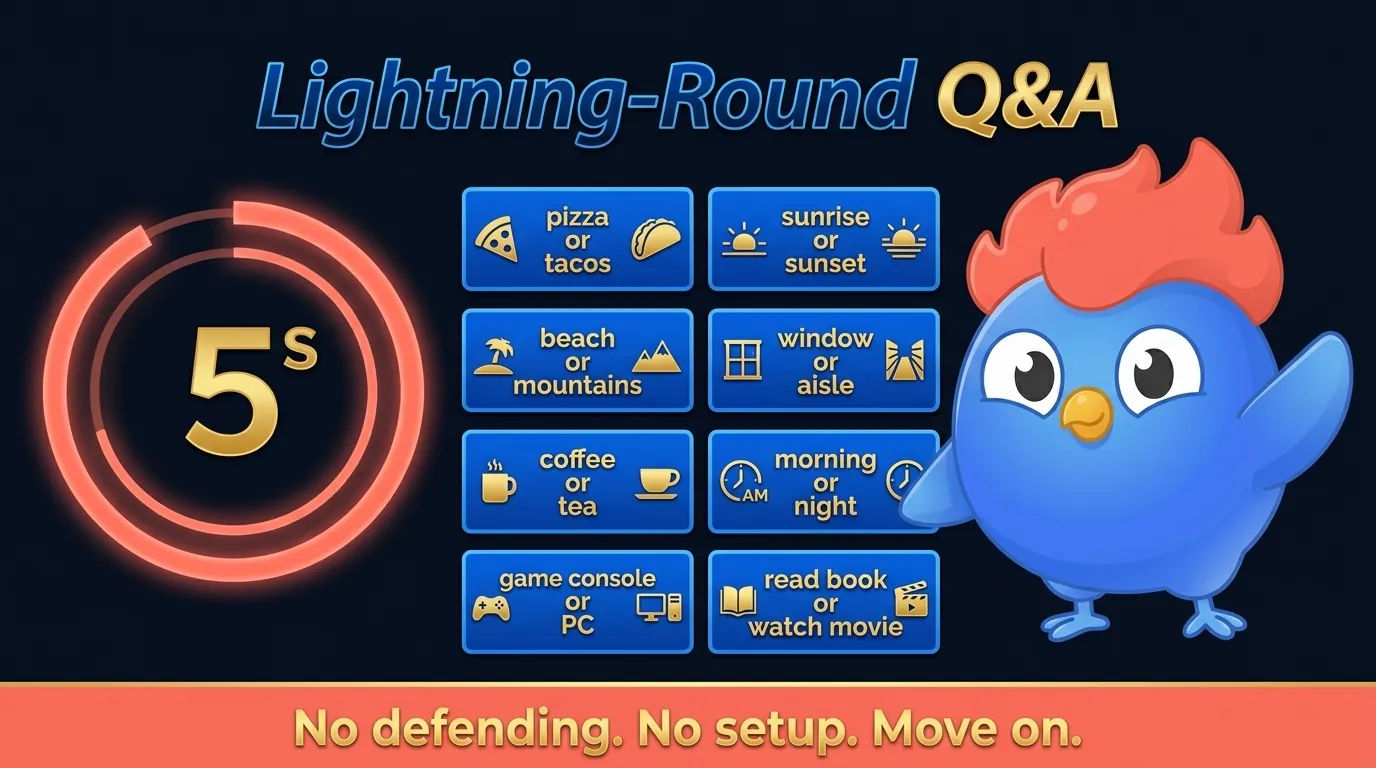
These work because they shut off overthinking. The prompt is binary or single-word, the timer is too short to rehearse, and the host moves to the next person in under 10 seconds. Energy resets, and the next deep set lands better than it would have cold.
For hundreds more binary splits, the 200+ this or that questions set takes the format much further.
Keep the rapid-fire going in a general knowledge duel →
109. Pizza or tacos?
110. Sunrise or sunset?
111. Beach or mountains?
112. Window seat or aisle?
113. Movie theater or streaming?
114. Coffee or tea?
115. Hot or iced?
116. Notebook or notes app?
117. Email or chat?
118. Morning or night?
119. Cake or pie?
120. Books or audiobooks?
121. Save or spend?
122. Dogs or cats?
123. Big group or small group?
124. Plan or wing it?
125. Comedy or drama?
126. Spicy or sweet?
127. Talk or text?
Deep-Connection Q&A: 12 Layer-3 Questions for Small Groups Only
Deep Q&A is Layer-3 territory, and the conditions are non-negotiable: small groups of 3 to 4 only, mutual self-disclosure, and explicit permission to skip any prompt. These 12 are shaped by the Aron 36 Questions framework on Greater Good in Action. Bring them out after a Layer-2 round, never as the opener.
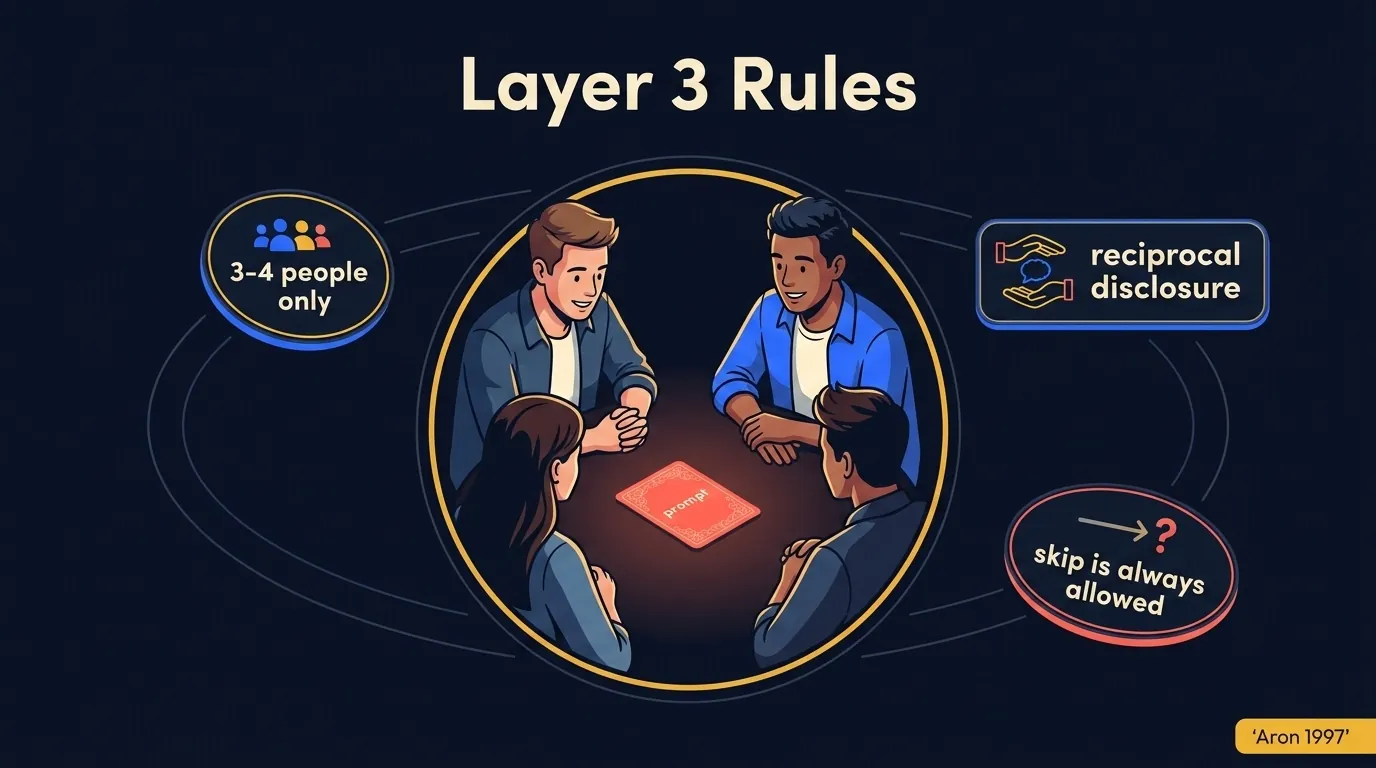 Layer 3 rules: small group, mutual disclosure, and a real option to skip.
First rule, size. Three to four people, sitting close, door closed if you can swing it. Opening up to 20 strangers is simply not the same psychological act as opening up to 3 friends you already trust.
Second rule, reciprocal. Whoever asks the prompt answers it too. Aron called this escalating self-disclosure, and it’s the line between a deep Q&A and an interview. When only one person opens up, the round goes flat and someone walks away feeling exposed.
Third rule, skip. Anyone passes on any prompt, no explanation owed. The skip is part of the consent layer, not a loophole around it.
128. What is something you’re proud of that nobody knows about?
129. What is a moment in the last year you’d freeze in time if you could?
130. What is a belief you’ve quietly let go of?
131. What is a piece of advice you wish you had at 17?
132. What is a fear you’ve outgrown, and what changed?
133. Who is a person you’d thank if you could only thank one?
134. What is a question you’d want a stranger to ask you?
135. What is the most surprising thing the last 5 years taught you?
136. What is a habit that has quietly changed your life?
137. What is a story you only share with people you trust?
138. What is something you haven’t said out loud in a while that you’d want to?
139. What would you want a future version of yourself to remember about today?
How LearnClash Players Run Q&A in Practice and Duels
LearnClash plays Q&A two ways. The 6-question Practice session is solo, one question at a time on a 45-second timer. The 18-question async duel matches you against another player by ELO across 6 rounds, with each side getting a 72-hour window to take their turn whenever it fits their day. Both modes pour into the same 3-stage SRS, so every answer enters a 7-day, then 90-day retention loop.
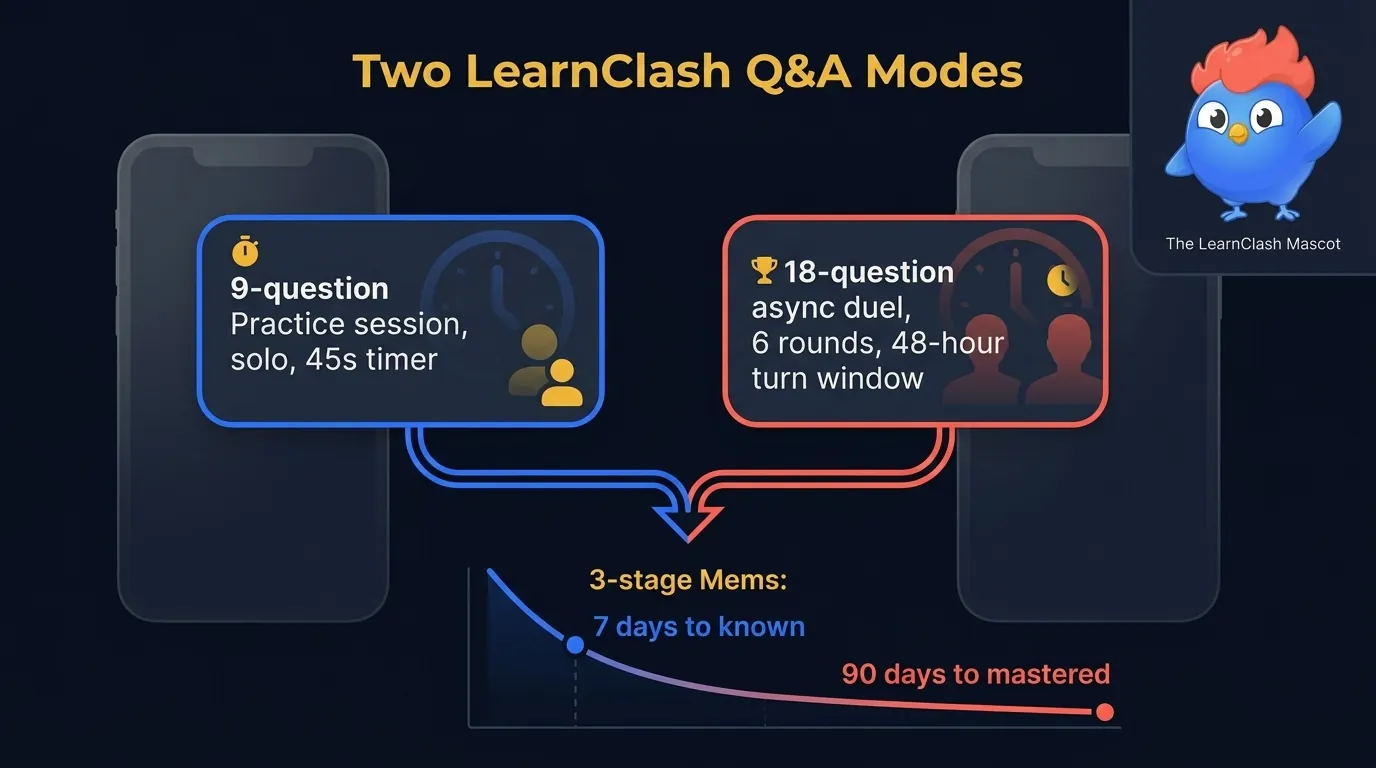 Figure 11: both modes feed the same retention loop. A question you answered Tuesday is back at day 7 and again at day 90.
One honest caveat, since I build the thing: LearnClash questions are quiz questions with a right answer. The 139 prompts above have no answer key, so inside the app the Q&A format shows up as trivia on topics your group picks: the same timer pressure, but with checkable answers. If your table wants a referee instead of a host, that’s the trade.
The retention loop is what a paper list can’t do. Miss a question and it returns after 7 days; get it right and the next checkpoint sits at 90 days; a later miss drops it one stage rather than resetting it to zero. Mastered questions leave the pool. The LearnClash spaced repetition explainer walks through the wrong→7d→known→90d→mastered shape and the retrieval-practice research behind it.
Everything this page describes fits in the free tier: daily duels, any topic, ELO ranking, the full 3-stage SRS, and a starter allowance of Clash Chat (30 intro messages, then 1 a day). Premium ($7.99 a month, or $59.99 a year with a 7-day free trial) unlocks Premium practice mode, your own topics (up to 100 in a library), and Premium Clash Chat. Neither tier shows ads.
Which Set Do You Open With?
If the room is cold, open with the warmup set and move to friends or party. For a team event, run the workplace set with the filter on and use the lightning round as the reset. A small dinner that’s already warm can go straight to one Layer-2 section, then the deep set, with the skip rule stated out loud. Score it with the 1-3-5-7 bet if the group likes stakes, or run it unscored if they don’t.
For more formats in this family, browse the LearnClash activities collection.
Frequently Asked Questions
What are good Q&A questions for groups?
Good Q&A questions are answerable in under 30 seconds, safe for the room, and specific enough to start a story. They land in Layer 2 depth: open enough to reveal something, light enough that anyone can answer. Every prompt on this list was filtered for exactly that: speed, safety, and replay value.
How do you run Q&A as a group game?
Pick 18 prompts, set a 30-second timer per answer, and use confidence-bet scoring. Each answer is worth 1, 3, 5, or 7 points based on how sure the answerer is, plus a final 0-10 wager round. Small groups stay together; medium groups split into 4-person breakouts; large groups use rapid-fire and a question queue.
What are the 3 depth layers of Q&A questions?
Layer 1 is fast warmups with 5 to 10 second answers. Layer 2 is rapport prompts with 20 to 30 second answers, the professional sweet spot. Layer 3 is deep questions for small groups of 3 to 4 people only. The structure follows Arthur Aron's 1997 research on reciprocal self-disclosure.
What Q&A questions should you avoid at work?
The work-safe filter behind this list drops salary, religion, politics, hiring bias, health status, family planning, and dating history, plus any prompt that turns a person's identity into a public ranking. Forced favorites and rehearsed fun facts are cut for a different reason: they stall the 30-second answer clock.
How does LearnClash play Q&A?
LearnClash plays Q&A as 6-question Practice sessions for solo learning or 18-question async duels across 6 rounds. Each question has a 45-second timer, each turn has a 72-hour window, and every answer enters the 3-stage SRS for long-term retention.