
53 Spirit Week Ideas for Work [Hybrid-Tested 2026]
53 spirit week ideas for work across 5 use cases: dress-up, trivia, wellness, holidays, virtual. Built for hybrid teams with an async LearnClash trivia round.

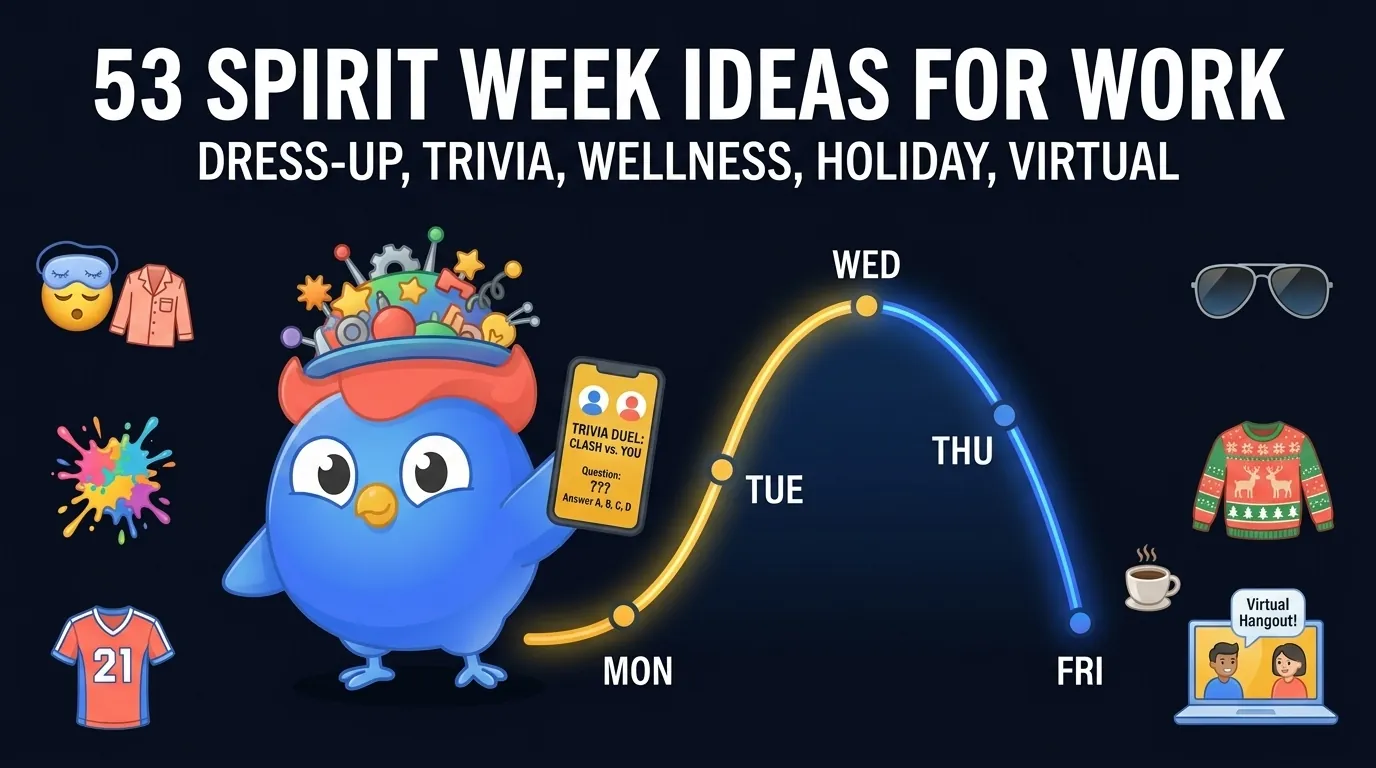
Gallup’s engagement tracking puts US employee engagement at 31 percent for 2025. Worldwide, the figure is 20 percent. Wellness programs, the usual HR answer to numbers like that, don’t fare much better: RAND’s Workplace Wellness Programs Study put it plainly, employee uptake of worksite wellness programs “remains limited.” A spirit week that ignores all of this gets the same polite shrug by Tuesday.
So every idea on this list had to pass four checks before it made the cut: cost, cringe, async fit, and whether anyone outside the planning committee would actually want to do it. Async fit did the most work. A trivia duel that plays out over a 72-hour window pulls in the teammate three time zones away; a live Zoom game leaves her staring at a calendar invite she’ll never make.
Below: five use-case sets, a 5-day arc template, and the five failure patterns that quietly kill participation.
The Four Checks Every Idea Had to Pass
A typical spirit week guide dumps 50 to 100 themes in no particular order and walks away. This one applies a bar instead. Four questions did the sorting.
Is it free, or at least clearly optional? Does it open a costume-cost gap between salaried and hourly staff? Does it work async, in-office, or both? And would anyone who isn’t on the planning committee choose it on their own?
The 53 below clear all four. The ideas that failed even one aren’t here.
The 5 Failure Patterns Behind Most Flops
The same five patterns show up in every spirit week people complain about afterward. Each idea here had to dodge all of them.
- HR-only design. HR plans it, workers endure it. No survey, no opt-in, no team co-design, and the team returns the favor by not showing up.
- Costume-cost gap. A theme that needs a $30 Hawaiian shirt, a $50 decade outfit, or a $20 ugly sweater quietly taxes the people who can least afford it. The same workers sit out every year, and nobody on the committee notices why.
- Identity traps. “Dress as your culture” or “show your country” is an HR complaint waiting to be filed. Anything that asked staff to perform cultural identity for a costume contest went out.
- Async erasure. Remote workers get bolted on as an afterthought. When the in-office day is treated as the real one and remote gets its own sad parallel Zoom, distributed teammates tune out early.
- Cringe prizes. Forced public ranking, “best costume,” participation leaderboards. Nobody remembers the company values printed on the banner; they remember coming in last.
What survived instead: no purchase required, async by default, opt-in credit, and a trivia day that needs no calendar slot. The 5-day arc near the end stacks all four.
Dress-Up Day Themes for Work (13)
Cost is where dress-up days break. Someone always can’t, or won’t, spend $40 on a costume they’ll wear once, so every theme that needs a new purchase got cut. The 13 below work from what’s already in the closet, or swap the costume for something that costs nothing.
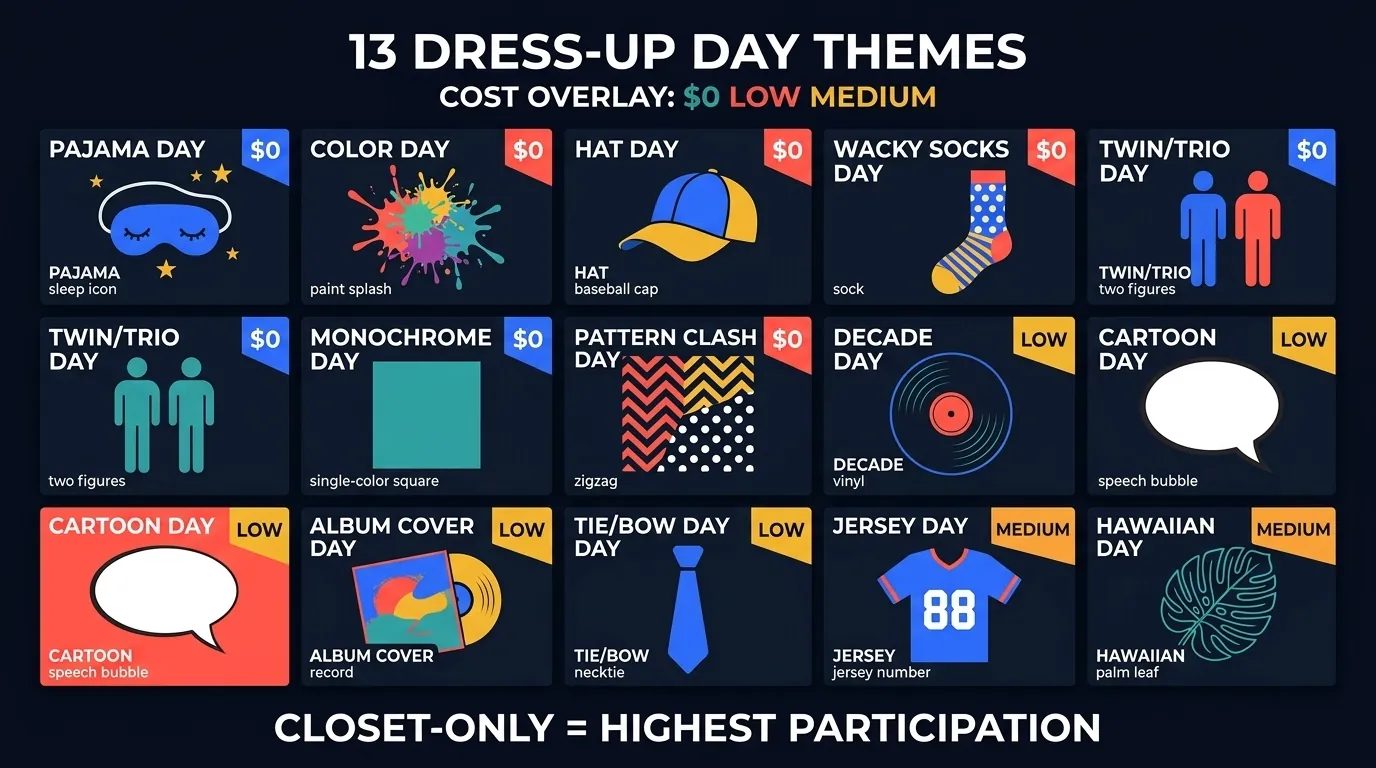 13 dress-up themes with cost tags. Pajama, Color, Hat, and Wacky Socks cost nothing and ask the least of anyone.
1. Pajama Day. Everyone owns pajamas. Cost: $0, effort: near zero, and it reads the same in the office and on Zoom.
2. Color-Coordinated Team Day. Hand each team a color (sales red, engineering blue, ops yellow) and let people raid their own closet. Team tags with no identity trap. Cost: $0 unless someone insists on a new shirt.
3. Decade Day, Assigned by Team. Free-choice decade days collapse because every team picks the 90s. Assign instead: sales gets the 80s, engineering the 70s, ops the 2000s. Thrift stores cover anyone whose closet doesn’t.
4. Sports Jersey Day. Any team, any league. Local clubs, retro jerseys, the weekend softball league. The “any team” framing is what closes the cost gap.
5. Crazy Hat Day. A hat is the smallest costume signal there is: hair ties, baseball caps, novelty hats left over from kids’ parties. It works on Zoom because the hat is the visible part.
6. Wacky Socks Day. Socks are the cheapest costume in the closet, and a remote worker can show them off by lifting one ankle on camera. Easy laugh, near-zero effort.
7. Twin or Trio Day. Pair up with one or two coworkers. The pairing is the activity, not the outfit, and it builds exactly the friendships the spirit week was for in the first place.
8. Hawaiian Shirt Day. Anyone who owns a Hawaiian shirt wears it, and nobody buys one new; say that out loud in the announcement. Or rebrand it “Loud Shirt Day” and any bold pattern qualifies.
9. Cartoon Throwback Day. Dress as a cartoon from your own childhood. The nostalgia keeps it personal, and the rule is no makeup, wigs, or rentals.
10. Album Cover Day. Dress as a cover you love. Joni Mitchell’s Blue means wear blue; Abbey Road means the whole team walks to coffee in single file. Music nerds finally get their day.
11. Tie or Bow-Tie Day. A loud tie, a novelty bow-tie, any neckwear that would fail a client meeting. Pairs with a logo-color shirt for team tags.
12. Monochrome Day. Head to toe in a single color. Most closets hold enough black, white, or navy to manage it without a purchase, and it photographs well for the Slack thread.
13. Pattern Clash Day. Mix on purpose: stripes with plaid, polka dots with paisley. The fashion crime is the point, and it’s closet-only by definition.
For a warm-up before any of these days, the would you rather questions set works as a 5-minute Slack opener with no costume planning attached.
Trivia & Quiz Rounds for Spirit Week (10)
This is the day with the highest ceiling. The reason is calendar math. A LearnClash trivia round runs async over 72 hours: 18 questions, 6 rounds, a 45-second timer per question, and each turn is six questions, so a spread-out team plays it between meetings without anyone booking a slot.
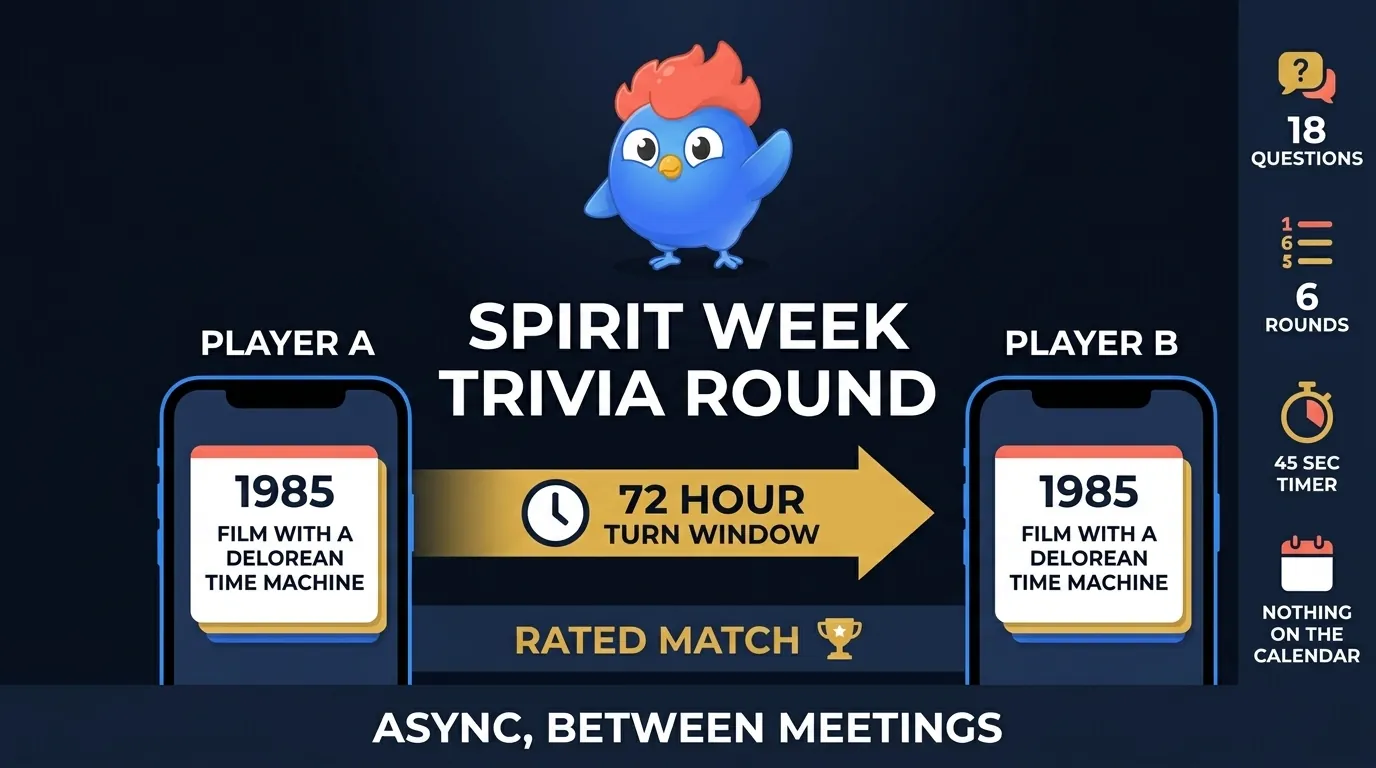 A LearnClash workplace round: async, a 72-hour clock, nothing on the calendar.
14. Throwback Trivia Tuesday. Pick a decade and run a 6-round duel on its films, music, and news. Skill-based pairing keeps each match close to the flow state Mihaly Csikszentmihalyi first described in 1975: hard enough to matter, easy enough to stay in. That balance is what brings people back for the next-day rematch.
15. Company Trivia (“How well do you know our shop?”). Pull facts from the founding story, early product names, the founder’s first job, the office plant nobody remembers watering. Skip pay numbers and anything HR-loaded.
16. Department Trivia Tournament. Sales vs Engineering vs Ops, single knockout, async over 3 days. Post the bracket in Slack; the bracket photo does more for the week than any prize.
17. Lunch and Learn Quiz. A 15-minute mini-round bolted to a brown-bag lunch. Lunch is the anchor, the quiz is the wedge. Pick a topic your team taught itself recently: a new tool, a recent ship, an industry trend.
18. Pop Culture Round (Decade-Themed). Mirror Decade Day with a trivia round on the same decade. Our pop culture topic works as the async back end.
19. Music Recognition Round. 30-second clips, best run async so each player listens at their own pace on their own headphones. No public reveal, just a Slack thanks at end of day.
20. Logo Quiz. Brand logos with the name stripped out, plus a bonus set of logos from your own sector. Free to run in Slack or as a duel.
21. “Who Said It?” Round. Match anonymous quotes to coworkers. Collect them through a Slack form a week ahead, opt-in only, and skip pay or politics.
22. Career-Day Quiz. Dream-job trivia. What does a forensic linguist do? How long does it take to qualify on a Boeing 747? It ties the day to whatever everyone wanted to be at age 12.
23. Bingo with Workplace Squares. A 5x5 grid with squares like “has 3 plants on their desk,” “used a Slack emoji today,” “took a walk between calls.” Runs all week, async, no Zoom.
For a live host-script format that runs 60 to 90 minutes, the 89 party trivia questions set is the one to use. For a 5-minute Slack opener, the this-or-that questions set needs no trivia setup at all.
Wellness & Recharge Days (8)
Wellness days get over-engineered fast. Someone books a $50 yoga instructor, blocks an hour of live Zoom, and suddenly the recharge day costs more energy than it returns. Anything that needs a $20 mat, a paid subscription, or 60 synchronous minutes was cut; the 8 below run on opt-in attention and $0.
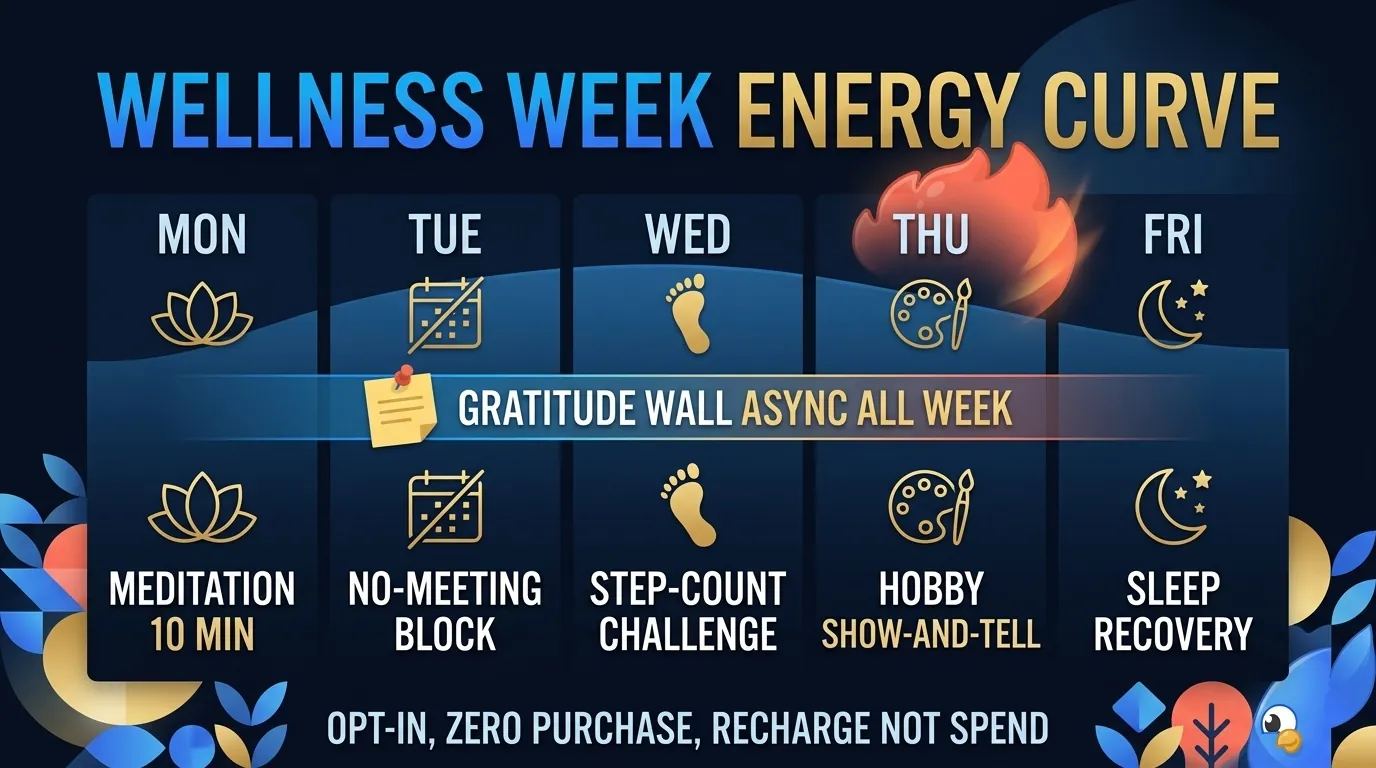 A 5-day wellness arc that gives time back instead of asking for it.
24. No-Meeting Wednesday. Block every internal meeting from 9 AM to 5 PM. It’s free, fair, and async-native, and it needs no announcement beyond a calendar hold.
25. Step-Count Challenge. A 3-day team total through whatever fitness app people already use. No purchase, remote-friendly. Cap teams at 10 so one quiet member never feels like the reason the team lost.
26. Gratitude Wall (Anonymous, Async). A Slack channel or shared doc where anyone drops anonymous thank-you notes for any coworker, all week. Opt-in to send, opt-in to receive. Credit without a ranking.
27. Meditation Morning. A 10-minute guided clip posted by 9 AM. Play it on the commute, at the desk, or skip it. No camera-on rule.
28. Hydration Hour. Water only from 8 to 10 AM, coffee after. The point is the small shared signal, not the water count, and opting out costs nothing.
29. Hobby Show-and-Tell. Three minutes per person in a Slack thread, video or photo. Pottery, woodwork, hiking, sourdough, video games. The 3-minute cap takes the stage fright out of it.
30. Sleep Friday. No after-hours pings from 4 PM Thursday to 9 AM Monday. Put it in writing, with a name attached to the promise.
31. Outdoor Lunch Day. Walk-and-eat for in-office staff; remote workers take the same block wherever they are. A phone photo in Slack is the only “proof” anyone owes, and even that is optional.
Holiday-Themed Spirit Weeks (Halloween, Christmas, Summer, Holiday) (12)
Holidays raise the cost risk. The day itself nudges everyone toward a purchase, so the bar tightens here: anything past $5 of new spend got cut, and every kept theme carries a $0 variant. The 12 below split across Halloween, Christmas, Summer, and two other holiday slots. For the prompt-list side of the same week, the 131 holiday icebreaker questions guide applies the same inclusivity filter.
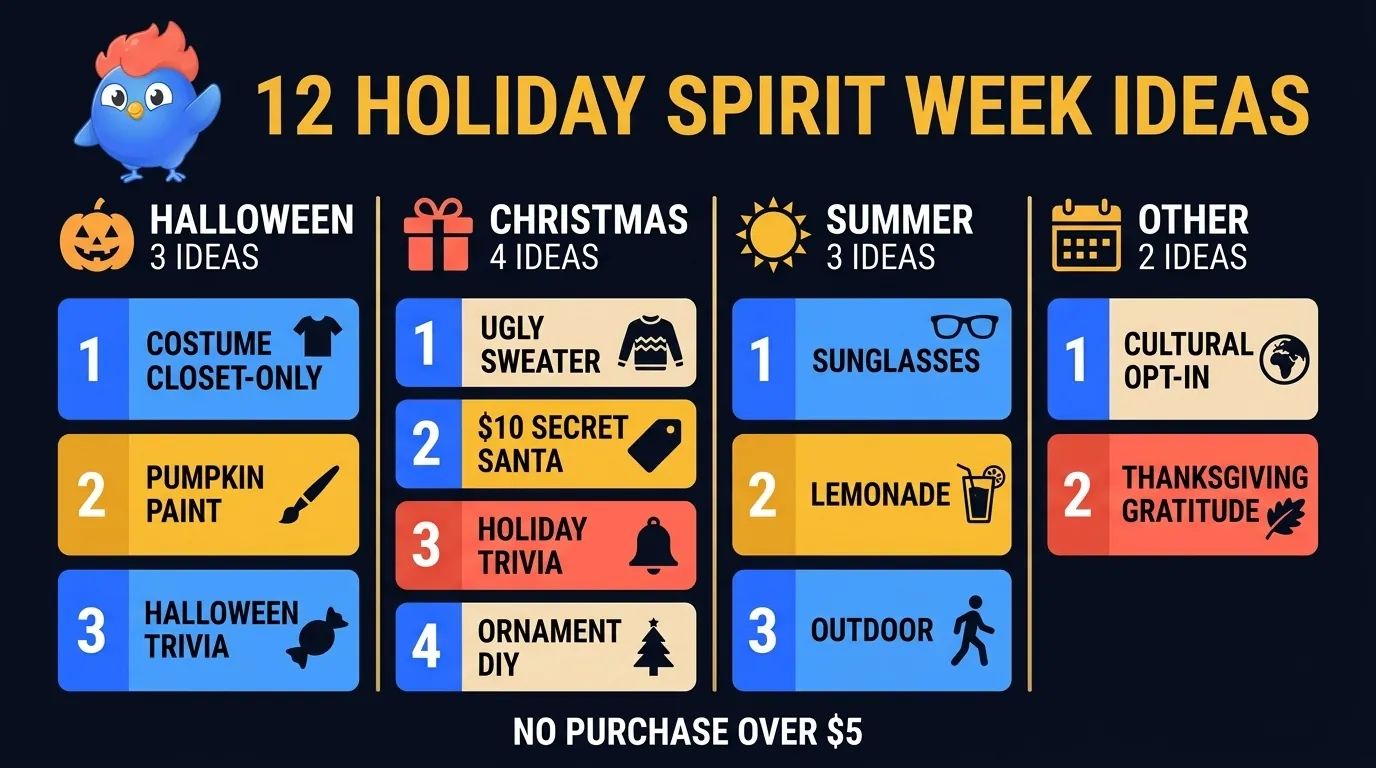 12 holiday ideas across Halloween, Christmas, Summer, and Thanksgiving, each with a cost-floor guard.
Halloween Spirit Week Ideas for Work (3)
32. Halloween Costume Contest (Closet-Only Rule). Costumes come from the existing closet plus $5 of craft supplies, no bought costumes. Give out several prizes (funniest, most clever, best DIY) instead of one “best.” That swap is the equity guard most Halloween lists leave out.
33. Pumpkin Decorating (Paint Only). No carving, no pumpkin purchase required. Paint a pumpkin, a paper pumpkin, or a coffee cup with a jack-o-lantern face, then photo to Slack.
34. Halloween Trivia Round (LearnClash Async). Horror films, the history of Halloween, candy-brand trivia. Same 72-hour format as the Wednesday round, themed to the day.
Christmas Spirit Week Ideas for Work (4)
35. Ugly Sweater Day. Closet sweaters and bold add-ons, opt-in only. Drop “must be ugly enough to win”; the cardigan nobody wears anyway is the whole point.
36. Secret Santa with a $10 Cap (or Secret Sentence). $10 is the floor, and say so. The no-buy swap is “Secret Sentence”: each player writes one anonymous thank-you to their match. Cheaper, and nobody has to pretend to like a mug.
37. Holiday Movie Trivia Round. Home Alone’s release year, the actor behind Hans Gruber in Die Hard, the North Pole nicknames in Elf. Lighter mental load than company trivia.
38. Ornament DIY Day. Paper, pipe cleaners, recycled card stock. The Slack photo is the credit layer. No purchase, all opt-in.
Summer Spirit Week Ideas for Work (3)
39. Sunglasses Day. A shades theme on the office Slack works at any latitude, and indoor sunglasses are silly enough on their own. Cost: zero for anyone who owns a pair.
40. Lemonade Stand Social. In-office lemonade on a $5 snack budget; remote staff post a blender smoothie photo. The drink is the prop, the 15 minutes around it are the point.
41. Outdoor Activity Day. A 30-minute outdoor block on everyone’s calendar. Walk, sit, read, talk. Remote staff take the same 30 minutes in their own block.
Other Holiday Spirit Week Ideas (2)
42. Cultural Celebration Day (Employee-Led Only). Anyone who wants to share food, music, or a story from their culture signs up. HR doesn’t assign, and nobody is asked to represent anything. That’s the only way to run a cultural day without an identity trap.
43. Thanksgiving Gratitude Round. A trivia round on US history paired with the gratitude wall from idea 26. Trivia is the activity; the wall is the close. Remote teammates join async inside the 72-hour window.
For longer Halloween, Christmas, and seasonal sets, the trivia questions hub covers the seasonal lineup.
Virtual & Hybrid Spirit Week Adaptations (10)
The usual mistake is to design for the office, then adapt for remote once the plan is locked. Flip it. Design hybrid-first, then check whether the idea still works in the office. Themes built that way pull remote teammates in; themes that are really an in-office idea wearing a Zoom costume don’t.
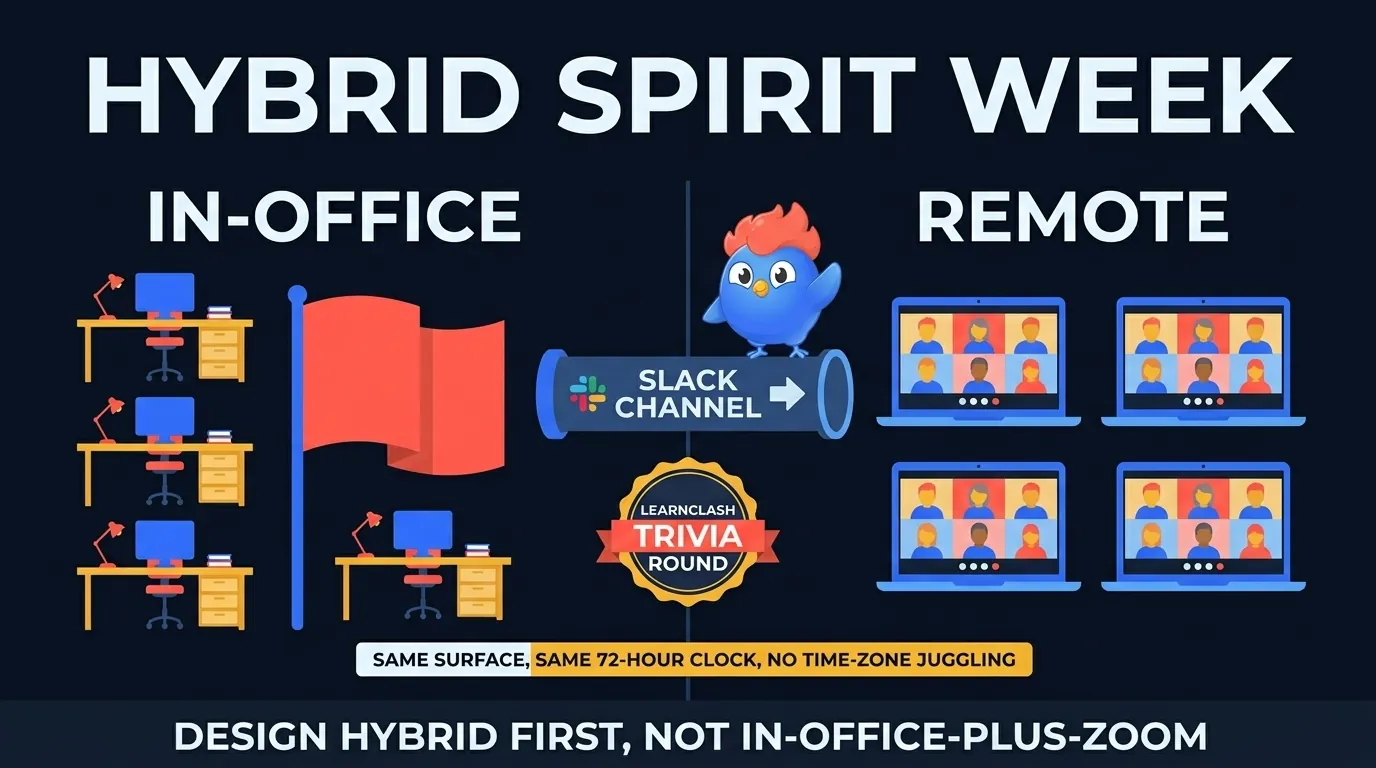 Hybrid-first: in-office and remote teammates on the same async surface.
44. Themed Zoom Background Challenge. Each day gets a theme (tropical, retro, imaginary workplace) and the background is the costume. Free background images are easy to find for almost any theme.
45. Slack or Teams Status Theme Day. Matching emoji and status line per team: “:fire: deep work mode,” “:palm_tree: tropical Thursday.” Zero effort, fully visible.
46. Async Show-and-Tell Channel. Post a 30-second video by end of day on a daily prompt: your desk, your pet, your coffee cup, your view. The 30-second cap is what makes people actually do it.
47. Pet Cameo Day. Every call this day gets a planned pet cameo. People with pets are on display; people without get to enjoy the chaos. Slack thread for photos.
48. Desk Setup Show. A desk-setup photo in Slack, async, caption optional. The productivity-nerd corner of engineering and design will carry this one.
49. Hybrid Trivia Round (LearnClash Async). 18 questions, 6 rounds, a 72-hour clock. In-office and remote play on the same surface with no time-zone juggling, which is why it sits at the center of the arc below.
50. Lunch Roulette. Random 1:1 pairs through the Donut bot for Slack or Teams. A 30-minute video coffee, camera optional, no agenda. Opt-in through a form earlier in the week.
51. Music Playlist Collab. A shared Spotify or Apple Music playlist, one song per person, posted in Slack with a one-sentence “why this song.” The why is what people actually read.
52. Virtual Scavenger Hunt. Camera on for the hunt only. A 5-item list (“something blue, something older than you, something soft, something from your kitchen, something with a logo”). The 73-prompt virtual scavenger hunt set covers a longer game.
53. Coffee or Tea Social. A 15-minute open Zoom, drop in or out, camera optional, agenda banned. Close Friday with the lowest-stakes activity of the whole week.
For deeper hybrid mechanics, the virtual team building games list covers the wider field of remote-team play.
The 5-Day Spirit Week Arc (Planning Template)
Day 3 spends Day 5’s energy. That’s the quiet killer of most spirit weeks: five themes dropped onto a calendar with no thought to the order, so the biggest day lands wherever it lands. Shape the energy instead. Low asks at the bookends, the competitive peak in the middle, and the trivia round parked on Wednesday where the week can afford it.
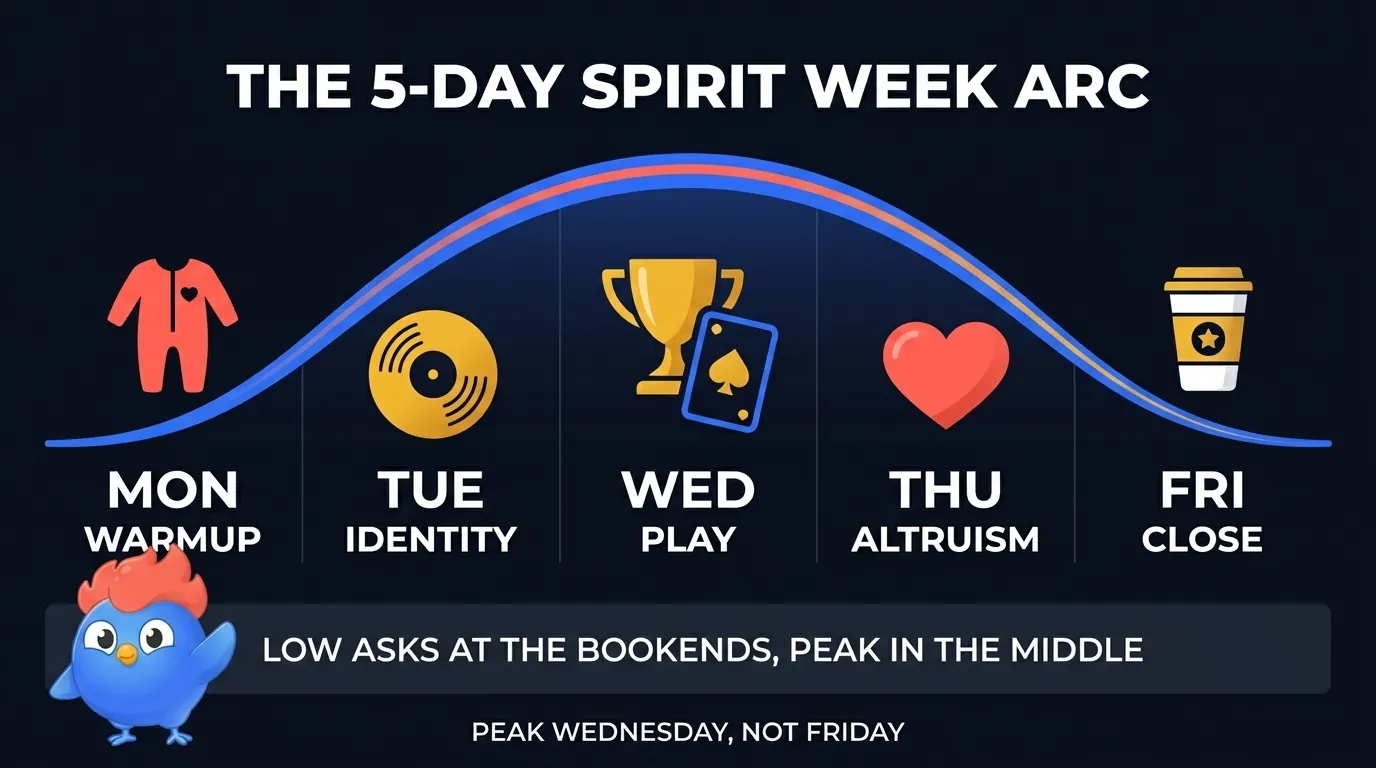 Low-effort bookends, identity and play in the middle, altruism Thursday, slow close Friday.
The 5-Day Arc
- Monday (Warmup, low effort). Pajama Day or Color-Coordinated Team Day. Set the tone with zero asks.
- Tuesday (Identity, mid effort). Decade Day Assigned, Cartoon Throwback, Album Cover. Self-expression with closet-only picks.
- Wednesday (Play, peak energy). LearnClash trivia round or Department Trivia Tournament. The day the whole week builds toward.
- Thursday (Altruism, mid-low effort). Gratitude Wall, Sleep Friday rollout, charity drive opt-in. The “feel good for someone else” day.
- Friday (Close, low-key). Outdoor Lunch, Coffee/Tea Social, or async hobby show-and-tell. Don’t end on a peak; end on a slow exhale.
Why This Order Beats Random
Same themes, different order, different week. A Monday peak burns the room out by Wednesday, and a Friday peak fights the weekend and loses. Put the peak mid-week and the runway on both sides survives.
One exception. If your team is under 8 people, a gratitude wall on Thursday reads as forced rather than warm, so run a second wellness day there instead.
How to Run a Spirit Week Trivia Round in LearnClash
Most guides mention the trivia round and move on. It deserves more, because it’s the one day that needs nothing from anyone’s calendar. LearnClash is built around the format: 18 questions across 6 rounds, a 45-second timer, and a 72-hour async turn window. Results are rated (an ELO-style number with Glicko-2 underneath), so a rookie who beats the office trivia shark gains more than the shark gains for beating the rookie.
Trivia also has an edge the dress-up days can’t match. Answering a question, even getting it wrong, does more for remembering the fact than reading it would. Psychologists call that the testing effect, and a spirit week round is a low-stakes way to put it to work.
A note on the 72-hour clock, since I built it. The first duel a player opens each day tops up the deadline on their other waiting turns (24 hours added, never more than 72 hours out), so someone who checks in once a day never loses a match to the clock. The week this guide first went up, I was shipping the backend job that settles duels when that clock does run out. The window is enforced, not decorative, which is exactly what a hybrid team needs: a real deadline that still bends around a daycare pickup.
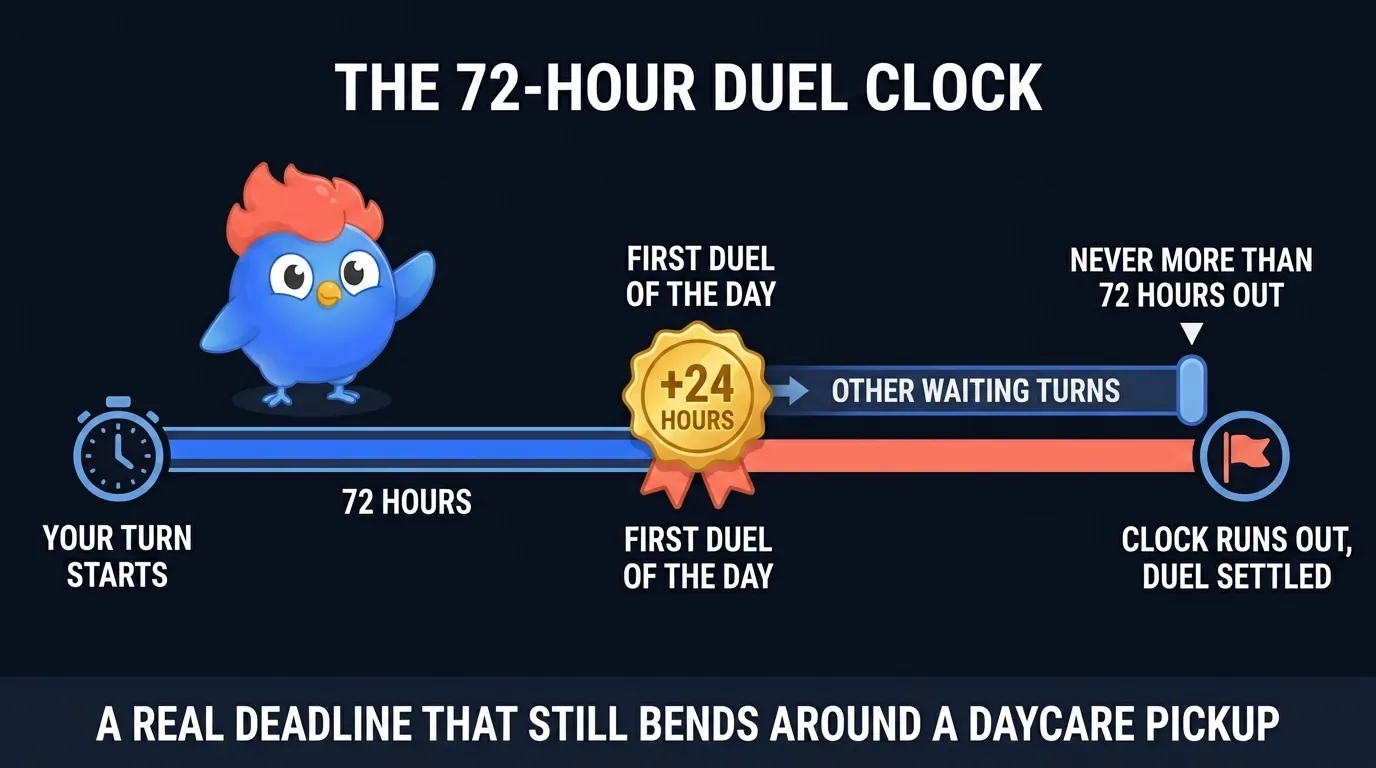 The 72-hour clock in one line: the first duel you open each day adds 24 hours to your other waiting turns, never past 72 hours out.
The Mechanics
| Element | LearnClash duel | Why it fits spirit week |
|---|---|---|
| Length | 18 questions, 6 rounds of 3 | Slots between meetings |
| Turn | 6 questions, 4.5 minutes at most | Fits a coffee break |
| Timer | 45 seconds per question | A reflex, not a research project |
| Turn window | 72 hours async | Hybrid and multi-time-zone friendly |
| Rating | ELO-style, Glicko-2 underneath | Upsets count for more |
| Topic | Any (pop culture, decades, your shop) | Themed to the spirit week day |
Format by Team Size
| Team size | Format | Give it |
|---|---|---|
| 2 to 8 | 1v1 duels, single bracket | One working day |
| 9 to 20 | Team round-robin, 1v1 within | Two days |
| 21 to 50 | Department vs department, async | The full 72-hour window |
| 50+ | Opt-in seeded bracket | Spirit week plus one week |
How It Plays in Practice
Match the topic to the day. Decade Day pairs naturally with a pop culture round. Drop the link in Slack at 9 AM Wednesday and put the close in the same post, taken from the table above: Thursday 9 AM for a 2-to-8 bracket (one working day), Friday 9 AM for a 9-to-20 round-robin (two days), Saturday 9 AM when a department round gets the full 72 hours, and the following Friday for a 50+ bracket. The app itself allows 72 hours per turn, so whichever deadline you pick is the event’s, not the app’s. Post the awards Friday afternoon for the two smaller formats (both have closed by Friday 9 AM) and on the Monday after the close for the two larger ones, as a Slack thanks rather than a ranked table: biggest upset, closest match, best comeback, plus an opt-in shout-out for anyone who wants their own score named.
Frame that awards post as “the close” rather than “the winners,” so there is no bottom half to become the story. LearnClash’s ELO and SRS numbers explain how the rating stays balanced across a mixed-skill office, and competitive learning covers why the duel format holds attention that a worksheet loses.
Five Picks and an Order
Spirit weeks fail in the five predictable ways from the top of this guide: an HR-only plan nobody asked for, a costume-cost gap, an identity trap sold as a theme, remote workers bolted on as an afterthought, and a public ranking that singles people out. The five picks below invert them. Arc-order the week so every day has a reason to exist, hold a $0 cost floor with closet-only dress-up so nobody pays to play and nobody performs their culture, design async-first so in-office and remote play on the same surface, give opt-in credit without a public board, and put the trivia round at the mid-week peak where the energy already is.
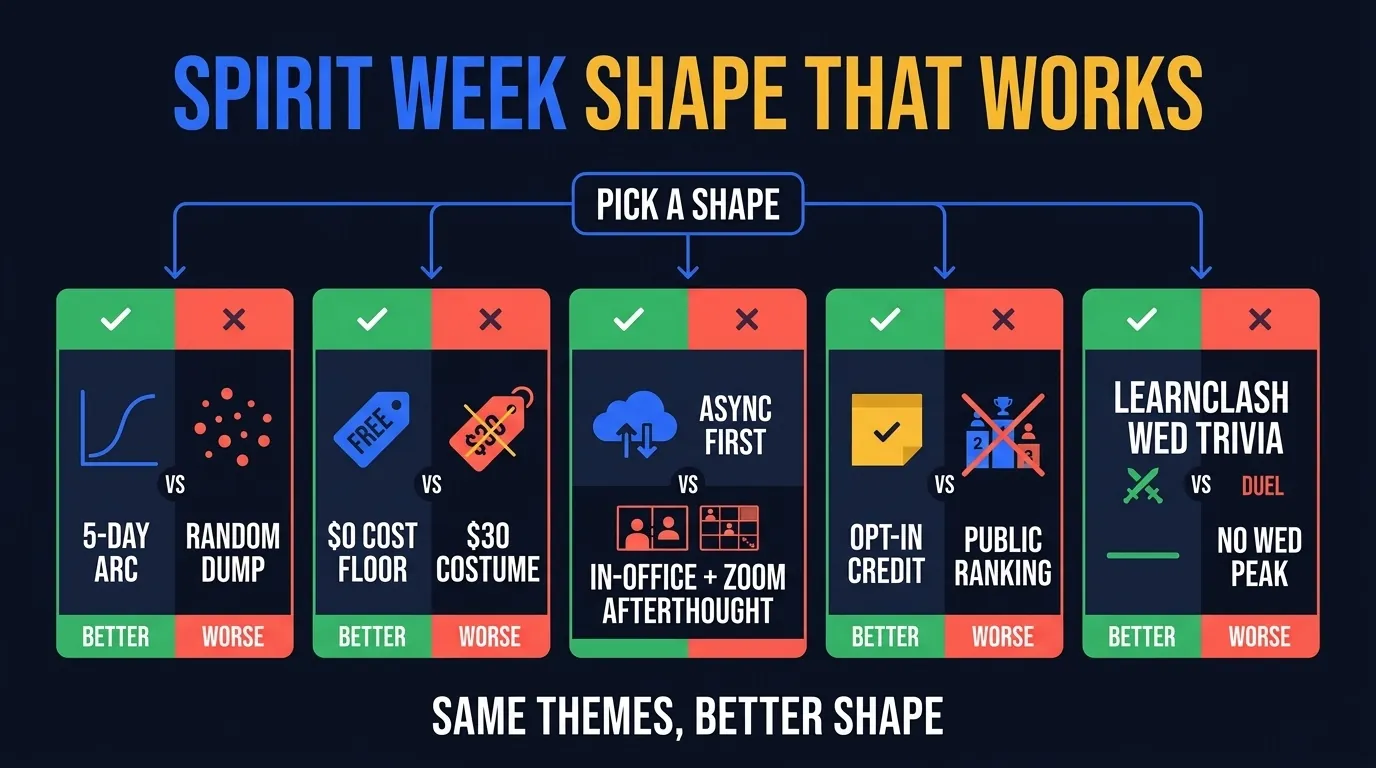 Five decisions that separate a theme dump from a week that holds.
The 5-pick checklist:
- Arc-order the 5 days (warmup, identity, play, altruism, close)
- $0 cost floor on every day (closet-only dress-up, opt-in everything else)
- Async-first design (in-office and remote on the same surface)
- Opt-in credit (Slack thanks, several prizes, no public ranking)
- Wednesday trivia round (the peak the rest of the week is built around)
The trivia round carries the week because it runs across time zones and skips live Zoom entirely. The 72-hour window means the parent on daycare duty plays at 9 PM and the early riser plays at 7 AM, and both turns count the same.
The rest of the engagement-formats playbook lives in the activities hub, from icebreaker questions for new-hire week to team-building trivia for off-sites.
Frequently Asked Questions
What is a spirit week at work?
A spirit week at work is a 3 to 5-day workplace event where each day has a theme (dress-up, trivia, wellness, holiday, virtual) that employees opt into to build connection and break routine. It works best when every day's activity is opt-in and async-friendly, so in-office and remote staff join on the same footing.
How long should a workplace spirit week be?
Five days is the standard, shaped as an arc: a low-effort Monday, an identity-driven Tuesday, a competitive Wednesday, an altruism-driven Thursday, and a celebration-driven Friday. Teams under 15 people are usually better served by three days, and anything past five starts competing with actual work.
What's a good spirit week theme for a hybrid team?
Themes that work async beat themes that require everyone on Zoom at the same time. Pajama Day, Color-Coordinated Team Day, and an async LearnClash trivia round all travel well across a distributed team. Themes that hinge on a synchronous Zoom slot (talent show, live cooking class) ask distributed teammates to rearrange their day around someone else's time zone.
How do I get high participation in a workplace spirit week?
Three rules: pick themes with zero purchase cost, design every activity to work async first, and let recognition arrive without a public ranking. The 5-day arc template in this article applies all three by default.
Are spirit weeks worth it for small teams under 15 people?
Yes, but downshift to 3 days and skip the costume-required themes. Small teams are the most exposed to cost-equity gaps and identity traps because there's nowhere to hide a non-participation. Async trivia rounds, gratitude walls, and outdoor lunch days carry less social exposure than dress-up, which matters more the smaller the room.